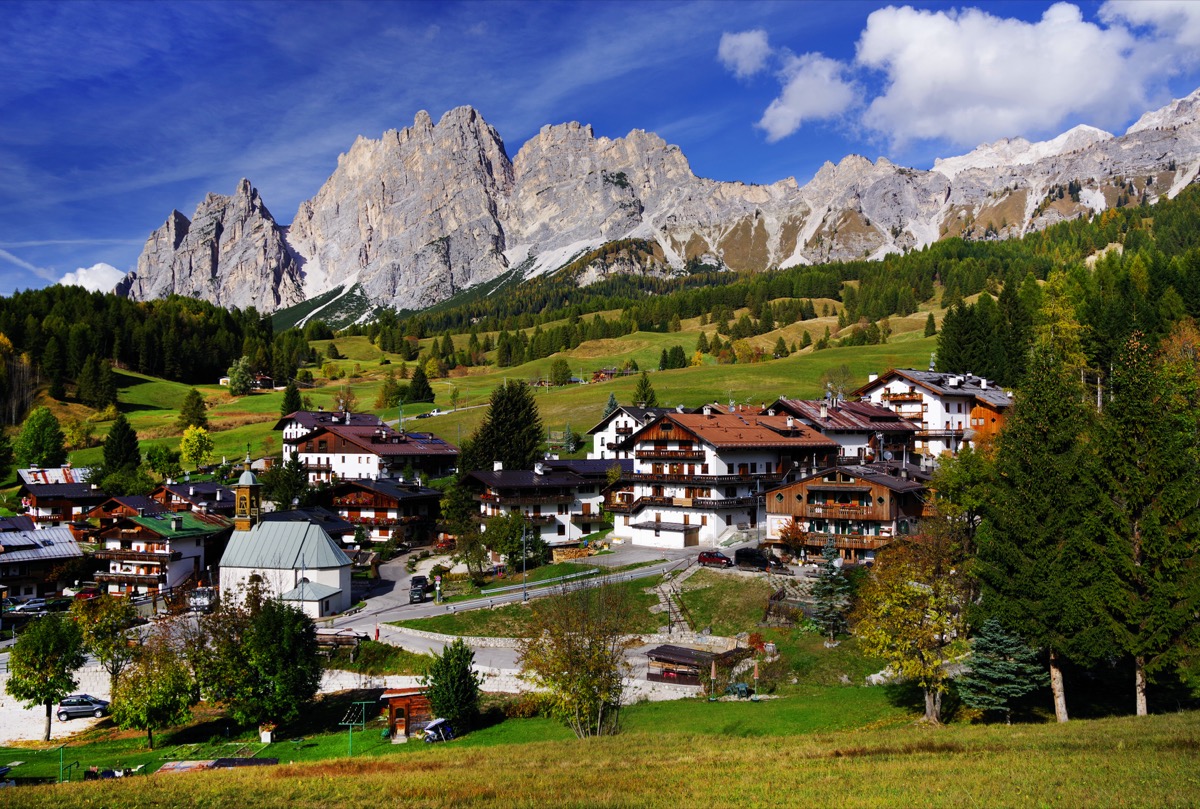
Cortina d’Ampezzo, nestled in the heart of the Dolomites in northern Italy, combines spectacular alpine scenery with refined Italian elegance. Known as the “Queen of the Dolomites,” this prestigious mountain resort hosted the 1956 Winter Olympics and continues to attract winter sports enthusiasts with its world-class skiing across 120 kilometers of slopes. Beyond winter, the surrounding UNESCO World Heritage landscape transforms into a paradise for hikers and climbers who explore dramatic limestone peaks, verdant valleys, and alpine meadows bursting with wildflowers. The pedestrian-friendly town center charms visitors with its bell tower, elegant shops along Corso Italia, and sophisticated atmosphere that has attracted celebrities and European royalty for generations. Local Ladin culture influences the exceptional mountain cuisine, which pairs perfectly with the breathtaking mountain views from restaurant terraces. Whether seeking adventure on challenging via ferrata routes or relaxation amid natural beauty, Cortina delivers an authentic Italian alpine experience with distinctive culinary, cultural, and outdoor offerings throughout the year.
The destination guide
Cortina D’Ampezzo
- Overall8/10
- Best forCouples, Adventure seekers, Luxury travelers
- PeakJun–Aug
- CurrencyEUR
Cortina sits in the Dolomites with peaks that glow pink at sunset — a 2026 Winter Olympics host town where the skiing and the scenery compete for your attention.
At a glance
- Italian
- Dolomite peaks
- Alpine valley
- Ski terrain
- Olympic heritage
How Cortina D’Ampezzo scores
Character
Editorial scores on a 10-point scale, weighed against destinations of the same kind.
Travel safety snapshot
SafePlace indicators use their source 100-point scale; higher is more favourable. Planning context, not a live travel advisory — check official government guidance before you go.
When to go
Best months to visit: January, February, March, June, July, August, September, October and December.
- January: -6.9 to 2.1 degrees Celsius, 54.4 millimetres of rain, best-time score 5 out of 5.
- February: -4.4 to 4.5 degrees Celsius, 73.2 millimetres of rain, best-time score 5 out of 5.
- March: -2.7 to 6.3 degrees Celsius, 83.9 millimetres of rain, best-time score 4 out of 5.
- April: 0.5 to 9.4 degrees Celsius, 122.7 millimetres of rain, best-time score 3 out of 5.
- May: 4.7 to 13.9 degrees Celsius, 172.3 millimetres of rain, best-time score 3 out of 5.
- June: 10.3 to 20.2 degrees Celsius, 170.4 millimetres of rain, best-time score 5 out of 5.
- July: 11.6 to 21.4 degrees Celsius, 186 millimetres of rain, best-time score 5 out of 5.
- August: 11.8 to 21.4 degrees Celsius, 153.7 millimetres of rain, best-time score 5 out of 5.
- September: 8.3 to 17.3 degrees Celsius, 112.6 millimetres of rain, best-time score 5 out of 5.
- October: 4.7 to 13.3 degrees Celsius, 133.6 millimetres of rain, best-time score 4 out of 5.
- November: -1.1 to 6.9 degrees Celsius, 129.5 millimetres of rain, best-time score 3 out of 5.
- December: -4.5 to 3.5 degrees Celsius, 92.8 millimetres of rain, best-time score 5 out of 5.
Month-by-month conditions and packing advice
- January
- Cold, occasional rain January in Cortina D'Ampezzo: the town is strongest for either ski season or high-summer Dolomites hiking and rifugio access. Crowds: January in Cortina D'Ampezzo is best for winter-ready travelers; outdoor plans need warm gear, shorter daylight expectations, and weather-aware transport planning. Pack: Pack insulated layers, warm footwear, gloves, and a serious winter coat.
- February
- Cold, some rain February in Cortina D'Ampezzo: the town is strongest for either ski season or high-summer Dolomites hiking and rifugio access. Crowds: February in Cortina D'Ampezzo is workable with normal seasonal planning; build in layers, weather checks, and a mix of indoor and outdoor activities. Pack: Pack warm layers, a coat, and comfortable shoes for cold mornings and evenings. Add a rain jacket or compact umbrella.
- March
- Cold, some rain March in Cortina D'Ampezzo: late winter or fall can be scenic with fewer crowds if lifts, huts, and weather cooperate. Crowds: March in Cortina D'Ampezzo is workable with normal seasonal planning; build in layers, weather checks, and a mix of indoor and outdoor activities. Pack: Pack warm layers, a coat, and comfortable shoes for cold mornings and evenings. Add a rain jacket or compact umbrella.
- April
- Cold, some rain April in Cortina D'Ampezzo: transition-season closures limit hiking or skiing choices despite beautiful scenery. Crowds: April in Cortina D'Ampezzo is workable with normal seasonal planning; build in layers, weather checks, and a mix of indoor and outdoor activities. Pack: Pack warm layers, a coat, and comfortable shoes for cold mornings and evenings. Add a rain jacket or compact umbrella.
- May
- Cool to mild, rainy May in Cortina D'Ampezzo: transition-season closures limit hiking or skiing choices despite beautiful scenery. Crowds: May in Cortina D'Ampezzo is one of the wetter periods, so museums, food stops, flexible reservations, and backup indoor plans make the trip easier. Pack: Pack layered clothing and comfortable walking shoes. Add a rain jacket or compact umbrella.
- June
- Mild to warm, rainy June in Cortina D'Ampezzo: the town is strongest for either ski season or high-summer Dolomites hiking and rifugio access. Crowds: June in Cortina D'Ampezzo is one of the wetter periods, so museums, food stops, flexible reservations, and backup indoor plans make the trip easier. Pack: Pack layered clothing and comfortable walking shoes. Add a rain jacket or compact umbrella.
- July
- Mild to warm, rainy July in Cortina D'Ampezzo: the town is strongest for either ski season or high-summer Dolomites hiking and rifugio access. Crowds: July in Cortina D'Ampezzo is one of the wetter periods, so museums, food stops, flexible reservations, and backup indoor plans make the trip easier. Pack: Pack layered clothing and comfortable walking shoes. Add a rain jacket or compact umbrella.
- August
- Mild to warm, rainy August in Cortina D'Ampezzo: the town is strongest for either ski season or high-summer Dolomites hiking and rifugio access. Crowds: August in Cortina D'Ampezzo is one of the wetter periods, so museums, food stops, flexible reservations, and backup indoor plans make the trip easier. Pack: Pack layered clothing and comfortable walking shoes. Add a rain jacket or compact umbrella.
- September
- Cool to mild, some rain September in Cortina D'Ampezzo: the town is strongest for either ski season or high-summer Dolomites hiking and rifugio access. Crowds: September in Cortina D'Ampezzo is workable with normal seasonal planning; build in layers, weather checks, and a mix of indoor and outdoor activities. Pack: Pack layered clothing and comfortable walking shoes. Add a rain jacket or compact umbrella.
- October
- Cool to mild, rainy October in Cortina D'Ampezzo: late winter or fall can be scenic with fewer crowds if lifts, huts, and weather cooperate. Crowds: October in Cortina D'Ampezzo is one of the wetter periods, so museums, food stops, flexible reservations, and backup indoor plans make the trip easier. Pack: Pack layered clothing and comfortable walking shoes. Add a rain jacket or compact umbrella.
- November
- Cold, some rain November in Cortina D'Ampezzo: transition-season closures limit hiking or skiing choices despite beautiful scenery. Crowds: November in Cortina D'Ampezzo is workable with normal seasonal planning; build in layers, weather checks, and a mix of indoor and outdoor activities. Pack: Pack warm layers, a coat, and comfortable shoes for cold mornings and evenings. Add a rain jacket or compact umbrella.
- December
- Cold, some rain December in Cortina D'Ampezzo: the town is strongest for either ski season or high-summer Dolomites hiking and rifugio access. Crowds: December in Cortina D'Ampezzo is workable with normal seasonal planning; build in layers, weather checks, and a mix of indoor and outdoor activities. Pack: Pack warm layers, a coat, and comfortable shoes for cold mornings and evenings. Add a rain jacket or compact umbrella.
- June
- July
- August
- November
- December
- January
- February
Know before you go
Neighbourhoods
Cortina D’ampezzo’s neighborhoods each offer unique experiences:
- Centro Storico: The historic center with shops, cafes, and cultural attractions.
- Rifugio: A popular area for hikers and nature lovers.
- Col Drusciè: Known for its ski lifts and stunning mountain views.
Explore these areas to experience the charm and beauty of Cortina.
Best time to visit
The best time to visit Cortina D’ampezzo is during the winter months from December to March for skiing and winter sports enthusiasts. Alternatively, the summer months from June to September offer excellent hiking and outdoor activities amidst breathtaking landscapes.
For those looking to avoid crowds, consider visiting in the shoulder seasons of late spring or early autumn, when the weather is still pleasant but the tourist numbers are lower.
Getting there and around
Getting there
To reach Cortina D’ampezzo, the nearest major airport is in Venice (Marco Polo Airport), approximately 160 km away. From the airport, you can take a bus or rent a car to reach Cortina. Alternatively, train services to Calalzo di Cadore are available, followed by a bus to Cortina.
Getting around
Cortina D’ampezzo is best explored on foot, given its compact town center. Public buses connect the town with nearby ski resorts and villages. For those looking to venture further, renting a car can provide flexibility to explore the stunning Dolomites at your own pace.
Top experiences in Cortina D’Ampezzo
Cinque Torri & Lagazuoi
Five distinctive rock towers rise from a high alpine meadow at 2,361 meters, approximately 15 minutes by car from Cortina. During World War I, Austrian and Italian forces fought through trenches and tunnels carved directly into these towers — an open-air war museum now preserves the fortifications. The adjacent Lagazuoi mountain (2,778m), reached by cable car, contains a network of restored military tunnels that visitors can walk through. The Cinque Torri area also serves as one of the Dolomites’ premier outdoor climbing sites, with routes graded from beginner to expert.
Tre Cime di Lavaredo (Three Peaks)
Three massive limestone pillars — the tallest reaching 2,999 meters — form perhaps the most iconic silhouette in the entire Dolomite range. A 9.5-kilometer loop trail circles the peaks at roughly 2,300 meters elevation, passing through meadows, scree fields, and World War I trenches. The hike takes three to four hours and is accessible from a toll road that climbs from Misurina (30 minutes east of Cortina). Two mountain rifugios along the route provide meals and overnight stays for those wanting to experience sunrise on the peaks.
Lago di Sorapis (Sorapis Lake)
An opaque turquoise lake sits in a steep-walled cirque at 1,925 meters, its color created by mineral-rich glacial meltwater. The marked trail from Passo Tre Croci (20 minutes east of Cortina) traverses forested slopes and exposed rock faces with the aid of fixed cables and ladders — appropriate for hikers with some mountain experience and a head for heights. The full round trip takes roughly five hours. The lake’s accessible season runs from late June through early October, depending on snowmelt.
Corso Italia
The pulsating heart of Cortina’s social life, this pedestrian-only street is lined with high-end boutiques, antique shops, and artisan workshops. It’s the place to see and be seen, especially during the evening ‘passeggiata’.
Museo d'Arte Moderna Mario Rimoldi
One of Italy’s most significant collections of 20th-century art, featuring over 800 works by De Chirico, Morandi, Guttuso, and other Italian masters, housed in the Ciasa de ra Regoles.
Editor-curated picks carried over from our original guide. Where a full place guide exists, the card links to it.
Worth booking ahead in Cortina D’Ampezzo
Hand-picked from the operators our guides already send readers to. Prices and availability are live on the partner site.
Guided tourGetYourGuide
Colosseum, Forum and Palatine Hill small-group tour (opens GetYourGuide in a new tab)
Small group with the Forum and Palatine Hill included; the standard Colosseum visit done properly.
Where to stayBooking.com
Stays in Cortina D’Ampezzo (opens Booking.com in a new tab)
Live rates and availability for Cortina D’Ampezzo on Booking.com; filter by neighbourhood once you know where your days start.
We earn a commission if you book through these links, at no extra cost to you. It is how we keep the guides free and independent.
Where to stay
Grand Hotel Savoia
Via Roma 62, 32043 Cortina d'Ampezzo, Italy
Standing on the Corso Italia since 1893, the Grand Hotel Savoia combines the proportions of a Belle Époque palace — a soaring lobby, marble floors, carved stone fireplaces — with a 21st-century spa and wellness wing converted from the hotel’s former stables. Rooms face either the Corso or the Tofane peaks. The location places guests directly on the main pedestrian street, but the hotel’s thick stone walls and internal courtyard keep the atmosphere surprisingly hushed.
Rosapetra Spa Resort
Via Cesare Battisti 66, 32043 Cortina d'Ampezzo, Italy
A design-forward mountain lodge that earned its reputation by rethinking the traditional Cortina hotel. Rough-cut Dolomite stone facades house sleek interiors — rooms feature floor-to-ceiling windows framing the Faloria massif, natural linen textiles, and handcrafted pine furniture from local Ladin artisans. The spa includes an outdoor heated pool with mountain views. The restaurant sources ingredients from an on-site garden and surrounding farms.
Franceschi Park Hotel
Località Zuel di Sopra 46, 32043 Cortina d'Ampezzo, Italy
Set slightly above the town center in the Zuel hamlet, the Franceschi Park occupies a 1920s villa surrounded by a private garden of century-old pines. The elevated position provides panoramic views of the entire Ampezzo valley and the Cinque Torri rock formations. Rooms retain the villa’s original character — wood-paneled walls, brass fixtures, parquet floors — without attempting a modern makeover. A shuttle service runs to the town center and ski lifts.
Editor-curated stays carried over from our original guide. Where we have reviewed the hotel, the card links to the review.
Tips from the field
Highlights
- Dolomite peaks — a UNESCO World Heritage landscape
- Cinque Torri and Lagazuoi WWI open-air museum
- Tre Cime di Lavaredo iconic loop hike
- 120km of ski pistes across three areas
- Co-host of Milan-Cortina 2026 Winter Olympics
Best activities
- Skiing 120km of Dolomite pistes with Cinque Torri and Tofana runs
- Hiking the Tre Cime di Lavaredo loop trail
- Trekking to the turquoise Lago di Sorapis
- Walking through WWI tunnels at Lagazuoi
- Via ferrata climbing on fixed-cable routes
- Evening passeggiata along the car-free Corso Italia
- Mountain biking on the Dolomites' marked MTB trails
- Visiting the Ciasa de ra Regoles ethnographic museum
Local experiences
- Join a 'casunziei' cooking class to learn how to make the local beetroot-filled ravioli, or participate in the 'Ra Bandes' folk music festival in August.
Practical tips
- Cortina is expensive — budget for €15–20 lunches and €40+ dinners. The Dolomiti Superski pass covers all three Cortina ski areas plus the broader Dolomites network. Via ferratas require a harness, helmet, and via ferrata set — rentable in town. Car parking is limited in the center
- use the peripheral lots and walk in. Reserve rifugio beds weeks ahead in July and August.
Keeping it authentic
- The Ladin-speaking Regole d'Ampezzo community still collectively owns the surrounding forests and pastures
- Mountain rifugios serve generations-old recipes — try casunziei and canederli
- Cortina's evening passeggiata along Corso Italia is a genuine Italian social ritual, not a tourist performance
- The town's wooden-balconied architecture reflects Ladin building traditions, not imported Alpine style
Culture, customs and safety
Cultural heritage
Cortina d’Ampezzo preserves Ladin culture in the “Queen of the Dolomites,” where the ancient Rhaeto-Romance language survives alongside Italian in this 1956 Winter Olympics host city. Traditional wood carving and filigree metalwork continue in workshops along Corso Italia. The distinctive onion-domed bell towers mark Tyrolean architectural influence, while rifugi mountain huts maintain century-old hospitality traditions. The town’s transformation from farming village to elite resort began with Victorian mountaineers, yet local families maintain hay meadows using traditional methods. The Regole d’Ampezzo, a 1,000-year-old commons system, still governs pasture and forest use. Annual festivals include the Ra Bandes folk music celebration preserving Ladin musical traditions.
Local customs & etiquette
In Cortina, locals appreciate politeness and a friendly demeanor. Here are some customs to keep in mind:
- Greet people with a friendly ‘Buongiorno’ in the morning.
- It is customary to say ‘Grazie’ when receiving service.
- Dining is a social affair; take your time and enjoy the experience.
Tipping is appreciated but not mandatory; rounding up the bill or leaving small change is sufficient.
Safety notes
Cortina d’Ampezzo is extremely safe with virtually no crime. Mountain safety requires attention: check weather forecasts before hikes, carry rain layers and warm clothes (conditions change rapidly above 2,000m), and stick to marked trails. Via ferrata routes require proper equipment and some experience. Mountain rescue: dial 118. Some trails include exposed sections with fixed cables — assess your comfort level honestly.