South Carolina barrier island blending luxury resort amenities with authentic Gullah cultural heritage, pristine beaches, world-class golf, and preserved natural habitats in a subtropical setting rich with African American history.
The destination guide
Hilton Head Island
Island in United States, North AmericaUpdated
- Overall6/10
- Best forCouples, Adventure seekers, Solo travelers
- PeakJan–Apr
- CurrencyUSD
Hilton Head is a South Carolina barrier island with 12 miles of beach, 24 golf courses, and a bike-path network that makes cars feel optional from check-in to checkout.
Travel guides for Hilton Head Island
More guides featuring Hilton Head Island (2)
At a glance
Currency$ USDCode: USD
Time zoneNew YorkAmerica/New_York
Languages
- English
Setting
- Barrier island
- Atlantic beaches
- Salt marshes
- Lowcountry lagoons
Population48,43848,438 residents
VisaDocuments: For domestic U.S. air travel, travelers age 18 and older must present a REAL ID-compliant driver's license or another TSA-accepted ID such as a valid passport
How Hilton Head Island scores
6/10OverallFair
Weather8/10
Value for money7/10
Safety8/10
Food & cuisine7/10
Culture & arts4/10
Cultural experience5/10
History6/10
Nature & outdoors9/10
Adventure4/10
Nightlife6/10
Shopping5/10
Family friendly5/10
Romance8/10
Character
Photography score7/10
Authenticity score7/10
Off-the-beaten-path score7/10
Editorial scores on a 10-point scale, weighed against destinations of the same kind.
Travel safety snapshot
Overall89/100High rating
Women travellers87/100
LGBTQ+ travellers72/100
Theft82/100
Medical care88/100
Physical harm90/100
Political freedom80/100
SafePlace indicators use their source 100-point scale; higher is more favourable. Planning context, not a live travel advisory — check official government guidance before you go.
When to go
Best months to visit: March, April, May, June, September, October and November.
- January: 7.5 to 14.4 degrees Celsius, 74.5 millimetres of rain, best-time score 2 out of 5.
- February: 10.5 to 17.4 degrees Celsius, 78.2 millimetres of rain, best-time score 2 out of 5.
- March: 12.9 to 19.9 degrees Celsius, 81 millimetres of rain, best-time score 4 out of 5.
- April: 16.2 to 23 degrees Celsius, 79.2 millimetres of rain, best-time score 5 out of 5.
- May: 20.5 to 26.7 degrees Celsius, 94.3 millimetres of rain, best-time score 5 out of 5.
- June: 23.7 to 29.4 degrees Celsius, 107.6 millimetres of rain, best-time score 4 out of 5.
- July: 25.4 to 30.9 degrees Celsius, 110.2 millimetres of rain, best-time score 3 out of 5.
- August: 24.9 to 29.8 degrees Celsius, 192.2 millimetres of rain, best-time score 3 out of 5.
- September: 22.8 to 28.2 degrees Celsius, 146.2 millimetres of rain, best-time score 5 out of 5.
- October: 18.5 to 24.7 degrees Celsius, 88.3 millimetres of rain, best-time score 5 out of 5.
- November: 12.9 to 19.8 degrees Celsius, 68.3 millimetres of rain, best-time score 4 out of 5.
- December: 9.6 to 16.2 degrees Celsius, 100.8 millimetres of rain, best-time score 3 out of 5.
Month-by-month conditions and packing advice
- January
- Cool to mild, some rain January in Hilton Head Island: this month is less ideal for a broad island visit. Crowds: January in Hilton Head Island is workable with normal seasonal planning; build in layers, weather checks, and a mix of indoor and outdoor activities. Pack: Pack layered clothing and comfortable walking shoes. Add a rain jacket or compact umbrella.
- February
- Cool to mild, some rain February in Hilton Head Island: this month is less ideal for a broad island visit. Crowds: February in Hilton Head Island is workable with normal seasonal planning; build in layers, weather checks, and a mix of indoor and outdoor activities. Pack: Pack layered clothing and comfortable walking shoes. Add a rain jacket or compact umbrella.
- March
- Cool to mild, some rain March in Hilton Head Island: conditions can work well with spring events, early summer beach days, or late fall festivals. Crowds: March in Hilton Head Island is workable with normal seasonal planning; build in layers, weather checks, and a mix of indoor and outdoor activities. Pack: Pack layered clothing and comfortable walking shoes. Add a rain jacket or compact umbrella.
- April
- Mild to warm, some rain April in Hilton Head Island: beaches, golf, biking, kayaking, seafood, and Lowcountry scenery balance warmth with fewer crowds. Crowds: April in Hilton Head Island is workable with normal seasonal planning; build in layers, weather checks, and a mix of indoor and outdoor activities. Pack: Pack layered clothing and comfortable walking shoes. Add a rain jacket or compact umbrella.
- May
- Mild to warm, some rain May in Hilton Head Island: beaches, golf, biking, kayaking, seafood, and Lowcountry scenery balance warmth with fewer crowds. Crowds: May in Hilton Head Island is workable with normal seasonal planning; build in layers, weather checks, and a mix of indoor and outdoor activities. Pack: Pack light clothing, sun protection, and comfortable walking shoes. Add a rain jacket or compact umbrella.
- June
- Warm to hot, some rain June in Hilton Head Island: conditions can work well with spring events, early summer beach days, or late fall festivals. Crowds: June in Hilton Head Island is workable with normal seasonal planning; build in layers, weather checks, and a mix of indoor and outdoor activities. Pack: Pack light clothing, sun protection, and comfortable walking shoes. Add a rain jacket or compact umbrella.
- July
- Warm to hot, some rain July in Hilton Head Island: summer heat, humidity, or winter chill reduce the balance. Crowds: July in Hilton Head Island is workable with normal seasonal planning; build in layers, weather checks, and a mix of indoor and outdoor activities. Pack: Pack light clothing, sun protection, and comfortable walking shoes. Add a rain jacket or compact umbrella.
- August
- Warm to hot, rainy August in Hilton Head Island: summer heat, humidity, or winter chill reduce the balance. Crowds: August in Hilton Head Island is one of the wetter periods, so museums, food stops, flexible reservations, and backup indoor plans make the trip easier. Pack: Pack light clothing, sun protection, and comfortable walking shoes. Add a rain jacket or compact umbrella.
- September
- Warm to hot, rainy September in Hilton Head Island: beaches, golf, biking, kayaking, seafood, and Lowcountry scenery balance warmth with fewer crowds. Crowds: September in Hilton Head Island is one of the wetter periods, so museums, food stops, flexible reservations, and backup indoor plans make the trip easier. Pack: Pack light clothing, sun protection, and comfortable walking shoes. Add a rain jacket or compact umbrella.
- October
- Mild to warm, some rain October in Hilton Head Island: beaches, golf, biking, kayaking, seafood, and Lowcountry scenery balance warmth with fewer crowds. Crowds: October in Hilton Head Island is workable with normal seasonal planning; build in layers, weather checks, and a mix of indoor and outdoor activities. Pack: Pack light clothing, sun protection, and comfortable walking shoes. Add a rain jacket or compact umbrella.
- November
- Cool to mild, occasional rain November in Hilton Head Island: conditions can work well with spring events, early summer beach days, or late fall festivals. Crowds: November in Hilton Head Island is workable with normal seasonal planning; build in layers, weather checks, and a mix of indoor and outdoor activities. Pack: Pack layered clothing and comfortable walking shoes.
- December
- Cool to mild, some rain December in Hilton Head Island: summer heat, humidity, or winter chill reduce the balance. Crowds: December in Hilton Head Island is workable with normal seasonal planning; build in layers, weather checks, and a mix of indoor and outdoor activities. Pack: Pack layered clothing and comfortable walking shoes. Add a rain jacket or compact umbrella.
Peak season
- March
- February
- January
- April
Off-peak
- September
- August
- July
- June
Know before you go
About
Hilton Head Island sits in the Lowcountry of South Carolina, separated from the mainland by a network of tidal marshes and the Intracoastal Waterway. The island measures 12 miles long and 5 miles wide, with 12 miles of broad, hard-packed sandy beaches facing the Atlantic Ocean. A strict tree-ordinance means the maritime forest canopy of live oaks, palmettos, and Spanish moss remains largely intact, giving the island a more natural feel than most East Coast beach destinations — even commercial buildings are tucked behind vegetation with muted signage. Roughly 40,000 permanent residents share the island with over 2.5 million annual visitors drawn by 24 championship golf courses, extensive bike trail networks, warm-water beaches, and a Gullah Geechee cultural heritage that traces back to enslaved Africans who shaped Lowcountry traditions over centuries.
Best time to visit
March through May and September through November for mild beaches. Summer brings peak heat and crowds but warm ocean swimming.
Season by season
Spring (April–May) and fall (September–October) are the shoulder seasons, offering warm weather (20–28°C), lower hotel rates, and thinner crowds — ideal for golf, cycling, and beach days. Summer (June–August) is peak season with hot temperatures (28–34°C), full beaches, and the highest accommodation prices. Winter (December–February) brings mild weather (8–18°C) that suits golf and nature walks, with the fewest tourists and the lowest prices. Hurricane season runs June through November, with peak risk in August–September.
Crowds
Hilton Head Island is busiest June–August (summer vacation) and holiday weeks with crowded beaches and bike paths; quietest in January–February (off-season) when visitor levels and services are reduced, though weekends in spring can be busy.
Getting there and around
Getting there
Hilton Head Island Airport (HHH) receives direct flights from Charlotte, Washington D.C., and select seasonal cities. Savannah/Hilton Head International Airport (SAV) is 45 minutes south and offers significantly more flight options, including connections from all major US hubs. From SAV, rental cars, shared shuttles, and ride-shares provide transport to the island. Driving from Savannah takes approximately one hour via US-278 across the bridges. From Charleston, the drive is about two hours south on I-95 and US-278. There are no train or long-distance bus services directly to the island.
Getting around
Biking is the preferred mode of transport — the island’s flat terrain and 100+ miles of dedicated paths make it practical for both recreation and getting between destinations. Bike rental shops operate throughout the island. A car is useful for reaching attractions at opposite ends of the island or for grocery runs, but many visitors manage an entire trip by bike. The free Breeze Trolley runs seasonally (April through Labor Day) connecting Coligny Beach, Shelter Cove, and the south end. Taxis and ride-shares (Uber, Lyft) operate on the island. Some gated plantation communities (Sea Pines, Palmetto Dunes, Shipyard) charge a daily gate fee for non-guests entering by car.
Top experiences in Hilton Head Island
Harbour Town Lighthouse & Marina
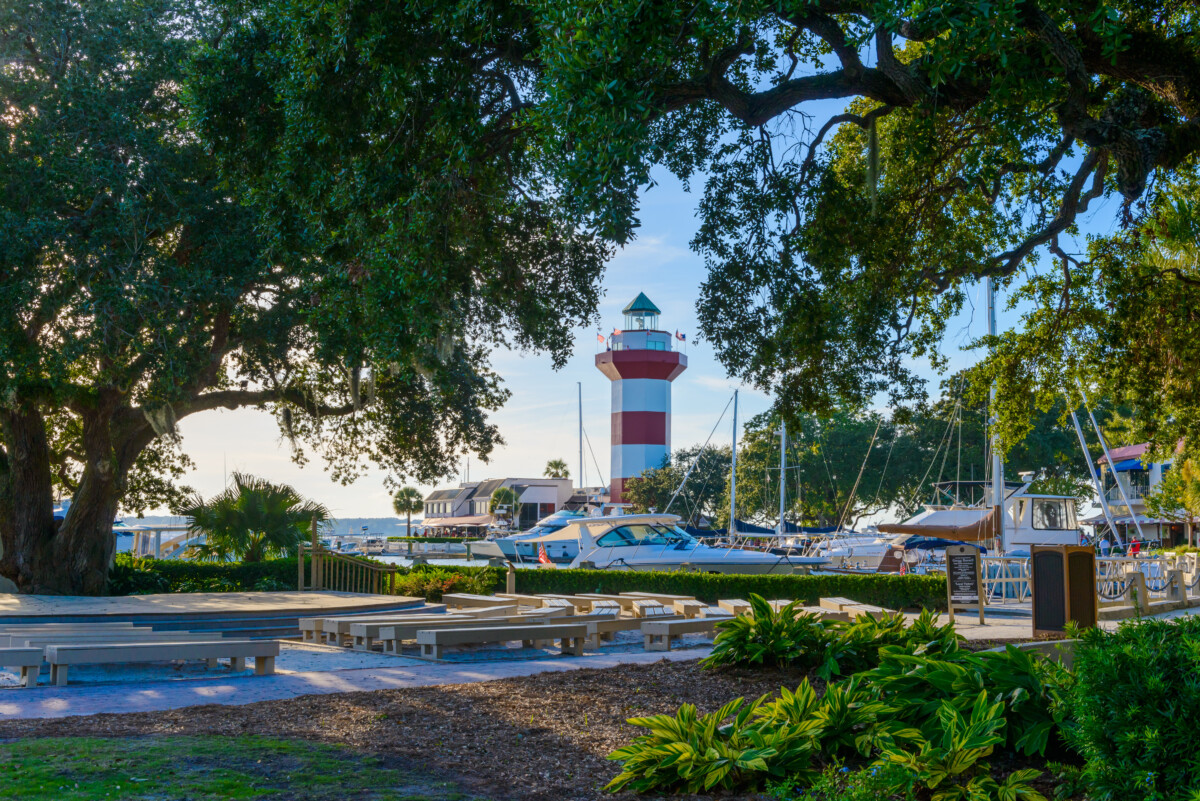
The red-and-white-striped Harbour Town Lighthouse is Hilton Head’s most recognizable landmark, standing at the entrance to the Harbour Town Yacht Basin in Sea Pines Resort. Climb the 114 steps to the observation deck for panoramic views over Calibogue Sound, the marina, and Daufuskie Island. The surrounding marina village features waterfront restaurants, boutiques, and live entertainment in a pedestrian setting. The adjacent Harbour Town Golf Links 18th hole is one of the most photographed finishes on the PGA Tour.
Sea Pines Forest Preserve
A 600-acre nature preserve within Sea Pines Resort, protecting maritime forest, freshwater ponds, marshland, and ancient Native American shell rings dating back 4,000 years. Over five miles of walking and biking trails wind through the preserve, passing observation platforms for birdwatching and wildlife spotting — deer, herons, egrets, and occasionally alligators are common sightings. The preserve’s wild character contrasts with the manicured resort landscape surrounding it.
Pinckney Island National Wildlife Refuge
A 4,053-acre refuge spanning multiple islands between the mainland and Hilton Head, managed by the U.S. Fish & Wildlife Service. Fourteen miles of trails loop through salt marshes, tidal creeks, and maritime forest hosting over 250 bird species, white-tailed deer, and loggerhead sea turtles. The refuge is free to enter and particularly rewarding for birdwatching — ibis rookeries, wood storks, bald eagles, and painted buntings are regularly spotted. Accessible by car from the mainland side of the Hilton Head bridges.
Mitchelville Freedom Park
A 26-acre park on the island’s north end commemorating one of the first self-governed communities of formerly enslaved people in the United States. Established in 1862 by Union General Ormsby Mitchel during the Civil War, the town of Mitchelville included schools, churches, and compulsory education — decades before such requirements existed elsewhere in the South. The park features interpretive trails, reconstructed buildings, and educational exhibits exploring Gullah Geechee history and the transition from slavery to freedom.
Daufuskie Island
A car-free barrier island accessible by ferry from Hilton Head, where unpaved roads, golf carts, and oyster-tabby ruins replace the development of its manicured neighbor. Daufuskie’s Gullah community maintains cultural traditions rooted in West African heritage, including traditional cooking, basket weaving, and storytelling. Historic landmarks include the First Union African Baptist Church and the Mary Fields School, where Pat Conroy taught and later based ‘The Water Is Wide.’ The island’s wild beaches and maritime forest offer a glimpse of what the Lowcountry looked like before resort development.
Editor-curated picks carried over from our original guide. Where a full place guide exists, the card links to it.
Worth booking ahead in Hilton Head Island
Hand-picked from the operators our guides already send readers to. Prices and availability are live on the partner site.
BrowseViator
Tours and tickets in Hilton Head Island on Viator (opens Viator in a new tab)
Viator's full list of bookable tours and tickets in Hilton Head Island.
BrowseGetYourGuide
Experiences in Hilton Head Island on GetYourGuide (opens GetYourGuide in a new tab)
Everything GetYourGuide sells in Hilton Head Island, with the cancellation terms on each listing.
Where to stayBooking.com
Stays in Hilton Head Island (opens Booking.com in a new tab)
Live rates and availability for Hilton Head Island on Booking.com; filter by neighbourhood once you know where your days start.
We earn a commission if you book through these links, at no extra cost to you. It is how we keep the guides free and independent.
Where to stay
Montage Palmetto Bluff
477 Mount Pelia Road, Bluffton, SC 29910, USA
A 20,000-acre luxury resort in the Lowcountry marshlands just across the May River from Hilton Head, featuring cottage-style accommodations, a Jack Nicklaus Signature golf course, a full-service spa, and multiple dining venues. The property’s waterfront setting, extensive nature trails, and kayak launches deliver a Lowcountry experience that prioritizes landscape over beachfront. It consistently ranks among the top resorts in the Southeast.
The Inn & Club at Harbour Town
7 Lighthouse Lane, Hilton Head Island, SC 29928, USA
A boutique hotel within the Sea Pines Resort, positioned steps from the iconic Harbour Town Lighthouse and Marina. The 60-room property offers access to three Sea Pines golf courses (including Harbour Town Golf Links), a private beach club, tennis courts, and priority dining reservations. The intimate scale and marina-front location set it apart from the island’s larger resort properties.
Omni Hilton Head Oceanfront Resort
23 Ocean Lane, Hilton Head Island, SC 29928, USA
A full-service oceanfront resort on the island’s south end, offering direct beach access, multiple pools, a spa, on-site dining, and a kids’ program. The 323-room property sits within Palmetto Dunes plantation, providing access to three championship golf courses, a tennis center, and the 11-mile Palmetto Dunes lagoon system for kayaking and paddleboarding.
Editor-curated stays carried over from our original guide. Where we have reviewed the hotel, the card links to the review.
Tips from the field
Highlights
- 12 miles of pristine beaches – broad, hard-packed Atlantic sand ideal for walking, cycling, and shelling
- 24+ championship golf courses – including Harbour Town Golf Links, host of the annual RBC Heritage PGA Tour event
- 100+ miles of bike paths – flat, paved trails connecting beaches, nature preserves, and neighborhoods island-wide
- Gullah Geechee heritage – living cultural traditions of the descendants of West African enslaved people who shaped Lowcountry food, art, and language
- Harbour Town Lighthouse – the island's iconic red-and-white-striped landmark with panoramic observation deck
- Dolphin watching – bottlenose dolphins are year-round residents of the island's tidal creeks and nearshore waters
Best activities
- Cycling is the quintessential Hilton Head activity — over 100 miles of flat, paved paths connect every corner of the island, from Coligny Beach through Sea Pines Forest Preserve to Harbour Town. Rent a cruiser bike and spend a morning riding beneath canopies of live oaks draped in Spanish moss. At the beach, the firm sand at low tide is wide enough for beach cruising along the full 12-mile shoreline.
- Golf anchors the island's identity: Harbour Town Golf Links hosts the annual RBC Heritage, South Carolina's only PGA Tour event, and Palmetto Dunes offers three championship courses designed by Arthur Hills, George Fazio, and Robert Trent Jones. Over 20 additional courses cater to every skill level and budget. Off the fairways, book a dolphin cruise from Shelter Cove Marina — bottlenose dolphins patrol the tidal creeks year-round and regularly approach boats in the Calibogue Sound.
- Nature buffs should explore Sea Pines Forest Preserve (600 acres of wetlands, fish ponds, and forest trails), Pinckney Island National Wildlife Refuge (accessible by car across the bridge, with 14 miles of trails and prolific birdwatching), and the Coastal Discovery Museum for Lowcountry natural and cultural history. Day-trip to Daufuskie Island by ferry for a car-free experience — golf carts, dirt roads, and historic Gullah communities make it feel a century removed from Hilton Head's groomed plantations.
Local experiences
- Join a guided Gullah heritage tour to learn about sweetgrass basket weaving, traditional Lowcountry cooking, and the history of Mitchelville Freedom Park directly from community members. Take the Daufuskie Island ferry for a half-day golf-cart exploration of an island where the pace dropped decades ago. Eat at a local seafood restaurant — options like Hudson's Seafood on the Docks serve catch-of-the-day overlooking the marshes. Kayak through the tidal salt marshes at dawn when egrets, herons, and fiddler crabs are most active.
Practical tips
- Reserve tee times well in advance, especially for Harbour Town and Palmetto Dunes courses. Sea Pines, Palmetto Dunes, and Shipyard plantations charge a daily gate fee ($8–10) for non-guest vehicles. Beach chairs, umbrellas, and bikes can be rented from multiple outfitters who deliver to your accommodation. Alcohol and glass containers are prohibited on all public beaches. Parking at beach access points fills early in summer — arrive before 10 AM or bike instead. Grocery stores (Publix, Harris Teeter) are well-stocked for self-catering stays.
Photography tips
- The Harbour Town Lighthouse and marina at sunset produce Hilton Head's most iconic shot — arrive at least 30 minutes before golden hour to secure a position along the waterfront. Low-tide beach walks reveal tidal pools and reflective sand ideal for wide-angle compositions. The Spanish moss draped over live oak allées, especially along Greenwood Drive and in Sea Pines Forest Preserve, photographs beautifully in dappled morning light. Dolphin cruises offer wildlife photography opportunities — use a fast shutter speed (1/1000+) to freeze breaching dolphins. Daufuskie Island's weathered historic structures provide textural compositions.
Timing
- Three to five days is ideal for Hilton Head. Allow one day for beach and biking, one day for golf, one day for nature (kayaking, dolphin cruise, Pinckney Island), and one day for a Daufuskie Island trip or Gullah heritage tour. A long weekend covers the highlights
- a full week allows a relaxed rotation through multiple golf courses and beaches without rushing.
Keeping it authentic
- Hilton Head's development is heavily managed — the island's architectural guidelines, tree ordinances, and muted signage laws prevent the visual clutter of typical beach towns, creating an unusually polished environment. This design-consciousness makes the island beautiful but can feel manicured. For a rawer Lowcountry experience, cross to Daufuskie Island or explore the mainland towns of Bluffton and Beaufort. The Gullah Geechee cultural presence is genuine and provides the island's deepest connection to its pre-resort identity.
Culture, customs and safety
Cultural heritage
Hilton Head’s cultural identity is rooted in the Gullah Geechee heritage of descendants of enslaved West Africans who worked Sea Island cotton plantations. Gullah traditions in sweetgrass basket weaving, indigo dyeing, storytelling, and cuisine — including dishes like shrimp and grits, she-crab soup, and red rice — remain a living part of Lowcountry life. Mitchelville Freedom Park commemorates one of the first self-governed towns of freed slaves in the United States, established on Hilton Head in 1862 during the Civil War. Historic plantation sites, including Zion Chapel of Ease, preserve the architectural and spiritual history of the antebellum and Reconstruction eras. The island also played a strategic role in the Civil War as a Union base following the Battle of Port Royal in 1861.
Local customs & etiquette
The Lowcountry pace is unhurried — expect friendly greetings from strangers and a conversational rhythm that leaves room for small talk. Respect gated community rules and speed limits, which are strictly enforced. Leave no trace on beaches: fill any holes dug in the sand, and carry out all trash. During sea turtle nesting season, shield beach-facing lights and avoid using flashlights on the sand after dark. Tipping 18–20% at restaurants is standard. Golf courses enforce dress codes — collared shirts and no denim are typical requirements.
Safety notes
Hilton Head Island has low crime rates and is considered very safe for visitors. The primary safety considerations are environmental: alligators inhabit freshwater lagoons and ponds throughout the island — maintain distance and never feed them. On the beach, rip currents can occur, especially near tidal inlets; swim near lifeguard stations during staffed hours. Jellyfish stings are occasionally reported in warmer months. Sun and heat exposure are significant from May through September — hydrate frequently and use sunscreen. Sea turtle nesting season (May–October) requires minimizing beach lighting at night and avoiding disturbance of marked nests.


Activities