

Mallorca, the largest of the Balearic Islands, is renowned for its stunning beaches, picturesque villages, and vibrant nightlife. The island offers a perfect blend of relaxation and adventure, with opportunities for hiking in the Tramuntana mountains, exploring charming towns like Valldemossa, and enjoying the lively atmosphere of Palma’s historic center.
The destination guide
Mallorca
Travel guides for Mallorca
Destination stories (1)
More guides featuring Mallorca (2)
At a glance
Currency€ EURCode: EUR
Time zoneCentral European Time
Languages
- Spanish
- Catalan
- Basque
- Galician
Setting
- Mediterranean island
- Sandy beaches
- Sierra de Tramuntana
- Pine forests
Known for
- Historic architecture
- Mediterranean cuisine
- Beach and coastal lifestyle
- Art and culture
Population967K966,908 residents
VisaDuration: Up to 90 days within any 180-day period in the Schengen Area · Documents: Valid passport issued within the last 10 years and valid for at least 3 months after planned departure, plus proof of accommodation, onward or return travel, and sufficient funds if requested
How Mallorca scores
6/10OverallFair
Weather9/10
Value for money7/10
Safety8/10
Food & cuisine8/10
Culture & arts6/10
Cultural experience8/10
History8/10
Nature & outdoors9/10
Adventure6/10
Nightlife8/10
Shopping7/10
Family friendly5/10
Romance9/10
Character
Photography score7/10
Authenticity score9/10
Off-the-beaten-path score7/10
Editorial scores on a 10-point scale, weighed against destinations of the same kind.
Travel safety snapshot
Overall82/100High rating
Women travellers78/100
LGBTQ+ travellers75/100
Theft60/100
Medical care80/100
Physical harm84/100
Political freedom72/100
SafePlace indicators use their source 100-point scale; higher is more favourable. Planning context, not a live travel advisory — check official government guidance before you go.
When to go
Best months to visit: April, May, June, September and October.
- January: 8.4 to 14.9 degrees Celsius, 42.6 millimetres of rain, best-time score 2 out of 5.
- February: 8.4 to 16.1 degrees Celsius, 44.3 millimetres of rain, best-time score 3 out of 5.
- March: 10.2 to 17.5 degrees Celsius, 52.8 millimetres of rain, best-time score 3 out of 5.
- April: 12 to 20 degrees Celsius, 54.3 millimetres of rain, best-time score 4 out of 5.
- May: 15.1 to 23.8 degrees Celsius, 42.9 millimetres of rain, best-time score 5 out of 5.
- June: 19.7 to 29.1 degrees Celsius, 29.3 millimetres of rain, best-time score 5 out of 5.
- July: 22.5 to 32.3 degrees Celsius, 11.2 millimetres of rain, best-time score 3 out of 5.
- August: 22.8 to 32.1 degrees Celsius, 20.2 millimetres of rain, best-time score 3 out of 5.
- September: 20.1 to 27.8 degrees Celsius, 68.4 millimetres of rain, best-time score 5 out of 5.
- October: 16.7 to 23.9 degrees Celsius, 64 millimetres of rain, best-time score 4 out of 5.
- November: 12.7 to 18.7 degrees Celsius, 62.3 millimetres of rain, best-time score 2 out of 5.
- December: 9.9 to 16.4 degrees Celsius, 33.9 millimetres of rain, best-time score 2 out of 5.
Month-by-month conditions and packing advice
- January
- Cool to mild, occasional rain January in Mallorca: cool, quieter and a bit wetter with many resort hotels closed for the season. Crowds: January in Mallorca is workable with normal seasonal planning; build in layers, weather checks, and a mix of indoor and outdoor activities. Pack: Pack layered clothing and comfortable walking shoes.
- February
- Cool to mild, occasional rain February in Mallorca: mild winter with almond blossom covering the hills, though many coastal resorts remain shut. Crowds: February in Mallorca is workable with normal seasonal planning; build in layers, weather checks, and a mix of indoor and outdoor activities. Pack: Pack layered clothing and comfortable walking shoes.
- March
- Cool to mild, occasional rain March in Mallorca: early spring warming with blossom and wildflowers, but cool seas and limited resort activity. Crowds: March in Mallorca is workable with normal seasonal planning; build in layers, weather checks, and a mix of indoor and outdoor activities. Pack: Pack layered clothing and comfortable walking shoes.
- April
- Mild to warm, occasional rain April in Mallorca: pleasant spring weather with blooming countryside and crowds yet to arrive. Crowds: April in Mallorca is comfortable for sightseeing, neighborhoods, food stops, day trips, and outdoor time with limited weather friction. Pack: Pack layered clothing and comfortable walking shoes.
- May
- Mild to warm, occasional rain May in Mallorca: warm sunny days, swimmable seas and light crowds make it one of the ideal months. Crowds: May in Mallorca is comfortable for sightseeing, neighborhoods, food stops, day trips, and outdoor time with limited weather friction. Pack: Pack layered clothing and comfortable walking shoes.
- June
- Warm to hot, mostly dry June in Mallorca: excellent warm weather and warm seas before the peak summer rush and heat set in. Crowds: June in Mallorca is workable with normal seasonal planning; build in layers, weather checks, and a mix of indoor and outdoor activities. Pack: Pack light clothing, sun protection, and comfortable walking shoes.
- July
- Warm to hot, mostly dry July in Mallorca: hot and crowded peak season with packed beaches and high room rates. Crowds: July in Mallorca is workable with normal seasonal planning; build in layers, weather checks, and a mix of indoor and outdoor activities. Pack: Pack light clothing, sun protection, and comfortable walking shoes.
- August
- Warm to hot, mostly dry August in Mallorca: hottest and busiest month with sweltering heat, hordes of tourists and peak prices. Crowds: August in Mallorca is workable with normal seasonal planning; build in layers, weather checks, and a mix of indoor and outdoor activities. Pack: Pack light clothing, sun protection, and comfortable walking shoes.
- September
- Warm to hot, occasional rain September in Mallorca: still summery with warm seas and noticeably thinner crowds, an ideal month. Crowds: September in Mallorca is comfortable for sightseeing, neighborhoods, food stops, day trips, and outdoor time with limited weather friction. Pack: Pack light clothing, sun protection, and comfortable walking shoes.
- October
- Mild to warm, occasional rain October in Mallorca: warm enough for swimming with pleasant days and fewer visitors, though rainfall increases. Crowds: October in Mallorca is comfortable for sightseeing, neighborhoods, food stops, day trips, and outdoor time with limited weather friction. Pack: Pack layered clothing and comfortable walking shoes.
- November
- Cool to mild, occasional rain November in Mallorca: cooler and wetter as many hotels close and the island winds down for winter. Crowds: November in Mallorca is workable with normal seasonal planning; build in layers, weather checks, and a mix of indoor and outdoor activities. Pack: Pack layered clothing and comfortable walking shoes.
- December
- Cool to mild, occasional rain December in Mallorca: mild but quiet and damp with most resorts closed and short daylight hours. Crowds: December in Mallorca is workable with normal seasonal planning; build in layers, weather checks, and a mix of indoor and outdoor activities. Pack: Pack layered clothing and comfortable walking shoes.
Peak season
- July
- August
- June
- September
Off-peak
- January
- February
- November
- December
- March
Know before you go
About
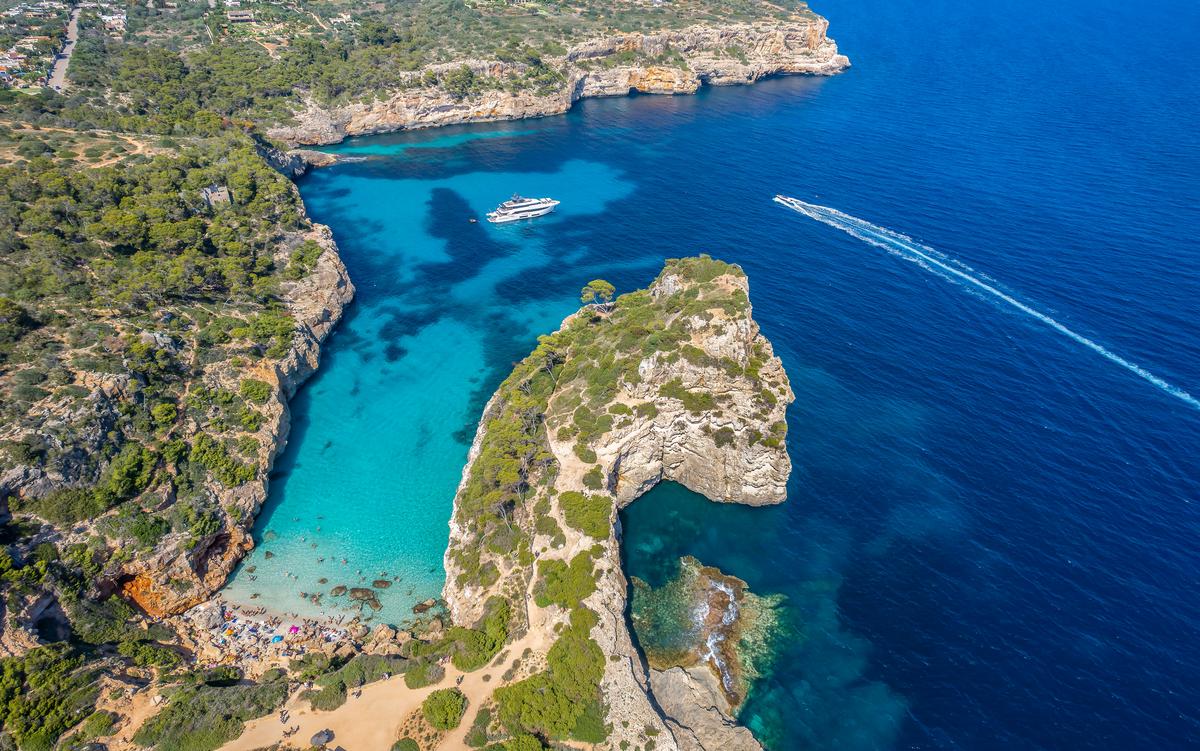
Mallorca, the largest of Spain’s Balearic Islands in the western Mediterranean, is a sun-soaked holiday favorite that rewards visitors far beyond its famous beaches. Covering about 3,640 km² with a population of roughly 920,000, the island centers on its lively capital, Palma, crowned by the soaring Gothic cathedral of La Seu overlooking the bay. Along the northwest coast runs the dramatic Serra de Tramuntana mountain range, a UNESCO World Heritage Site of terraced hillsides, stone villages like Valldemossa and Deià, and the high peak of Puig Major. Mallorca’s coastline is dotted with turquoise coves, or calas, sweeping resort beaches, and dramatic sea caves such as the Coves del Drac. Inland, almond groves, wineries, and hilltop towns invite slower exploration by car or bike. Easily reached through one of Europe’s busiest airports, Mallorca pairs beach-resort comfort with mountains, culture, and Mediterranean cuisine, making it one of Spain’s most versatile island destinations.
Best time to visit
The best time to visit Mallorca is during the spring (April to June) and early fall (September to October) when the weather is warm and the tourist crowds are smaller. Summer months can be busy, with many festivals and events, while winter offers a quieter experience with mild temperatures.
Getting there and around
Getting there
Mallorca accessible via Palma Airport (Son Sant Joan), 8km east of Palma – 3rd largest Spanish airport. Direct flights from most European cities via Ryanair, EasyJet, Wizzair (from €30-40). United direct from New York Newark. By ferry from Barcelona: 1pm/10pm departures (7.5hrs to Palma, 6hrs to Alcúdia), Valencia (8-9hrs), Dénia (5hrs evening departure), Ibiza (2-4hrs). Airport to Palma: taxi 20min (€10-20, €2.90 surcharge, €13 minimum), Line 1 bus to Plaça d’Espanya for island connections. Car rental essential for exploring – book 4-8 weeks advance in summer.
Getting around
Getting around Mallorca is surprisingly convenient, thanks to its robust and budget-friendly public transportation network. The island’s buses, operated by TIB, efficiently connect Palma with most towns and beaches, and while there’s no metro, Palma does have a small, clean metro line primarily serving the university area. Taxis are widely available but pricier, and while rideshare apps aren’t as prevalent as in mainland Spain, local apps like Taxiclick or joining WhatsApp-based taxi groups in small towns can be very useful. For longer stays or multiple trips, buy a rechargeable Intermodal Card at Palma’s Estació Intermodal to save significantly on fares—especially handy for day trips to Sóller, Valldemossa, or Alcúdia, which are walkable gems once you arrive.
Worth booking ahead in Mallorca
Hand-picked from the operators our guides already send readers to. Prices and availability are live on the partner site.
BrowseViator
Tours and tickets in Mallorca on Viator (opens Viator in a new tab)
Viator's full list of bookable tours and tickets in Mallorca.
BrowseGetYourGuide
Experiences in Mallorca on GetYourGuide (opens GetYourGuide in a new tab)
Everything GetYourGuide sells in Mallorca, with the cancellation terms on each listing.
Where to stayBooking.com
Stays in Mallorca (opens Booking.com in a new tab)
Live rates and availability for Mallorca on Booking.com; filter by neighbourhood once you know where your days start.
We earn a commission if you book through these links, at no extra cost to you. It is how we keep the guides free and independent.
Where to stay
Belmond La Residencia
Son Moragues, 07179 Deià, Mallorca, Spain
Iconic mountain retreat in the Tramuntana highlands with world-class art collection, a spa, saltwater pools, and panoramic views that have drawn artists and royalty for generations.
Sant Francesc Hotel Singular
Plaça Sant Francesc 5, 07001 Palma de Mallorca, Spain
Five-star hotel in Palma’s Old Town featuring contemporary artwork, a rooftop pool with 360-degree city views, and an intimate luxury atmosphere.
Four Seasons Resort Mallorca
Carretera Formentor, 07470 Port de Pollença, Mallorca, Spain
Grand luxury resort on the Formentor peninsula with a private beach, spa, fine dining, and stunning Mediterranean coastal scenery.
Editor-curated stays carried over from our original guide. Where we have reviewed the hotel, the card links to the review.
Tips from the field
Highlights
- Catedral-Basílica de Santa María de Mallorca
- Castell de Bellver
- Royal Palace of La Almudaina
- Es Baluard Museu d'Art Contemporani de Palma
Best activities
- Tour the magnificent Catedral-Basílica de Santa María de Mallorca
- Visit Castell de Bellver for panoramic views of the city
- Explore the Royal Palace of La Almudaina
- Stroll through the beautiful Jardí del Bisbe
Practical tips
- Many attractions offer free entry or discounts with the Palma Pass
- Wear comfortable shoes for exploring the old town's cobblestone streets
- Siesta time is typically from 2-5 PM, plan activities accordingly
Keeping it authentic
- Visit the Arab Baths (Banys Àrabs) for a glimpse into Palma's Moorish history
- Explore the narrow streets of the old town to experience authentic local life
Culture, customs and safety
Cultural heritage
Mallorca represents the cultural heart of Balearic island civilization and Mediterranean lifestyle sophistication, where ancient Talayotic culture, Islamic agricultural innovation, and contemporary European island tourism created one of the Mediterranean most culturally rich island destinations. The island preserves traditional Mallorcan crafts, including pottery and textile weaving, while maintaining its role as refuge for artists, writers, and European cultural figures. Mallorca cultural heritage encompasses ancient Mediterranean island culture, Islamic agricultural traditions, traditional Balearic crafts, and contemporary European cultural tourism that continues to influence Mediterranean island cultural development and Spanish regional identity.
Local customs & etiquette
Mallorca blends Spanish and Catalan cultures with Mallorquí dialect spoken locally. Two official languages: Catalan and Castilian Spanish. Traditional siesta 2-5pm shop closures. Tap water unsafe – drink bottled water. Strong Catalan identity with traditional dances: Ball dels Cossiers (13th-14th century import), Correfoc pyrotechnic festivals. Folk music features xeremies (bagpipes), guitarra de canya instruments. May best for moderate weather, July-August peak party season. December magical with Christmas decorations, 20°C sunny weather. Beach and mountain culture combined. Formal dining later than northern Europe.


Activities