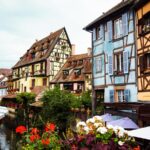
La Petite France is the most historically intact quarter of Strasbourg’s Grande Île, a UNESCO World Heritage island formed by branches of the Ill River. Once home to tanners, millers, and fishermen from the 15th century onward, the district retains its original timber-frame architecture, narrow canal-lined lanes, and medieval lock systems. It sits at the southwestern tip of the Grande Île, roughly a 15-minute walk from Strasbourg Cathedral.
What is La Petite France known for?
La Petite France is known primarily for its dense cluster of half-timbered Alsatian houses (colombages) reflected in the Ill River canals, the four medieval defensive towers of the Ponts Couverts (Covered Bridges), and the Barrage Vauban, a 17th-century dam and defensive weir designed by military engineer Sébastien Le Prestre de Vauban that offers a rooftop panorama over the entire quarter.
- Half-timbered houses concentrated along Rue du Bain-aux-Plantes
- Ponts Couverts: four square towers and three bridges over the Ill
- Barrage Vauban: free rooftop terrace with panoramic views
- Working lock system (écluse) managing Ill River water levels
Best things to do in La Petite France
The single most rewarding activity in La Petite France is walking the full length of Rue du Bain-aux-Plantes, crossing the Ponts Couverts, and ascending the free rooftop terrace of the Barrage Vauban for an unobstructed aerial view of the timber-frame roofscape and the Ill canals below.
- Walk Rue du Bain-aux-Plantes end to end for the best colombage facades
- Cross all three bridges of the Ponts Couverts at dusk
- Climb the Barrage Vauban rooftop terrace (free, open daily)
- Take a boat tour along the Ill departing near the Ponts Couverts
- Visit the Musée Alsacien on nearby Quai Saint-Nicolas for regional folk artifacts
Where to eat in La Petite France
La Petite France and its immediate edges on Rue des Moulins and Quai de la Bruche concentrate several traditional Alsatian winstubs and restaurants serving tarte flambée (flammekueche), choucroute garnie, and baeckeoffe, the slow-cooked Alsatian meat-and-potato casserole, alongside local Kronenbourg and craft Alsatian beers.
- Tarte flambée: thin-crust Alsatian flatbread with crème fraîche and lardons
- Choucroute garnie: sauerkraut with pork cuts and Riesling-braised sausages
- Baeckeoffe: slow-cooked lamb, beef, and potato casserole in a sealed terrine
- Restaurants cluster along Rue des Moulins and Quai de la Bruche
Where to walk in La Petite France
The most scenic walking loop in La Petite France begins at Place Benjamin Zix, follows Rue du Bain-aux-Plantes northwest along the canal, crosses the Ponts Couverts towers, continues over the Barrage Vauban, and returns via the southern canal quay back to the lock and Place Benjamin Zix, covering roughly 1.2 kilometers.
- Place Benjamin Zix: small square at the heart of the quarter
- Rue du Bain-aux-Plantes: the main street of historic tanner houses
- Quai de la Bruche: southern canal embankment with water reflections
- Ponts Couverts to Barrage Vauban: the essential northwestern loop
How to get to La Petite France
La Petite France is reachable on foot in about 15 minutes from Strasbourg’s main train station (Gare de Strasbourg) by walking east along Rue du Vieux-Marché-aux-Vins and then south through the Grande Île; tram lines A, D, and E stop at the central Homme de Fer interchange, from which the quarter is a 10-minute walk southwest.
- Tram lines A, D, E: stop at Homme de Fer, 10-minute walk
- Tram line C: stop at Alt Winmärik (Grand’Rue), 8-minute walk
- Gare de Strasbourg: 15-minute walk or short tram ride
- Vélo’v and Vélhop bike-share stations near Ponts Couverts
Best time to visit La Petite France
La Petite France is most atmospheric in early morning between 7 and 9 a.m. before tour groups arrive, and in December when the Strasbourg Christmas Market (Marché de Noël), one of Europe’s oldest, extends illuminated stalls toward the quarter; spring and early autumn offer mild temperatures and manageable crowds for photography and canal walks.
- Early morning: empty lanes, best canal reflections in low light
- December: Strasbourg Marché de Noël illuminations reach the quarter
- April–June and September–October: mild weather, moderate crowds
- July–August: peak crowds; visit before 9 a.m. or after 7 p.m.