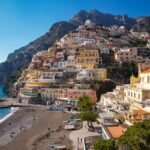
Spiaggia Grande is Positano’s largest and most central beach, stretching roughly 300 metres along the base of the town’s amphitheatre of pastel-coloured houses. The beach is composed of dark grey volcanic sand and pebbles, a characteristic of the Amalfi Coast’s geology, and serves as both a social hub and a working harbour where small fishing boats and ferries share the waterfront. Via Marina Grande, the road running parallel to the shore, connects the beach to the rest of the town.
What is Spiaggia Grande known for?
Spiaggia Grande is known as the visual centrepiece of Positano, where the town’s distinctive stacked architecture rises directly from the shoreline, making it one of the most photographed beaches in Italy. The beach is divided between a small free public section on the western end near the breakwater and a larger stretch of privately managed beach clubs, called stabilimenti balneari, that rent sunbeds and umbrellas. The Church of Santa Maria Assunta, with its majolica-tiled dome, stands immediately above the beach and is visible from the water.
Best things to do at Spiaggia Grande
- Rent a sunbed and umbrella from one of the established beach clubs such as Internazionale or La Scogliera.
- Swim in the clear Tyrrhenian Sea directly off the beach or snorkel around the rocky edges near the breakwater.
- Take a short boat taxi or hire a small motorboat from the harbour to reach the quieter Spiaggia di Fornillo beach to the west.
- Visit the Chiesa di Santa Maria Assunta, a short walk up from the beach, to see its 13th-century Byzantine icon of the Black Madonna.
- Watch the daily arrival and departure of the SITA ferry and hydrofoil services from the small pier at the eastern end of the beach.
Where to eat near Spiaggia Grande
The restaurants and bars lining Via Marina Grande and the beach promenade serve fresh seafood and Amalfi Coast specialities within metres of the waterfront, making it easy to combine dining with a beach visit. Bruno Ristorante and La Cambusa are long-established seafood restaurants on or just above the beach, known for dishes such as spaghetti alle vongole, grilled orata, and frittura di paranza. Gelato and granita stands operate along the promenade throughout summer, and several beach clubs serve food and aperitivo directly on the sand.
How to get to Spiaggia Grande
Spiaggia Grande is reached by descending the main pedestrian stairway, Via dei Mulini, from the upper town, or by taking the SITA bus from Amalfi or Praiano, which stops at Positano Chiesa and requires a short walk downhill. Hydrofoils and ferries operated by Alicost and NLG connect the beach pier directly to Amalfi, Salerno, and the island of Capri from April through October. Driving is strongly discouraged in peak season due to limited parking; the closest paid car parks are on Via Cristoforo Colombo above the town.
Best time to visit Spiaggia Grande
Late May through early June and September offer the best balance of warm sea temperatures, manageable crowds, and full ferry service, while July and August bring peak congestion when the beach and surrounding lanes become extremely crowded. The beach is technically open year-round, but most beach clubs and boat rental operators close from November through March. Morning arrivals before 10 a.m. allow the best access to the free public section and clearer views for photography before tour groups descend.
Where to walk from Spiaggia Grande
The most rewarding short walk from Spiaggia Grande follows the coastal footpath westward along Via Positanesi d’America, a cliffside lane that connects the main beach to the smaller and less crowded Spiaggia di Fornillo in roughly 10 to 15 minutes on foot. A steeper inland walk up Via dei Mulini and then Via Cristoforo Colombo leads through the town’s boutique-lined lanes to the upper bus stops and panoramic terraces overlooking the bay. Both routes pass characteristic bougainvillea-draped walls and offer multiple viewpoints back toward the beach.