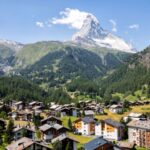
Zermatt’s village center is the car-free heart of the Swiss Valais resort, arranged along its pedestrian main street, Bahnhofstrasse, within easy walking distance of the railway station. Zermatt has banned combustion cars since 1961, so the streets belong to pedestrians, electric taxis, and the horse-drawn carriages that still run along the promenade.
Bahnhofstrasse is the village’s social spine, lined with bars, restaurants, bakeries, patisseries, and Alpine sport shops. Just off it, the Hinterdorf quarter preserves clusters of weathered 16th-century wooden houses and grain stores raised on stone stilts — some of the oldest surviving buildings in the valley.
The Matterhorn dominates everything. Looking southwest from the steps of St. Mauritius Church or the church bridge over the Vispa, the peak rises directly above the rooftops — the view that made Zermatt famous. In midsummer, a herd of around 100 black-necked goats is herded down Bahnhofstrasse each morning and evening, a local tradition that draws a crowd.
The center is the staging point for the mountain: cogwheel trains, cable cars, and the Gornergrat railway all depart from here toward the high Alpine terrain, while the compact, walkable core keeps hotels, dining, and après-ski within a few minutes of one another.