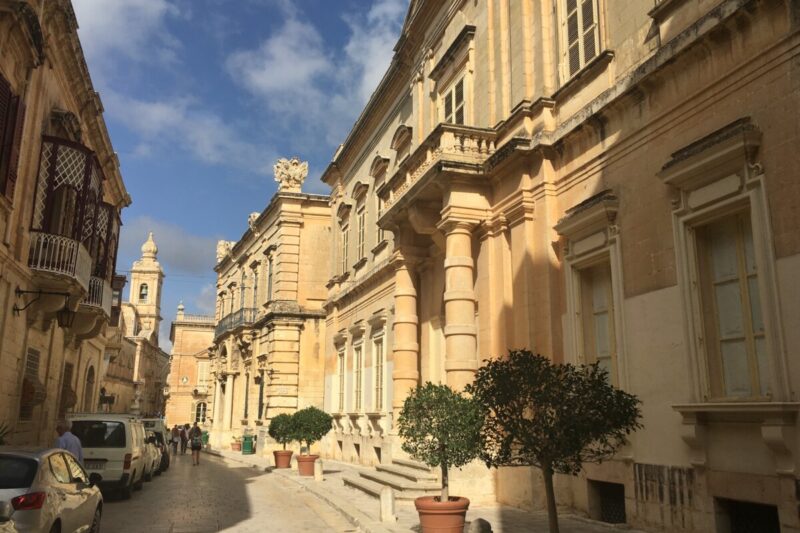
Valletta is the capital of Malta and one of the smallest capital cities in the European Union, occupying a narrow limestone peninsula between the Grand Harbour and Marsamxett Harbour. Built by the Knights of St. John following the Great Siege of 1565, the city was designated a UNESCO World Heritage Site in 1980 and served as a European Capital of Culture in 2018. Its grid-pattern streets, Baroque palaces, and harbour bastions are remarkably well preserved within walls that have stood for over 450 years.
What is Valletta known for?
Valletta is known primarily for its Baroque architecture, its role as the headquarters of the Knights of St. John, and two of Malta’s most significant cultural institutions: St. John’s Co-Cathedral and the Grandmaster’s Palace. St. John’s Co-Cathedral on St. John’s Street houses Caravaggio’s The Beheading of Saint John the Baptist (1608), the only painting he signed, alongside a mosaic marble floor of Knights’ tombstones and ornate chapels dedicated to the langues of the Order. The Grandmaster’s Palace on Republic Street contains the Palace Armoury, one of Europe’s most complete collections of 16th- and 17th-century armour.
Best things to do in Valletta
The top experiences in Valletta include visiting St. John’s Co-Cathedral, walking the Upper Barrakka Gardens for panoramic views of the Grand Harbour, and watching the daily Saluting Battery cannon firing at noon and 4 pm. Other key sites are the National Museum of Archaeology on Republic Street, which holds the Sleeping Lady figurine from Ħal Saflieni Hypogeum, the Lascaris War Rooms beneath the bastions, and the Malta Experience audiovisual show at the Mediterranean Conference Centre. Fort St. Elmo at the peninsula’s tip houses the National War Museum.
- Upper Barrakka Gardens cannon salute at noon and 4 pm daily
- St. John’s Co-Cathedral and its Caravaggio oratory
- National Museum of Archaeology on Republic Street
- Lascaris War Rooms underground wartime headquarters
- Fort St. Elmo and the National War Museum
Where to eat in Valletta
Valletta’s dining ranges from traditional Maltese pastizzi at street-level kiosks to sit-down restaurants serving bragioli, stuffat tal-fenek (rabbit stew), and fresh lampuki fish. Crystal Palace on Republic Street is a long-established kiosk serving pastizzi — flaky pastry filled with ricotta or mushy peas — for a few cents each. Café Cordina on Republic Street is one of Malta’s oldest cafés, known for its ornate interior and nougat. The Strait Street area, historically Valletta’s entertainment district, now hosts wine bars, bistros, and small live-music venues in restored townhouses.
- Pastizzi from Crystal Palace kiosk, Republic Street
- Café Cordina for coffee and traditional Maltese sweets
- Strait Street bistros and wine bars in restored buildings
- Stuffat tal-fenek (rabbit stew) at traditional Maltese restaurants
Where to walk in Valletta
The most rewarding walk in Valletta follows Republic Street from City Gate at the landward end straight through the city’s spine to Fort St. Elmo at the seaward tip, a distance of roughly one kilometre passing the main squares, cathedral, and palace. A parallel route along Merchants Street passes the covered market building and connects to St. George’s Square, the main civic piazza in front of the Grandmaster’s Palace. The city walls themselves offer walking along the bastions, with the Lower Barrakka Gardens on the south side providing views toward Fort Ricasoli across the Grand Harbour entrance.
How to get to Valletta
Valletta is served by Malta’s central bus terminus at the City Gate interchange, where routes from Malta International Airport (approximately 10 km away), Sliema ferry terminal, and all major towns on the island converge. The X2 airport express bus connects Malta International Airport to Valletta in roughly 30 minutes. A passenger ferry runs between Sliema’s Ferries landing and Valletta’s Sa Maison marina side, crossing Marsamxett Harbour in about 10 minutes. Valletta itself is car-free for most visitors; parking is available outside the walls at the Triton Fountain area.
Best time to visit Valletta
Valletta is a year-round destination, but spring (April–May) and autumn (October–November) offer the most comfortable temperatures for walking the city’s hilly streets, typically 18–24 °C, with fewer crowds than the July–August peak. The Valletta Carnival in February and the Isle of MTV concert held in summer at Granaries Square (Floriana, immediately outside the gates) are major seasonal draws. The Feast of St. Paul’s Shipwreck on 10 February is a significant local religious and cultural event centred on the Collegiate Parish Church of St. Paul’s Shipwreck on St. Paul’s Street.