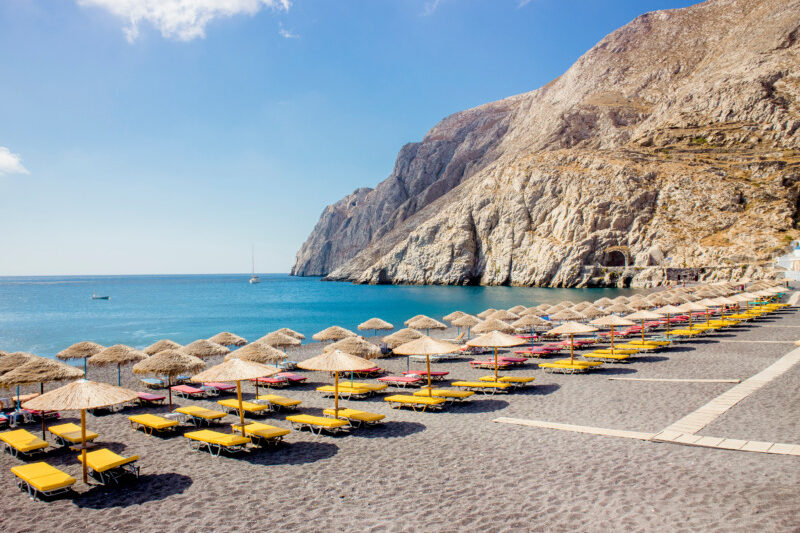
Kamari Beach stretches along Santorini‘s southeastern coastline as a distinctive volcanic marvel, where crystalline Aegean waters meet striking black sand created by ancient lava flows. Unlike Santorini’s clifftop caldera villages, Kamari offers a different island experience with its accessible beachfront promenade lined with tavernas, boutiques, and cafés shaded by tamarisk trees. The dramatic backdrop of Mesa Vouno mountain, crowned with the ruins of ancient Thera, creates a stunning visual contrast with the dark shoreline and turquoise sea. Awarded Blue Flag status for its cleanliness, the beach features organized sections with sunbeds and umbrellas alongside more secluded spots for tranquility seekers. Water sports enthusiasts find excellent opportunities for paddleboarding, jet skiing, and parasailing in the calm, clear waters. As evening approaches, Kamari’s ambiance transforms when beachfront establishments illuminate their terraces and the open-air cinema screens films beneath the stars. Culturally significant, the beach lies near archaeological sites including Ancient Thera (accessible via scenic hiking path or shuttle) and Panagia Episkopi, Santorini’s oldest Byzantine church. For travelers seeking an authentic experience beyond the famous sunset views of Oia, Kamari Beach offers the perfect balance of natural beauty, authentic Greek dining, and relaxed sophistication within a genuine local community.
Cultural Context
Kamari Beach holds a significant place within the cultural fabric of Santorini, reflecting the island’s deep connection to the sea and its volcanic heritage. The beach is more than a recreational spot; it is a venue where local traditions and contemporary life merge. The nearby village of Kamari hosts traditional festivals, such as the annual celebration of Agios Nikolaos, the patron saint of sailors, which includes religious processions and community feasts that honor the island’s maritime history. Local customs often revolve around the sea, with fishing and small-scale viticulture playing a role in daily life. The black volcanic sand of Kamari Beach is emblematic of Santorini’s volcanic origins and is a reminder of the island’s resilience and adaptation through centuries of geological upheaval. The beach also serves as a gathering place for both locals and visitors during cultural events, where traditional music and dance can often be experienced, showcasing the Aegean’s vibrant heritage. Kamari’s cultural context is deeply intertwined with its natural environment, making it a living example of how Santorini’s communities maintain their identity through a blend of ancient customs and modern tourism. The cultural practices observed around Kamari Beach continue to enrich the visitor experience by providing insight into the island’s unique way of life.
Historical Context
Kamari Beach’s history is inseparable from the broader narrative of Santorini, an island shaped by one of the most significant volcanic eruptions in human history—the Minoan eruption around 1600 BCE. This catastrophic event drastically altered the island’s landscape and influenced the development of ancient civilizations in the Aegean. While Kamari itself was a modest fishing village for much of its early history, it became increasingly important as a coastal settlement in the 20th century, particularly after the growth of tourism following World War II. The volcanic black sand of Kamari is a direct result of the island’s volcanic activity, which has defined Santorini’s geological and cultural evolution. Throughout the centuries, the area around Kamari has seen influences from various ruling powers, including the Venetians and Ottomans, each leaving subtle marks on the local culture and infrastructure. The beach’s modern development began in the 1970s when it transformed from a quiet fishing shore into a popular tourist destination, reflecting broader economic and social changes on the island. Today, Kamari Beach stands as a testament to Santorini’s ability to preserve its historical roots while adapting to contemporary demands, embodying a layered history that continues to unfold.