UNESCO World Heritage volcanic caldera masterpiece (1990) formed by massive ancient eruption creating incomparable geological formation surrounded by cliff-perched villages: Oia, Fira, Firostefani, Imerovigli, Akrotiri offering unparalleled Aegean Sea views across this active volcano rim. Iconic white buildings with dazzling blue domes contrasting volcanic landscape and brilliant Aegean waters, epitomizing Cycladic architecture where postcard-perfect Oia captures Greece’s most photographed essence as sunset capital. World’s most spectacular sunset views casting golden glows over whitewashed buildings and turquoise seas, attracting global visitors to this breathtaking daily spectacle from Oia’s northernmost caldera point. Fira’s vibrant capital (260m above sea level) combining traditional Cycladic architecture with modern facilities, cliff-edge restaurants, smart boutiques, and vibrant nightlife overlooking Nea Kameni volcanic island. Renowned wineries including Santo Wines, Venetsanos, Gaia, Sigalas utilizing volcanic soil and unique climate producing world’s most delicious wines through guided tours from grape harvesting to bottling. 10-kilometer Fira-to-Oia caldera edge hiking trail (2-3 hours) treating adventurers to awe-inspiring cliff, sea, volcanic island views across charming village stops, making this the most sought-after romantic getaway where exquisitely clear waters meet massive active volcano rims.
The destination guide
Santorini

Travel guides for Santorini
Things to do (1)
Where to stay (1)
At a glance
- Greek (English widely spoken in tourism areas
- German and French common)
- Volcanic caldera
- Aegean Sea cliffs
- Whitewashed clifftop villages
- Mediterranean climate
- Islands
- History
- Beach
- Culture
- Food
- Romance
How Santorini scores
Editorial scores on a 10-point scale, weighed against destinations of the same kind.
Travel safety snapshot
SafePlace indicators use their source 100-point scale; higher is more favourable. Planning context, not a live travel advisory — check official government guidance before you go.
When to go
Best months to visit: January, February, March, April, May, June, September, October, November and December.
- January: -0.1 to 6.4 degrees Celsius, 161.2 millimetres of rain, best-time score 4 out of 5.
- February: 1.3 to 8.5 degrees Celsius, 110.6 millimetres of rain, best-time score 4 out of 5.
- March: 2.8 to 10.9 degrees Celsius, 116.3 millimetres of rain, best-time score 5 out of 5.
- April: 6.2 to 15.2 degrees Celsius, 92.1 millimetres of rain, best-time score 5 out of 5.
- May: 10.1 to 19.1 degrees Celsius, 99.2 millimetres of rain, best-time score 5 out of 5.
- June: 15 to 24.3 degrees Celsius, 77.8 millimetres of rain, best-time score 4 out of 5.
- July: 17.9 to 27.7 degrees Celsius, 39.1 millimetres of rain, best-time score 3 out of 5.
- August: 17.6 to 27 degrees Celsius, 42.3 millimetres of rain, best-time score 3 out of 5.
- September: 13.8 to 22.5 degrees Celsius, 124.7 millimetres of rain, best-time score 5 out of 5.
- October: 9.7 to 17.5 degrees Celsius, 83.8 millimetres of rain, best-time score 5 out of 5.
- November: 6.1 to 12.6 degrees Celsius, 140.5 millimetres of rain, best-time score 4 out of 5.
- December: 2.3 to 8.5 degrees Celsius, 122.3 millimetres of rain, best-time score 4 out of 5.
Month-by-month conditions and packing advice
- January
- Cold, rainy Mild winter, pleasant for exploring. Crowds: January in Santorini is one of the wetter periods, so museums, food stops, flexible reservations, and backup indoor plans make the trip easier. Pack: Pack warm layers, a coat, and comfortable shoes for cold mornings and evenings. Add a rain jacket or compact umbrella.
- February
- Cold, some rain Comfortable temperatures, low crowds. Crowds: February in Santorini is workable with normal seasonal planning; build in layers, weather checks, and a mix of indoor and outdoor activities. Pack: Pack warm layers, a coat, and comfortable shoes for cold mornings and evenings. Add a rain jacket or compact umbrella.
- March
- Cool to mild, some rain Spring weather, excellent for outdoor activities. Crowds: March in Santorini is workable with normal seasonal planning; build in layers, weather checks, and a mix of indoor and outdoor activities. Pack: Pack warm layers, a coat, and comfortable shoes for cold mornings and evenings. Add a rain jacket or compact umbrella.
- April
- Cool to mild, some rain Beautiful spring days, perfect sightseeing time. Crowds: April in Santorini is workable with normal seasonal planning; build in layers, weather checks, and a mix of indoor and outdoor activities. Pack: Pack layered clothing and comfortable walking shoes. Add a rain jacket or compact umbrella.
- May
- Cool to mild, some rain Warm and sunny before summer peaks. Crowds: May in Santorini is workable with normal seasonal planning; build in layers, weather checks, and a mix of indoor and outdoor activities. Pack: Pack layered clothing and comfortable walking shoes. Add a rain jacket or compact umbrella.
- June
- Mild to warm, some rain Getting warm, early beach weather. Crowds: June in Santorini is workable with normal seasonal planning; build in layers, weather checks, and a mix of indoor and outdoor activities. Pack: Pack light clothing, sun protection, and comfortable walking shoes. Add a rain jacket or compact umbrella.
- July
- Warm to hot, occasional rain Hottest month, can be crowded. Crowds: July in Santorini is comfortable for sightseeing, neighborhoods, food stops, day trips, and outdoor time with limited weather friction. Pack: Pack light clothing, sun protection, and comfortable walking shoes.
- August
- Mild to warm, occasional rain Very warm and busy. Crowds: August in Santorini is comfortable for sightseeing, neighborhoods, food stops, day trips, and outdoor time with limited weather friction. Pack: Pack light clothing, sun protection, and comfortable walking shoes.
- September
- Mild to warm, some rain Excellent weather as heat subsides. Crowds: September in Santorini is workable with normal seasonal planning; build in layers, weather checks, and a mix of indoor and outdoor activities. Pack: Pack layered clothing and comfortable walking shoes. Add a rain jacket or compact umbrella.
- October
- Cool to mild, some rain Mild autumn, comfortable and less crowded. Crowds: October in Santorini is workable with normal seasonal planning; build in layers, weather checks, and a mix of indoor and outdoor activities. Pack: Pack layered clothing and comfortable walking shoes. Add a rain jacket or compact umbrella.
- November
- Cool to mild, rainy Cooler but still pleasant. Crowds: November in Santorini is one of the wetter periods, so museums, food stops, flexible reservations, and backup indoor plans make the trip easier. Pack: Pack layered clothing and comfortable walking shoes. Add a rain jacket or compact umbrella.
- December
- Cold, some rain Mild winter, festive atmosphere. Crowds: December in Santorini is workable with normal seasonal planning; build in layers, weather checks, and a mix of indoor and outdoor activities. Pack: Pack warm layers, a coat, and comfortable shoes for cold mornings and evenings. Add a rain jacket or compact umbrella.
- July
- August
- November
- December
- January
- February
Know before you go
About
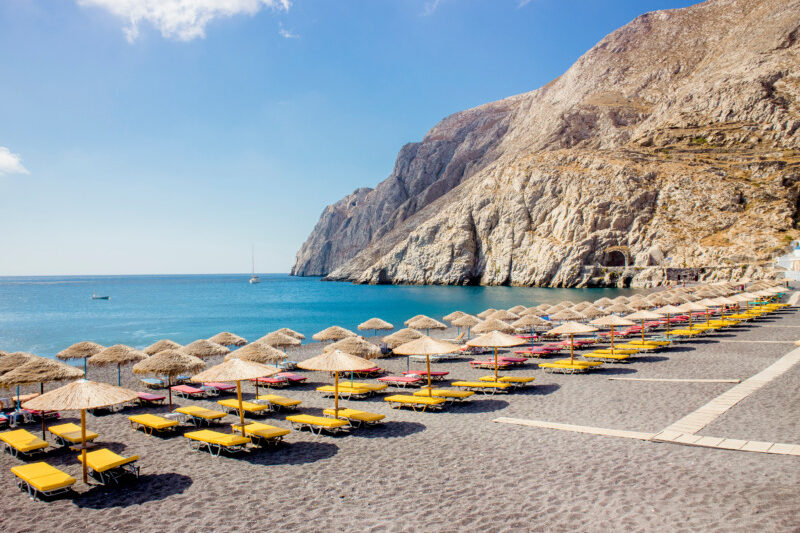
Santorini, officially Thira, is a crescent-shaped Greek island in the South Aegean’s Cyclades, ringed by dramatic cliffs that plunge to a flooded volcanic caldera roughly 12 by 7 km across. The caldera was carved by the colossal Minoan eruption around 1600 BC—one of the largest in human history—which also buried the Bronze Age town of Akrotiri, often called a “Greek Pompeii.” Today about 15,500 people live across an island of some 73 km², with the clifftop capital Fira perched near 260 m above the sea and Oia famed worldwide for its sunsets over white-washed, blue-domed houses. Visitors come for caldera views, black- and red-sand beaches such as Kamari and Red Beach, volcanic-soil wines like Assyrtiko, and boat trips to the smoldering volcanic islets at the caldera’s center. Profitis Ilias, the island’s highest point at about 367 m, crowns one of the Mediterranean’s most photographed landscapes.
Neighbourhoods
Oia, Fira, Imerovigli, Kamari
Best time to visit
Late April to June and September to October for warm weather, swimming-ready seas, and manageable crowds
Season by season
Spring (April–June):
Weather: 60–80°F, warming steadily, wildflowers
Highlights: Greek Easter (moveable date), fewer crowds, pleasant hiking
Best For: Sightseeing, hiking, ferry travel, Crete & Peloponnese
Summer (July–August):
Weather: 85–100°F, hot, dry, intense sun
Highlights: Beach season peak, Cyclades at full buzz, meltemi winds
Best For: Island hopping, beach clubs, sailing
Consider: Extreme crowds on Santorini/Mykonos; book months ahead
Autumn (September–October):
Weather: 70–85°F, warm sea, golden light
Highlights: Warm swimming, grape harvest, quieter islands
Best For: Best overall balance of weather, sea, and crowds
Winter (November–March):
Weather: 45–60°F, rain, some snow in mountains
Highlights: Athens museums, ski resorts (Arachova), fewer tourists
Best For: City breaks, budget travel, mainland road trips
Crowds
Extreme on Santorini and Mykonos in July–August; moderate in shoulder seasons; low in winter
Getting there and around
Getting there
Santorini Airport (JTR) has seasonal direct flights from European cities. Ferries from Piraeus (Athens) take 5-8 hours; high-speed ferries cut it to 4.5.
Getting around
Local KTEL buses connect Fira to Oia, Kamari, and the port. ATV/quad rental is popular but risky on narrow cliffside roads. Water taxis serve beaches in summer.
Top experiences in Santorini
Oia Village & Blue Domed Churches
Perched on the northern cliff edge of the caldera, Oia is world-famous for its labyrinth of whitewashed cave houses, cliffside infinity pools, blue-domed Orthodox chapels, and breathtaking sunset panoramas over the Aegean Sea.
Santorini Caldera
Santorini’s crescent-shaped caldera — formed by a catastrophic volcanic eruption around 1600 BC — plunges 300 m into the deep-blue Aegean. The clifftop villages of Fira, Imerovigli, and Oia cascade down the inner wall in an avalanche of whitewashed cubes with blue-domed churches. Sunset from Oia’s castle ruins is the island’s iconic moment. A boat tour reaches the volcanic hot springs and Nea Kameni islet. The Fira-to-Oia hike (10 km, 3–4 hr) traverses the caldera rim. Visit May–June or September–October to avoid peak-season crowds.
Meteora Monasteries
Six Eastern Orthodox monasteries perch atop towering sandstone pillars in central Greece, accessible via stone staircases carved into the rock and modern bridges. The monastic community dates to the 14th century; at its peak, 24 monasteries operated here. The Great Meteoron, Varlaam, and Roussanou are the most visited. The combination of sheer geology, Byzantine frescoes, and spiritual solitude is unlike anything else in Europe. UNESCO World Heritage Site. Admission ~€3 per monastery. Modest dress required. The town of Kalabaka serves as a base.
Palace of Knossos
Europe’s oldest city and centre of the Minoan civilisation (2000–1400 BC), Knossos lies 5 km south of Heraklion, Crete. The partially reconstructed palace, excavated by Sir Arthur Evans in the early 1900s, reveals a labyrinthine complex of 1,300 rooms, advanced plumbing, vivid frescoes (copies — originals in Heraklion Archaeological Museum), and the legendary Throne Room. The site is associated with the myth of the Minotaur and the Labyrinth. Admission ~€15. Visit early morning. Combine with Heraklion’s superb Archaeological Museum.
Delphi
Perched on the slopes of Mount Parnassus, Delphi was considered the centre of the world (omphalos) in ancient Greek religion. The sanctuary of Apollo housed the famous Oracle, consulted by kings and generals for centuries. Remains include the Temple of Apollo, the well-preserved 5,000-seat theatre, the stadium where the Pythian Games were held, and the Delphi Archaeological Museum with the bronze Charioteer. The mountain setting — overlooking an olive-filled valley to the Gulf of Corinth — is majestic. UNESCO World Heritage Site. Admission ~€12. Day-trippable from Athens (2.5 hr).
Editor-curated picks carried over from our original guide. Where a full place guide exists, the card links to it.


Worth booking ahead in Santorini
Hand-picked from the operators our guides already send readers to. Prices and availability are live on the partner site.
BrowseViator
Tours and tickets in Santorini on Viator (opens Viator in a new tab)
Viator's full list of bookable tours and tickets in Santorini.
BrowseGetYourGuide
Experiences in Santorini on GetYourGuide (opens GetYourGuide in a new tab)
Everything GetYourGuide sells in Santorini, with the cancellation terms on each listing.
Where to stayBooking.com
Stays in Santorini (opens Booking.com in a new tab)
Live rates and availability for Santorini on Booking.com; filter by neighbourhood once you know where your days start.
We earn a commission if you book through these links, at no extra cost to you. It is how we keep the guides free and independent.
Where to stay
Grace Hotel, Auberge Resorts Collection, Santorini
Fira 847 00, Santorini, Greece
Carved into the caldera cliff in Imerovigli, Grace Hotel Santorini commands one of the island’s most dramatic positions. Each suite features a private plunge pool overlooking the volcanic caldera and the Aegean Sea. The restaurant serves creative Greek cuisine with wines from the island’s volcanic vineyards. The infinity pool appears to merge directly with the sea hundreds of metres below. Rates €400–1,500+ per night.
Four Seasons Astir Palace Hotel Athens
Vouliagmenis Avenue, Astir Beach, 166 71 Vouliagmeni, Athens, Greece
Reopened in 2019 after a €100 million renovation, the Four Seasons Astir Palace sits on a private peninsula 25 km south of Athens. Three beaches, two outdoor pools, and a spa overlook the Saronic Gulf. The property blends mid-century Mediterranean architecture with contemporary luxury. Dining spans Greek taverna fare to Japanese tasting menus. The proximity to Cape Sounion and the Temple of Poseidon makes it a sublime base for exploring the Attica coast. Rates €500–2,000+ per night.
Blue Palace Elounda, Crete
Elounda, 720 53 Crete, Greece
This Relais & Châteaux property on Crete’s Mirabello Bay operates as a ‘living museum’ of Cretan culture. Suites and villas feature private pools and sea views. The six restaurants showcase Cretan cuisine with ingredients from the resort’s organic farm. A private beach, extensive spa, and the 9-hole Dunes course complete the picture. The resort can arrange visits to nearby Spinalonga Island and the Lasithi Plateau. Rates €350–1,200+ per night.
Editor-curated stays carried over from our original guide. Where we have reviewed the hotel, the card links to the review.
Tips from the field
Highlights
- Oia Village & Sunset Points — World-famous whitewashed village with blue-domed churches
- Santorini Caldera — Dramatic volcanic sea cliffs, cruising, and panoramic caldera hiking
- Akrotiri Archaeological Site — Exceptionally preserved Minoan Bronze Age ruins
- Red Beach (Kokkini Paralia) — Striking volcanic crimson cliffs and Aegean snorkeling
- Fira to Oia Cliff Hike — Breathtaking 10-kilometer walking trail along the caldera rim
- Volcanic Wineries — Distinctive indigenous Assyrtiko wines cultivated in woven basket vines
Best activities
- Watch sunset from Oia on Santorini
- Climb the Acropolis at dawn before the crowds
- Island-hop through the Cyclades by ferry (Mykonos, Paros, Naxos, Milos)
- Hike the 16 km Samaria Gorge in Crete
- Swim at Navagio (Shipwreck Beach) in Zakynthos
- Explore the monasteries of Meteora at sunrise
- Sail around Milos to discover Kleftiko's sea caves
- Taste wine on Santorini's volcanic vineyards
- Dive the WWII wrecks and vibrant reefs of the Aegean
- Eat a seafood meze by the harbour in a fishing village
Local experiences
- Join a cooking class in a Cretan village, visit a family-run olive press during harvest (October–November), attend a panigiri (village saint's day festival), watch the sunset from a fishing caïque, learn to dance sirtaki at a taverna, take a wine-tasting tour on Santorini's volcanic vineyards, and swim in the thermal springs at Vouliagmeni.
Practical tips
- Carry cash — many tavernas on smaller islands don't accept cards.
- Ferry schedules change seasonally — check and book via Ferryhopper.com.
- Water is safe to drink on the mainland and most larger islands.
- Greek pharmacies (green cross) are well-stocked and pharmacists can advise.
- Learn key phrases: Efcharisto (thank you), Parakalo (please/you're welcome), Yamas (cheers).
Photography tips
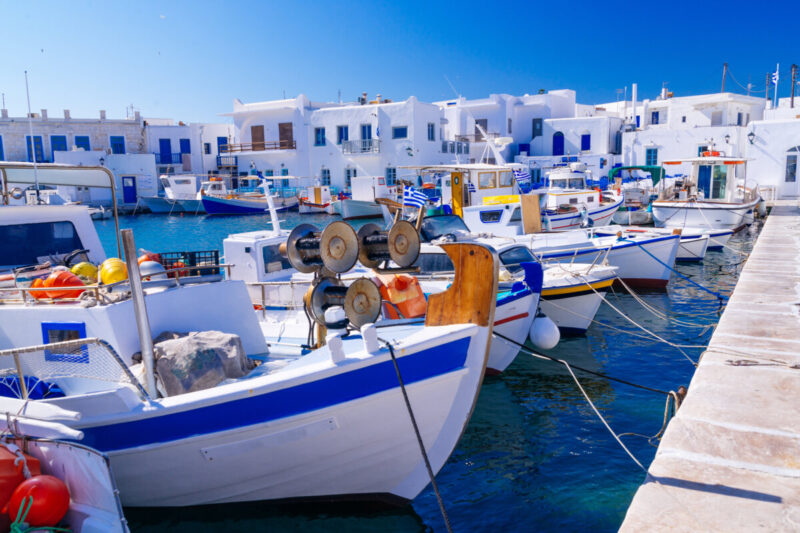
- Santorini's blue domes (Three Bells of Fira and Oia's blue-domed churches) photograph best in morning light when the sun illuminates the caldera. The Acropolis is most dramatic shot from Philopappou Hill at golden hour. Meteora's monasteries frame well from the Great Meteoron viewing platform at sunrise. Navagio Beach in Zakynthos is best captured from the clifftop viewpoint. Greek harbours with fishing boats pop against whitewashed backgrounds in afternoon light.
Timing
- Plan 2–3 days for Athens, 2–3 days for Santorini, 2–3 days for Crete, and 2 days each for other islands. A classic island-hopping trip takes 10–14 days. Add 2–3 days for Meteora and Delphi on the mainland.
Keeping it authentic
- Greek cultural traditions are lived realities, not tourist performances. The evening volta (promenade), the kafeneio (coffee house) where old men debate over backgammon, the Sunday family taverna lunch, and religious festivals (Easter is far more significant than Christmas) are authentic community rhythms. Philoxenia — the ancient Greek concept of hospitality to strangers — remains a genuine social value, particularly on the islands and in rural areas.
Culture, customs and safety
Cultural heritage
Greece is the cradle of Western civilisation — birthplace of democracy, philosophy (Socrates, Plato, Aristotle), drama, the Olympic Games, and classical architecture. The country has 19 UNESCO World Heritage Sites, including the Acropolis, Delphi, Olympia, Mystras, and the medieval city of Rhodes. Byzantine churches, Venetian fortresses, and Ottoman mosques layer atop classical ruins. Greek Orthodox Christianity shapes daily life, festivals, and the calendar. The oral tradition of rebetiko music (Greek blues) is a UNESCO Intangible Heritage.
Local customs & etiquette
Greeting with a handshake is standard. Dress modestly when visiting churches. Tipping 5-10% is appreciated in restaurants. Greeks eat late — dinner starts at 9 PM.
Safety notes
US State Department rates Greece Level 1 (exercise normal precautions). Greece is generally very safe for travellers. Pickpocketing occurs in Athens (Monastiraki, Syntagma, metro) and on crowded ferries. Bag-snatching by scooter is rare but reported. Strikes and protests occasionally disrupt transport in Athens — check local news. Greece is seismically active; familiarise yourself with earthquake procedures. Wildfire risk exists June–September. Emergency number: 112.