Current specifications and US list prices were checked on August 4, 2026, but prices, stock, colors, and product versions can change.
Our top pick is the Peak Design Everyday Backpack. It is the most useful option for travelers who want one bag for a camera, laptop, and daily essentials. The Tech Pouch is the easiest lower-cost entry into the Peak Design system, while the Camera Cube V2 adds padded camera organization to luggage you already own.
Peak Design gear costs more than many competing travel bags and camera accessories. The premium makes the most sense when you will use the brand’s fast access, configurable dividers, attachment system, weather-resistant materials, and lifetime warranty. A simpler bag may be better value if you do not need those features.
This guide combines our team’s real-world use with current product research. It is written for travelers, commuters, and travel photographers who need help choosing the right product rather than a catalog of everything Peak Design sells.
Best Peak Design Products: Quick Picks
- Choose the Everyday Backpack for the best balance of camera access, laptop storage, and daily carry.
- Choose the Tech Pouch for cables, chargers, batteries, card readers, and small travel items.
- Choose a Camera Cube V2 when you already own a comfortable suitcase, tote, or backpack.
- Choose the Travel Duffel 65L for checked gear, long road trips, or bulky equipment rather than standard carry-on travel.
- Choose the Packable Tote as a lightweight backup bag.
- Choose the aluminum Travel Tripod for better value or the carbon version when saving about 0.63 pounds matters enough to justify a $200 premium.
How We Tested and Selected These Products
This roundup draws on original photography, product demonstrations, full reviews, long-term ownership, and trip testing by the ViaTravelers team. We preserved specific field observations from the supplied article and removed claims that were generic, repetitive, or not adequately supported.
Peak Design refreshed several products in 2026. Some of our photos and videos show earlier-generation Everyday bags or accessories. Our firsthand notes still explain the carry concept and practical tradeoffs, while capacities, prices, compatibility limits, and current product descriptions below reflect the official versions available when this guide was updated.
We evaluated each product using six practical criteria:
- Usefulness during flights, road trips, city travel, hikes, or photography assignments
- Speed of access and quality of internal organization
- Comfort when the product is loaded
- Protection against impact, abrasion, and ordinary rain
- Compatibility with cameras, computers, luggage, and other Peak Design products
- Value relative to the current price and realistic frequency of use
Best Peak Design Products at a Glance
| Product | Best for | Current size or capacity | Official US price | Main drawback |
|---|---|---|---|---|
| Everyday Backpack | Best overall camera and daily backpack | 20L or 30L | $279.95 or $299.95 | Expensive and heavier than simple daypacks |
| Travel Duffel 65L | Checked gear and road trips | 65L | $179.95 | Too large for standard carry-on use |
| Travel Duffelpack 65L | Maximum-capacity backpack carry | About 45L compressed; 65L expanded | $239.95 | Large and heavy when fully packed |
| Packable Tote | Lightweight backup bag | Packs slightly larger than a deck of cards | $29.95 | Limited support for heavy loads |
| Tech Pouch | Cables and small electronics | Small or Regular | $49.95 or $59.95 | Regular size becomes bulky when full |
| Everyday Totepack | Convertible city and work carry | 20L | $189.95 | Less supportive than a dedicated backpack |
| Everyday Sling 10L | Compact mirrorless camera kits | 3L, 6L, or 10L | 10L costs $169.95 | One-shoulder carry becomes tiring |
| Everyday Messenger | Fast shoulder access for work and photography | 13L | $249.95 | Limited space and asymmetric weight |
| Camera Cube V2 | Adding camera protection to another bag | Six sizes | $49.95 to $139.95 | Uses substantial luggage space |
| Travel Tripod | Portable full-height tripod support | Aluminum or carbon fiber | $399.95 or $599.95 | High price and specialized head |
| Capture Camera Clip | Fast camera access while moving | Fits straps up to 2.5 inches wide and 0.88 inches thick | $79.95 | Can be awkward on thick, curved straps |
| Slide Lite | Mirrorless and lighter DSLR setups | Sling, neck, or shoulder carry | $69.95 | Thin webbing can become uncomfortable |
Best Peak Design Travel Bags
1. Everyday Backpack: Best Overall

Best for: Travelers who want a single backpack for a camera kit, laptop, and everyday essentials.
The current Peak Design Everyday Backpack comes in 20L and 30L versions. The 20L costs $279.95, while the 30L costs $299.95. Both use Peak Design’s MagLatch top closure, configurable FlexFold dividers, and side panels with weatherproof UltraZips.
The main advantage is access. You can open the top for ordinary daily items or reach a camera through either side without removing everything above it. The 20L is the more manageable choice for a compact mirrorless kit and daily use. The 30L gives larger lenses, extra layers, and travel gear more room, but it feels substantial when fully loaded.
Our water-beading photo shows the version we tested rather than a guarantee that the bag is waterproof. It handles routine rain better than many ordinary backpacks, but it should not be treated as submersible protection for expensive electronics.
Read our complete Peak Design Everyday Backpack review for more detail on organization, comfort, and camera access.
Pros
- Fast top and dual-side access
- FlexFold dividers adapt to camera gear or ordinary daily items
- Dedicated laptop storage and useful exterior pockets
- 20L and 30L options cover different kit sizes
Cons
- Costs considerably more than a standard daypack
- The structured body adds weight even before packing
- The 30L can feel oversized for light daily use
2. Travel Duffel 65L: Best Checked Gear Hauler

Best for: Checked camera equipment, road trips, sports gear, and longer trips that require substantial capacity.
The Travel Duffel 65L costs $179.95. Peak Design now sells the Duffel in 35L, 50L, 65L, and 80L sizes. The company positions the 35L and 50L versions as carry-on-sized bags and the 65L and 80L versions as check-in and road-trip gear haulers. Airline limits still vary, so dimensions should always be checked before departure.
The long zipper gives a clear view of the interior, while internal mesh pockets and exterior zip pockets prevent small items from disappearing into the main compartment.
Its repositionable Cord Hook handles allow hand, shoulder, or backpack-style carry. We found that system clever and versatile, although the handles can twist or come loose if they are not seated correctly.
This is not a padded camera bag by itself. Add a Camera Cube when carrying lenses or bodies. Travelers who need a smaller cabin bag should compare it with the options in our guide to the best travel duffel bags.
Our full Peak Design Travel Duffel review covers the opening, strap system, materials, and packing experience in greater depth.
Watch our video review of the bigger Peak Design Duffel in 80L of capacity.
Pros
- Large 65L capacity for bulky equipment or longer trips
- Long zip path makes the interior easy to inspect and pack
- Multiple internal and external pockets
- Repositionable handles support several carry styles
Cons
- Too large for standard carry-on use
- Requires a separate Camera Cube for padded equipment protection
- The movable handle system can be finicky
3. Travel Duffelpack 65L: Best High-Capacity Backpack

Best for: Travelers who need duffel-like capacity but prefer a backpack harness and waist belt.
The Travel Duffelpack 65L costs $239.95. Its expansion zippers allow it to carry roughly 45L in its compressed form and up to 65L when fully opened. The large main compartment, side access, stowable shoulder straps, and waist belt make it more practical to carry than a conventional 65L shoulder duffel.
This is still a large bag. It works well for vehicle-based travel, gear-heavy assignments, and trips where the bag will be checked. It is not a sensible full-size airline carry-on when expanded, and the combined weight of the pack, camera inserts, and equipment can become significant.
The interior pairs well with Peak Design Camera Cubes, packing cubes, a Wash Pouch, and a Shoe Pouch. Read our complete Peak Design Duffelpack review for a closer look at the harness, access points, and packed size.
Watch our video review testing the product here.
Pros
- Expands when extra capacity is needed
- Backpack harness and waist belt distribute weight better than a shoulder duffel
- Large opening and side access simplify packing
- Integrates well with Camera Cubes and packing tools
Cons
- Heavy and bulky when packed near its limit
- Not a standard carry-on at full expansion
- More bag than most light packers need
4. Packable Tote: Best Backup Bag

Best for: Groceries, beach gear, day trips, laundry, and overflow items on the return journey.
The Peak Design Packable Tote costs $29.95 and packs down to slightly larger than a deck of cards. Its zip closure is more secure than the open top found on many packable totes. A microfiber-padded single strap supports hand or shoulder carry, while the one-piece nylon construction minimizes seams and stress points.
It takes almost no room in a suitcase, which makes it one of the easiest Peak Design products to recommend. The tradeoff is limited structure and load support. It is suitable for clothing, snacks, shopping, and lighter daily items rather than a heavy camera kit or dense electronics.
Read our Peak Design Packable Tote review or watch our original product demonstration below. Travelers who need a structured under-seat bag should also compare our best personal item bags.
Pros
- Packs into a very small pouch
- Zip closure keeps contents more secure
- Minimal seams reduce common stress points
- Low price compared with most Peak Design gear
Cons
- Unstructured design provides little protection
- Single strap is not ideal for heavy loads
- Does not replace a purpose-built personal-item bag
5. Tech Pouch: Best Travel Organizer

Best for: Chargers, cables, batteries, memory cards, small hard drives, adapters, and everyday electronics.
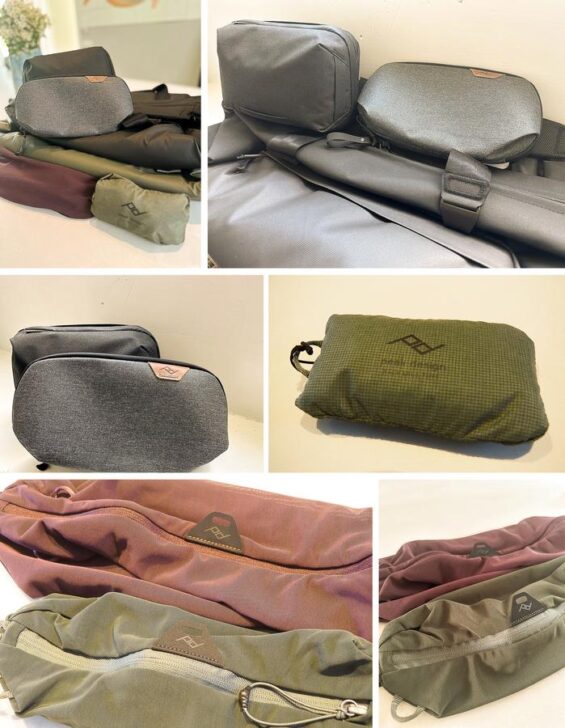
The Tech Pouch now comes in Small and Regular sizes. The Small costs $49.95, while the Regular costs $59.95. Both use layered internal pockets and elastic loops to keep small items visible instead of collecting in one compartment.
Kyle owns several Tech Pouches and uses them to separate different equipment kits. That approach works particularly well when one pouch holds computer accessories, another holds camera batteries and media, and a third remains packed for flights.
The Regular pouch can hold a surprising amount, but that capacity also makes it easy to overpack. A fully loaded pouch becomes dense and occupies a noticeable block of luggage space. The Small is the better choice for a charger, cables, cards, and a few adapters.
Our Peak Design Tech Pouch review examines the internal layout and everyday usefulness in more detail.
Watch our video review of the Peak Design Touch Pouch in regular size. We also reviewed it in small too.
Pros
- Excellent visibility and separation for small items
- Small and Regular options fit different packing styles
- Structured opening stays accessible on a desk or hotel table
- External pocket includes a charging-cable pass-through
Cons
- The Regular pouch is bulkier than its product photos suggest
- Internal organization encourages some users to pack unnecessary accessories
- Costs more than a simple zippered cable pouch
6. Everyday Totepack: Best Tote-Backpack Hybrid

Best for: Urban travel, commuting, and travelers who switch between tote and backpack carry.
The 20L Everyday Totepack costs $189.95. It combines top tote handles with stowable backpack straps, two side-access zippers, FlexFold dividers, and separate sleeves for a laptop up to 15 inches and a tablet.
The rolltop gives the bag some extra headroom when needed, while side access prevents the taller shape from becoming inconvenient. It works well for a compact camera, computer, and ordinary work items. The harness is less substantial than the one on the Everyday Backpack, so the Totepack is not our first choice for a dense camera load or hours of walking.
Pros
- Converts between tote and backpack carry
- Dual side zippers provide useful access
- FlexFold dividers support camera or everyday organization
- Dedicated laptop and tablet storage
Cons
- Backpack straps are less supportive under heavy loads
- Only one primary size is available
- The tall shape will not suit every camera configuration
7. Everyday Sling 10L: Best Compact Camera Day Bag

Best for: A mirrorless body, several compact lenses, batteries, and daily essentials.
The current Everyday Sling is available in 3L, 6L, and 10L sizes. The 10L costs $169.95. The 3L suits a minimal setup, the 6L offers a useful middle ground, and the 10L provides the most room for a larger kit and non-camera items.
The 10L uses configurable dividers, a quick-adjust shoulder strap, and exterior carry straps for a compact tripod or jacket. It is easier to access than a backpack and less cumbersome in crowded streets. The disadvantage is load concentration on one shoulder. A heavily packed 10L Sling becomes tiring sooner than a two-strap backpack.
Our photo and video may show an earlier Sling generation. The current product has been refreshed, so buyers should use the official product page for current colors, materials, and included components. Compare other carry formats in our guide to the best camera bags for travel.
Watch our hands-on Sling demonstration:
Pros
- Fast access without removing the bag
- Three sizes cover minimal and larger camera kits
- Dividers protect and separate equipment
- Exterior straps can secure a tripod or light layer
Cons
- A heavy load places sustained pressure on one shoulder
- The 10L still cannot replace a full camera backpack
- Premium price for a compact bag
8. Everyday Messenger: Best for Fast Shoulder Access

Best for: Commuters and photographers who prioritize quick access over maximum carrying comfort.
The current 13L Everyday Messenger costs $249.95. Peak Design originally developed the bag with photographer Trey Ratcliff and has since refreshed it using customer feedback.
The Messenger provides a laptop or document sleeve, configurable dividers, internal pockets, and a padded shoulder strap. It is easy to swing forward for camera access, which is useful at events, on trains, or while moving through a city.
Its 13L capacity requires disciplined packing, and the one-shoulder format becomes less comfortable as equipment weight increases. Travelers carrying a large telephoto lens, multiple bodies, or substantial clothing will be better served by a backpack.
Pros
- Fast access without setting the bag down
- Useful organization for a small camera and work kit
- Dedicated computer or document storage
- Low-profile appearance for office and city use
Cons
- Limited 13L capacity
- Heavy equipment places uneven pressure on the body
- Costs more than many larger messenger bags
Best Peak Design Camera Accessories
9. Camera Cube V2: Best Camera Insert

Best for: Travelers who already own a comfortable suitcase, tote, duffel, or backpack and need removable camera protection.
The current Camera Cube V2 comes in X-Small, Small, Smedium, Medium, Large, and X-Large sizes. Prices run from $49.95 to $139.95. Configurable dividers support cameras, lenses, drones, and video equipment, while handles and multiple openings make the cube easier to remove from a larger bag.
ViaTravelers contributor Kim Magaraci carried a Camera Cube V2 inside a Travelpro Maxlite Tote during a fall-color photography trip in Maine. The cube kept the kit organized and could be pulled out quickly during driving stops. Its side handles also made it easy to move or conceal when the equipment had to remain in the vehicle.

The V2 line uses weather-resistant materials, zippers, and seam construction, but a fabric cube is not a waterproof hard case. Choose the smallest size that holds your actual kit. An oversized cube adds unused bulk and consumes luggage space that could hold clothing or other travel items.
Compare other protection formats in our guide to travel cases for camera gear.
Watch our video review of the camera cube from when we tested the product.
Pros
- Turns ordinary luggage into a configurable camera bag
- Six sizes cover compact and professional kits
- Removable dividers support different equipment layouts
- Multiple handles improve access inside larger bags
Cons
- Larger sizes occupy substantial luggage space
- Costs more than basic padded inserts
- Does not provide hard-shell or submersible protection
10. Travel Tripod: Best Premium Tripod for Travel

Best for: Photographers who want full tripod height and load capacity in a narrow packed shape.
The Peak Design Travel Tripod costs $399.95 in aluminum and $599.95 in carbon fiber. Both deploy to 60 inches and are rated for equipment weighing up to 20 pounds. The aluminum model weighs about 3.44 pounds, while the carbon model weighs about 2.81 pounds.
The carbon version therefore saves about 0.63 pounds for a $200 premium. That tradeoff makes sense for frequent hikers, airline travelers, and photographers who count every ounce. The aluminum model provides the same basic layout and is the better value for most buyers.
Our team tested both versions. Kim carried the aluminum tripod to the summit of Cadillac Mountain in Acadia National Park. Despite wind on the exposed granite, the resulting frames showed no visible tripod shake, and the feet held securely on the rock.

The compact ball head and narrow packed diameter are the main reasons to buy it. Photographers who require an independent pan lock, a conventional head, spike feet, or specialized mounting hardware should budget for additional accessories or compare other tripod systems.
Read our full Peak Design Travel Tripod review for setup details and a closer comparison of the two materials.
Pros
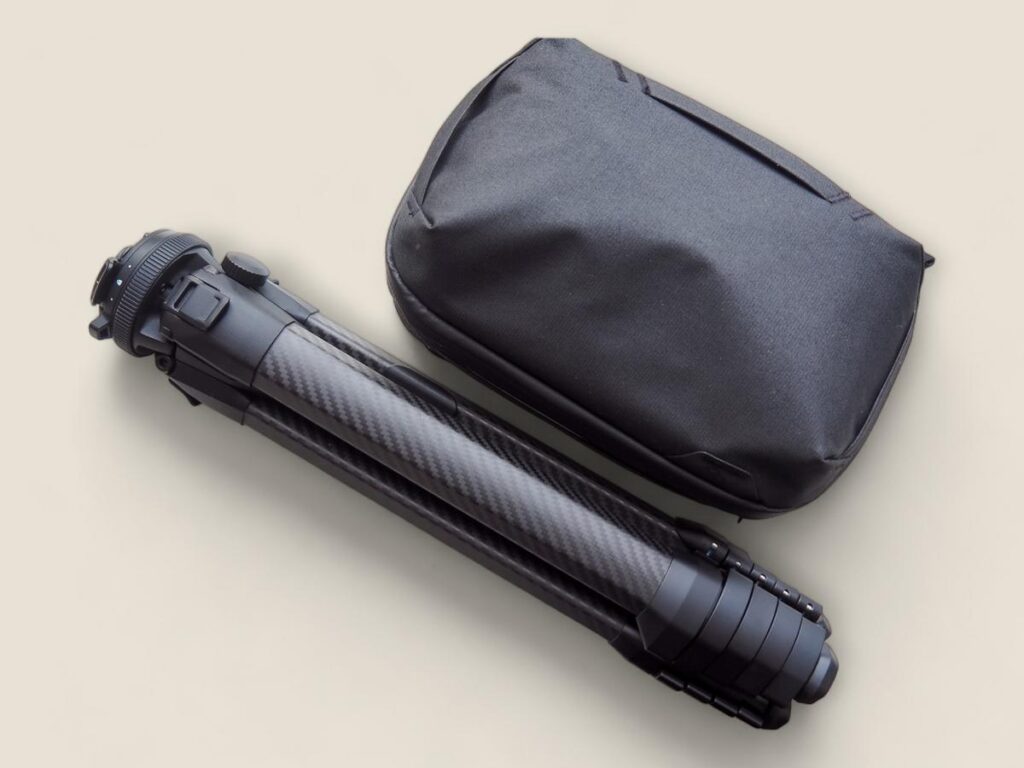
- Packs to roughly the diameter of a water bottle
- Reaches 60 inches despite its narrow packed shape
- Quick leg deployment and compact integrated ball head
- Aluminum and carbon versions share the same basic design
Cons
- Both versions are expensive
- Carbon fiber costs $200 more for a 0.63-pound reduction
- No independent pan lock
- Some specialized accessories cost extra
11. Capture Camera Clip: Best for Fast Camera Access

Best for: Hikes, events, street photography, and assignments where a camera must remain accessible without hanging from a neck strap.
The current Capture Camera Clip costs $79.95. It attaches to a belt or bag strap up to 2.5 inches wide and 0.88 inches thick. A compatible camera plate locks into the clip and releases using a side button.
Kim keeps a Capture Clip on a hiking backpack for much of the year. It is straightforward to fit on ordinary webbing, but thick, curved, or heavily padded shoulder straps can take more effort even when their measurements fall within the stated limit.

The clip keeps a camera more stable than a loose neck strap, but the camera’s weight still transfers into the belt or backpack strap. A large body and long lens can pull on the harness or become uncomfortable during extended wear. For scrambling, running, or highly technical movement, we prefer to secure the camera inside a pack.
Our product photos and long-term observations may show the previous Capture generation. Use the official page for current hardware, fit measurements, colors, and included plate details.
Pros
- Camera remains visible and accessible
- Release button supports quick removal
- Works on many belts and backpack straps
- Useful when carrying a second camera body at events
Cons
- Installation can be difficult on thick or contoured straps
- Heavy cameras can distort a backpack harness
- Exposed equipment remains vulnerable to impacts and weather
12. Slide Lite Camera Strap: Best Versatile Strap

Best for: Mirrorless cameras and lighter DSLR setups that need quick adjustment between sling, shoulder, and neck carry.
The Peak Design Slide Lite costs $69.95. Two quick-pull adjusters change the strap length while the Anchor Link system allows it to be removed or reconfigured in seconds.
Kim has used a Slide Lite for at least three years without encountering anchor or webbing failure. The narrow strap remains unobtrusive and packs more easily than a thick padded camera strap. That same thin profile can become uncomfortable after several hours, particularly with a heavier lens.

The photo above shows Peak Design’s shared Anchor Link connection on a Leash strap rather than the Slide Lite itself. The connection concept is the same. Inspect the replaceable anchors periodically and follow Peak Design’s wear guidance rather than waiting for visible damage to become severe.
Pros
- Quickly converts between three carry positions
- Length adjusts without removing the strap
- Anchor Links make it easy to remove or swap straps
- Low-profile webbing packs easily
Cons
- Thin webbing can create pressure during long sessions
- Less comfortable with a heavy body and large lens
- Replaceable anchors require periodic inspection
Current Peak Design Products We Have Not Ranked Yet
Peak Design has expanded its catalog since this roundup was first published. Current additions include the Travel Backpack in 20L, 30L, and 45L sizes, the modular Travel Backpack 2-in-1, the Roller Pro Carry-On, and the lighter City Backpack line.
We have not inserted those products into the numbered ranking without documented ViaTravelers testing, original photos, or a full review. Their omission should not be interpreted as a negative verdict. It reflects a decision to keep the ranking tied to evidence rather than current launch activity.
How to Choose the Right Peak Design Product
Start With the Carry Problem
Choose the product according to the task it must perform. The Everyday Backpack is built around frequent camera access. The Travel Duffel and Duffelpack prioritize capacity. The Sling and Messenger emphasize fast access. A Camera Cube adds protection to a bag you already like, while a Tech Pouch organizes small items rather than carrying an entire travel setup.
Peak Design may be unnecessary when a basic compartment and ordinary zipper already solve the problem. Compare the wider market in our guides to the best travel backpacks and best travel accessories before committing to a complete system.
Match Capacity to the Actual Trip
More capacity creates room for extra equipment, but it also encourages overpacking. Lay out the camera bodies, lenses, computer, chargers, clothing, and personal items you normally carry. Choose the smallest product that accommodates that load without forcing closures or stacking fragile equipment.
Capacity in liters does not determine airline compliance. Exterior dimensions, expansion, pockets, and an airline’s specific rules matter. The 65L Duffel and expanded Duffelpack belong in the checked-luggage or road-trip category.
Account for the Space Used by Camera Protection
A padded Camera Cube protects equipment by using foam, dividers, and structure. That protection reduces the space available for clothing. Test the intended cube inside the intended bag before a long trip, particularly when combining a large cube with a personal-item or carry-on limit.
Consider Weight Distribution
A Sling or Messenger offers faster access, while a backpack distributes weight across both shoulders. The difference becomes more important as lenses, computers, batteries, and water add weight. The largest available bag is rarely the most comfortable choice for a long walking day.
Treat Weather Resistance as a Backup
Peak Design uses weather-resistant fabrics and weatherproof components across much of its range. Those features help during ordinary rain and splashes. They do not turn a soft bag into a waterproof case. Use an additional rain cover, dry bag, or hard case when conditions or equipment value justify it.
Include the Warranty in the Value Calculation
Peak Design’s lifetime warranty covers manufacturing defects and failures that make all or part of a product nonfunctional. It does not cover cosmetic wear, stains, scratches, misuse, neglect, accidents, intentional damage, lost items, or stolen equipment. Factory 2nd products are also excluded from the standard lifetime coverage.
The warranty adds real value when a product will receive years of regular use. It does not automatically make an expensive item a sensible purchase when a cheaper product already meets the same need.
Peak Design and Sustainability

Peak Design’s 2024 Annual Impact Report states that the company has measured and offset its full carbon footprint since its beginning. The report identifies Scope 3 activities, including purchased goods, energy, and transportation, as 99.95% of its reported 2024 emissions. That concentration is typical of a company whose impact largely occurs through materials, manufacturing, and logistics rather than its offices.
The company also reports giving at least 1% of revenue to environmental organizations through 1% for the Planet, with more than $5.8 million contributed through the reporting period. Its current materials targets include greater use of recycled fabrics, recycled aluminum, Bluesign-approved fabrics, and solution-dyed textiles.
The independent Change Climate profile for Peak Design confirms a current certification year of 2025 and reports both climate-project funding and stated reduction plans.
These programs do not make a manufactured product impact-free. Carbon credits and external projects are different from eliminating supply-chain emissions. A practical buyer should also consider product lifespan, repair, warranty support, refurbished inventory, secondhand availability, and the likelihood that the item will be used for many years. Keeping one functional bag in service is usually preferable to replacing several marginal upgrades.
Frequently Asked Questions
What is the best Peak Design product for travel?
The Everyday Backpack is our best overall choice for travelers who carry a camera, laptop, and daily essentials. The Tech Pouch is the best lower-cost organizer, while the Camera Cube V2 is the better choice when you already own a comfortable bag.
Are Peak Design products worth the price?
They can be worth the price when you regularly use the fast access, configurable dividers, attachment system, weather-resistant construction, and lifetime warranty. A simpler bag is usually better value when you only need basic storage.
Is the Peak Design Travel Duffel 65L a carry-on bag?
No. Peak Design positions the 65L and 80L Duffels for airline check-in and road trips. The company describes the 35L and 50L versions as carry-on-sized, but travelers must still confirm the limits of their airline and ticket.
Are Peak Design bags waterproof?
Peak Design uses weather-resistant fabrics and weatherproof components, but its soft bags should not be treated as submersible waterproof cases. Add a rain cover, dry bag, or hard case when conditions require greater protection.
What does the Peak Design lifetime warranty cover?
The warranty covers manufacturing defects and failures that make a product nonfunctional. It excludes cosmetic wear, stains, scratches, misuse, neglect, accidents, intentional damage, apparel, Factory 2nd products, and lost or stolen items.
Which Peak Design Everyday Sling size should I buy?
Choose 3L for a minimal camera setup, 6L for a compact general-purpose kit, and 10L when you need additional lenses or daily items. Confirm the fit using your actual camera and largest lens before buying.
Which Peak Design Product Should You Buy?
The Everyday Backpack is the strongest all-around choice for travelers who regularly carry camera gear and a computer. The Tech Pouch offers the easiest entry point for anyone who mainly needs better organization. A Camera Cube V2 makes more sense than a new backpack when you already own luggage that carries comfortably.
Choose the 65L Duffel or Duffelpack only when you genuinely need checked-bag capacity. Choose the aluminum Travel Tripod for value and the carbon version when reducing pack weight is worth the extra $200. The Sling, Messenger, Capture Clip, and Slide Lite are more specialized purchases whose value depends on how often you need immediate camera access.
Peak Design earns its premium through thoughtful access, modular organization, and long-term support. Those benefits are useful, but they should solve a specific carry problem before they justify replacing equipment that already works.