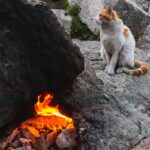
Yanartaş—also called the Chimaera flames or Turkey’s flaming rocks—is a group of natural gas vents on a rocky slope above Çıralı in Antalya Province. It is on the Lycian coast, not in Cappadocia. Visitors reach the flames by a 30–40-minute climb on stone steps, and the site is most striking after sunset.
This guide explains where Yanartaş is, why the rocks burn, how difficult the trail is, how to arrange transport, what to bring, and which details to verify before you go.

Yanartaş at a Glance
| Planning point | What to know |
|---|---|
| Location | Above Çıralı in Kemer district, Antalya Province, on Turkey’s Mediterranean coast |
| What you see | Small open flames sustained by gas escaping through fractured rock |
| Walk from the entrance | About 30–40 minutes uphill on stone steps and uneven ground |
| Best timing | Arrive before sunset, then stay until the flames stand out after dark |
| Time to allow | About 1.5–2 hours for the round trip and time at the flame field |
| Admission and hours | Paid entry; verify the current fee and last-entry time on the day of your visit |
| Accessibility | Not wheelchair- or stroller-accessible; the route involves sustained stairs and rough stone |
| Cable car | None. The nearby Olympos Teleferik serves Tahtalı Mountain, not Yanartaş |
Current-information note: Kemer Municipality confirms that admission is charged, but its visitor page does not publish a live tariff or current gate hours. Independent 2026 listings conflict. Verify the fee, payment method, and last entry with your accommodation or the entrance before making a late-evening trip. Last verified July 15, 2026.
Key Takeaways
- Yanartaş is near Çıralı and Olympos in Antalya Province, not in Cappadocia.
- The walk is short but steep enough to require closed-toe shoes, water, and a proper flashlight.
- Climb while there is still daylight and plan the descent for darkness.
- There is no cable car to the flames, and the site is not an inactive volcano.
- Do not cook over, add fuel to, relight, or otherwise manipulate the vents.
In This Guide
- What Yanartaş is and where it is
- Why the flames burn
- The Chimaera myth
- How to get to Yanartaş
- What the hike is like
- Best time to visit
- Admission fees and hours
- What to bring
- Safety and responsible visiting
- A practical one-day itinerary
- Places to visit nearby
- Where to stay
- Frequently asked questions
What Is Yanartaş, and Where Is It?
Yanartaş means “burning stone” in Turkish. The site is also called Chimaera, Chimera, Khimaira, or Mount Chimaera in English-language travel material. These names refer to the same flame field above the village of Çıralı.
Yanartaş sits within Olympos-Beydağları Coastal National Park in Kemer district, Antalya Province. Kemer Municipality places it about 1 kilometer from Çıralı Beach and roughly 250 meters above sea level. The area is also on a branch of the Lycian Way and has been designated a strictly protected sensitive area.
For regional trip planning, use the ViaTravelers Antalya travel guide and Turkey travel guide. For the site’s protected status and official location context, see Kemer Municipality’s Yanartaş notice.
Yanartaş is not in Cappadocia. Çıralı is on the Mediterranean coast, several hundred kilometers from Cappadocia’s Göreme area. The underground cities and fairy chimneys of Cappadocia do not belong in a Yanartaş itinerary.
There is also no cable car to the flames. The cable car often marketed as “Olympos Teleferik” climbs Tahtalı Mountain elsewhere in the national park. GoTürkiye’s Mediterranean national parks guide distinguishes Tahtalı Mountain from Yanartaş.
Why Do the Flames at Yanartaş Burn?
The flames are fed by gas escaping through fractures in an ophiolite outcrop; they are not evidence of an inactive volcano. Ophiolite is rock from ancient oceanic crust and the upper mantle that was pushed onto land by tectonic processes.
A peer-reviewed 2011 study found that gas samples from the Chimaera seep were composed mainly of methane, at about 87% by volume, and hydrogen, at about 10%, with smaller amounts of other gases. The researchers linked most of the methane to low-temperature serpentinization, a water-rock reaction involving ultramafic rock, while also identifying a smaller thermogenic component.
The study described vents issuing through fractures across an ophiolite outcrop of about 5,000 square meters and estimated that the seep releases at least 150–190 metric tons of methane per year. Continuous gas flow sustains the visible flames once the gas is burning. Read the Earth and Planetary Science Letters study for the full geochemical analysis.

The 2,500-year description refers to the long-lived seep system documented in ancient and modern accounts, not a claim that every individual flame has occupied the same exact spot continuously.
The Chimaera Myth Behind Yanartaş

In Greek mythology, the Chimaera was a fire-breathing creature commonly described with a lion’s head, a goat’s body, and a serpent’s tail. The hero Bellerophon, riding the winged horse Pegasus, defeated the creature. Local tradition interprets the flames at Yanartaş as the monster’s breath continuing below the mountain.
Kemer Municipality recounts this story in its official Yanartaş overview. The Metropolitan Museum of Art also summarizes the broader Bellerophon and Chimaera myth.
Regional retellings sometimes connect the flame to ancient torch races or the origin of the Olympic fire. Treat that as local legend rather than settled Olympic history. The stronger historical point is that the flames were known in antiquity and became part of the region’s religious and mythological landscape.
How to Get to Yanartaş
The practical destination is the Yanartaş entrance above Çıralı, not a mountain summit or cable-car station. Search your navigation app for “Yanartaş” or “Chimaera” and confirm that the route ends near Çıralı in Kemer district.
By Car
From Antalya or Kemer, follow the D400 west toward Kumluca, take the signed turn for Çıralı, and continue through the village toward the Yanartaş entrance. Plan roughly 1.5 hours from central Antalya in normal conditions. Kemer Municipality describes the drive from Kemer as about one hour. Traffic and the final winding road can extend either estimate.
The entrance area is where the vehicle portion ends. From there, everyone continues on foot. Do not follow directions for Olympos Teleferik; that is a different attraction.
By Public Transport
Public transport is possible but requires more planning, especially for an after-dark return. From Antalya, first reach the main bus station. Regional buses and minibuses traveling west toward Kumluca, Finike, or Kaş may stop at the Çıralı junction on the D400, but services and stopping patterns change. Confirm the stop with the operator before boarding.
The highway junction is not the Yanartaş entrance. Arrange a local shuttle, taxi, or accommodation transfer for the final road into Çıralı and onward to the trailhead. Check municipal connections and current fare information through the Antalya Transport Department, then verify regional and evening services locally.
Do not begin the hike without a return plan. The flames are best after dark, when public transport is less frequent and the walk back to your lodging may be poorly lit.
Self-Guided Visit or Guided Tour?
| Option | Best for | Advantages | Tradeoffs |
|---|---|---|---|
| Self-guided | Travelers staying in Çıralı or driving themselves | Flexible timing and more control over sunset arrival | You must handle navigation, parking, admission, and the return after dark |
| Guided group tour | Travelers based in Kemer or Antalya without a car | Transport and night return are usually organized | Time at the flames may be limited; group pace may not suit slower hikers |
| Private tour or transfer | Families, small groups, or travelers with a fixed schedule | Flexible pickup and easier coordination with Olympos or Phaselis | Higher cost; confirm exactly what admission and waiting time are included |
Affiliate disclosure: ViaTravelers may earn a commission from qualifying bookings at no extra cost to you. Before booking, compare the pickup area, time allowed for the hike, admission inclusions, meal stops, and return time.
What Is the Yanartaş Hike Like?
Kemer Municipality estimates a 30–40-minute climb from the entrance. The route uses stone stairs and rough sections rather than a smooth paved walkway. It is a moderate short hike for a reasonably mobile traveler, but the sustained ascent, heat, and dark descent make it more demanding than the distance suggests.
- Footing: Expect irregular steps, loose stones, and uneven rock.
- Lighting: Carry a headlamp or strong flashlight for the descent; a phone light is a weak backup.
- Mobility: The trail is not suitable for wheelchairs or strollers. Travelers with knee, balance, heart, or respiratory concerns should assess the climb conservatively.
- Children: Children who can manage sustained stairs may be able to complete the route, but they need close supervision around darkness, uneven ground, and open flames.
- Pace: Allow slower hikers to start before sunset rather than rushing uphill in fading light.
This is a visitor trail, not a technical mountain climb. Do not confuse it with a full ascent of Tahtalı Mountain or a longer Lycian Way stage.
Best Time to Visit Yanartaş
The best strategy is to arrive at the entrance about 30–45 minutes before sunset. You can climb while the trail is still visible, watch the flames become more distinct as daylight fades, and descend with a flashlight.
The flames are present during the day, but Turkey’s Culture Portal notes that they are much easier to see at night. Avoid starting too late: gate access may be restricted, and a rushed dark ascent adds unnecessary risk.
- Spring and autumn: Usually the most comfortable balance of temperature and daylight for the climb.
- Summer: Favor evening hours, carry more water, and avoid climbing during peak heat.
- Winter and wet weather: Cooler conditions can be pleasant, but rain can make stone steps slippery. Check the forecast and local access conditions.
Before leaving, check the local forecast from the Turkish State Meteorological Service.
Yanartaş Admission Fees and Opening Hours
Yanartaş charges admission, but the current price and last-entry time should be treated as same-day information. Kemer Municipality confirms paid entry but does not publish a live fee schedule or current hours on its visitor page.
As of July 15, 2026, independent listings showed conflicting prices and inconsistent implications about late-night access. For that reason, this guide does not present an exact fee or a guaranteed closing time. Ask your accommodation, tour operator, or the entrance directly before traveling, especially outside the main summer season.
- Carry Turkish lira as a backup even if card payment is expected.
- Ask whether the quoted time is the gate closing time or the final admission time.
- Do not plan a very late arrival unless the gate has confirmed access.
- Check whether a tour price includes Yanartaş admission.
What to Bring to Yanartaş
- Headlamp or strong flashlight: Keep your hands free and pack spare batteries if your light is not rechargeable.
- Closed-toe walking shoes: Choose footwear with grip; skip flip-flops and smooth-soled sandals.
- Water: Carry enough for the climb, time at the flames, and descent.
- Light layer: The slope can feel cooler after sunset, particularly outside midsummer.
- Charged phone and power bank: Save an offline map and your driver or accommodation contact details.
- Small first-aid kit and insect repellent: Useful for a rocky evening walk in a wooded Mediterranean setting.
For additional packing ideas, see the ViaTravelers adventure travel gear checklist. Keep the day pack light enough that it does not affect your balance on the stairs.
Safety and Responsible Visiting
Yanartaş is a protected natural site, not an outdoor kitchen or an interactive fire display. Old guides sometimes encourage visitors to roast food over the vents. Do not follow that advice. Cooking, adding fuel, moving stones, or relighting vents can damage the site, create litter, and put other visitors at risk.
| Do | Avoid |
|---|---|
| Stay on the established steps and paths | Cutting across unstable slopes or vegetation |
| Keep a safe distance from flames and hot rock | Touching vents, moving stones, or trying to enlarge a flame |
| Carry out every item you bring | Leaving food, skewers, bottles, or biodegradable waste |
| Use a flashlight on the mountain trail | Shining bright lights across turtle-nesting beach areas |
| Follow current signs and staff instructions | Relying on old blog posts for rules, fees, or access times |
If you combine Yanartaş with Çıralı Beach, remember that Çıralı is a loggerhead sea-turtle nesting beach. GoTürkiye identifies the main nesting period as May through August. Stay away from marked nests, limit light near the beach after dark, and follow current local signs.
These choices align with broader sustainable travel practices: use established routes, minimize waste, respect protected habitat, and leave the site unchanged.
A Practical Olympos, Çıralı, and Yanartaş Itinerary
Yanartaş works best as the final stop in a day around Çıralı rather than as an isolated out-and-back trip from Antalya.
- Morning: Explore Olympos. Walk the forested ruins before the hottest part of the day. Confirm current archaeological-site hours and admission through the Antalya Provincial Culture and Tourism Directorate.
- Midday: Swim or rest at Çıralı Beach. Use marked access points and respect protected nesting areas.
- Late afternoon: Eat in Çıralı and organize the return. Confirm your driver, taxi, or accommodation transfer before leaving for the trailhead.
- Before sunset: Start the Yanartaş climb. Give slower walkers extra time and carry a real flashlight.
- After dark: View the flames, then descend carefully. Do not stay so late that you risk missing a confirmed gate or transport cutoff.
From central Antalya, this becomes a long full-day outing. Staying in Çıralı reduces transport risk and lets you choose a calmer sunset window.
Places to Visit Near Yanartaş
| Place | Why pair it with Yanartaş | Planning note |
|---|---|---|
| Olympos Ancient City | Lycian, Roman, and Byzantine ruins in a forested river valley beside the coast | Check current archaeological-site hours and admission before arrival |
| Çıralı Beach | The closest beach base and a practical place to spend the afternoon before the sunset hike | Respect marked loggerhead turtle nesting zones |
| Phaselis Ancient City | A coastal archaeological site with three historic harbors | It is north of Çıralı; allow a separate stop rather than squeezing it into late afternoon |
| Tahtalı Mountain | High-elevation views reached by Olympos Teleferik | The cable car does not connect to Yanartaş |
| Adrasan | A beach and boat-trip base within the same national-park region | Best added with an overnight stay or a separate day |
For official context, see Kemer Municipality’s Phaselis overview and GoTürkiye’s Beydağları Coastal National Park guide.
Where to Stay for a Yanartaş Visit
| Base | Best for | Tradeoff |
|---|---|---|
| Çıralı | The easiest sunset visit, beach access, and a short local transfer to the trailhead | Fewer large-resort services than Kemer or Antalya |
| Olympos | Budget stays, social accommodation, and access to the ruins | Confirm late transport to and from the Yanartaş entrance |
| Kemer | Resorts, organized excursions, and broader visitor services | About an hour from Yanartaş by road before the hike |
| Antalya | Travelers combining Yanartaş with an Antalya city stay | The longest evening logistics; a guided tour or private transfer is often simpler |
Choose accommodation based on the return trip, not just the daytime map. A property in Çıralı that can confirm current gate information and arrange a transfer may be more useful than a cheaper room far from the trailhead.
Yanartaş FAQs
Where are the flaming rocks in Turkey?
The flaming rocks are at Yanartaş above Çıralı in Kemer district, Antalya Province, on Turkey’s Mediterranean coast. They are not in Cappadocia.
Is Yanartaş the same as Mount Chimaera?
Yes. Yanartaş is the natural flame site commonly called Chimaera, Chimera, or Mount Chimaera in English-language travel material.
Why do the rocks at Yanartaş burn?
Gas rich in methane and hydrogen escapes through fractures in serpentinized ophiolite rock and sustains open flames at the surface. Yanartaş is not an inactive volcano.
How difficult is the Yanartaş hike?
Allow about 30–40 minutes uphill on irregular stone steps. It is a moderate short hike for mobile travelers, but heat, loose footing, and a dark descent add difficulty.
What is the best time to visit Yanartaş?
Arrive 30–45 minutes before sunset, climb in daylight, and stay until the flames become clearer after dark. Carry a headlamp or strong flashlight for the descent.
Can you visit Yanartaş without a tour?
Yes. A self-guided visit is straightforward if you have transport to the entrance and a reliable return plan after dark. A tour is more practical from Kemer or Antalya without a car.
How much is Yanartaş entry, and what are the opening hours?
Admission is charged, but the official municipal visitor page does not publish a live fee or current gate hours. Verify both on the day of your visit, especially before a late arrival.
Is there a cable car to Yanartaş?
No. The Olympos Teleferik cable car goes to Tahtalı Mountain, a separate attraction elsewhere in the national park.
Plan the Visit Around Sunset, Not Guesswork
Yanartaş is worth the climb because it combines unusual geology, Lycian landscape, and a myth that has shaped the site’s identity for centuries. The practical plan is simple: stay near Çıralı when possible, verify the current gate details, start before sunset, carry a proper light, and leave the flame field exactly as you found it.