Argostoli is the administrative and commercial capital of Kefalonia, the largest of the Ionian Islands, situated on the western shore of a sheltered lagoon formed by the Koutavos inlet. The town was largely rebuilt after the devastating 1953 earthquake and retains a grid-street layout with neoclassical-influenced architecture, a palm-lined central square, and a working port used by local ferries and fishing boats. Visitors use Argostoli as the main base for exploring the island while finding genuine daily life, fresh seafood, and island history concentrated within walking distance.
What is Argostoli known for?
Argostoli is best known as Kefalonia’s commercial hub and for the Drapano Bridge, an early 19th-century stone causeway roughly 900 metres long that spans the lagoon and carries road traffic between the town and the Paliki peninsula road network; the town is also famous for sea turtles (Caretta caretta) that regularly surface in the harbour lagoon and for the sea swallow phenomenon of seawater disappearing into sinkholes called katavothres near the lighthouse at Agios Theodoros.
- Drapano Bridge (De Bosset Bridge), the longest stone bridge over salt water in Greece
- Koutavos lagoon, a protected wetland hosting waterbirds and loggerhead sea turtles
- Katavothres seawater sinkholes at the northern tip of the peninsula
- Agios Theodoros Lighthouse, reconstructed after 1953, marking the lagoon entrance
Best things to do in Argostoli
The single most rewarding activity in Argostoli is walking the full length of the waterfront esplanade along Ioannou Metaxa street from the port quay to the De Bosset Bridge at dawn or dusk, when sea turtles are most visible near the fishing boats and the Koutavos wetland path is quiet enough to spot herons and egrets.
- Visit the Korgialenio History and Folklore Museum on Ilia Zervou street for earthquake-era photographs and island artifacts
- Explore the Archaeological Museum of Argostoli on Rokou Vergoti street for Mycenaean and Classical finds from Kefalonia
- Walk the Koutavos lagoon nature trail, a signposted loop on the eastern shore of the inlet
- Watch the daily fish auction and browse the central produce market on and around Plateia Valianou
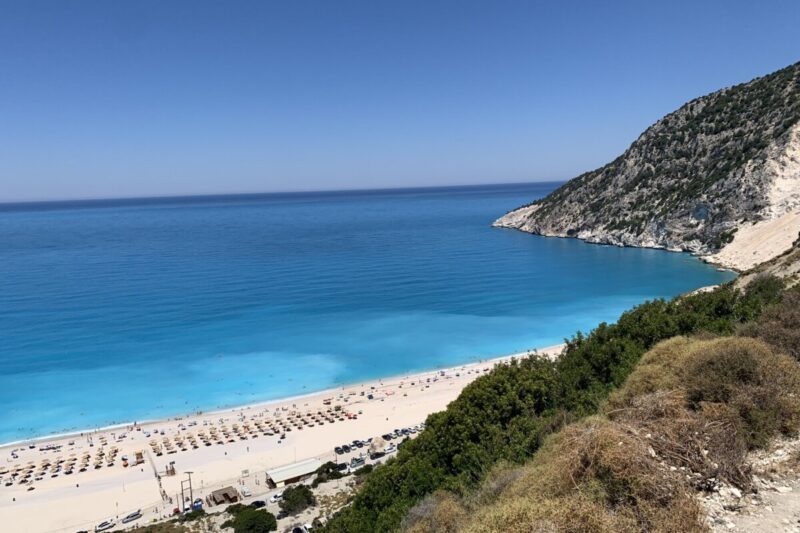
- Day-trip to Myrtos Beach, Melissani Cave, and Assos village using Argostoli as the base
Where to eat in Argostoli
The port-side tavernas and esplanade restaurants along Ioannou Metaxa and the lanes immediately behind it serve local Kefalonitan dishes including kreatopita (meat pie with rice and kefalotiri cheese), bourdeto (spicy fish stew), and fresh grilled fish weighed to order, with the morning fish market on the quayside supplying many kitchens directly.
- Plateia Valianou, the main square, is lined with cafes for Greek coffee and loukoumades
- Tavernas near the port quay specialise in freshly caught bream, sea bass, and octopus
- Local bakeries on Lithostroto pedestrian street sell Kefalonitan meat pie by the slice
- Robola wine from the Robola Cooperative of Kefalonia is the island’s signature white and widely available
Where to walk in Argostoli
The primary walking route is along Lithostroto, the pedestrianised shopping street running through the town centre parallel to the waterfront, which connects Plateia Valianou to the residential neighbourhoods and small churches including the Catholic Church of Agios Nikolaos and leads toward the hilltop Kiani Akti area with lagoon views.
- Waterfront esplanade: port quay north along Ioannou Metaxa to De Bosset Bridge
- Koutavos lagoon trail: signposted path encircling the eastern wetland shoreline
- Lithostroto pedestrian street: town-centre shopping and cafe lane
How to get to Argostoli
Argostoli is reached by air via Kefalonia International Airport (EFL), located approximately 9 kilometres south of town, with seasonal direct flights from Athens (operated by Sky Express and Olympic Air) and international charter services; ferry connections run from Killini on the Peloponnese mainland and from Lixouri across the lagoon to the Argostoli port.
- Kefalonia International Airport (EFL), 9 km south, taxi or hire car required
- Ferry from Killini (Peloponnese) to Argostoli port, operated by Levante Ferries
- Local ferry crossing between Argostoli and Lixouri across the lagoon, frequent daily service
- KTEL Kefalonia buses connect Argostoli to Sami, Poros, Fiskardo, and Skala from the central bus station
Best time to visit Argostoli
May, June, and September offer the most comfortable conditions for exploring Argostoli and the wider island, with warm temperatures between 22–28 °C, reduced crowds compared to July and August, and full operation of ferries, museums, and tavernas, while the loggerhead sea turtle nesting season (June through August) makes summer visits particularly rewarding for wildlife observation in the harbour.