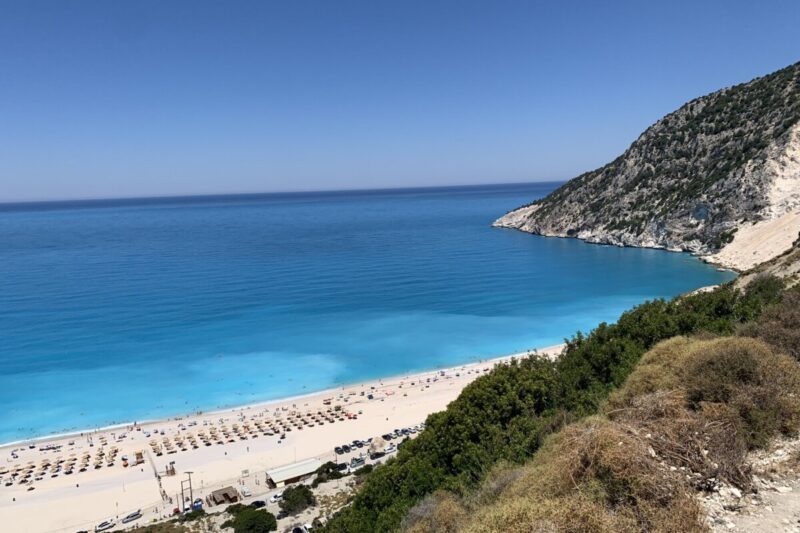
Assos sits on a narrow isthmus on the northwest coast of Kefalonia, connecting the mainland of the island to a wooded peninsula topped by a 16th-century Venetian fortress. The village wraps around a sheltered bay whose water shifts from emerald to deep turquoise, and the entire settlement is compact enough to explore on foot in under an hour. Rebuilt largely after the 1953 earthquake that devastated much of Kefalonia, Assos retains a quiet, unhurried character distinct from the busier resort towns to the south.
What is Assos known for?
Assos is best known for the Venetian Castle of Assos, a large fortified complex built by the Venetians in 1593 on the peninsula hill above the village, for its exceptionally clear turquoise bay, and for being one of the few northwest Kefalonian settlements that preserved a coherent village atmosphere after the 1953 earthquake. The castle walls and interior ruins are freely accessible via a footpath and cover a substantial area with panoramic views of the Ionian Sea. The village square shaded by plane trees and the colourful neoclassical houses lining the harbour are also frequently cited as among the most photogenic scenes in Kefalonia.
Best things to do in Assos
Climbing to the Castle of Assos is the single most rewarding activity, taking roughly 20–30 minutes on foot from the village along a signed dirt-and-stone path through pine and cypress forest, with the ruined Venetian walls, a small church of San Marco inside the complex, and sweeping coastal views at the top. Beyond the castle, visitors can swim directly from the rocks and small pebble patches around the isthmus, explore the village lanes on foot, and sit at the waterfront square to watch fishing boats in the harbour.
- Walk the isthmus path to the Venetian Castle of Assos
- Swim in the sheltered bay on either side of the isthmus
- Stroll the harbour-front and the village’s narrow back lanes
- Visit the small church inside the castle complex
- Watch the sunset from the castle ramparts over the Ionian Sea
Where to eat in Assos
Assos has a small cluster of tavernas and cafés concentrated around the main plateia and the waterfront, serving standard Greek island fare including fresh grilled fish, mezedes, and Kefalonían specialities such as kreatopita (meat pie) and locally produced Robola wine. The dining scene is intimate and informal; most establishments are family-run and menus reflect the day’s catch. Booking ahead in peak summer is advisable given the village’s small size.
- Grilled fresh fish and seafood at waterfront tavernas
- Kreatopita (Kefalonían spiced meat pie) at local eateries
- Robola white wine, produced in the Omala Valley, Kefalonia
- Greek mezedes and horiatiki salad at the village square cafés
Where to walk in Assos
The primary walking route in Assos leads from the village plateia across the narrow isthmus, then up the signed footpath through pine forest to the Castle of Assos on the peninsula summit, a round trip of approximately 3–4 kilometres with modest elevation gain and rewarding sea views throughout. A secondary walk follows the harbour-front road around the bay perimeter, passing the colourful boat landing and the stone bridge-like isthmus road, suitable for all fitness levels.
How to get to Assos
Assos is reached by road from Argostoli, the capital of Kefalonia, via the main northwestern coastal route through Divarata, a drive of roughly 40 kilometres taking approximately one hour depending on traffic and road conditions on the winding mountain sections. KTEL Kefalonia buses connect Argostoli to the northwest of the island, with services that can include or pass near Assos, though frequency is limited and a hire car or taxi gives significantly more flexibility. There is no ferry service directly to Assos village.
- Drive from Argostoli via the northwest coastal road, approximately 1 hour
- KTEL Kefalonia bus from Argostoli (limited frequency; check timetables locally)
- Taxi from Argostoli or Fiskardo
Best time to visit Assos
Late May through June and September through early October offer the best balance of warm swimming weather, manageable crowds, and full taverna opening hours, while July and August bring peak visitor numbers to what is a very small village with limited parking and dining capacity. The castle path and harbour walk can be enjoyed outside the main season, though some businesses close from November through March.