Centro Storico Taormina occupies a narrow limestone ridge 200 meters above the Ionian Sea in northeastern Sicily. The historic center is car-free along its main spine, Corso Umberto I, which connects two medieval gate towers — Porta Messina in the north and Porta Catania in the south. Layered with Greek, Roman, Arab-Norman, and Baroque architecture, it is one of the most intact medieval town centers in Sicily.
What is Centro Storico Taormina known for?
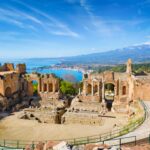
Centro Storico Taormina is best known for the Teatro Antico di Taormina (Greek-Roman Theatre), a 3rd-century BC structure dramatically framing Mount Etna and the Ionian Sea that remains in active use for summer concerts and film festivals. The Duomo di San Nicola on Piazza del Duomo, begun in the 13th century, and the Arab-Norman Torre dell’Orologio clock tower at Piazza IX Aprile are defining landmarks. The pedestrian Corso Umberto I runs the full length of the centro for roughly one kilometer, lined with palazzi, churches, and independent boutiques.
Best things to do in Centro Storico Taormina
Visiting the Teatro Antico di Taormina is the single essential activity; the site is open daily and combines archaeological importance with sweeping views of Etna and the bay. Beyond the theatre, key experiences include:
- Walking the full length of Corso Umberto I between the two medieval gates
- Viewing the medieval fountain in Piazza del Duomo, decorated with Taormina’s centaur symbol
- Entering the 15th-century Palazzo Corvaja, which houses the regional tourist office and a museum
- Climbing to the Castello Saraceno ruins above the centro for unrestricted panoramic views
- Attending an evening performance at the Teatro Antico during the Taormina Arte festival season
Where to eat in Centro Storico Taormina
The centro storico offers Sicilian specialties including arancini, pasta alla norma (pasta with fried aubergine, tomato, and salted ricotta), swordfish carpaccio, and granita with brioche at cafes clustered around Piazza IX Aprile and along Corso Umberto I. Piazza del Duomo and the surrounding side streets hold trattorias serving locally caught Ionian swordfish and red tuna. Pasticcerie along Corso Umberto I sell marzipan fruits, a Sicilian tradition with Arab origins, produced here for centuries.
Where to walk in Centro Storico Taormina
The primary walk runs along Corso Umberto I from Porta Messina south to Porta Catania, passing Piazza IX Aprile, the Torre dell’Orologio arch, Palazzo Corvaja, and the Duomo — covering the full historic center in under 20 minutes at a casual pace. A second route climbs the stepped path from the upper centro to the Castello Saraceno along Via Circonvallazione, rewarding walkers with unobstructed views toward Calabria across the strait.
How to get to Centro Storico Taormina
Taormina-Giardini railway station on the Messina–Catania line sits at sea level below the hill; a cable car (funivia) connects the station area at Mazzarò to the centro storico, and INTERBUS coaches run directly up from the station to Taormina’s bus terminal near Porta Catania. Private vehicles must park outside the ZTL (limited traffic zone) at Lumbi or Porta Catania car parks. Catania Fontanarossa Airport is approximately 55 kilometers south and served by regular bus transfers.
Best time to visit Centro Storico Taormina
April through June and September through October offer the most comfortable conditions in the centro storico — mild temperatures, manageable crowds, and full access to open-air venues. July and August bring peak crowds, maximum heat, and the Taormina Film Fest and Taormina Arte concerts at the Greek Theatre, making evening visits particularly rewarding despite daytime congestion. Winter months are quiet, with most of the archaeological site and major churches still accessible.