Cours Mirabeau is the central axis of Aix-en-Provence, a 440-meter boulevard laid out in 1651 on the site of the old ramparts. Lined on its north side by cafés and patisseries and on its south side by grand hôtels particuliers, it remains the social and symbolic heart of the city. Three monumental fountains punctuate the length of the avenue, each fed by natural thermal or spring water.
What is Cours Mirabeau known for?
Cours Mirabeau is known for its four rows of plane trees that form a dense green canopy over the boulevard, its 17th- and 18th-century aristocratic mansions on the southern side, three historic fountains, and the legendary café culture that has drawn writers, artists, and students for centuries. The Fontaine de la Rotonde anchors the western end, the mossy Fontaine d’Eau Chaude sits mid-boulevard fed by a 34°C thermal spring, and the Fontaine du Roi René stands at the eastern end.
Best things to do on Cours Mirabeau
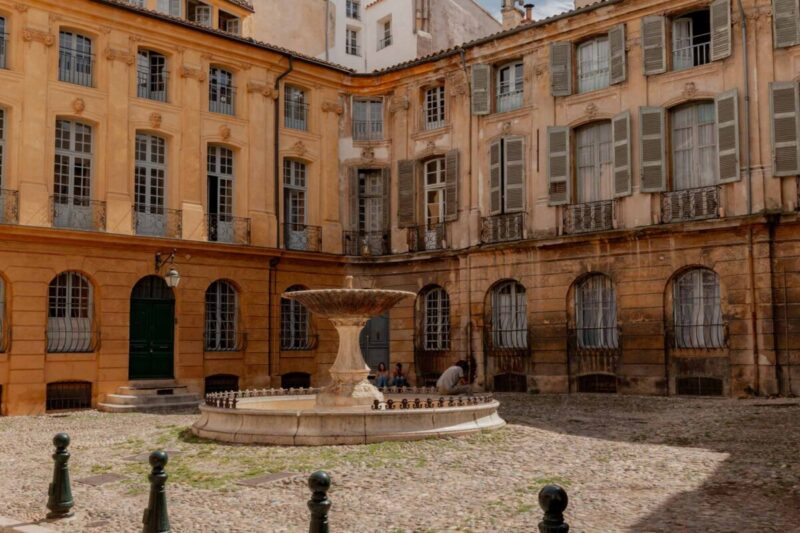
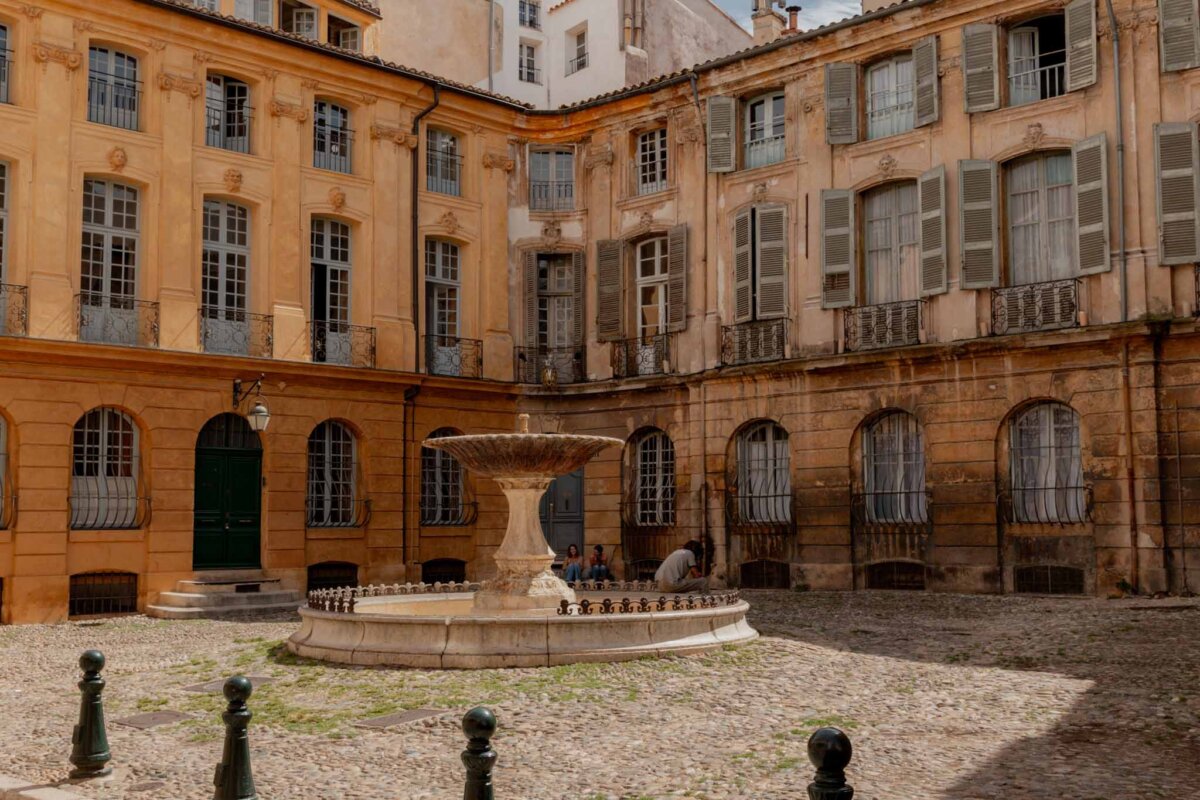
Sitting at a terrace table on Cours Mirabeau and watching daily Aixois life unfold under the plane trees is the essential activity, best done at one of the cafés on the north side of the boulevard. Beyond the terrace ritual, visitors can study the carved stone façades of the southern hôtels particuliers, follow the boulevard east toward the Quartier Mazarin, and browse the flower and food stalls of the nearby Marché du Palais de Justice on Place de Verdun.
- Walk the full length from Fontaine de la Rotonde to Fontaine du Roi René
- Order coffee and a calisson at a north-side pavement café
- Examine the thermal Fontaine d’Eau Chaude, draped in green moss year-round
- Cross into the Quartier Mazarin via Rue du 4 Septembre or Rue Cardinale
- Visit the Saturday flower market on nearby Place des Prêcheurs
Where to eat and drink near Cours Mirabeau
Les Deux Garçons, at 53 Cours Mirabeau, is Aix’s most historically cited café-brasserie, open since 1792 and a former haunt of Cézanne and Zola; its mirrored interior and terrace are landmarks in their own right. The north side of the boulevard holds several other cafés and boulangeries where Provençal specialties such as calissons, navettes, and tapenade can be found. Rue d’Italie and Rue des Cordeliers, running off the boulevard, offer additional restaurants serving traditional Provençal cuisine.
How to get to Cours Mirabeau
Cours Mirabeau is most easily reached on foot from the Aix-en-Provence city centre bus hub at La Rotonde, where numerous Aix en Bus urban lines terminate and intersect. The Aix-en-Provence TGV station is served by the Navette Aéroport-Gare shuttle bus into the city centre, dropping passengers within walking distance of the boulevard. Aix-en-Provence Centre train station, roughly 700 metres north on Avenue Victor Hugo, connects to Marseille and regional services.
- Aix en Bus lines 1, 2, 3, and 6 stop near La Rotonde at the western end
- Navette shuttle from Aix TGV station to city centre bus hub at La Rotonde
- Aix-en-Provence Centre SNCF station, approximately 10-minute walk north
Where to walk around Cours Mirabeau
The most rewarding walking route combines Cours Mirabeau with the adjacent Quartier Mazarin to the south, a 17th-century grid neighbourhood of quiet streets, the Musée Granet on Place Saint-Jean-de-Malte, and the Fontaine des Quatre-Dauphins on Place des Quatre-Dauphins. North of the boulevard, the pedestrian lanes of the Vieil Aix — including Rue Gaston de Saporta leading to the Cathédrale Saint-Sauveur — extend the walk into medieval Aix.
Best time to visit Cours Mirabeau
Late spring and early autumn offer the most pleasant conditions on Cours Mirabeau: the plane trees are in full leaf from May through October, temperatures are comfortable for terrace sitting, and the boulevard hosts open-air events during the Festival International d’Art Lyrique d’Aix-en-Provence each July. Weekday mornings are quieter for photography; weekend afternoons bring the liveliest local crowd to the cafés and the nearby markets.