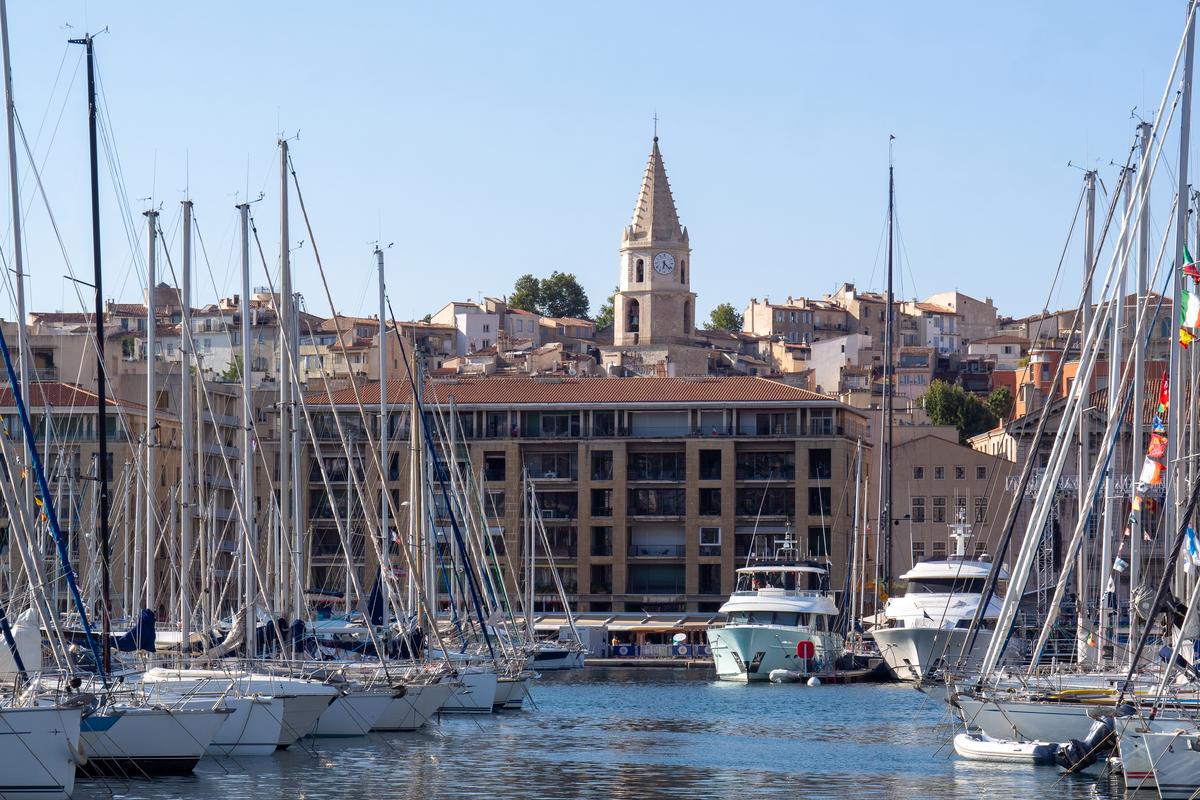
The heart of Marseille‘s maritime heritage, this ancient harbor has been the city’s lifeline since Greek sailors founded Massalia in 600 BCE. Today, the Vieux-Port blends centuries of Mediterranean trading history with a vibrant modern atmosphere. Local fishermen still auction their daily catch at the morning fish market (Quai des Belges), while restaurants serving authentic bouillabaisse line the quayside. The port is framed by historic forts—Fort Saint-Nicolas and Fort Saint-Jean—and offers spectacular views, especially at sunset when the masts of moored sailboats create a forest of silhouettes against the golden light. As Marseille’s cultural crossroads, the port embodies the city’s multicultural spirit and serves as both a working harbor and a gathering place where locals and visitors alike come to experience the authentic Mediterranean way of life.
Cultural Context
The Vieux-Port de Marseille stands as one of Europe’s most historically significant harbors, representing the legendary birthplace of Marseille and 2,600 years of continuous Mediterranean civilization. This ancient natural harbor, originally called “Lacydon” by the Greeks, became the foundation of Massalia around 600 BC when Phocaean Greeks established France’s oldest city. According to legend immortalized by Aristotle, the city was born from the love story between Greek sailor Protis and Gyptis, daughter of the local Celtic-Ligurian chieftain Nannos, who offered her hand in marriage at a wedding feast—making this the romantic birthplace of one of Europe’s greatest ports. Throughout antiquity and the Middle Ages, this harbor served as the beating heart of a powerful maritime city-state that controlled Mediterranean trade routes and introduced Greek civilization to Gaul. The port’s strategic importance continued through the Roman Empire, medieval trading republics, and France’s colonial expansion to North Africa and the Far East. Today, while the massive commercial operations have moved to modern facilities, the Vieux-Port remains the cultural and social heart of Marseille, where traditional fish markets, the famous ferry-boat service (operating since 1880), and waterfront restaurants serving authentic bouillabaisse preserve centuries of Mediterranean maritime culture.
Historical Context
The Vieux-Port de Marseille, or Old Port of Marseille, serves as the historic heart of the city and is one of the oldest ports in Europe, with origins tracing back to 600 BCE when Greek settlers from Phocaea established the colony of Massalia. This harbor was pivotal for trade and cultural exchange throughout antiquity, serving as a gateway between the Mediterranean and inland Gaul. Over centuries, the port evolved through Roman, medieval, and modern periods, adapting to shifting political and economic landscapes. In the Middle Ages, it became a bustling center for commerce and naval activity, while in the 17th century, Louis XIV ordered extensive fortifications around the port to protect the city from maritime threats. The port experienced significant transformations during the 19th and 20th centuries with the advent of industrialization and modernization of maritime infrastructure. Despite these changes, the Vieux-Port has retained its central role in Marseille’s identity, witnessing historical events such as the French Revolution and World War II, during which the port was a strategic military site. Today, it stands as a living monument to Marseille’s enduring connection to the sea and its layered history spanning over 2,600 years.