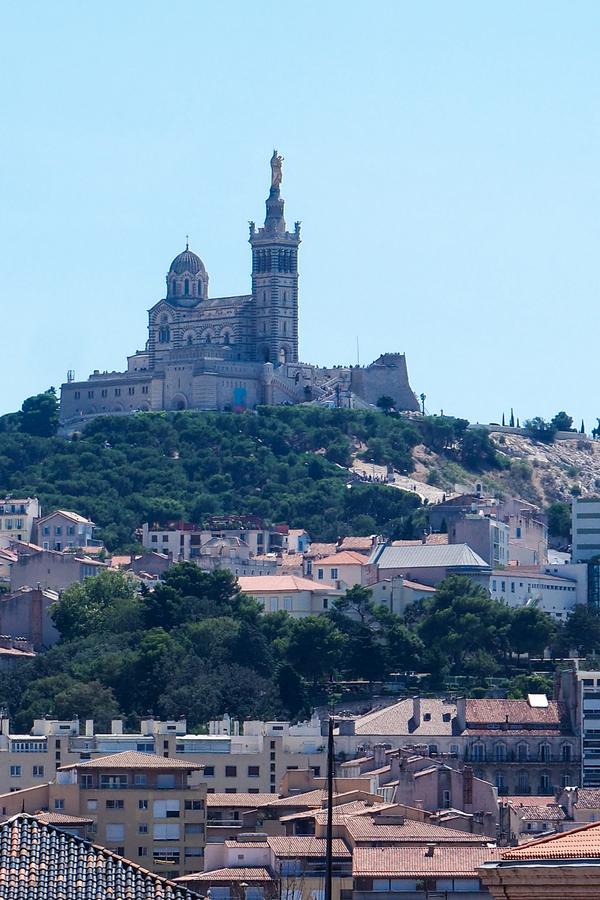
Marseille’s beloved guardian, Notre-Dame de la Garde crowns the city’s highest hill with Byzantine splendor. This 19th-century basilica, topped by a golden Madonna statue, offers breathtaking 360-degree views while serving as both spiritual sanctuary and the symbol of Marseille’s maritime heritage.
Cultural Context
Notre Dame de la Garde holds profound cultural significance for the people of Marseille and the broader Provence region. Known affectionately as ‘La Bonne Mère’ (The Good Mother), the basilica is deeply woven into the local identity, embodying protection and hope for the city’s inhabitants. Traditionally, fishermen and sailors have sought the Virgin Mary’s blessing here before embarking on voyages, reflecting the city’s longstanding maritime heritage. The site is also a focal point for religious festivals, especially the annual Assumption Day on August 15th, when thousands of locals participate in processions and celebrations that blend Catholic devotion with regional Provençal customs. The basilica’s role transcends pure religious function; it is a symbol of resilience and community solidarity, especially during times of hardship such as war or economic uncertainty. Local customs often involve lighting candles and leaving ex-votos—small offerings of thanks—inside the church, a practice that illustrates the intimate relationship between the faithful and the sacred space. Moreover, the basilica’s position atop Marseille’s highest natural point makes it a physical and spiritual landmark, visible from much of the city, reinforcing its cultural presence in everyday life. The site also hosts concerts and cultural events, further integrating it into the social fabric of Marseille beyond strictly religious observance. This rich blend of tradition, faith, and local identity makes Notre Dame de la Garde an essential cultural pillar for both residents and visitors alike.
Historical Context
Notre Dame de la Garde’s history dates back to the 13th century when a small chapel was first established on the site, serving as a beacon for sailors navigating the Mediterranean. The current basilica was constructed between 1853 and 1864 under the direction of architect Henri-Jacques Espérandieu, replacing the earlier chapel to accommodate growing pilgrimages and the city’s expanding population. Throughout its history, the basilica has played a protective role for Marseille, especially during periods of conflict such as the Franco-Prussian War and both World Wars, when it was seen as a spiritual guardian of the city. The statue of the Virgin Mary holding the infant Jesus, gilded in gold leaf and perched atop the bell tower since 1870, became a symbol of hope and divine protection. The basilica also witnessed significant historical moments, including serving as a lookout point during the Siege of Marseille and enduring damage during bombings in World War II, after which it was carefully restored. Over the centuries, Notre Dame de la Garde evolved from a modest chapel to a monumental neo-Byzantine basilica reflecting Marseille’s growth and the deepening religious devotion of its citizens. This evolution mirrors broader historical trends in France, including the rise of Marian devotion in the 19th century and the church’s role in urban identity. Today, the basilica stands as a testament to Marseille’s layered history, symbolizing both spiritual continuity and resilience through turbulent times.