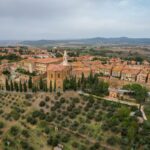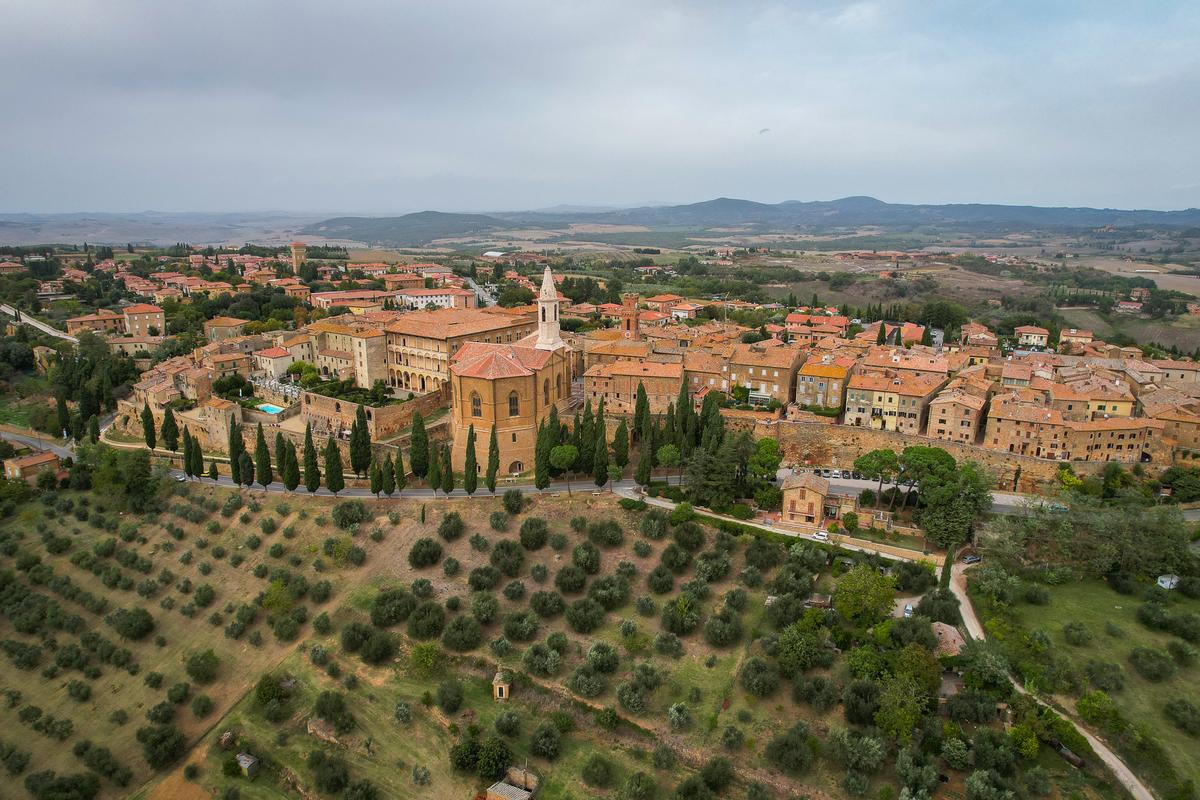
Pienza is a purpose-built Renaissance town in the Val d’Orcia valley of southern Tuscany, commissioned by Pope Pius II in the 1460s and redesigned by architect Bernardo Rossellino. The historic center was inscribed as a UNESCO World Heritage Site in 1996, recognized alongside the wider Val d’Orcia landscape. Its compact grid of streets, anchored by Piazza Pio II, contains an extraordinary concentration of 15th-century civic and religious architecture within a few hundred meters.
What is Pienza Historic Center known for?
Pienza is known as the first example of Renaissance urban planning, where Pope Pius II transformed his birthplace of Corsignano into an ideal humanist city between 1459 and 1462, producing Pienza Cathedral, Palazzo Piccolomini, Palazzo Comunale, and the Bishop’s Palace arranged around a single trapezoidal piazza. The town is also internationally recognized for Pecorino di Pienza, a aged sheep’s-milk cheese sold in shops along Corso il Rossellino.
Best things to do in Pienza Historic Center
Visiting Palazzo Piccolomini, the former papal residence designed by Rossellino, is the centerpiece activity; guided tours move through the papal apartments, armory, and a hanging garden with panoramic views over the Val d’Orcia. Pienza Cathedral, with its late-Gothic interior and five altarpiece paintings commissioned simultaneously in 1462, is open daily. The Museo Diocesano on Corso il Rossellino holds Flemish tapestries and relics from the papal court.
- Tour Palazzo Piccolomini and its loggia garden overlooking Val d’Orcia
- Enter Pienza Cathedral to see the five contemporary altarpieces
- Visit the Museo Diocesano for papal-era tapestries and goldwork
- Walk the full length of Corso il Rossellino for cheese and wine shops
- Descend to the lower terraced gardens below the city walls
Where to eat and shop in Pienza
Corso il Rossellino, the main street running east–west through the historic center, is lined with alimentari and cheese vendors selling Pecorino di Pienza in several aging stages—fresco, semi-stagionato, and stagionato—alongside truffle products and local Orcia DOC wines. Several small restaurants and enoteca along Via della Fortuna and Via Condotti serve pici pasta, ribollita, and grilled meats typical of southern Tuscany.
- Buy aged Pecorino di Pienza directly from producers along Corso il Rossellino
- Try pici cacio e pepe at trattorias near Piazza Pio II
- Sample Orcia DOC red wine at local enoteche
Where to walk in Pienza Historic Center
The primary walk runs from Porta al Ciglio, the eastern gate, along Corso il Rossellino through Piazza Pio II to Porta Vicarello at the western edge, a flat traverse of roughly 400 meters that passes every major monument. A secondary route follows Via dell’Amore and the town’s southern perimeter walkway along the city walls, offering unobstructed views across the Val d’Orcia toward Monte Amiata.
How to get to Pienza
Pienza has no train station; the nearest rail connections are at Chiusi-Chianciano Terme on the main Rome–Florence line, approximately 30 kilometers away, with onward bus or taxi service. Tiemme bus routes connect Pienza to Siena (roughly 90 minutes), Montepulciano (about 30 minutes), and San Quirico d’Orcia. By car, Pienza sits on the SP146 between San Quirico d’Orcia and Montepulciano, with parking available outside the historic walls at Parcheggio di Pienza.
Best time to visit Pienza Historic Center
Late April through June and September through October offer mild temperatures, clear light for photography over the Val d’Orcia, and manageable visitor numbers; July and August bring peak crowds and heat. The Fiera del Cacio, a cheese festival held annually in September in Piazza Pio II, is the town’s most significant local event, featuring a traditional Pecorino-rolling competition.