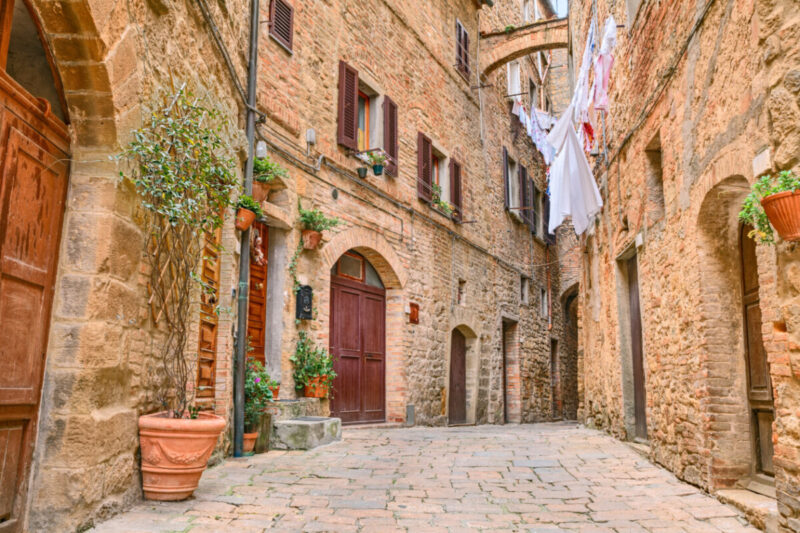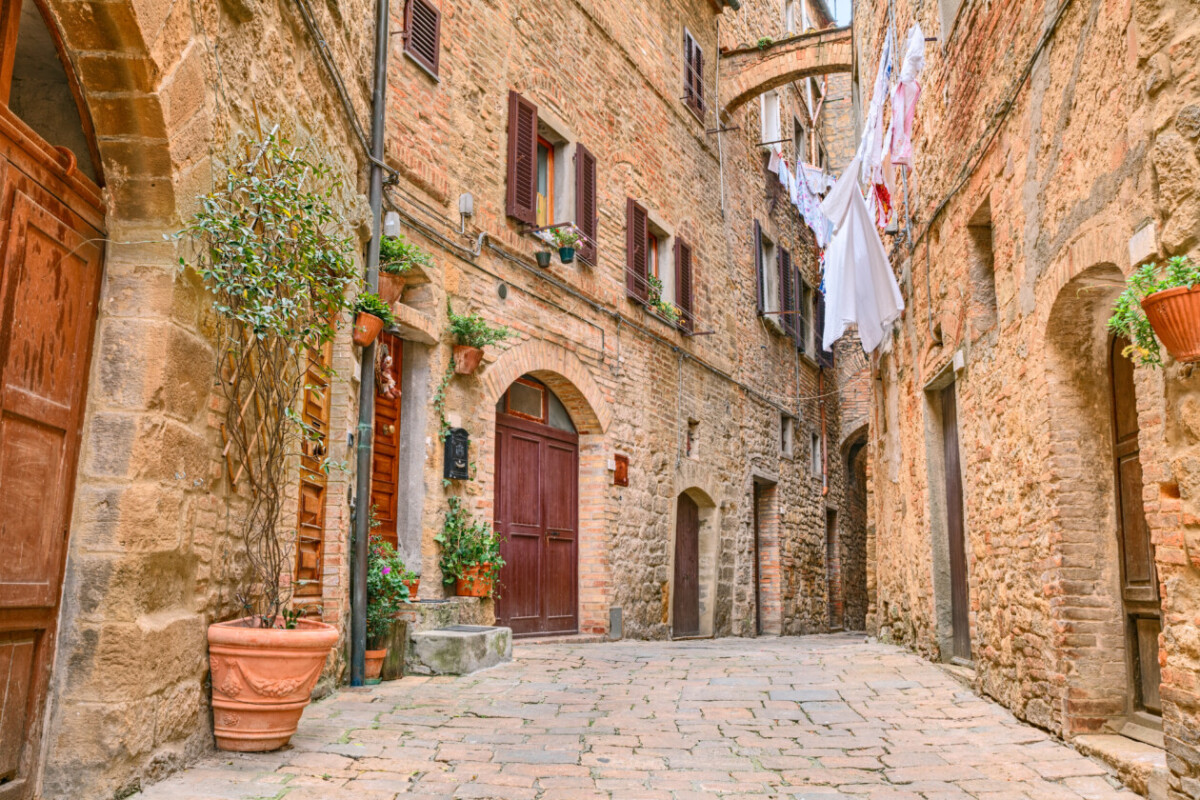
Volterra’s historic center occupies a dramatic hilltop in the Tuscan Metalliferous Hills, enclosed by Etruscan and medieval walls that date back more than 2,500 years. The compact centro storico holds a remarkable layering of civilizations — Etruscan necropoli, Roman baths, medieval palazzi, and Renaissance churches — all within comfortable walking distance. Alabaster carving remains the town’s living craft tradition, practiced in workshops throughout the old streets.
What is Volterra’s historic center known for?
Volterra’s historic center is known for its intact Etruscan and medieval fortifications, the Piazza dei Priori considered one of Tuscany’s finest medieval squares, and a centuries-old alabaster crafting industry that still operates in family-run botteghe along streets such as Via dei Sarti and Via Porta all’Arco. The Museo Etrusco Guarnacci houses one of Italy’s most important Etruscan collections, including over 600 funerary urns. The Roman Theater, dating to the 1st century BC, remains among the best-preserved in Italy and is visible from the Viale Francesco Ferrucci belvedere.
Best things to do in Volterra’s historic center
The single most rewarding activity is a circuit of the major monuments on foot, beginning at Porta all’Arco, an Etruscan arch from the 3rd century BC, and continuing to the Roman Theater excavations, the Cattedrale di Santa Maria Assunta with its 16th-century painted ceiling, and the Fortezza Medicea — a 15th-century Medici fortress still functioning as a prison and viewable from outside.
- Visit the Museo Etrusco Guarnacci on Via Don Minzoni for the alabaster Urna degli Sposi funerary urn
- Watch alabaster artisans at work in botteghe on Via dei Sarti and surrounding streets
- Walk the partially preserved Etruscan walls along Viale dei Ponti for panoramic valley views
- Attend the Astiludio flag-throwing pageant held each August in Piazza dei Priori
- Explore the Pinacoteca e Museo Civico on Via dei Sarti for works by Luca Signorelli and Rosso Fiorentino
Where to eat in Volterra’s historic center
Restaurants in the historic center serve classic Tuscan and Volterran dishes including cinghiale (wild boar) ragù, pappardelle al cinghiale, tripe prepared in the local style, and torta di ceci — a chickpea flatbread eaten as street food. Ristorante Enoteca del Duca on Via di Castello and Osteria La Pace near Piazza dei Priori are long-established dining options. The weekly Thursday market on Piazza dei Priori and surrounding streets offers local cheeses, salumi, and seasonal produce.
How to get to Volterra’s historic center
Volterra has no direct train station in the centro storico; the nearest rail connection is Saline di Volterra station on the Cecina–Saline–Volterra branch line, linked to the main Pisa–Rome coastal line at Cecina, from which Tiemme buses complete the uphill journey to the town center. By road, the SS68 connects Volterra to Colle di Val d’Elsa and the Siena–Florence corridor, and to Cecina on the coast. Tiemme regional buses also serve routes from San Gimignano, Siena, and Pisa, arriving at the Piazza Martiri della Libertà bus terminus just outside the historic walls.
Where to walk in Volterra’s historic center
The most rewarding walking route begins at Porta all’Arco on the southern edge of the walled town, proceeds up Via Porta all’Arco and Via Matteotti to Piazza dei Priori, then continues via Via dei Sarti past the Pinacoteca to the Roman Theater viewpoint on Viale Francesco Ferrucci, finishing along Viale dei Ponti beside the Etruscan walls with open views across the Val di Cecina.
Best time to visit Volterra’s historic center
Late spring (May–June) and early autumn (September–October) offer the most favorable conditions — mild temperatures, lower crowds than peak July and August, and full access to outdoor sites including the Roman Theater and the town’s belvedere terraces. August brings the Volterra Teatro festival and the Astiludio pageant but also the highest visitor volumes. Winter months see fewer tourists and occasional fog that enhances the town’s atmospheric qualities, though some smaller museums may reduce hours.