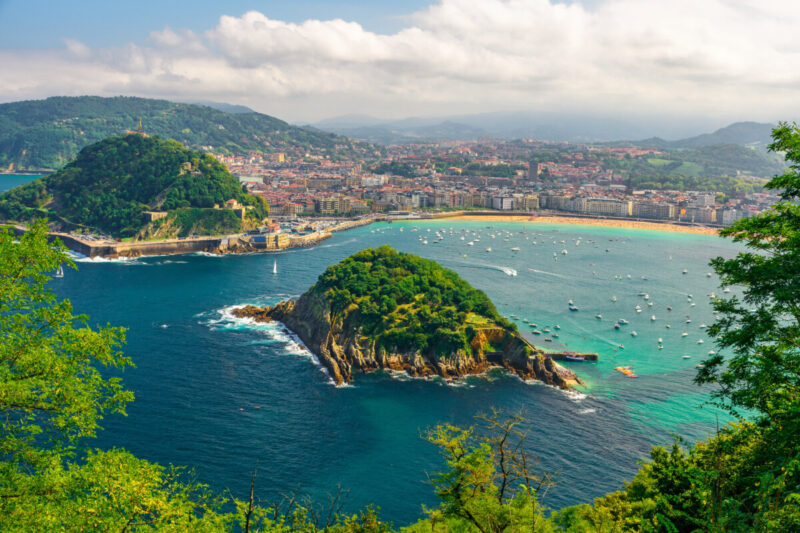
The Parte Vieja, or Historic Center of San Sebastián, occupies a compact grid of narrow streets between Monte Urgull and the Río Urumea estuary, facing the Cantabrian Sea. This is the gastronomic and cultural heart of the Basque city, where centuries-old churches stand alongside some of the highest concentrations of Michelin-starred restaurants and pintxos bars anywhere in the world. The neighborhood anchors the broader city of Donostia-San Sebastián in the Basque Country of northern Spain.
What is the Parte Vieja known for?
The Parte Vieja is best known for its extraordinary density of pintxos bars, particularly along Calle 31 de Agosto and the surrounding streets, where dozens of counters display elaborate Basque bite-sized snacks on bread, earning San Sebastián a global reputation as one of Europe’s premier food destinations. The neighborhood also contains the Gothic façade of the Basílica de Santa María del Coro, the Baroque church of San Vicente, and the ruins and fortifications of Monte Urgull rising directly above the old town grid.
Best things to do in the Parte Vieja
Visitors can spend a full day between the old town’s landmarks, market halls, and waterfront without leaving the neighborhood.
- Tour the Basílica de Santa María del Coro on Calle 31 de Agosto, a Baroque-façade church dating to the 18th century.
- Climb the footpaths of Monte Urgull to reach the Castillo de la Mota and the Cristo de la Mota statue for panoramic bay views.
- Browse La Bretxa market, the neighborhood’s covered fresh-produce and fish hall, on Plaza de la Bretxa.
- Visit the San Telmo Museoa, a 16th-century Dominican convent converted into the Basque museum of society and culture on Plaza Zuloaga.
- Walk the Paseo Nuevo seawall promenade along the rocky Atlantic-facing coast below Monte Urgull.
Where to eat in the Parte Vieja
The streets radiating from Plaza de la Constitución—especially Calle Fermín Calbetón and Calle 31 de Agosto—contain the highest concentration of pintxos bars in the city, where the local ritual is to order txakoli white wine and sample two or three pintxos per bar before moving to the next. Classic pintxos include the gilda (olive, anchovy, and guindilla pepper skewer, said to have been invented in San Sebastián), bacalao pintxos, and txangurro-stuffed crab preparations. Bar La Viña on Calle 31 de Agosto is widely credited with creating San Sebastián’s iconic burnt Basque cheesecake.
Where to walk in the Parte Vieja
The most rewarding walk begins at Plaza de la Constitución, the former bullring turned arcaded square at the neighborhood’s center, then follows Calle Mayor west to the seafront, turns onto the Paseo Nuevo coastal walkway beneath Monte Urgull, and ends at the small harbor of the Puerto Viejo where fishing boats dock alongside the aquarium. A second route climbs from the Basílica de Santa María through the Monte Urgull park trails to the castle summit and returns via the eastern slope to the Kursaal bridge area.
How to get to the Parte Vieja
The Parte Vieja is walkable from San Sebastián’s main Renfe railway station (Estación del Norte) in roughly 15 minutes across the Puente de María Cristina and Puente del Kursaal bridges over the Urumea river. City buses operated by Dbus serve the neighborhood perimeter, with stops on Boulevard (Alameda del Boulevard) forming the main transit spine along the old town’s southern edge. From Bilbao, direct EuskoTren and Renfe services reach San Sebastián’s station in approximately 60–70 minutes.
Best time to visit the Parte Vieja
The Parte Vieja is liveliest from June through September when the Semana Grande festival in August fills Plaza de la Constitución and the beachfront with events, though spring and early autumn offer milder crowds with the same full range of bars and markets open. The pintxos bar scene peaks on Thursday through Saturday evenings year-round, and the Tamborrada drum festival on January 20 brings the entire city into the old town streets for a 24-hour celebration.