The best places to visit on the Rhine are concentrated in Germany’s Upper Middle Rhine Valley, the castle-lined section between Bingen and Rüdesheim in the south and Koblenz in the north. First-time visitors should prioritize Koblenz, Marksburg Castle, Boppard, St. Goar and Rheinfels Castle, Loreley, Bacharach, Rüdesheim, and a daylight cruise through the Rhine Gorge.
This 65-kilometer cultural landscape is protected by UNESCO for its historic towns, vineyard terraces, castles, and long association with European trade and Rhine Romanticism. It is compact enough to explore by train, ferry, and boat, yet varied enough to fill a three- or four-day Rhine Valley itinerary.
Disclosure: ViaTravelers may earn a commission when you book through selected hotel or tour links in this guide, at no additional cost to you. Recommendations are based on route value, logistics, and relevance to the reader’s trip.
Last verified: July 22, 2026. Opening hours, ticket prices, ferry crossings, cable cars, and cruise schedules can change because of season, weather, maintenance, and river levels. Check the linked official source before setting out.
Rhine Valley trip-planning takeaways
- Best first-trip route: Focus on the UNESCO-listed Upper Middle Rhine between Bingen/Rüdesheim and Koblenz rather than trying to cover the Rhine’s entire European course.
- Ideal duration: Three full days balances castles, historic towns, a cruise, and one longer viewpoint or museum visit.
- Best base for transport: Koblenz. Choose Boppard or Bacharach for a smaller river-town setting, or Rüdesheim for wine and easy access to the southern end of the gorge.
- A car is optional: Trains run along both banks, while ferries connect selected opposite-bank towns. Check which bank your next stop is on before boarding.
- Best cruise segment: Travel one way from Bingen or Rüdesheim toward St. Goar or Boppard, then return by train rather than spending the day retracing the same scenery.
- Accessibility varies: Castle interiors commonly include narrow stairs, uneven stone, and steep approaches. Rheinstein and Reichenstein are not fully wheelchair accessible.
Quick comparison of the best Rhine River stops
| Place | Best for | Suggested time | Car-free access | Important planning note |
|---|---|---|---|---|
| Koblenz | Transport, city sights, fortress views | Half to one day | Easy | Use the cable car for Ehrenbreitstein when operating |
| Marksburg and Braubach | Medieval castle interiors | Two to three hours | Moderate | The castle is visited by guided tour and requires an uphill approach |
| Boppard | Roman history, chairlift, hiking | Half to one day | Easy | The chairlift and longer trails are seasonal and weather-dependent |
| St. Goar and Rheinfels | Large castle ruins | Three to four hours | Easy | Lower passages require a guided tour |
| Loreley | Rhine Gorge views and literary history | Two to three hours | Moderate | Reaching the plateau may require a ferry plus local transport or a hike |
| Oberwesel | Walkable medieval walls | Two to three hours | Easy | Expect stairs and exposed wall sections |
| Kaub and Pfalzgrafenstein | Island toll-castle history | Two to three hours | Moderate | Castle access depends on a small passenger ferry and river conditions |
| Bacharach | Half-timbered streets and wine-town atmosphere | Three to five hours | Easy | Allow time to climb toward Werner Chapel or Burg Stahleck |
| Rheinstein Castle | Romantic-era interiors and gardens | Two to three hours | Moderate | A steadily rising 380-meter path leads from the parking area |
| Reichenstein Castle | Castle museum and overnight stay | Two to four hours | Moderate | The museum is not wheelchair accessible and does not permit dogs |
| Rüdesheim | Wine, cable-car views, and cruises | Half to one day | Easy | Check the current status of the Assmannshausen chairlift before planning a ring tour |
| Middle Rhine cruise | Seeing multiple castles efficiently | Half to one day | Easy | Services are seasonal and can change during high or low water |
How to plan a Rhine Valley trip
Which section of the Rhine should you visit?
The Rhine flows through several countries and very different landscapes. For a first sightseeing trip in Germany, concentrate on the Upper Middle Rhine Valley recognized by UNESCO. Its principal sightseeing corridor extends from Bingen and Rüdesheim to Koblenz.
This is the Rhine of steep vineyard terraces, compact wine towns, river ferries, hilltop fortifications, and the narrow Loreley passage. Cologne, Bonn, Düsseldorf, Mannheim, and the Upper Rhine can all justify separate visits, but adding them to a short Romantic Rhine itinerary creates more travel time than sightseeing value.
For broader trip planning beyond the valley, use the ViaTravelers Germany travel guide.
How many days do you need in the Rhine Valley?
Three days is the practical minimum for a well-paced first visit. Two days works for Koblenz, one castle, one small town, and a cruise. Four or five days gives you time for a longer hike, several castle interiors, or slower evenings in Bacharach, Boppard, or Rüdesheim.
A common mistake is treating every visible castle as a separate half-day attraction. Many are privately occupied, used as hotels, visible only from the river, or open on limited schedules. Choose two or three interiors with different strengths—Marksburg for medieval defensive architecture, Rheinfels for ruins, and Rheinstein or Reichenstein for Rhine Romanticism.
Where should you stay?
- Koblenz: Best for train connections, a wider hotel selection, restaurants, and travelers arriving late or leaving early.
- Boppard: Best compromise between convenient rail access, river views, walks, restaurants, and a smaller-town setting.
- Bacharach: Best for a compact historic center and quiet evenings, but with fewer late-night choices.
- Rüdesheim: Best for Rheingau wine, the Niederwald cable car, and departures from the southern end of the scenic cruise route.
Can you explore the Rhine Valley without a car?
Yes. Railway lines follow both sides of the Rhine, and most towns in this guide have stations. Boats and local ferries fill some of the cross-river gaps because bridges are limited inside the gorge.
The important detail is the riverbank. Koblenz, Boppard, St. Goar, Oberwesel, Bacharach, Bingen, and Trechtingshausen are generally approached from the left bank. Braubach, St. Goarshausen, Kaub, and Rüdesheim are on the right bank. A destination that appears close on a map can require a ferry or a longer rail connection.
Use current rail and ferry planners rather than relying on a fixed article timetable. Leave a buffer before the final train or ferry of the evening.
When is the best time to visit?
Late April through October offers the broadest choice of cruises, castle openings, cable cars, and outdoor dining. May, June, and September usually provide a useful balance of operating schedules and manageable visitor numbers. July and August bring long daylight hours but also heat, busier boats, and a greater need to reserve accommodation.
Autumn is attractive for vineyards and wine events, but daylight contracts and some transport or attraction schedules begin to taper. Winter can work for Koblenz and selected towns, but many castles, boats, chairlifts, and museum facilities either close or operate reduced hours.
Current Rhine travel alert, verified July 22, 2026: KD is publishing low-water notices and current ship-movement lists. Cruises may be canceled, rescheduled, or unable to serve particular landings. Pfalzgrafenstein’s official tourism listing also carried a low-water closure notice when this guide was checked. Review the latest KD shipping notices and the attraction’s official status on the day of travel.
12 best places to visit on the Rhine River
1. Koblenz: Deutsches Eck and Ehrenbreitstein Fortress

Koblenz is the most practical northern base for the Middle Rhine. Its defining landmark is Deutsches Eck, the headland where the Moselle joins the Rhine. The rivers, promenade, monumental equestrian statue, cable car, and fortress are all visible from this compact area.
Cross the Rhine by cable car to Ehrenbreitstein Fortress. The present Prussian fortification was built between 1817 and 1828, although defensive structures on the site date back to around the year 1000. The plateau stands 118 meters above the Rhine and provides one of the clearest views of the river confluence.
From March 29 through November 1, 2026, the fortress’s exhibition buildings were scheduled to open daily from 10:00 a.m. to 6:00 p.m. The grounds remain more extensive than they first appear, so allow at least two hours if you plan to visit the museums rather than only the viewpoint.
Best use of your time: Walk the old town and Deutsches Eck in the morning, take the cable car to the fortress, and return to the riverfront for dinner. A full guide to the city is available in our article on the best things to do in Koblenz.
2. Marksburg Castle and Braubach

Address: Marksburg, 56338 Braubach, Germany
Marksburg is the strongest choice for travelers who want to understand how a working medieval fortress was organized. It is the only hilltop castle on the Middle Rhine that was never destroyed, allowing visitors to see defensive gates, residential rooms, a kitchen, a chapel, armor, and other spaces within an unusually coherent complex.
The interior is accessible only through a guided tour, which takes roughly 50 minutes. In 2026, summer hours from March through October were 10:00 a.m. to 5:00 p.m. Winter hours from November through February were 11:00 a.m. to 4:00 p.m., with closure on December 24 and 25. English-language tours were scheduled at 1:00 p.m. and 4:00 p.m. in summer, subject to short-notice changes.
The 2026 adult ticket was €12, with reduced schoolchild and family prices. Confirm the latest schedule on the official Marksburg visitor page.
Braubach is roughly ten minutes from Koblenz by regional train. From the station, plan approximately 30 minutes for the uphill approach. Drivers can park closer to the castle, but a short climb still remains. The tour includes uneven stone, narrow passages, and stairs, making it a difficult choice for travelers with substantial mobility limitations.
After the castle, allow time for Braubach’s half-timbered center before continuing along the right bank. For more comparisons, see our guide to the best castles in Germany.
3. Boppard: Roman ruins, the chairlift, and Rhine views

Boppard combines several eras and travel styles in one convenient rail stop. The center contains the remains of a large Roman fort built during the middle of the fourth century. Its walls once reached nine meters, and the land-facing side was reinforced by 20 horseshoe-shaped towers. The open-air ruins can be visited free of charge.
The town’s other major attraction is its seasonal chairlift. The 915-meter ride climbs 232 vertical meters in about 20 minutes, ending near viewpoints over the largest bend in the Rhine and the landscape known as the Four Lakes View. The “lakes” are separated-looking sections of the river created by hills in the foreground.
Travelers with more time can combine the town with a forest walk or continue toward the Fünfseenblick viewpoint near Bad Salzig. This is better treated as a hiking excursion than a quick observation stop.

Best use of your time: Visit the Roman fort and old town in the morning, then take the chairlift or complete a longer hike in the afternoon. Our guide to the best things to do in Boppard covers additional churches, walks, and riverfront stops.
4. St. Goar and Rheinfels Castle
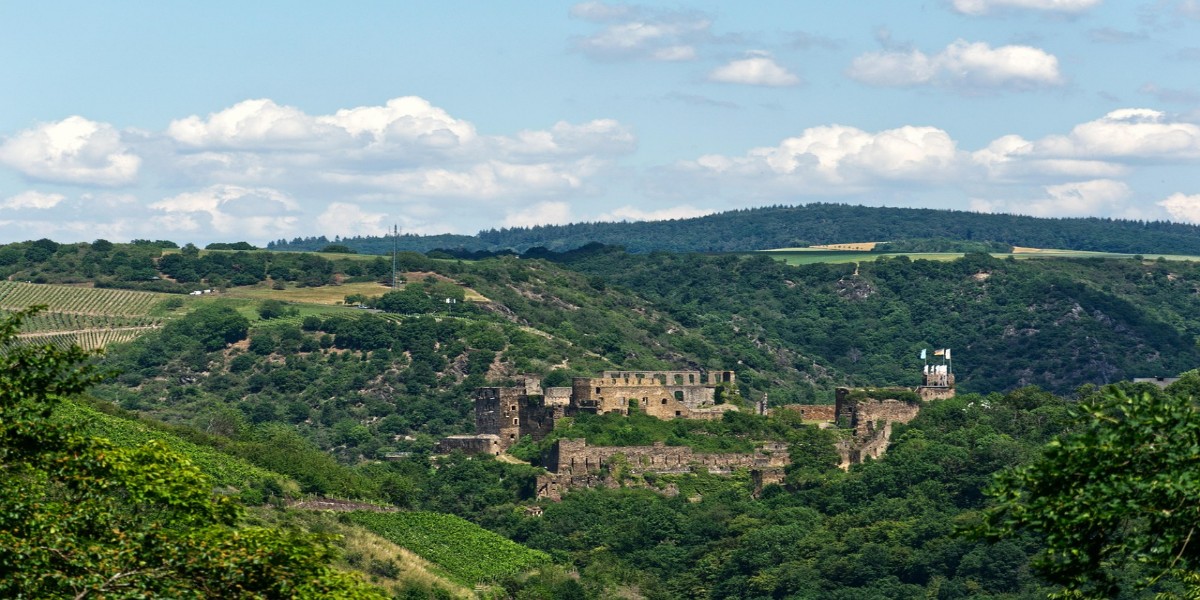
Rheinfels is the most substantial ruined fortress in the Middle Rhine Valley. Count Dieter V of Katzenelnbogen founded it in 1245, and later expansions transformed the site into a vast defensive complex above St. Goar.
The appeal is scale rather than polished rooms. Visitors move through walls, courtyards, vaults, exposed viewpoints, and surviving sections that reveal how the fortress grew over several centuries. The lower castle and mine passages can be entered only with a guided tour, while extensive upper areas and the museum can be explored independently.
When verified in July 2026, the official listing showed daily hours from 9:00 a.m. to 6:00 p.m., with final entry at 5:00 p.m. Adult admission was €6. The site may close during adverse weather, and the steep, uneven ruin requires stable footwear.
St. Goar is also a useful transport point. Its railway station sits on the left bank, while a ferry connects it with St. Goarshausen on the opposite side. That makes the town a logical place to combine Rheinfels with Loreley, although ferry and local transport timing must be checked in advance.
Confirm opening and tour information on the official Rheinfels Castle listing.
5. Loreley Plateau and the Rhine Gorge

Loreley—also written Lorelei—is the slate rock and narrow river passage associated most closely with Rhine Romanticism. The rock rises approximately 125 meters above the water, while the confined river and historic underwater reefs once made this a difficult section for navigation.
The familiar woman-combing-her-hair legend is literary rather than an unchanged ancient tradition. Clemens Brentano introduced the female Loreley figure in an 1800 ballad. Heinrich Heine’s 1824 poem and Friedrich Silcher’s later musical setting shaped the version known today.
The open-air plateau is accessible throughout the day. Paths lead to several perspectives over the gorge, while the visitor center provides regional information. When checked, the tourist information office was open daily from 11:00 a.m. to 4:00 p.m. Parts of the visitor facility and grounds have certified accessibility features, although not every path or viewpoint is fully barrier-free.
Car-free visitors should plan this stop carefully. One option is to take the ferry from St. Goar to St. Goarshausen and continue by local transport or taxi. Experienced hikers can approach through the surrounding trail network, but the elevation change should not be underestimated.
Review current access and background on the official Loreley page.
6. Oberwesel and its walkable town walls
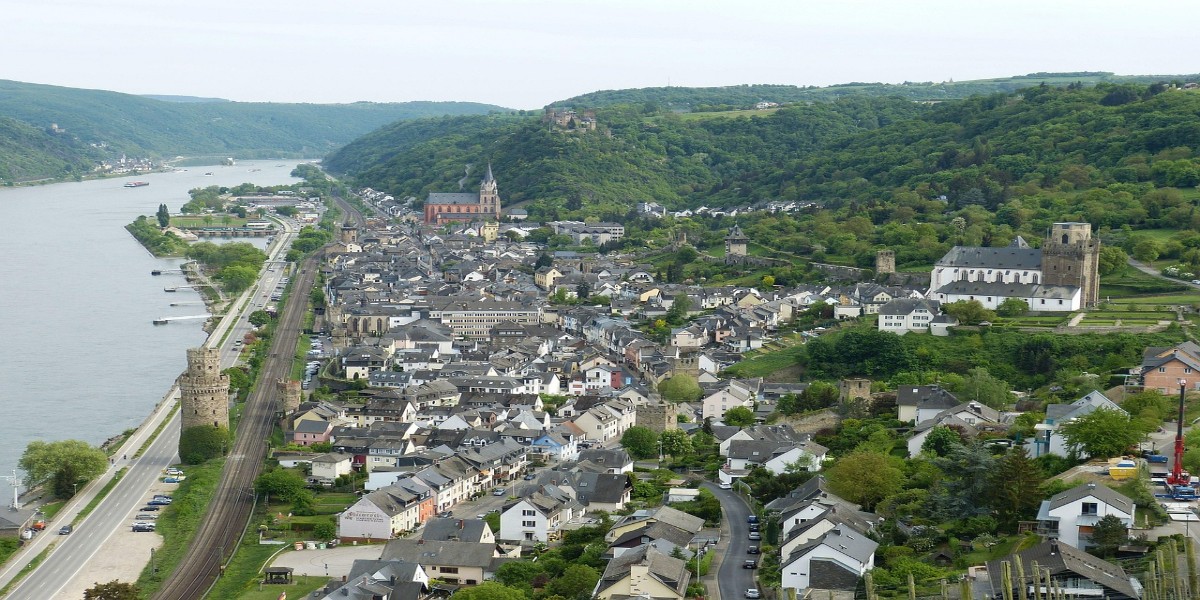
Oberwesel deserves more than a glance through a train window. Its defining feature is a preserved medieval fortification with 16 defensive towers. Large sections of the wall are walkable, giving visitors an elevated route above the streets, churches, roofs, and vineyard slopes.
The town works particularly well for travelers who want medieval architecture without committing to another castle ticket. Combine the wall with the red Liebfrauenkirche, St. Martin’s Church, the riverside, and a short walk through the center.
Allow two to three hours. The wall sections include stairs, uneven surfaces, narrow areas, and exposed viewpoints, so footwear matters. Some access points may close temporarily for maintenance or poor weather.
The official Oberwesel town-wall listing provides current information.
7. Kaub and Pfalzgrafenstein Castle

Pfalzgrafenstein looks like a stone ship anchored in the Rhine. Its position is functional rather than decorative: the island fortress formed part of a lucrative medieval toll station controlled from Kaub and nearby Gutenfels Castle.
The first pentagonal keep was commissioned in 1327 by Count Palatine Ludwig, who later became Emperor Ludwig IV. The surrounding walls and walkways followed, creating one of the Rhine’s most recognizable defensive silhouettes.
The island can be reached only by a small passenger ferry from Kaub. That makes Pfalzgrafenstein more vulnerable than a conventional attraction to water levels, currents, and operating conditions.
Important 2026 caveat: When this guide was verified on July 22, the official tourism page still displayed a low-water closure notice dated June 13, 2026. Do not build a fixed itinerary around entering the castle until you have checked the same-day status. Even during a closure, the fortress remains visible from Kaub, passing trains, ferries, and cruises.
Consult the official Pfalzgrafenstein listing for current ferry access.
8. Bacharach

Bacharach is one of the most rewarding places to slow down along the Rhine. Its center combines half-timbered houses, narrow lanes, wine taverns, sections of the old wall, St. Peter’s Church, the ruins of Werner Chapel, and Burg Stahleck above the town.
The elevated landmarks help visitors understand the town’s compact geography. A short but steep climb leads toward Werner Chapel and Burg Stahleck, with changing views over the rooftops, vineyards, railway, and river.
Werner Chapel also requires historically responsible interpretation. Construction followed the 1287 death of a boy named Werner. Members of the Jewish community were falsely blamed, and the accusation contributed to antisemitic violence in which dozens of people were killed. The ruined chapel should not be presented only as a picturesque Gothic backdrop; it also records the consequences of a fabricated ritual-murder accusation.
Allow at least three hours, and consider staying overnight if you want the lanes after day-trippers leave. See our complete guide to the best things to do in Bacharach for a longer walking route.
9. Rheinstein Castle

Address: Burg Rheinstein, 55413 Trechtingshausen, Germany
Rheinstein is one of the clearest expressions of 19th-century Rhine Romanticism. The medieval toll castle had fallen into ruin before Prince Friedrich Wilhelm Ludwig of Prussia acquired it in 1823 and rebuilt it as an idealized vision of a medieval residence.
Visitors can explore the museum independently, moving through furnished rooms, a chapel, gardens, courtyards, and towers. The attraction is less about untouched medieval fabric than the way the Romantic period reinterpreted the Rhine’s castle landscape.
For the 2026 main season, Rheinstein was scheduled to open daily from March 21 through November 8, from 10:00 a.m. to 6:00 p.m., with final admission at 5:30 p.m. Adult admission was €11, and children ages five through 14 were €7.
The castle cannot be reached directly by vehicle. From the parking area, a 380-meter path climbs steadily for roughly six to ten minutes. The wider site is not wheelchair accessible. Train travelers face a longer walk from Trechtingshausen or Bingen-Bingerbrück, so a seasonal boat connection or taxi can reduce the approach.
Check the latest visitor information on the official castle website and read our Rheinstein Castle visitor guide.
10. Reichenstein Castle

Address: Burgweg 24, 55413 Trechtingshausen, Germany
Reichenstein combines three different reasons to stop: a castle museum, panoramic grounds, and an operating hotel and restaurant. That flexibility makes it useful for travelers who want more than a short daytime fortress visit.
The museum focuses on arms, armor, hunting objects, decorative stove tiles, and the castle’s later reconstruction. A bilingual audio guide adds context without requiring visitors to match a fixed guided-tour departure.
In 2026, the museum listed daily opening from 9:00 a.m. to 6:00 p.m., with the final-admission time changing by season. Admission was €12 for adults and visitors aged 14 or older, €6 for children ages five through 13, and free for younger children.
The museum and historic grounds are not wheelchair accessible. Dogs are not allowed in the museum area, including the historic grounds. Check the official museum information before visiting.
For an overnight stay, review our Hotel Burg Reichenstein guide or compare current room availability. The hotel is best suited to travelers who value the setting and historic character over being in the center of a large town. Our guide to castle hotels in Germany covers alternatives.
11. Rüdesheim am Rhein

Rüdesheim anchors the southern end of the scenic Middle Rhine route and the western edge of the Rheingau wine region. It works well as a cruise departure point, a wine-focused overnight stop, or the start of a trip north through the gorge.
Drosselgasse is the best-known old-town lane. It runs for 144 meters through a dense concentration of historic buildings, wine taverns, restaurants, and music venues. It is heavily visited, so explore the surrounding streets and waterfront rather than treating the lane as the whole town.
The Rüdesheim cable car rises over the vineyards toward the Niederwald Monument and nearby walking paths. In 2026, the regular operating season ran from March 21 through November 1, with daily service beginning at 9:30 a.m.
Current limitation: The Assmannshausen chairlift was listed as out of order when checked on July 22, 2026. Ring and Romantic tours that depend on that chairlift were therefore unavailable. Confirm the latest notice on the official cable-car website before buying a combined route.
Wine is central to the experience, but local Riesling should not be described as uniformly sweet. Rheingau producers make styles ranging from dry and mineral to richly sweet. Our guides to the best things to do in Rüdesheim and Rheingau wine provide more detailed planning.
12. A Rhine River cruise through the Middle Rhine

A daylight cruise is the most efficient way to understand the landscape. From the river, the relationship between toll castles, riverside settlements, railway lines, vineyard terraces, and narrow passages becomes much clearer than it does from a single viewpoint.
The highest-value segment for a first visit runs from Bingen or Rüdesheim toward Bacharach, Oberwesel, St. Goar, Loreley, and Boppard. Travel one way by boat and return by train. A long out-and-back cruise repeats scenery and leaves less time for towns or castle interiors.
KD’s published 2026 timetable included Loreley round trips from Boppard and Rüdesheim from April 25 through October 4. Published schedules are not guarantees: low or high water, technical issues, events, and pier restrictions can alter a service after tickets go on sale.
Before paying, compare the precise embarkation pier, cruise direction, total sailing time, included meals, language options, cancellation terms, and the rail connection at your destination. A “Rhine cruise” from Cologne is a different experience from a castle-gorge trip through the Middle Rhine.
Travelers starting in Frankfurt can compare organized Rhine Valley day trips from Frankfurt. Those tours are convenient for limited schedules, but independent travelers gain more control by staying in the valley.
For a shorter urban experience before or after the Middle Rhine, you can also check current Cologne Rhine cruise availability. Do not substitute it for the castle corridor if the Upper Middle Rhine is your principal reason for traveling.
Our comparisons of the best Rhine River cruises and best river cruises in Europe cover longer itineraries and overnight products.
Worthwhile extension: Schloss Drachenburg

Schloss Drachenburg is north of the central UNESCO sightseeing corridor, near Königswinter and Bonn. It should therefore be treated as an extension rather than one of the core twelve Middle Rhine stops.
Built between 1882 and 1884, Drachenburg was conceived as an elaborate private palace rather than a medieval military fortress. Its interiors, landscaped grounds, Drachenfels setting, and Rhine views make it a strong choice for travelers continuing toward Bonn or Cologne.
Read our Schloss Drachenburg guide before adding it to the route, as the visit requires additional travel time beyond Koblenz.
A practical three-day Rhine Valley itinerary
- Day 1: Koblenz and Marksburg. Explore Deutsches Eck in the morning, take the cable car to Ehrenbreitstein, then use the right-bank train to Braubach for a timed Marksburg tour. Return to Koblenz for the night.
- Day 2: Boppard, St. Goar, and Rheinfels. Walk Boppard’s Roman fort and riverfront, choose the chairlift if the weather is clear, then take the train to St. Goar. Tour Rheinfels and cross to St. Goarshausen only if the ferry and onward Loreley transport fit your schedule.
- Day 3: Rüdesheim, Bacharach, and a one-way cruise. Begin at the southern end of the valley. Explore Rüdesheim or Bacharach before boarding a northbound boat through the most castle-dense part of the gorge. Disembark at St. Goar or Boppard and return by train.
Travelers staying in Boppard or Bacharach can reverse the sequence. Confirm the boat schedule first, then build rail and castle visits around the fixed sailing rather than assuming several departures will be available.
Frequently asked questions
What is the most scenic part of the Rhine River?
The most scenic section for most first-time visitors is the Upper Middle Rhine Valley between Bingen and Rüdesheim in the south and Koblenz in the north. The stretch around Bacharach, Oberwesel, St. Goar, Loreley, and Boppard has the greatest concentration of castles, vineyard slopes, historic towns, and river-gorge scenery.
How many days do you need in the Rhine Valley?
Three full days is ideal for a first trip. Two days covers the principal highlights, while four or five days gives you time for longer hikes, additional castle interiors, wine tastings, and quieter evenings in the smaller towns.
What is the best town to stay in along the Rhine?
Koblenz is the best base for transport and hotel choice. Boppard offers the best balance of convenience and smaller-town atmosphere. Bacharach is suited to quiet historic surroundings, while Rüdesheim is strongest for wine and southern cruise departures.
Can you visit the Rhine Valley without a car?
Yes. Trains run along both riverbanks, and ferries connect selected opposite-bank towns. Check which bank each destination is on, because the nearest bridge may be well outside the gorge and evening ferry service can end earlier than rail service.
What is the best Rhine River cruise segment?
The best sightseeing segment runs between Bingen or Rüdesheim and St. Goar or Boppard. This route passes Bacharach, Oberwesel, multiple castles, and Loreley. Take the boat in one direction and return by train to avoid repeating the same scenery.
When is the best time to visit the Rhine Valley?
Late April through October offers the broadest operating schedules. May, June, and September often provide the best balance of weather, daylight, and visitor numbers. Cruise and castle schedules are more limited in winter.
Final planning advice
The Rhine rewards selective planning. Choose a convenient base, reserve only the castle interiors that add something distinct, and leave room for one boat journey, one elevated viewpoint, and one unhurried historic town.
Before each travel day, verify river conditions, the exact cruise pier, ferry service, and the final admission time at your chosen castle. Those checks matter more than trying to follow a rigid list in order.
Use our Rhine Valley itinerary to turn these places into a day-by-day route based on your arrival city, available time, and preferred pace.