Venice is easiest to enjoy when you group its sights by neighborhood instead of racing between isolated attractions. First-time visitors should prioritize St. Mark’s Basilica, Doge’s Palace, the Grand Canal, the Rialto area, and one quieter district such as Dorsoduro. Add Murano and Burano if you have a third day.
Two full days give you enough time for Venice’s essential landmarks without reducing the trip to a checklist. Three days allow for a proper lagoon-island excursion. This guide explains which attractions deserve advance reservations, how long each one takes, and which paid experiences offer a worthwhile advantage.
Prices, access rules, and temporary closures were last checked on August 3, 2026. Attraction schedules can change for religious services, maintenance, weather, rehearsals, and private events, so verify official information shortly before your visit.
Venice trip-planning takeaways
- Allow two full days for the historic center and three days if Murano and Burano are priorities.
- Reserve timed admission for St. Mark’s Basilica, Doge’s Palace, and St. Mark’s Campanile during busy travel periods.
- The official gondola tariff is €90 for a 30-minute daytime ride and €110 for a 35-minute nighttime ride.
- Venice’s 2026 access-fee trial has ended. As of August 3, 2026, no payment or exemption request is required.
- A 24-hour ACTV pass costs less than three standard vaporetto journeys and is useful when combining distant neighborhoods or lagoon islands.
Affiliate disclosure: ViaTravelers may earn a commission when you book through selected links in this guide. The price you pay is not increased, and recommendations are based on practical usefulness rather than commission rates.
The 20 experiences at a glance
| Experience | Best for | Time to allow | Reserve ahead? |
|---|---|---|---|
| St. Mark’s Basilica | Byzantine mosaics and religious art | 60–90 minutes | Yes |
| Doge’s Palace | Venetian political history and grand interiors | 2 hours | Yes |
| Bridge of Sighs | Architecture and photography | 15–30 minutes | No for exterior views |
| Piazza San Marco | Venice’s main architectural ensemble | 30–60 minutes | No |
| St. Mark’s Campanile | Elevated city and lagoon views | 30–45 minutes | Recommended |
| Grand Canal | Palaces and Venice’s waterborne layout | 45–75 minutes | No for vaporetto |
| Rialto Bridge and Market | Canal views, food-market atmosphere, and shops | 45–75 minutes | No |
| San Giorgio Maggiore | Palladian architecture and skyline views | 60–90 minutes | No |
| Peggy Guggenheim Collection | Modern art | 90–120 minutes | Recommended |
| Santa Maria della Salute | Baroque architecture and Grand Canal views | 30–60 minutes | Usually no |
| Teatro La Fenice | Opera and historic interiors | 45–60 minutes for a tour | Yes for performances |
| Museo Correr | Venetian civic history | 90–120 minutes | Recommended |
| Murano | Glassmaking and island canals | 3–4 hours | For workshops |
| Burano | Colorful streets, lace, and lagoon scenery | 3–4 hours | Usually no |
| Libreria Acqua Alta | Books, photography, and flood-adapted displays | 20–30 minutes | No |
| Caffè Florian | Historic setting on Piazza San Marco | 30–60 minutes | Usually no |
| Giardini Papadopoli | A shaded break near Piazzale Roma | 20–40 minutes | No |
| Hostaria Osottoosopra | Traditional Venetian dishes | 90 minutes | Recommended for dinner |
| Bacaro Jazz | Late drinks near Rialto | 60–90 minutes | Optional |
| Venice Carnival | Masks, costumes, performances, and seasonal events | Half day or longer | Yes for lodging and ticketed events |
Before you go: Venice planning essentials for 2026
Is the Venice access fee currently required?
No. The city’s 2026 trial ended on July 26. From July 27, 2026, visitors can enter Venice without paying the fee or requesting an exemption. The city has not yet confirmed whether another version will apply in 2027, so check the official Venice Access Fee portal before a future trip.
Overnight visitors may still owe Venice’s separate accommodation tax through their hotel or other lodging provider. Include that charge when estimating how much a trip to Italy costs.
ACTV vaporetto fares and passes
Venice is highly walkable, but waterbuses save time when traveling to the railway station, Piazzale Roma, Dorsoduro, San Giorgio Maggiore, Murano, or Burano. The following ACTV fares were current on August 3, 2026.
| ACTV ticket | Price | Best use |
|---|---|---|
| 75-minute ticket | €9.50 | One waterbus journey with permitted transfers |
| 24-hour pass | €25 | Three or more vaporetto journeys in one day |
| 48-hour pass | €35 | A two-day visit with several waterbus journeys |
| 72-hour pass | €45 | A three-day trip that includes the lagoon islands |
| Seven-day pass | €65 | A longer stay with frequent public transport use |
Three single waterbus tickets cost €28.50, so the €25 day pass becomes the cheaper option at the third journey. Airport transport is not automatically included in standard passes; check the ticket conditions before purchasing.
Current official gondola prices
The municipal gondola tariff is €90 for 30 minutes between 9:00 a.m. and 7:00 p.m. The nighttime tariff is €110 for 35 minutes between 7:00 p.m. and 4:00 a.m. Traffic, tides, and weather can alter the duration slightly.
Before boarding, confirm the price, expected duration, route, and whether singing or other extras cost more. An online private gondola product may use a different duration or meeting point than the municipal walk-up service, so compare the details rather than the headline price alone.
Booking, etiquette, high water, and accessibility
- Book St. Mark’s Basilica, Doge’s Palace, and the Campanile in advance during weekends, school holidays, Carnival, and peak summer months.
- Religious services can interrupt sightseeing access. Dress and behave appropriately inside active churches.
- Do not feed pigeons, swim in the canals, sit on monuments, or stop for a picnic on bridges and church steps. Venice enforces conduct rules intended to protect the city and keep pedestrian routes open.
- During acqua alta, raised walkways may be installed and some waterbus routes can change. Follow current municipal and ACTV notices rather than relying on an old timetable.
- Travelers with limited mobility should consult Venice’s mapped accessible routes before choosing accommodation. Bridges remain the main obstacle, but several museum and waterfront routes avoid or reduce steps.
20 best things to do in Venice, Italy
1. See the mosaics inside St. Mark’s Basilica

Address: Piazza San Marco, 328, 30124 Venezia VE, Italy
Plan on: 60 to 90 minutes. Book ahead: Yes, particularly for morning entry.
St. Mark’s Basilica is Venice’s defining religious building. The present basilica took shape during the 11th century, combining Byzantine forms, marble decoration, domes, and extensive gold mosaics. The visual focus is inside, where the mosaics cover biblical scenes across the vaults and domes.
The official 2026 ticket office lists basic basilica admission at €10. Admission with either the Pala d’Oro or the museum and Horses Loggia costs €20, while the complete basilica ticket costs €30. The Campanile requires a separate €15 ticket.
The museum and Horses Loggia are worthwhile if you want closer views of the mosaics and an elevated outlook across Piazza San Marco. The basilica remains an active place of worship, so visitor access may pause during services.
2. Tour Doge’s Palace

Address: Piazza San Marco, 1, 30124 Venezia VE, Italy
Plan on: About two hours. Book ahead: Yes.
Doge’s Palace was the residence of Venice’s elected doge and the center of the Venetian Republic’s government and judicial system. Its visitor route moves through monumental staircases, council chambers, courtrooms, armories, and rooms decorated by artists including Tintoretto and Veronese.
The building developed over several centuries and should not be attributed to a single late-Renaissance architect. Its Gothic exterior, internal courtyards, and heavily decorated state rooms reflect different periods of construction and renovation.
As of August 3, 2026, the official visitor route through the New Prisons is temporarily suspended. The rest of the palace remains the primary reason to visit, but travelers expecting the complete prison route should check for an update before booking.
A knowledgeable guide adds value here because the political structure of the Venetian Republic is difficult to infer from the rooms alone. This combined Doge’s Palace and St. Mark’s Basilica tour can simplify timed entry if both attractions are on your schedule.
3. View the Bridge of Sighs from both sides

Plan on: 15 to 30 minutes for exterior views.
The enclosed limestone Bridge of Sighs crosses the Rio di Palazzo between Doge’s Palace and the New Prisons. Two interior corridors once carried prisoners between the palace’s judicial rooms and the prison complex.
Ponte della Paglia, beside the lagoon-facing side of Doge’s Palace, provides the familiar exterior view. Ponte de Canonica offers another angle from the opposite side. Visit early in the morning if you want space for a photograph.
Interior access normally forms part of the Doge’s Palace route rather than a separate Bridge of Sighs ticket. The New Prisons route is temporarily suspended as of this guide’s verification date, so confirm the current route before purchasing a ticket primarily for the bridge crossing.
4. Walk through Piazza San Marco
Address: Piazza San Marco, 30124 Venezia VE, Italy
Plan on: 30 to 60 minutes outdoors, plus time inside the surrounding attractions.
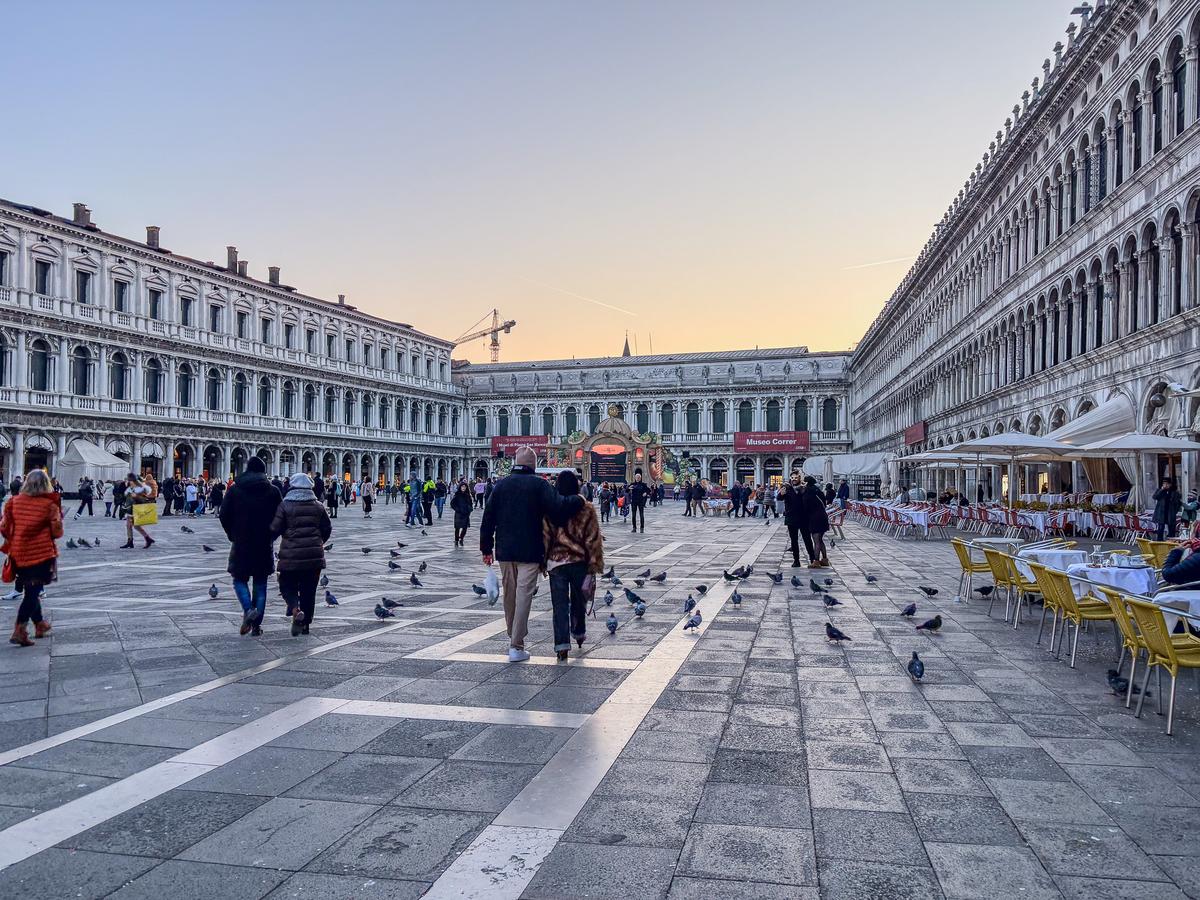
Piazza San Marco brings together St. Mark’s Basilica, the Campanile, Doge’s Palace, the Procuratie, Museo Correr, and historic cafes. It is a useful orientation point rather than a quiet rest area, and crowd levels rise quickly after tour groups begin arriving.
Come shortly after sunrise for photographs and return after dark to see the arcades illuminated. During high tides, water can collect in lower sections of the square and raised walkways may be installed.
Venice prohibits feeding pigeons and restricts sitting, eating, or blocking movement on monuments and steps. Use a cafe, designated bench, or nearby campo when you need a longer break.
5. Ride the lift up St. Mark’s Campanile

Address: Piazza San Marco, 30124 Venezia VE, Italy
Plan on: 30 to 45 minutes. Book ahead: Recommended in busy periods.
St. Mark’s Campanile rises separately beside the basilica and provides broad views across Venice, the lagoon, and nearby islands. The current tower is a reconstruction completed after the earlier Campanile collapsed in 1902.
Visitors reach the belfry by lift rather than climbing a long staircase. The official 2026 price is €15. Visibility is best on clear mornings, but wind and severe weather can affect access.
The tower is a better choice than a gondola for travelers primarily seeking an overview of Venice’s geography. From above, the relationship between the dense historic center, open lagoon, and outer islands becomes much easier to understand.
6. Travel along the Grand Canal
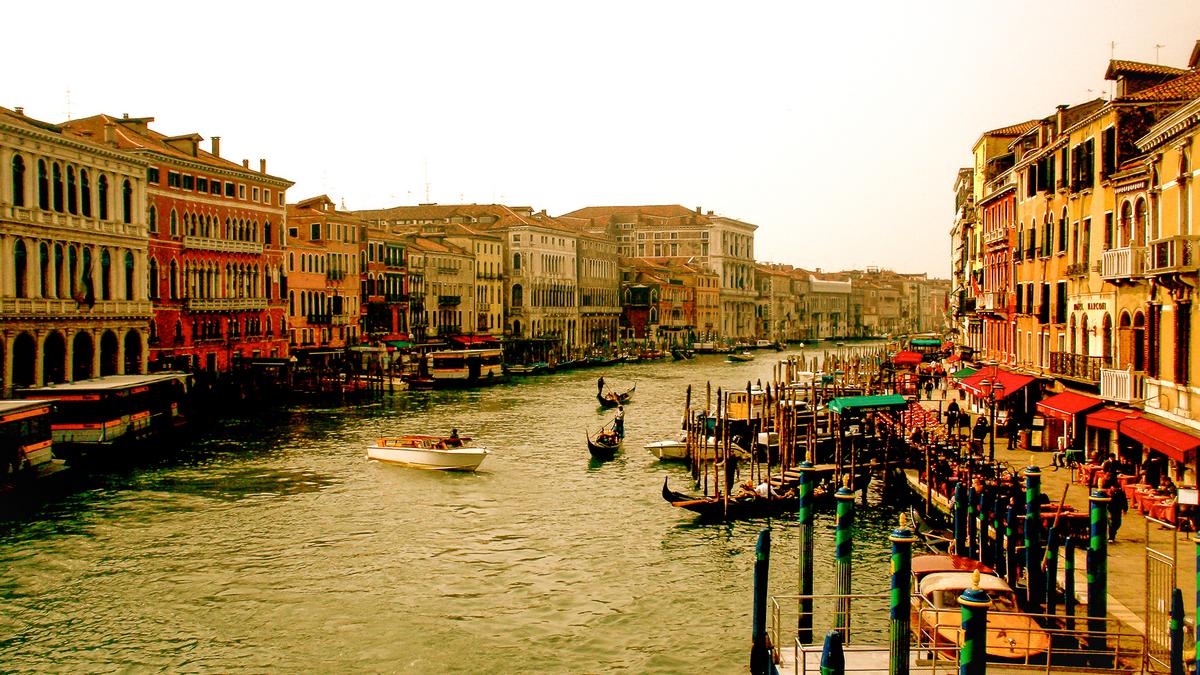
Plan on: 45 to 75 minutes for a sightseeing journey.
The Grand Canal is Venice’s principal water corridor. Palaces, churches, hotels, markets, and former trading houses line its bends, while the Rialto Bridge, Accademia Bridge, Constitution Bridge, and Scalzi Bridge provide major crossing points.
A public vaporetto offers the best value for a complete canal journey. A gondola provides a slower and more private experience but may spend more time on narrower side canals, depending on the route. The guide to Venice’s Grand Canal covers its major landmarks in more detail.
Travel outside the morning and late-afternoon commuter peaks when possible. On a crowded waterbus, move away from the boarding area and avoid blocking passengers who need to disembark.
Travelers who prefer a prearranged private experience can compare the meeting point, route, and duration of this 45-minute private gondola ride with the official walk-up tariff before booking.
7. Cross the Rialto Bridge and visit the market
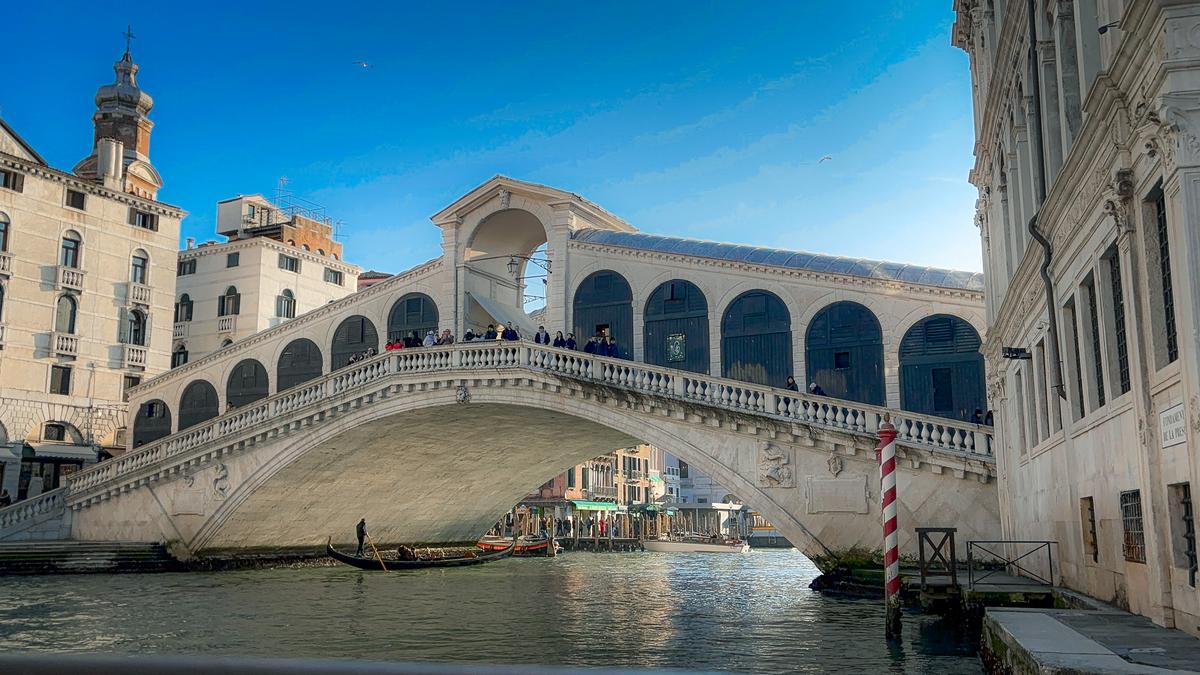
Address: Sestiere San Polo, 30125 Venezia VE, Italy
Plan on: 45 to 75 minutes for the bridge, waterfront, and market area.
The present stone Rialto Bridge dates to the late 16th century and carries two rows of shops over the Grand Canal. Its central and outer walkways provide different views, although both can become congested during the middle of the day.
The Rialto Market is nearby on the San Polo side rather than on the bridge itself. Visit in the morning to see the area operating as a food market rather than arriving after many vendors have finished for the day.
For a clearer photograph, walk along the canal to a nearby vaporetto platform or waterfront edge instead of stopping in the bridge’s narrowest sections. The evening view is particularly good when the palaces and waterbus stops are illuminated.
8. Take the vaporetto to San Giorgio Maggiore

Address: Isola di San Giorgio Maggiore, 30133 Venezia VE, Italy
Plan on: 60 to 90 minutes, excluding transport.
San Giorgio Maggiore sits across the basin from Piazza San Marco. The island’s Palladian basilica, waterfront, monastery complex, and cultural exhibitions provide a calmer counterpoint to the busiest parts of central Venice.
Inside the church, look for major works by Tintoretto and the strong proportions of Andrea Palladio’s architecture. The waterfront also provides one of the clearest views back toward Doge’s Palace and the Campanile.
The San Giorgio Maggiore bell tower is temporarily closed for extraordinary maintenance, with no reopening date announced as of August 3, 2026. The island remains worth visiting for the church, exhibitions, and waterfront, but do not cross solely for the tower view until reopening is confirmed.
9. Visit the Peggy Guggenheim Collection

Address: Dorsoduro 701–704, 30123 Venezia VE, Italy
Plan on: 90 minutes to two hours. Book ahead: Recommended during weekends and major exhibitions.
The Peggy Guggenheim Collection occupies Palazzo Venier dei Leoni, Peggy Guggenheim’s former home on the Grand Canal. Its collection concentrates on 20th-century European and American art, including Cubism, Surrealism, Abstract Expressionism, and Italian Futurism.
The museum’s manageable scale makes it a useful alternative to a much larger gallery. The sculpture garden and low, unfinished palazzo are integral parts of the visit rather than secondary additions designed by a later museum architect.
The museum is open from 10:00 a.m. to 6:00 p.m., with last admission at 5:00 p.m. It is closed on Tuesdays and December 25. Check the current exhibition schedule before selecting a visit date.
10. Step inside Santa Maria della Salute

Address: Dorsoduro 1, 30123 Venezia VE, Italy
Plan on: 30 to 60 minutes.
Santa Maria della Salute was commissioned as a votive church following Venice’s 1630–1631 plague. Architect Baldassare Longhena designed its prominent octagonal form and dome at the entrance to the Grand Canal.
The main church is generally free to enter, while access to areas such as the sacristy may follow separate hours or ticket arrangements. The interior is more restrained than St. Mark’s Basilica, with the architecture and altar arrangement providing the main visual interest.
Opening hours are commonly divided into morning and afternoon periods and may change for religious services. Check the basilica’s current schedule on the day of your visit rather than assuming continuous access.
Combine the church with the Peggy Guggenheim Collection and Punta della Dogana for an efficient Dorsoduro route.
11. Tour or attend a performance at Teatro La Fenice

Address: Campo San Fantin 1965, 30124 Venezia VE, Italy
Plan on: 45 to 60 minutes for a daytime visit; longer for a performance.
Teatro La Fenice opened in 1792 and remains one of Italy’s principal opera houses. Its name, meaning “the phoenix,” proved fitting after fires and reconstructions repeatedly changed the building.
A daytime visit provides access to the gilded auditorium, royal box, and exhibition spaces when rehearsals or performances do not restrict the route. An evening performance offers the complete theater experience but requires more advance planning.
The theater’s official dress code distinguishes among events. Black tie is recommended for the season’s opening night, and premieres are more formal. Button-down shirts and jeans are allowed on ordinary evenings, while shorts and sleeveless shirts are not permitted in the auditorium.
This La Fenice admission ticket with an audio guide is suited to travelers who want to see the interior without committing to an evening performance. Verify the available route on your selected date.
12. Learn how Venice governed itself at Museo Correr

Address: Piazza San Marco 52, 30124 Venezia VE, Italy
Plan on: 90 minutes to two hours.
Museo Correr explains Venice through maps, paintings, sculpture, coins, navigational material, civic objects, and rooms from the Napoleonic and Habsburg periods. The collection originated with the bequest of Venetian collector Teodoro Correr rather than a museum founded by Napoleon’s sister.
The museum is especially useful after visiting Doge’s Palace because it provides broader social and urban context. Its rooms also offer elevated views across Piazza San Marco.
The official schedule lists opening hours of 10:00 a.m. to 6:00 p.m. from April through October and 10:00 a.m. to 5:00 p.m. from November through March, with last admission one hour before closing. Extraordinary openings and temporary exhibitions can alter the schedule.
13. Watch glassmakers at work on Murano

Location: Murano, Venetian Lagoon, 30141 Venezia VE, Italy
Plan on: Three to four hours, including transport.
Murano’s glassmaking industry moved to the island during the Middle Ages and remains its central cultural identity. A useful visit combines a reputable furnace demonstration with the Glass Museum and a walk along the island’s canals.
The Murano Glass Museum is open daily from 10:00 a.m. to 6:00 p.m. between April and October and from 10:00 a.m. to 5:00 p.m. between November and March. In summer 2026, it has extended Friday and Saturday hours on specified dates.
Ask workshops how their demonstrations operate before entering. Some free demonstrations lead directly into a showroom, while paid workshops generally provide a more structured experience. When buying glass, ask where the object was made and keep documentation for high-value purchases.
Travelers who prefer coordinated transport can use this Murano, Burano, and Torcello tour. A guided excursion simplifies logistics but usually provides less independent time on each island.
14. Photograph Burano’s colorful streets

Location: Burano, Venetian Lagoon, 30142 Venezia VE, Italy
Plan on: Three to four hours, including transport.
Burano is known for its brightly painted homes, fishing heritage, canals, and lace-making tradition. The island is small enough to explore on foot, but its travel time from central Venice makes it more than a brief detour.
Leave the busiest route around the vaporetto stop and Piazza Galuppi to see quieter residential canals. The houses are private homes, so avoid blocking doors, leaning on windows, or treating residents’ laundry and courtyards as photo sets.
The Burano Lace Museum is open from 10:00 a.m. to 4:00 p.m. and is closed on Mondays. Its compact collection explains a craft that souvenir shops alone cannot adequately document.
Murano and Burano can be combined in one day, but allow six to eight hours and start early. A structured lagoon-island boat excursion is efficient for an overview; independent ACTV travel provides more flexibility.
15. Browse Libreria Acqua Alta

Address: Calle Longa Santa Maria Formosa 5176b, 30122 Venezia VE, Italy
Plan on: 20 to 30 minutes.
Libreria Acqua Alta stores books in gondolas, bathtubs, and raised containers intended to limit damage when water reaches the shop. Its mix of Italian books, used volumes, prints, postcards, cats, and improvised flood defenses has made it one of Venice’s most photographed shops.
The shop is free to enter and currently lists daily hours from approximately 9:00 a.m. to 7:10 p.m. It is compact and can become congested, so keep bags close, leave access routes open, and buy something if you spend substantial time using the shop as a photo location.
The spelling is Libreria Acqua Alta, not “Librarie.” It is close enough to combine with Santa Maria Formosa, the Bridge of Sighs, or the northern edge of the San Marco district.
16. Have coffee at Caffè Florian

Address: Piazza San Marco 57, 30124 Venezia VE, Italy
Plan on: 30 to 60 minutes.
Caffè Florian opened on December 29, 1720, and occupies a sequence of decorated rooms beneath the Procuratie Nuove. The setting and history are the main reasons to visit.
This is not a budget coffee stop. Prices reflect the Piazza San Marco location, table service, historic interiors, and, when applicable, music service. Review the current menu and charges before ordering rather than assuming the price of a standard neighborhood espresso.
Choose an interior table if you want to study the decorated rooms. Choose the terrace when the square and live music matter more than the cafe itself. Travelers concerned primarily with coffee quality or value will find more economical bars elsewhere in Venice.
17. Rest in Giardini Papadopoli

Address: Santa Croce, 30135 Venezia VE, Italy
Plan on: 20 to 40 minutes.
Giardini Papadopoli is a small enclosed public garden near Piazzale Roma and the western entrance to the historic center. Its benches, shade, paths, and children’s play area make it useful for a rest after arriving by bus, car, or airport transfer.
The garden is not a reason to cross Venice from San Marco, and it does not have the extensive sports facilities, large rose garden, or visitor tunnels previously attributed to it. Treat it as a practical green pause along an arrival or departure route.
18. Try Venetian dishes at Hostaria Osottoosopra

Location: Santa Croce, Venice
Plan on: About 90 minutes. Reserve ahead: Recommended for dinner.
Hostaria Osottoosopra is one option for a seated Venetian meal in Santa Croce. Its menu has included regional dishes alongside broader Italian choices, but current dishes, opening hours, age policies, and prices should be confirmed directly with the restaurant.
Look for dishes such as sarde in saor, seafood, seasonal risotto, or fegato alla veneziana when available. The Italian food guide explains the wider culinary context and common regional terms.
No single restaurant is universally the “best” in Venice. Choose according to the current menu, recent service record, location, dietary needs, and reservation availability rather than relying on an old ranking.
19. Have a late drink at Bacaro Jazz

Address: San Marco 5546, 30124 Venezia VE, Italy
Plan on: 60 to 90 minutes.
Bacaro Jazz is a late-opening cocktail bar and restaurant near the Rialto area. Its central location and long evening hours make it convenient after dinner or a nighttime walk along the Grand Canal.
Despite the name, do not assume that it operates as a dedicated live-jazz club or hosts a concert every night. Check the venue’s current event information if live music is essential to your plans.
Venice’s nightlife is generally more subdued than that of larger Italian cities. Bacaro Jazz suits travelers looking for drinks in a lively central bar rather than a large club or formal performance venue.
20. Visit during Venice Carnival

Next scheduled dates: January 23 to February 9, 2027
Venice Carnival combines public performances, processions, elaborate costumes, mask competitions, workshops, dinners, and private balls. The tradition has documented medieval roots and was revived in its modern form in 1979 after a long interruption.
The official Carnival site currently lists January 23 through February 9, 2027. The detailed program can continue changing as the event approaches, so use the official schedule rather than an older third-party calendar.
Many street events can be experienced without a formal ticket, while dinners, balls, performances, and workshops may require reservations. Accommodation prices and availability tighten considerably, making early lodging reservations more important than a rigid minute-by-minute itinerary.
A Venetian mask-decorating workshop provides more context than buying an anonymous imported mask from a souvenir stall. Verify the workshop location, duration, age requirements, and materials before booking.
How to organize one, two, or three days in Venice
One day in Venice
- Start at St. Mark’s Basilica with the first practical timed entry.
- Tour Doge’s Palace and view the Bridge of Sighs from Ponte della Paglia.
- Walk through Piazza San Marco and ride the Campanile lift if visibility is good.
- Walk to Rialto through the central lanes and visit the market area.
- Finish with a vaporetto journey along the Grand Canal or a prearranged gondola ride.
This route covers Venice’s most important first-visit sights, but it leaves little time for museums beyond Doge’s Palace.
Two days in Venice
Use the first-day route above, then spend the second day in Dorsoduro. Visit Santa Maria della Salute, the Peggy Guggenheim Collection, and the Accademia area. Continue to Teatro La Fenice or cross to San Giorgio Maggiore, depending on museum hours, weather, and the current bell-tower closure.
Use the evening for cicchetti, a reserved dinner, or drinks near Rialto. This schedule provides more time away from Piazza San Marco without requiring a long lagoon-island journey.
Three days in Venice
Dedicate the third day to Murano and Burano. Start early, use a 24- or 72-hour ACTV pass, and allow six to eight hours for transport, the Glass Museum, a demonstration, lunch, the Lace Museum, and independent walking.
Return to central Venice for a relaxed final evening rather than scheduling another timed museum immediately after the island excursion.
Frequently asked questions
How many days do you need in Venice?
Two full days are enough for St. Mark’s Basilica, Doge’s Palace, the Grand Canal, Rialto, and part of Dorsoduro. Plan three days if you also want to visit Murano and Burano without rushing.
What should a first-time visitor not miss in Venice?
Prioritize St. Mark’s Basilica, Doge’s Palace, Piazza San Marco, the Grand Canal, and the Rialto Bridge. Add the Peggy Guggenheim Collection or San Giorgio Maggiore according to your interests and available time.
Do visitors currently have to pay the Venice access fee?
No. Venice’s 2026 trial ended on July 26, and no payment or exemption request has been required since July 27, 2026. Future years depend on new decisions by the City of Venice, so check the official portal before traveling.
How much does a gondola ride cost in Venice?
The current municipal tariff is €90 for a 30-minute daytime ride between 9:00 a.m. and 7:00 p.m. The nighttime tariff is €110 for 35 minutes between 7:00 p.m. and 4:00 a.m. Confirm the route, duration, and any extras before departure.
Can you visit Murano and Burano in one day?
Yes. Allow six to eight hours, start early, and use a multi-journey ACTV pass if traveling independently. A guided boat tour simplifies transport, while independent travel gives you more control over the time spent on each island.
Plan the rest of your Venice trip
Choose accommodation after deciding which neighborhoods and transport connections matter most. The guide to where to stay in Venice compares the practical advantages of San Marco, San Polo, Dorsoduro, Cannaregio, Santa Croce, and mainland options.
For a wider itinerary, use the Italy travel hub, compare other places to visit in Northern Italy, or review the best things to do in Italy.