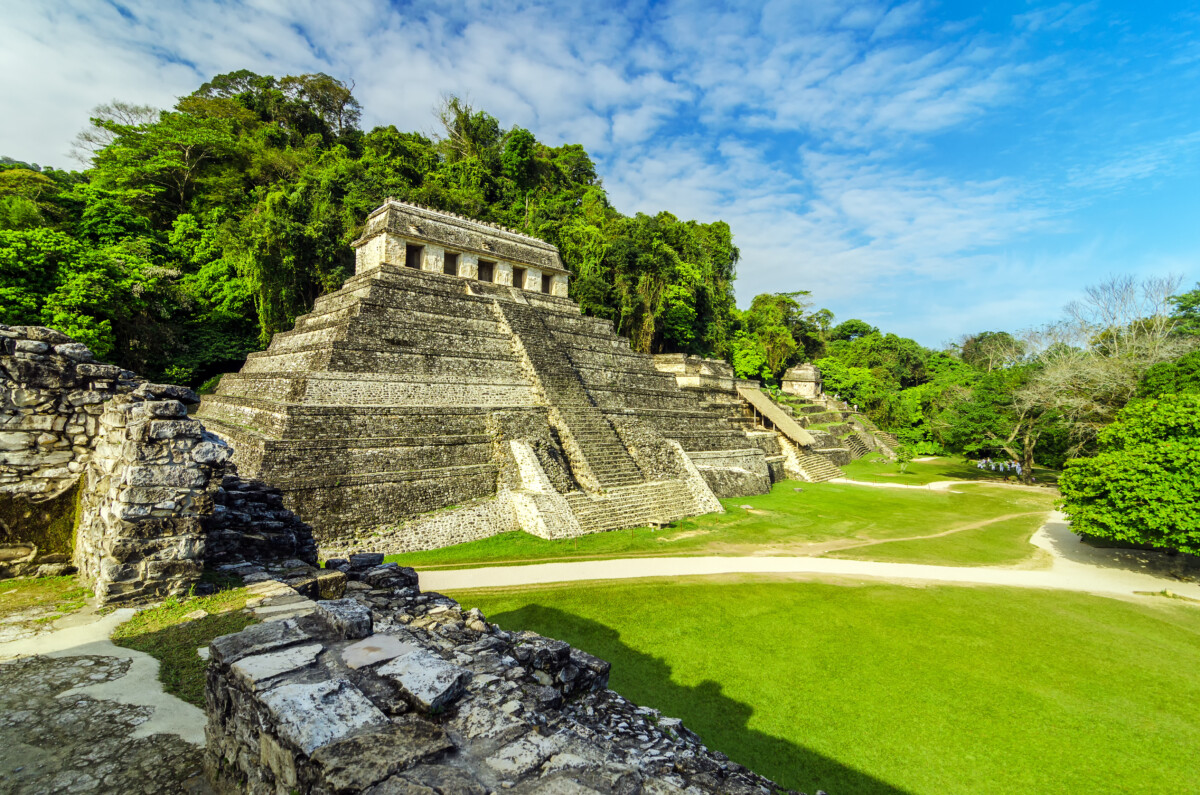
Palenque is worth visiting for its refined Classic Maya architecture, royal tombs, carved inscriptions, and rainforest setting. The archaeological zone lies roughly 7 kilometers from modern Palenque in Chiapas. Most visitors need 3.5 to 5 hours inside the site, while one full day allows time for transport, ticketing, the principal monuments, and a forest trail.
Current planning requires more than checking a single ticket price. Mexico’s archaeology agency, INAH, and the Palenque National Park authority, CONANP, publish separate fees and slightly different service hours. Entry processing begins at the CATVI visitor complex, and the Alberto Ruz L’Huillier Site Museum is currently listed as temporarily closed.
Visitor information was last verified on July 15, 2026. Recheck fees, museum status, transport arrangements, structure access, and travel advisories immediately before your trip.

Palenque Ruins at a Glance
| Question | Current answer |
|---|---|
| Where is Palenque? | In northern Chiapas, roughly 7 kilometers from modern Palenque town. |
| Is it open every day? | INAH currently lists daily hours of 8:00 a.m. to 5:00 p.m., with final access at 4:00 p.m. CONANP lists park service hours from 8:30 a.m. to 4:00 p.m. |
| How much does it cost? | INAH currently lists MXN 210 general admission and MXN 105 for Mexican nationals and foreign residents. CONANP separately lists a MXN 225 general park fee, with qualifying discounts and exemptions. |
| How long do you need? | Allow 3.5 to 5 hours for the main archaeological zone. Stay two nights in town if you also want a waterfall or remote Maya-site excursion. |
| Best months | February and March offer the strongest balance of lower historical rainfall and less intense heat. April is drier but hotter. |
| Museum status | The Alberto Ruz L’Huillier Site Museum is currently listed as temporarily closed. Verify before travel. |
| Can you climb the ruins? | Only enter or climb areas that are visibly open. Access changes for conservation and safety. |
A Brief History of Palenque
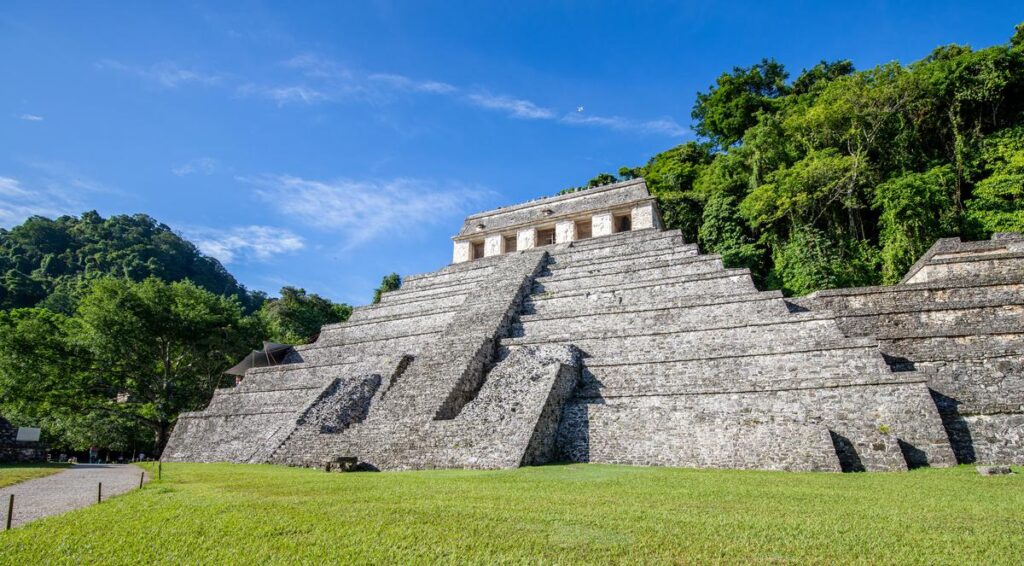
The ancient Maya knew Palenque as Lakamha, usually translated as “Big Waters,” a fitting name for a city crossed by springs and streams. Settlement began long before its best-known rulers, and Palenque was not founded by K’inich Janaab’ Pakal. The city developed over centuries and became an influential Classic-period capital.
Palenque reached a major political and artistic peak under Pakal, who ruled from 615 to 683, and under later members of his dynasty. Its architects built elevated temples, enclosed courtyards, aqueducts, royal apartments, and sanctuaries covered with inscriptions and modeled stucco. The surviving texts record accessions, warfare, ritual events, ancestry, and the rulers’ relationship with the gods.
Pakal’s tomb was found inside the Temple of the Inscriptions in 1952 by archaeologist Alberto Ruz L’Huillier. The discovery helped establish that major Maya pyramids could serve as funerary monuments as well as temple platforms.
The city declined and was largely abandoned around the ninth century. Forest growth protected many buildings while also concealing most of the urban area. UNESCO inscribed Palenque as a World Heritage Site in 1987 and reports roughly 1,400 identified structures, only about 10 percent of which have been explored. See how Palenque compares with other archaeological sites in Mexico.
Palenque Tickets, Hours, and Current Status
| Item | Published information | Planning note |
|---|---|---|
| Archaeological-zone hours | 8:00 a.m.–5:00 p.m. daily; final access at 4:00 p.m. | Published by INAH. |
| National-park hours | 8:30 a.m.–4:00 p.m. | Published by CONANP. Agency schedules differ slightly. |
| INAH admission | MXN 210 general; MXN 105 for Mexican nationals and foreign residents. | This does not include separately collected third-party charges. |
| CONANP park fee | MXN 225 general. | Discounts and exemptions apply to qualifying visitors. Bring valid identification. |
| Arrival point | CATVI visitor complex | Ticket offices and onward transport to the archaeological area are organized here. |
| Site museum | Temporarily closed | Check the official museum listing for reopening information. |
At the currently posted rates, a nonresident adult should allow roughly MXN 435 for the INAH and CONANP charges combined, before transport, guide fees, or optional tours. Treat that figure as a planning estimate rather than a permanent total. Carry valid identification for discounts and keep a backup payment method in case one ticket point has a temporary card or connectivity problem.
Arrive between 8:00 and 8:30 a.m. The early start reduces heat exposure, gives you more time before final entry, and helps you reach the principal monuments before larger tour groups.
Disclosure: Some links in this guide are affiliate links. ViaTravelers may earn a commission if you book through them, at no additional cost to you. Recommendations are based on usefulness and fit rather than commission.
A Practical One-Day Palenque Itinerary
This route prioritizes the buildings with the greatest historical and architectural value while leaving time for photographs, interpretation panels, and heat breaks.
- 8:00–8:30 a.m.: Arrive at CATVI. Purchase or validate the required tickets, use the facilities, and confirm the day’s transport and access arrangements.
- 8:30–10:00 a.m.: Explore the Temple of the Inscriptions and Palace. These are the site’s most important royal and administrative monuments. Spend time viewing the Palace courtyards rather than only photographing its tower.
- 10:00–11:15 a.m.: Walk to the Group of the Cross. Compare the Temple of the Cross, Temple of the Sun, and Temple of the Foliated Cross as one related dynastic complex.
- 11:15 a.m.–12:15 p.m.: See Temple XIII, the Temple of the Skull, and the North Group. These smaller buildings add burial, residential, and chronological context.
- 12:15–1:30 p.m.: Follow an open forest trail or revisit the central group. Use only marked paths, do not enter closed structures, and do not feed wildlife.
- After 1:30 p.m.: Return to town for lunch. Add the site museum only if INAH has confirmed that it has reopened.
Fast walkers can see the principal structures in about three hours, but that pace leaves little time for inscriptions, architectural details, heat breaks, or forest trails. A half-day visit is more realistic.
Best Things to See at the Palenque Ruins
1. The Palace

The Palace is not one building but a complex of rooms, galleries, stairways, patios, underground passages, and ceremonial spaces constructed in multiple phases. Rulers received visitors, supervised tribute, staged rituals, displayed captives, and conducted court business here.
Its most recognizable feature is a four-story tower. The tower has been described as an observation point, watchtower, or astronomical structure, but no single interpretation is conclusively established. Treat its function as an open archaeological question rather than a settled fact.
Look for the Palace’s corbelled vaults, stucco fragments, broad openings, courtyards, and the Oval Palace Tablet, which depicts Pakal’s accession. Access to individual rooms can change, so follow current barriers rather than older guidebooks.
2. The Temple of the Inscriptions

The Temple of the Inscriptions is Palenque’s principal funerary monument. Its name comes from three large hieroglyphic panels in the upper sanctuary. The texts connect Pakal’s reign with earlier dynastic history and ritual chronology.
A concealed stairway leads down through the pyramid to Pakal’s burial chamber and carved stone sarcophagus. Alberto Ruz L’Huillier reached the tomb in 1952 after years of clearing the passage. The discovery changed how archaeologists interpreted the function of Maya temple pyramids.
Do not expect to enter the crypt. Interior access is tightly controlled and may be closed entirely for conservation. The temple remains significant from the plaza because its pyramid, sanctuary, inscriptions, and relationship with the Palace reveal how royal authority shaped the city center.
3. The Group of the Cross
The Group of the Cross consists of three related temples commissioned under K’inich Kan B’alam II, Pakal’s successor. Together, their carved sanctuary panels connect royal accession, ancestry, agriculture, warfare, cosmology, and patron deities. The “crosses” are not Christian symbols; they are stylized world-tree and plant forms within Maya iconography.
Temple of the Sun

The Temple of the Sun is among Palenque’s best-preserved sanctuaries and retains a prominent roof comb. Its inner panel includes a shield with solar associations supported above a supernatural earth or underworld image. The monument relates royal power to warfare and celestial symbolism rather than functioning as a generic shrine to a single “sun god.”
Temple of the Cross

The Temple of the Cross is the largest of the three temples. Its sanctuary tablet depicts a branching world-tree form, ancestral and divine figures, and Kan B’alam within a carefully constructed dynastic narrative. It was not a small shrine dedicated to Chac, as older popular descriptions sometimes claim.
The elevated setting gives strong views over the plaza when the stairway is open. Do not cross barriers to reach a viewpoint; conservation restrictions can change without appearing in older photographs or travel reports.
Temple of the Foliated Cross

The Temple of the Foliated Cross uses plant and maize imagery to connect rulership with fertility, agricultural abundance, and the ordered universe. Its name refers to the leafy form represented in the sanctuary panel, not a Christian cross.
There is no reliable archaeological basis for claims that making a wish here changes a visitor’s life or guarantees that the wish will come true. The documented iconography and relationship with the other two temples are more interesting than the modern legend.
4. Temple XIII, the North Group, and Other Structures

- Temple XIII and the Red Queen: Archaeologists found the cinnabar-covered remains of an elite woman in Temple XIII. INAH commonly identifies her as Tz’ak-bu Ajaw, Pakal’s consort, although archaeological identifications should be understood as evidence-based interpretations rather than absolute certainty.
- Temple of the Skull: The building takes its modern name from a relief often interpreted as a rabbit skull. Claims about stored enemy heads or a dedication to Chac are not well supported.
- Temple of the Count: This early temple stands near the North Group. Its modern name recalls the 19th-century traveler Jean-Frédéric Waldeck, who styled himself as a count.
- North Group: These structures help show that Palenque developed through multiple building periods rather than appearing as one unified royal project.
- Aqueducts and water channels: Palenque’s builders redirected streams through masonry channels, allowing dense construction in a landscape defined by flowing water.
5. Alberto Ruz L’Huillier Site Museum

The Alberto Ruz L’Huillier Site Museum normally provides crucial context for Palenque’s inscriptions, funerary objects, sculpture, and architectural decoration. Its exhibits help visitors understand details that can be difficult to interpret on weathered buildings.
INAH currently labels the museum as temporarily closed. Do not build a fixed itinerary around it until the official listing confirms that it has reopened. When operational, normal listed hours are Tuesday through Sunday from 9:00 a.m. to 5:00 p.m.
How to Get to the Palenque Ruins

From Palenque Town
The archaeological area is roughly 7 kilometers from town. Taxis and local colectivos generally serve the route, but pickup points, fares, and whether transport terminates at CATVI can change. Confirm the current arrangement with your accommodation or at the transport terminal rather than relying on an old blog price.
Modern Palenque is the most practical base because it has intercity transport, restaurants, tour operators, and accommodation at several price levels. For wider route planning, use the Mexico travel guide.
By Tren Maya
Palenque has a Tren Maya station, and official visitor planning describes a connection between the station, CATVI, the museum area, and the archaeological zone. Train schedules and fares are volatile, so check the official Tren Maya reservation platform rather than reproducing a timetable that may become obsolete.
Build transfer time into the itinerary. A train arrival in Palenque does not mean you will step directly into the ruins, and the final-entry deadline still applies.
From Villahermosa
CONANP places Villahermosa about 145 kilometers from Palenque National Park. It is a common flight and overland gateway. A prearranged transfer, reputable coach, or rental car is more practical than trying to combine an airport arrival and a full archaeological visit without buffer time.
From San Cristóbal de las Casas
San Cristóbal is about 191 kilometers away in straight route planning, but the security situation on the common Highway 199 corridor materially affects this journey. The UK currently advises against all but essential travel on Highway 199 between Rancho Nuevo, outside San Cristóbal, and the Chancalá junction outside Palenque because of roadblocks and kidnapping risk.
Do not book this transfer solely because an old itinerary calls it a standard tourist route. Check current government advice, ask the operator for the exact route, travel during daylight, and use a well-established transport provider. A longer route may be preferable when official warnings affect the direct road.
Best Time to Visit Palenque

February and March provide the best overall balance for most visitors. Historical records from the Palenque weather station show average monthly rainfall of roughly 97 millimeters in February and 94 millimeters in March, while average daytime highs remain around 30–32°C.
April is historically drier, at roughly 73 millimeters of rain, but average highs rise above 34°C. May is hotter still. September and October are substantially wetter, with historical monthly averages above 300 millimeters. Review the underlying SMN climate normals rather than treating any month as guaranteed dry weather.
| Period | What to expect | Best for |
|---|---|---|
| February–March | Lower historical rainfall, warm days, and generally manageable heat | Best overall balance |
| April–May | Drier conditions but higher temperatures and stronger heat exposure | Heat-tolerant travelers prioritizing lower rain risk |
| June–October | Heavier rainfall, humidity, slippery stone, and possible route disruption | Travelers comfortable with wet-season variability |
| November–January | Somewhat cooler, but not necessarily as dry as February or March | Holiday travel and cooler mornings |
Regardless of month, visit early. The difference between an 8:30 a.m. plaza and a midday plaza is more important than a small variation in monthly average temperature.
What to Pack, Park Rules, and Accessibility

Packing List
- Refillable water bottle
- Breathable shirt and lightweight travel shorts for hot weather
- Supportive shoes with grip for wet stone and uneven paths
- Hat and broad-spectrum sunscreen
- Insect repellent
- Compact rain shell or poncho, even outside the wettest months
- Valid identification for any admission discount
- Cash and a backup payment card
- Small waterproof pouch for a phone, passport copy, and tickets
National Park Rules
CONANP rules prohibit extracting plants or other natural material, lighting fires, feeding wildlife, marking trees, smoking, climbing lianas, and swimming in protected cascades. Remain on marked routes and take all waste out with you.
Howler monkeys may be audible in the canopy, but wildlife sightings are never guaranteed. Keep food secured, maintain distance, and do not use food or sound to attract animals.
Accessibility
CATVI and the museum complex may provide some accessibility services, but the archaeological zone includes uneven stone, roots, slopes, narrow passages, and long staircases. Many monuments are not step-free. Visitors with mobility, balance, or heat-tolerance concerns should contact INAH before travel, ask which route is currently accessible, and avoid assuming that photographs represent present-day access.
Where to Stay Near the Palenque Ruins
Choose between a forest resort closer to the archaeological zone and a town hotel closer to restaurants and intercity transport. Rates and exact amenities change, so the useful comparison is location and property style rather than a temporary nightly price.
| Hotel | Best for | Why it works | Tradeoff |
|---|---|---|---|
| Chan-Kah Resort Village | Resort facilities near the ruins | Forest setting, large pool area, restaurant, bar, and spa facilities | Less convenient for walking around central Palenque |
| Hotel Museo Xibalba | A practical town base | Central location and straightforward rooms near town services | Less immersive than the forest properties and farther from the ruins |
| Piedra de Agua Palenque | A smaller boutique and spa stay | Forest setting, outdoor pool, spa services, terraces, and proximity to the archaeological corridor | Transport is useful for reaching the town center, and rates may exceed simpler town hotels |
For an early archaeological visit, proximity to CATVI can be more valuable than nightlife or a large restaurant selection. For travelers arriving late by bus or train, a town hotel may simplify the first and final night.
Best Day Trips from Palenque

Yaxchilán and Bonampak
Yaxchilán and Bonampak make a long but historically rewarding excursion. Yaxchilán requires onward river transport, while Bonampak is known for preserved murals. The distance, border-region logistics, and boat connection make a reputable organized trip more practical than improvising the route.
Confirm pickup time, boat arrangements, inclusions, passport requirements, and the current security situation before booking a Yaxchilán and Bonampak excursion from Palenque.
Misol-Há and Agua Azul
Misol-Há is a tall forest waterfall, while Agua Azul spreads through a sequence of limestone pools and cascades. Color, water volume, swimming access, and road conditions vary with rainfall. The route toward Agua Azul can overlap with corridors affected by security warnings, so verify the operator’s exact route and current government advice before departure.
A combined Palenque, Misol-Há, and Agua Azul tour can reduce transport complexity, but a long multi-stop day gives less time at each place.
Roberto Barrios Waterfalls
Roberto Barrios is a more compact waterfall outing from Palenque. Conditions still depend on rain, current, and local access rules. Use designated swimming areas, secure valuables, and confirm return transport before leaving town.
Is Palenque Safe to Visit?
Palenque should not be described as uniformly safe or unsafe without naming the route and the advisory source. As of July 2026, the U.S. Department of State advises reconsidering travel to Chiapas because of crime and terrorism concerns. The Canadian advisory excludes Palenque city, the ruins, and Highway 186 from its broader avoid-nonessential-travel warning for Chiapas. The UK advisory specifically warns against all but essential travel on part of Highway 199 between San Cristóbal and the Palenque area.
Those positions use different geographic and policy frameworks. They should not be reduced to a single statement that “Palenque is safe.” Check the advice issued by your own government and compare it with your exact route.
- Use established daytime transport and ask for the planned route.
- Avoid unplanned night driving and do not continue through an active roadblock.
- Keep passports, cards, and excess cash secured rather than carrying everything together.
- Download offline maps and save accommodation and transport contact details.
- Monitor road and weather conditions on the morning of any regional excursion.
- Follow instructions from park staff and do not enter closed forest routes or structures.
Travel insurance may help with eligible medical, evacuation, cancellation, or disruption costs, but coverage depends on the policy, destination advisory, exclusions, and purchase date. Compare terms rather than selecting a policy on price alone. Options include VisitorsCoverage and SafetyWing; neither is appropriate for every traveler or itinerary.
Palenque Ruins FAQs
Is Palenque open every day?
INAH currently lists the archaeological zone as open daily from 8:00 a.m. to 5:00 p.m., with final access at 4:00 p.m. CONANP lists national-park service hours from 8:30 a.m. to 4:00 p.m., so confirm the current schedule before travel.
How much does it cost to visit the Palenque ruins?
As of July 2026, INAH lists MXN 210 general admission and MXN 105 for Mexican nationals and foreign residents. CONANP separately lists a MXN 225 general park fee, with qualifying discounts and exemptions. Allow for both charges and verify current prices before visiting.
How long do you need at Palenque?
Allow 3.5 to 5 hours inside the archaeological zone. One full day is enough for transport, ticketing, the principal monuments, and a forest trail. Stay two nights in Palenque if you also want a regional day trip.
Can visitors climb the ruins at Palenque?
Do not assume that a structure is open for climbing. Access changes for conservation and safety. Use only stairways, platforms, and interiors that are visibly open, and obey every barrier and staff instruction.
Is the Palenque site museum open?
INAH currently lists the Alberto Ruz L’Huillier Site Museum as temporarily closed. Check the official museum page shortly before travel rather than building your itinerary around a reopening date that has not been confirmed.
Is Palenque safe for tourists?
Official advisories differ by country and route. The U.S. currently advises reconsidering travel to Chiapas, Canada excludes Palenque city and the ruins from its broader Chiapas warning, and the UK warns against the Highway 199 corridor from San Cristóbal toward Palenque. Check your own government’s current advice and use reputable daytime transport.
Final Planning Advice
Palenque rewards travelers who give the site enough time and prepare for its heat, rain, uneven terrain, and changing access arrangements. For most visitors, the strongest plan is two nights in Palenque town, an early half-day at the ruins, and one flexible day for a regional excursion or weather delay.
Verify the two official fees, CATVI process, museum status, train or road conditions, and government travel advice 24 to 48 hours before departure. Once those logistics are settled, focus on the relationships between the Palace, Temple of the Inscriptions, and Group of the Cross rather than treating the site as a checklist of unrelated pyramids.
For further historical trip planning, compare Palenque with other ancient ruins and archaeological sites around the world.