Puerto Rico is the strongest all-around choice for many first-time Caribbean travelers, Turks and Caicos is the clearest pick for calm beaches, Saint Lucia works especially well for honeymoons, Jamaica pairs resort convenience with culture, Dominica leads for hiking, and the British Virgin Islands are built for sailing. The right island still depends on your budget, flight options, preferred pace, and tolerance for complicated logistics.
This comparison covers 20 destinations by trip type, practical tradeoffs, suggested stay length, and the experiences each place handles best. The numbers are for navigation, not a universal ranking.
The Bahamas is commonly grouped with Caribbean travel even though much of the country lies in the Atlantic. Bermuda is farther north in the North Atlantic and is included because travelers often compare it with Caribbean islands. Its seasons and sea temperatures differ from the tropical Caribbean.
Last verified: August 3, 2026. Entry rules, ferry schedules, attraction access, travel advisories, and weather conditions can change. Check official government and destination sources before booking.
Disclosure: ViaTravelers may earn a commission from qualifying bookings made through links in this guide, at no additional cost to you. Recommendations are based on destination fit and practical usefulness, not commission rates.
In this guide
- Quick picks by trip type
- How these islands were evaluated
- Caribbean island comparison table
- Detailed island guides
- When to visit the Caribbean
- How to choose the right island
- Frequently asked questions
Quick picks: which Caribbean island is best for your trip?
Use this table to build a shortlist. Flight schedules and total trip cost can change the answer, so compare the door-to-door journey before committing to a destination.
| Trip priority | Best starting point | Why it fits | Good alternative |
|---|---|---|---|
| First Caribbean trip | Puerto Rico | City, rainforest, beaches, food, and easy domestic travel for U.S. citizens | Barbados |
| Calm, polished beach vacation | Turks and Caicos | Grace Bay, clear water, upscale resorts, and easy family days | Cayman Islands |
| Honeymoon scenery | Saint Lucia | Pitons, rainforest, small resorts, and strong couples appeal | Grenada |
| All-inclusive resorts plus culture | Jamaica | Large resort range with music, food, waterfalls, and distinct regions | Aruba |
| Family trip | Barbados | Good mix of beaches, activities, restaurants, and history | Grand Cayman |
| Scuba diving | Cayman Islands | Accessible reefs, walls, wrecks, and established dive infrastructure | Dominica |
| Hiking and rainforest | Dominica | Volcanic terrain, waterfalls, hot springs, and demanding trails | Guadeloupe |
| Sailing and island-hopping | British Virgin Islands | Short passages, protected anchorages, and distinct islands | Antigua |
| Food and culture | Puerto Rico | Old San Juan, regional cuisine, music, and day-trip variety | Trinidad and Tobago |
| No passport for U.S. citizens | U.S. Virgin Islands | Straightforward domestic trip with beaches and national parkland | Puerto Rico |
How we chose these Caribbean islands
The list favors destinations that give a specific traveler a clear reason to choose them. Each island was evaluated on the following criteria:
- Quality and range of beaches, nature, cultural sites, food, and water activities
- Fit for common trips such as honeymoons, family vacations, diving, hiking, sailing, and short escapes
- Flight, ferry, road, and inter-island logistics
- Range of accommodations and ease of planning without assuming a luxury budget
- Seasonal weather, hurricane exposure, and potential sargassum disruption
- Current legal, entry, and safety constraints that materially affect a trip
This is not a claim that every island suits every traveler. Some destinations earn a place because they are unusually good at one kind of trip, while others offer a broader mix.
Caribbean island comparison table
| Destination | Best for | Suggested stay | Main tradeoff |
|---|---|---|---|
| Jamaica | All-inclusive resorts, music, food, waterfalls | 5-7 nights | Road transfers can be long; review current safety guidance |
| Turks and Caicos | Calm beaches, luxury, family downtime | 4-7 nights | High prices and limited public transportation |
| The Bahamas | Island variety, boating, short flights from Florida | 4-7 nights | The experience depends heavily on which island you choose |
| Saint Lucia | Honeymoons, Piton views, rainforest | 5-7 nights | Winding roads make transfers slower than the map suggests |
| Antigua and Barbuda | Beaches, sailing, English Harbour | 4-7 nights | Barbuda excursions depend on weather and transport schedules |
| Barbados | Families, food, beaches, history | 5-7 nights | The south and west coasts feel more developed |
| Aruba | Reliable sun, easy resorts, desert scenery | 4-7 nights | Wind and a built-up hotel zone are part of the experience |
| Bermuda | Pink-sand beaches, short East Coast trips, British Atlantic culture | 3-5 nights | It is cooler than the tropical Caribbean and can be expensive |
| Cayman Islands | Diving, families, calm water, dining | 4-7 nights | Accommodation and meals often cost more than expected |
| Dominica | Hiking, waterfalls, whale watching | 5-7 nights | Fewer classic white-sand resort beaches |
| Grenada | Balanced beach-and-nature trip | 5-7 nights | Hilly roads and slower transfers |
| Guadeloupe | French Creole road trip, beaches, rainforest | 7-10 nights | A rental car and some French make the trip easier |
| Martinique | Cuisine, Mount Pelee, beaches, rum | 6-8 nights | Driving is useful; French is the main language |
| Saint Barthelemy | Villas, dining, quiet luxury | 4-7 nights | Very high prices and a more involved arrival |
| Saint Kitts and Nevis | History, scenic rail, relaxed couples trips | 5-7 nights | Build ferry and transfer time into a two-island itinerary |
| Trinidad and Tobago | Carnival culture, food, birding, Tobago beaches | 5-8 nights | Current U.S. guidance says to reconsider travel |
| U.S. Virgin Islands | No-passport trips for U.S. citizens, beaches, national parks | 4-7 nights | Popular areas can be busy and lodging is not cheap |
| Puerto Rico | First-time trips, city and nature, no passport for U.S. citizens | 5-8 nights | A car helps outside San Juan; popular sites require planning |
| British Virgin Islands | Sailing, island-hopping, beach bars | 7 nights | Passport, customs, boat costs, and ferry timing matter |
| Cuba | Architecture, history, music, cultural travel | 7-10 nights | Legal, payment, power, and transport constraints require preparation |
20 best Caribbean islands to visit
1. Jamaica: best for all-inclusive resorts, music, and regional variety

Jamaica works well for travelers who want an easy resort base without giving up food, music, waterfalls, and day trips. The island is large enough that choosing the right region matters more than choosing a single hotel. Montego Bay has the busiest resort corridor and a major airport; Negril is known for Seven Mile Beach and its west-end cliffs; Ocho Rios is convenient for Dunn’s River Falls and other north-coast attractions; Kingston has the strongest music and urban culture; Port Antonio suits travelers who prefer a slower, greener base.
Families can start with ViaTravelers’ guide to all-inclusive family resorts in Jamaica. Travelers staying around Montego Bay can also compare a catamaran cruise from Montego Bay, but check the operator’s pickup zone before booking.

Plan around transfer time. A stay split between Negril and Port Antonio can consume much of a week on the road. The U.S. State Department’s Jamaica travel advisory was Level 2 as of June 23, 2026, with some areas carrying higher risk. Use established transportation, confirm which neighborhoods and routes are appropriate, and review the latest guidance shortly before departure.
Best fit: resort travelers who still want strong local food, music, and excursions. Suggested stay: five to seven nights in one region, or eight to ten nights for two bases.
2. Turks and Caicos: best for calm water and an upscale beach break

Providenciales is the practical base for most first visits to Turks and Caicos. Grace Bay has calm, clear water, a broad beach, restaurants, and most of the territory’s full-service resorts. North and Middle Caicos feel quieter and require more independent planning, while Grand Turk appeals to divers and cruise visitors.
The destination suits families, couples, and groups who expect to spend much of the trip in or near the water. Snorkeling, wall diving, paddleboarding, and mangrove trips are easy to arrange; this Providenciales mangrove tour is one option. For lodging research, use the guide to resorts in Turks and Caicos rather than assuming every property includes meals or airport transfers.

The main drawbacks are cost and limited public transportation. The U.S. advisory was Level 2 on July 7, 2026, and specifically warns that firearms and ammunition are illegal, including stray rounds accidentally left in luggage. Review the current Turks and Caicos advisory and inspect every bag before flying.
Best fit: travelers prioritizing beach quality, calm water, and polished resorts. Suggested stay: four to seven nights.
3. The Bahamas: best for choosing your own style of island trip

The Bahamas is an Atlantic archipelago of roughly 700 islands and cays, so “a trip to the Bahamas” can describe very different vacations. Nassau and Paradise Island offer the simplest combination of frequent flights, large resorts, restaurants, historic sites, and organized excursions. The Exumas are better for boat days, shallow turquoise water, and smaller settlements. Eleuthera and Harbour Island suit a quieter beach trip, the Abacos appeal to boaters, and Andros is a strong choice for diving, fishing, and nature.
For a first trip, decide whether you want a resort-centered stay or an Out Island itinerary before comparing hotels. ViaTravelers’ guide to things to do in the Bahamas provides a broader planning base. Travelers interested in Big Major Cay can compare an Exumas day trip from Nassau, but a long speedboat day is not equivalent to staying in the Exumas.

Island-hopping is possible, but routes do not form one simple network; many connections run through Nassau or require a flight. The U.S. State Department advisory was Level 2 on July 28, 2026, due to crime. Review the latest Bahamas guidance, stay aware in busy areas, and use reputable excursion operators.
Best fit: travelers willing to choose a specific island rather than treating the country as one uniform destination. Suggested stay: four to seven nights on one island; seven to ten for a planned two-island trip.
4. Saint Lucia: best for honeymoons, Piton views, and rainforest scenery

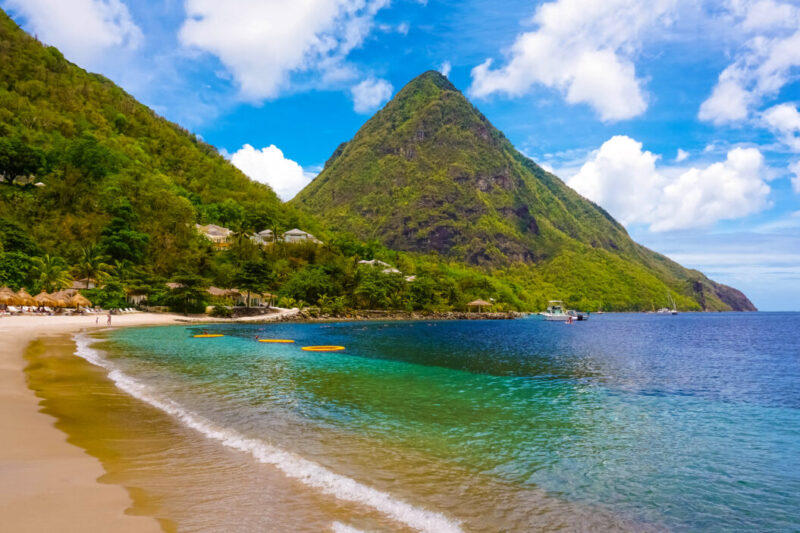
Saint Lucia is the strongest choice on this list for couples who want dramatic scenery built into the hotel experience. Soufriere and the southwest coast place you near the Pitons, Sugar Beach, volcanic springs, and rainforest trails. The north, including Rodney Bay and Gros Islet, has a larger concentration of restaurants, nightlife, marinas, and conventional beach resorts.

The Pitons Management Area is a UNESCO World Heritage Site. Travelers can hike, snorkel near Anse Chastanet, visit botanical gardens, or take a rainforest aerial tram and zipline tour. Choose a guide and difficulty level that matches your fitness rather than treating every Piton hike as a casual walk.

The map understates travel time. Mountain roads are narrow and winding, and airport transfers to the north or southwest can take a substantial part of a day. A split stay can work, but only if the itinerary is long enough to justify repacking.
Best fit: honeymoons, anniversaries, and nature-focused couples trips. Suggested stay: five to seven nights, or eight nights for north and south bases.
5. Antigua and Barbuda: best for beaches, sailing, and English Harbour

Antigua offers a dense choice of coves and beaches, a major sailing culture, and enough restaurants and historic sites for a full week. English Harbour and Nelson’s Dockyard suit travelers interested in maritime history and yachts; the west and north coasts have many of the larger resorts; smaller bays around the island make beach-hopping practical with a rental car or driver.
Barbuda is flatter, quieter, and less developed. Its Frigate Bird Sanctuary and long beaches are the main reasons to make the crossing. Treat a Barbuda visit as a separate excursion with weather-dependent boat or flight logistics, not as a guaranteed add-on to every Antigua itinerary. A guided Antigua island tour can be useful for travelers who do not want to drive.

Antigua is easy to enjoy as a resort trip, but it rewards at least one day away from the hotel. Check cruise schedules if you want to visit St. John’s with fewer crowds, and confirm sea conditions before any long boat excursion.
Best fit: beach collectors, sailors, and couples who want a relaxed week with a few cultural outings. Suggested stay: four to seven nights.
6. Barbados: best for families, food, and an easy mix of beach and culture

Barbados is one of the easiest islands to recommend to mixed-interest groups. The west coast has calmer water and many upscale hotels; the south coast combines beaches, restaurants, and nightlife; the east coast has rougher Atlantic scenery and stronger surf. Inland attractions, rum history, gardens, and caves give non-beach days a clear purpose.
Historic Bridgetown and its Garrison form a UNESCO World Heritage Site. Harrison’s Cave is another useful family outing, and travelers can compare a guided cave and garden tour. ViaTravelers’ Barbados budget guide helps identify where self-catering and local transport can reduce costs.

The island is developed by Caribbean standards, which is an advantage for dining and logistics but may disappoint travelers seeking isolation. Families should still match the coast to swimming ability because Atlantic-facing beaches can have powerful surf.
Best fit: families, first-time visitors, food-focused travelers, and groups with different interests. Suggested stay: five to seven nights.
7. Aruba: best for reliable sun, straightforward resorts, and desert scenery

Aruba sits in the southern Caribbean close to Venezuela and has a drier, windier climate than many islands farther north. It is a constituent country within the Kingdom of the Netherlands, not a property “owned” by the Netherlands. Palm Beach provides the biggest concentration of resorts, restaurants, and water activities, while Eagle Beach feels broader and less enclosed by high-rise hotels.
The island’s dry interior is a major part of its appeal. Arikok National Park protects desert terrain, caves, coastal viewpoints, and native plants. Baby Beach, Oranjestad’s Dutch Caribbean architecture, the California Lighthouse, and snorkeling sites can fill several days without long drives.

Flamingos are not a normal feature of Aruba’s public beaches. The best-known encounters are on private islands connected to specific resorts or day-pass programs, including the private island described by the Aruba Tourism Authority. Aruba lies outside the main hurricane belt, but nearby tropical systems can still affect weather and flights; no Caribbean destination is weather-proof.
Best fit: travelers who want a simple beach-and-dining trip with dependable sunshine and easy road trips. Suggested stay: four to seven nights.
8. Bermuda: best for pink sand and a short North Atlantic escape

Bermuda is not in the Caribbean. The official tourism authority places it in the North Atlantic about 650 nautical miles from Cape Hatteras, North Carolina. It belongs in this comparison because travelers often consider it for a warm-weather island trip, especially from the U.S. East Coast, but its climate is more seasonal than the tropical Caribbean.
Pink-sand beaches, clear coves, shipwreck diving, limestone caves, white-roofed houses, the Royal Naval Dockyard, and historic St. George’s create a compact itinerary. Hamilton is the commercial capital, while the National Museum of Bermuda is at the Dockyard rather than in Hamilton.

Conventional rental cars are not available to visitors. Buses, ferries, taxis, scooters, bicycles, and small electric rental vehicles are the main options; review official Bermuda transportation information before deciding where to stay. Winter can be mild but too cool for travelers expecting tropical swimming weather.
Best fit: three- to five-night escapes, pink-sand beaches, golf, diving, and travelers comfortable with higher prices. Suggested stay: three to five nights.
9. Cayman Islands: best for diving, families, and calm-water comfort

Grand Cayman combines a polished beach trip with one of the Caribbean’s deepest activity menus. Seven Mile Beach, George Town, restaurants, boat trips, and established dive operators make it practical for families and first-time divers. Cayman Brac and Little Cayman trade convenience for quieter roads, smaller properties, and more specialized diving.
The official tourism site promotes more than 365 dive sites across the three islands. Stingray City is the best-known excursion, but choose an operator that follows current wildlife rules and keeps the interaction controlled. Eden Rock, wall dives, snorkeling, and the calm western shoreline give non-divers plenty to do.

The Cayman Islands are expensive, and many visitors underestimate food, taxi, and activity costs. Renting a car can help outside the main resort zone; traffic drives on the left. Travelers who prefer a smaller, less commercial island should compare Cayman Brac or Little Cayman rather than assuming Grand Cayman is the only option.
Best fit: divers, families, and travelers who value strong dining and easy beach days. Suggested stay: four to seven nights.
10. Dominica: best for hiking, waterfalls, hot springs, and whale watching

Dominica is the nature-first choice on this list. The island has volcanic terrain, rainforest, waterfalls, hot springs, black-sand beaches, and a smaller resort footprint than Jamaica, Aruba, or Barbados. It is better for active travelers than for visitors who want a long white-sand beach outside the hotel door.
Morne Trois Pitons National Park is a UNESCO World Heritage Site. The Boiling Lake trek is strenuous, weather-sensitive, and requires a licensed guide under current local rules. Trafalgar Falls, Titou Gorge, snorkeling at Champagne Reef, and whale-watching trips provide less demanding alternatives. ViaTravelers also has guides to things to do in Dominica and where to stay in Dominica.

Roads are steep and slow, so a short distance can take longer than expected. Beach-focused travelers should understand that many shores are volcanic and darker; the guide to black-sand beaches explains how those coastlines differ from coral-sand beaches.
Best fit: hikers, naturalists, divers, and travelers who would rather explore than stay at a large resort. Suggested stay: five to seven nights.
11. Grenada: best for a balanced beach-and-nature trip

Grenada balances a recognizable Caribbean beach vacation with rainforests, waterfalls, spice estates, and a compact capital. Grand Anse is the main beach and lodging area; St. George’s has a photogenic harbor and market; the interior provides hiking and freshwater stops. Carriacou and Petite Martinique add a quieter island-hopping option for longer trips.
The Molinere Underwater Sculpture Park is a distinctive snorkeling and diving site. Travelers can compare an underwater sculpture park snorkeling trip, then leave another day for Grand Etang National Park, a waterfall, or a spice-focused tour.
Grenada is hilly, and road journeys can be slow. That tradeoff comes with a less standardized feel than the biggest resort islands. It is a strong alternative to Saint Lucia for couples who want scenery and a good beach without centering the trip on a single landmark.
Best fit: couples, active beach travelers, and visitors seeking a quieter all-rounder. Suggested stay: five to seven nights.
12. Guadeloupe: best for a French Creole road trip with beaches and rainforest

Guadeloupe is an archipelago and French overseas department, not one uniform island. Grande-Terre has many of the best-known beaches, flatter roads, and resort areas. Basse-Terre is mountainous and greener, with waterfalls, rainforest, and La Soufriere volcano inside Guadeloupe National Park. The contrast makes the destination particularly good for a self-drive trip.
A week allows time for both main islands; longer itineraries can add Les Saintes, Marie-Galante, or La Desirade. Diving around the Cousteau Reserve, hiking in the national park, local markets, rum distilleries, and Creole food give the trip more range than a beach-only stay.

A rental car is usually the most efficient way to connect beaches and trailheads. French is the main language, the euro is used, and restaurant hours can feel different from a North American resort island. The original lodging suggestions for this article included properties in Martinique; those have been removed rather than presented as Guadeloupe hotels.
Best fit: independent travelers who enjoy driving, hiking, food, and several distinct islands. Suggested stay: seven to ten nights.
13. Martinique: best for French Caribbean food, Mount Pelee, and varied coasts

Martinique combines French infrastructure with Creole food, rum, beaches, rainforest, and volcanic terrain. The south has many of the island’s most accessible beaches and resort areas; Fort-de-France is the transport and commercial center; the north is greener and more closely tied to Mount Pelee and the ruins of Saint-Pierre.
The volcanoes and forests of Mount Pelee and the northern peaks of Martinique are a UNESCO World Heritage Site. Hiking conditions can change quickly, so check trail status and weather before heading into the mountains. Beach days around Les Salines, Sainte-Anne, or Les Anses-d’Arlet pair well with a distillery, market, or food-focused day.

Driving is useful outside Fort-de-France, and French is the main language. The island uses the euro and feels more like a self-directed French Caribbean trip than a sealed all-inclusive resort experience. The uncertain Christopher Columbus naming story in the previous version has been removed.
Best fit: food-focused travelers, hikers, Francophiles, and couples who want more than a resort strip. Suggested stay: six to eight nights.
14. Saint Barthelemy: best for villas, dining, and low-key luxury

Saint Barthelemy, usually called St. Barts or St. Barths, is a small French Caribbean island built around villas, compact beaches, restaurants, boutiques, and a yacht-filled harbor. Gustavia is the main town; St. Jean is convenient for beach clubs and dining; Saline, Gouverneur, and Colombier appeal to travelers seeking quieter stretches of sand.
The island suits couples and small groups who care about privacy, design, and food more than large-scale attractions. Travelers planning a romantic trip can also compare ViaTravelers’ guides to holiday destinations for couples and romantic destinations.

Most visitors connect through St. Maarten or another nearby hub. Roads are steep and narrow, and the official tourism authority recommends arranging transportation in advance during busy periods. Prices are high across lodging, dining, taxis, and beach services, so St. Barts is not the place to improvise a budget trip.
Best fit: luxury couples trips, villa stays, dining, and travelers who prefer small beaches over major sightseeing. Suggested stay: four to seven nights.
15. Saint Kitts and Nevis: best for history, scenic rail, and a slower two-island trip

Saint Kitts and Nevis gives travelers two complementary islands. Saint Kitts has the airport, Basseterre, Brimstone Hill Fortress, former sugar estates, and the scenic railway. Nevis is smaller and quieter, with Charlestown, plantation inns, Pinney’s Beach, hiking, and a stronger slow-travel feel.
Alexander Hamilton was born on Nevis, not Saint Kitts. The Nevis Tourism Authority identifies his birthplace in Charlestown and offers historical context. That correction replaces the original article’s inaccurate attribution.

A two-island itinerary is practical, but ferries and private transfers add time. Travelers staying only on Saint Kitts can still see the southeast peninsula, Frigate Bay, Brimstone Hill, and Basseterre. Those seeking a quiet beach-and-history trip should reserve at least two nights on Nevis rather than treating it as a rushed day trip.
Best fit: history-minded couples, repeat Caribbean visitors, and travelers who prefer smaller islands. Suggested stay: five to seven nights, with at least two nights on Nevis for a split stay.
16. Trinidad and Tobago: best for culture and nature, with a serious current safety caveat

Trinidad and Tobago offers one of the region’s strongest combinations of food, music, Carnival culture, birding, rainforest, and marine life. Trinidad is the larger, more urban and industrial island; Tobago has the more conventional beach vacation, including Pigeon Point, Mount Irvine, rainforest, and reef trips.
The destination should not be presented as an uncomplicated resort recommendation in 2026. The U.S. State Department’s Trinidad and Tobago advisory was Level 3, “Reconsider travel,” on April 13, 2026, citing crime, health, and terrorism. The advisory also noted that crime rates were lower in Tobago than in Trinidad, but the country-level warning still applies.

Travelers considering the islands should read the full advisory, monitor local conditions, and make a deliberate risk decision rather than relying on old resort descriptions. Those who proceed may find Tobago better aligned with a nature-and-beach itinerary, while Trinidad requires more careful route, transport, and nighttime planning.
Best fit: experienced travelers prioritizing culture, birding, food, and Tobago’s nature. Suggested stay: five to eight nights only after reviewing current guidance.
17. U.S. Virgin Islands: best for a no-passport Caribbean trip for U.S. citizens

The U.S. Virgin Islands are the clearest passport-free option for U.S. citizens traveling directly from the United States. St. Thomas has the most flights, resorts, shopping, and organized activities; St. John has extensive national parkland and a quieter beach focus; St. Croix offers larger-scale local history, food, diving, and a more independent feel.
The official tourism authority says U.S. citizens do not need a passport for the territory, though carrying one remains the easiest proof of citizenship and is recommended. A passport is required for side trips into the British Virgin Islands. Use the guide to places U.S. citizens can visit without a passport and the separate list of things to do in St. Thomas to plan the right island.

St. John’s beaches and trails can be busy around cruise and holiday periods, and lodging across the territory is often expensive. Reef-safe mineral sunscreen rules apply in the U.S. Virgin Islands, so check ingredients before packing.
Best fit: U.S. families, first-time Caribbean travelers, national park visitors, and short island-hopping trips. Suggested stay: four to seven nights.
18. Puerto Rico: best all-around Caribbean island for many first-time visitors

Puerto Rico is the broadest all-around choice in this guide. U.S. citizens can travel without a passport, and one trip can combine Old San Juan, beaches, food, nightlife, mountains, El Yunque National Forest, surf towns, and bioluminescent bays. The flight network and range of lodging also make it easier to plan than many smaller islands.
Use San Juan for history and an urban base; the east coast for El Yunque, marinas, and access to Vieques or Culebra; the west for surf, sunsets, and a road-trip feel; and the central mountains for coffee and cooler scenery. Start with ViaTravelers’ guides to things to do in Puerto Rico, things to do in San Juan, and Puerto Rico resorts.

A car is useful outside San Juan, but parking and traffic can be frustrating in the city. El Yunque access, ferries, small-plane seats, and bioluminescent bay tours can sell out or change procedures, so verify the current system rather than relying on an old itinerary.
Best fit: first-time visitors, mixed-interest groups, U.S. travelers without passports, and travelers who want both city and nature. Suggested stay: five to eight nights.
19. British Virgin Islands: best for sailing and true island-hopping

The British Virgin Islands are the strongest sailing destination in this comparison. Tortola is the main transport and charter base; Virgin Gorda has the Baths and Gorda Peak; Jost Van Dyke is known for White Bay and beach bars; Anegada offers flat limestone terrain, reefs, and a very different pace. Short passages make it possible to experience several distinct islands in one week.
A bareboat charter gives the most flexibility, but travelers without sailing experience can use crewed charters, day boats, or ferries. The Baths should be planned around sea conditions and crowd levels, and Anegada requires more attention to route and weather than the closer islands.

The British Virgin Islands are a separate territory from the U.S. Virgin Islands. A valid passport is required, and day trips crossing between the two groups involve immigration and customs. Confirm current ferry routes and port procedures before building a same-day connection. ViaTravelers’ guide to the safest Caribbean islands provides additional planning context, but no destination is risk-free.
Best fit: sailors, small groups, repeat Caribbean visitors, and travelers who value movement between islands. Suggested stay: seven nights.
20. Cuba: best for culture and history, but only with careful legal and logistical planning

Travelers subject to U.S. jurisdiction cannot travel to Cuba solely for tourism. The U.S. Treasury’s Office of Foreign Assets Control states that travel-related transactions are permitted only under authorized categories. Review the current OFAC Cuba travel rules and the U.S. State Department guidance before booking transportation, lodging, or activities. Travelers from other countries must follow their own governments’ rules and Cuba’s entry requirements.
For eligible travelers, Havana’s architecture and music, Trinidad’s colonial streets, Vinales and tobacco country, and beach areas such as Varadero or the northern cays can form a varied itinerary. The value of the trip comes from culture, history, and daily life rather than a frictionless resort experience.

Power outages, cash and card limitations, fuel shortages, transport changes, and inconsistent internet can affect plans. Casas particulares may offer more direct local context than a resort, but travelers should verify that every transaction and property complies with applicable rules. The previous list of hotel affiliate links has been removed because legal eligibility and current availability require individual verification.
Best fit: legally eligible, well-prepared cultural travelers who can tolerate uncertainty. Suggested stay: seven to ten nights.
When is the best time to visit the Caribbean?
December through April is the most popular window for many tropical Caribbean islands because conditions are often drier and less humid. It also brings the highest room rates and the least flexibility at popular resorts. Climate varies by island, and Bermuda follows a cooler North Atlantic pattern.
The official Atlantic hurricane season runs from June 1 through November 30. Storm risk is not equal across the region, and the ABC islands, including Aruba, usually face fewer direct strikes than islands farther north, but tropical systems can still disrupt flights, seas, and rainfall. Review the National Weather Service hurricane guidance and buy insurance that covers the risks you actually care about.
Sargassum is also variable by island, coast, week, and wind direction. It often becomes more noticeable during spring and summer, but a clean beach and an affected beach can exist on opposite sides of the same island. Check recent hotel photos, local beach reports, and the NOAA sargassum inundation reports close to departure rather than treating last year’s conditions as a forecast.
| Travel window | Typical advantage | What to watch |
|---|---|---|
| December-April | Drier conditions across many tropical islands; strong flight schedules | Peak prices, holiday crowds, limited last-minute availability |
| May-early June | Often lower prices and warmer water | Increasing humidity and possible sargassum |
| June-November | Potential deals and fewer crowds outside holidays | Atlantic hurricane season; flexible plans and insurance matter |
| Late November-early December | Shoulder-season value before peak holidays | Weather varies; some services may be transitioning into high season |
How to choose the right Caribbean island
- Start with the main purpose of the trip. Pick beaches, diving, hiking, sailing, culture, family ease, or luxury before comparing resorts.
- Compare the full journey. A cheaper room can lose its value after an overnight connection, ferry, private transfer, or long island drive.
- Choose the right part of the island. Jamaica, Saint Lucia, Barbados, Puerto Rico, Guadeloupe, and the Bahamas vary sharply by region.
- Set a realistic daily budget. Turks and Caicos, Cayman, Bermuda, St. Barts, and the BVI generally require more spending on food and transportation.
- Check current risk and legal constraints. Travel advisories, passport rules, local laws, and Cuba restrictions can materially change the decision.
- Recheck weather and beach conditions near departure. Hurricane forecasts and sargassum conditions are too dynamic to lock in months ahead.
After choosing an island, use the vacation packing list and check whether an overwater bungalow in the Caribbean fits the trip or simply adds cost without improving the experience.
Frequently asked questions
Do you still need ID if you are not carrying a passport?
Puerto Rico and the US Virgin Islands are US territories, so reaching them is a domestic flight – every other island on this list is a foreign country and needs a passport. Since May 7, 2025 a domestic flight requires a REAL ID-compliant licence – the one with a star in the upper corner – or another ID the TSA accepts: a US passport or passport card, an Enhanced Driver’s License (Michigan, Minnesota, New York, Vermont and Washington issue them), a DHS trusted traveler card such as Global Entry, or a Department of Defense ID. A licence printed with “federal limits apply” is not enough on its own. Passengers under 18 are not required to show identification for domestic travel.
If the passport question is the deciding factor, we have narrowed the field to all-inclusive resorts without a passport.
If you reach the checkpoint without an accepted ID, the TSA’s ConfirmID process costs $45 through Pay.gov and covers a 10-day travel period from the travel start date you enter. The TSA states plainly that identity verification is not guaranteed, so check the card in your wallet before you book rather than at the airport.
Which Caribbean island is best for first-time visitors?
Puerto Rico is the best all-around starting point for many U.S. travelers because it combines beaches, Old San Juan, rainforest, food, and easy domestic travel. Barbados is a strong alternative for travelers who want a smaller island with straightforward resort logistics.
Which Caribbean island is best for families?
Barbados, Grand Cayman, Turks and Caicos, Puerto Rico, and the U.S. Virgin Islands are reliable family choices. Barbados offers the broadest activity mix, while Turks and Caicos and Grand Cayman work especially well for calm-water beach time.
Which Caribbean island is best for a honeymoon?
Saint Lucia is the strongest honeymoon pick for dramatic scenery and small luxury resorts near the Pitons. St. Barts suits high-budget travelers who prioritize villas and dining, while Grenada offers a quieter balance of beaches and nature.
Which Caribbean islands have the best beaches?
Turks and Caicos, Antigua and Barbuda, Aruba, Grand Cayman, the Exumas, and the U.S. Virgin Islands are leading beach choices. The best match depends on whether you want calm water, snorkeling, resort services, privacy, or surf.
Which Caribbean islands can U.S. citizens visit without a passport?
U.S. citizens can visit Puerto Rico and the U.S. Virgin Islands without a passport on direct domestic itineraries. Carrying a passport is still recommended, and it is required for side trips to foreign territories such as the British Virgin Islands.
What is the best month to visit the Caribbean?
February and March are strong choices for many islands because they fall within the drier peak season. They are also expensive. May and early June can offer better value, while June through November requires more attention to hurricane risk.
Are the Bahamas and Bermuda in the Caribbean?
The Bahamas is commonly included in Caribbean travel planning, although much of the country is in the Atlantic. Bermuda is in the North Atlantic, not the Caribbean, and has a cooler, more seasonal climate.
Build a Caribbean shortlist that fits the actual trip
A useful shortlist should contain no more than three islands. Choose one broad all-rounder, one destination that excels at your main priority, and one practical alternative with a better flight or price. Then compare total travel time, the right coast or region, current advisories, and cancellation terms before booking.
For more inspiration, compare tropical vacation ideas, beach vacation destinations, and lesser-known places around the Caribbean Sea.