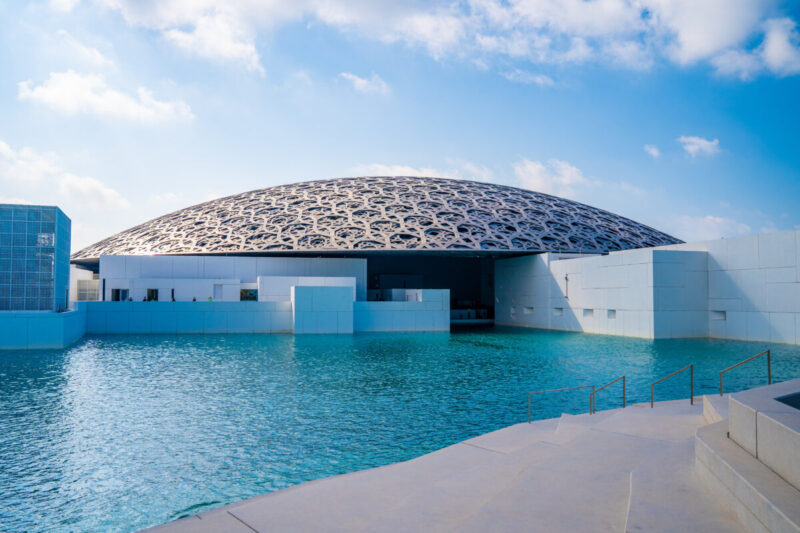
Burj Khalifa’s 828-meter world record-breaking tower (tallest building, freestanding structure, highest observation deck) offering 163-story sunset viewing platforms watching Dubai illuminate beneath Arabian Gulf skies. Sheikh Zayed Grand Mosque’s magnificent scale as the country’s largest and world’s ninth-largest mosque featuring 1,000 columns, four 107-meter minarets, 82 domes, and rare non-Muslim accessibility showcasing Islamic architectural grandeur. World’s largest shopping experiences via Dubai Mall’s indoor roller coaster and Mall of the Emirates’ indoor ski slope, plus every top designer boutique creating ultra-luxurious retail paradise. Desert safari adventures combining dune bashing 4×4 thrills, sandboarding, ATV rides, camel experiences, and sunset Bedouin camp dining across Abu Dhabi’s peaceful yet adventurous desert landscapes. Burj al Arab’s iconic 7-star sail-shaped luxury hotel and Emirates Palace’s 24-carat gold cappuccinos representing Arabian hospitality excellence. Louvre Abu Dhabi’s global art journey from earliest human settlements to contemporary collections, plus Ferrari World’s first branded theme park creating cultural-entertainment fusion. Ultramodern achievements harmonizing with traditional Arabian heritage where record-breaking architecture meets authentic desert culture in this Gulf region’s most ambitious luxury destination.
The destination guide
United Arab Emirates

Country in AsiaUpdated
- Overall6/10
- Best forLuxury travelers
- PeakNov–Mar
- CurrencyAED
The Burj Khalifa at sunset hits different when Dubai’s grid lights up 828 meters below. But the desert an hour outside the city is the real reason to stay longer.
Travel guides for United Arab Emirates
More guides featuring United Arab Emirates (11)
At a glance
- Arabic
- English
- Desert landscape
- Modern skyline
- Coastal beaches
- Oasis towns
- Luxury
- Architecture
- Shopping
- Desert Adventure
- Culture & Heritage
- Beach
- Family
- Nightlife
Practical basics
- Driving side
- Right
- Electrical standard
- 240V/50Hz Type G
- Measurement system
- Metric
- Emergency numbers
- 999/997
- Country code
- AE
How United Arab Emirates scores
Character
Editorial scores on a 10-point scale, weighed against destinations of the same kind.
Travel safety snapshot
SafePlace indicators use their source 100-point scale; higher is more favourable. Planning context, not a live travel advisory — check official government guidance before you go.
When to go
Best months to visit: January, February, March, April, October, November and December.
- January: 14.9 to 24.3 degrees Celsius, 15.2 millimetres of rain, best-time score 5 out of 5.
- February: 15.8 to 26 degrees Celsius, 5.8 millimetres of rain, best-time score 5 out of 5.
- March: 18.5 to 30.4 degrees Celsius, 22.4 millimetres of rain, best-time score 5 out of 5.
- April: 22.2 to 35.5 degrees Celsius, 5.4 millimetres of rain, best-time score 4 out of 5.
- May: 25.7 to 39.6 degrees Celsius, 2.6 millimetres of rain, best-time score 3 out of 5.
- June: 28.3 to 42 degrees Celsius, 0 millimetres of rain, best-time score 2 out of 5.
- July: 30.8 to 43.5 degrees Celsius, 1.6 millimetres of rain, best-time score 2 out of 5.
- August: 30.6 to 43.6 degrees Celsius, 6.1 millimetres of rain, best-time score 2 out of 5.
- September: 28.2 to 41.3 degrees Celsius, 0.2 millimetres of rain, best-time score 2 out of 5.
- October: 25 to 36.5 degrees Celsius, 1.6 millimetres of rain, best-time score 4 out of 5.
- November: 21 to 31.2 degrees Celsius, 1.1 millimetres of rain, best-time score 5 out of 5.
- December: 17.3 to 26.5 degrees Celsius, 3.8 millimetres of rain, best-time score 5 out of 5.
Month-by-month conditions and packing advice
- January
- Mild to warm, mostly dry January in United Arab Emirates: cooler weather supports city sightseeing, beaches, desert trips, outdoor dining, shopping, and cultural sites. Crowds: January in United Arab Emirates is comfortable for sightseeing, neighborhoods, food stops, day trips, and outdoor time with limited weather friction. Pack: Pack light clothing, sun protection, and comfortable walking shoes.
- February
- Mild to warm, mostly dry February in United Arab Emirates: cooler weather supports city sightseeing, beaches, desert trips, outdoor dining, shopping, and cultural sites. Crowds: February in United Arab Emirates is comfortable for sightseeing, neighborhoods, food stops, day trips, and outdoor time with limited weather friction. Pack: Pack light clothing, sun protection, and comfortable walking shoes.
- March
- Warm to hot, mostly dry March in United Arab Emirates: cooler weather supports city sightseeing, beaches, desert trips, outdoor dining, shopping, and cultural sites. Crowds: March in United Arab Emirates is workable with normal seasonal planning; build in layers, weather checks, and a mix of indoor and outdoor activities. Pack: Pack light clothing, sun protection, and comfortable walking shoes.
- April
- Very hot, mostly dry April in United Arab Emirates: conditions remain usable while heat is building or easing. Crowds: April in United Arab Emirates can be very hot, so travelers should favor early starts, shaded breaks, indoor attractions, and flexible afternoon pacing. Pack: Pack breathable clothing, strong sun protection, and a refillable water bottle.
- May
- Very hot, mostly dry May in United Arab Emirates: heat starts to limit outdoor plans to mornings and evenings. Crowds: May in United Arab Emirates can be very hot, so travelers should favor early starts, shaded breaks, indoor attractions, and flexible afternoon pacing. Pack: Pack breathable clothing, strong sun protection, and a refillable water bottle.
- June
- Very hot, mostly dry June in United Arab Emirates: extreme summer heat makes outdoor sightseeing impractical. Crowds: June in United Arab Emirates can be very hot, so travelers should favor early starts, shaded breaks, indoor attractions, and flexible afternoon pacing. Pack: Pack breathable clothing, strong sun protection, and a refillable water bottle.
- July
- Very hot, mostly dry July in United Arab Emirates: extreme summer heat makes outdoor sightseeing impractical. Crowds: July in United Arab Emirates can be very hot, so travelers should favor early starts, shaded breaks, indoor attractions, and flexible afternoon pacing. Pack: Pack breathable clothing, strong sun protection, and a refillable water bottle.
- August
- Very hot, mostly dry August in United Arab Emirates: extreme summer heat makes outdoor sightseeing impractical. Crowds: August in United Arab Emirates can be very hot, so travelers should favor early starts, shaded breaks, indoor attractions, and flexible afternoon pacing. Pack: Pack breathable clothing, strong sun protection, and a refillable water bottle.
- September
- Very hot, mostly dry September in United Arab Emirates: extreme summer heat makes outdoor sightseeing impractical. Crowds: September in United Arab Emirates can be very hot, so travelers should favor early starts, shaded breaks, indoor attractions, and flexible afternoon pacing. Pack: Pack breathable clothing, strong sun protection, and a refillable water bottle.
- October
- Very hot, mostly dry October in United Arab Emirates: conditions remain usable while heat is building or easing. Crowds: October in United Arab Emirates can be very hot, so travelers should favor early starts, shaded breaks, indoor attractions, and flexible afternoon pacing. Pack: Pack breathable clothing, strong sun protection, and a refillable water bottle.
- November
- Warm to hot, mostly dry November in United Arab Emirates: cooler weather supports city sightseeing, beaches, desert trips, outdoor dining, shopping, and cultural sites. Crowds: November in United Arab Emirates is workable with normal seasonal planning; build in layers, weather checks, and a mix of indoor and outdoor activities. Pack: Pack light clothing, sun protection, and comfortable walking shoes.
- December
- Mild to warm, mostly dry December in United Arab Emirates: cooler weather supports city sightseeing, beaches, desert trips, outdoor dining, shopping, and cultural sites. Crowds: December in United Arab Emirates is comfortable for sightseeing, neighborhoods, food stops, day trips, and outdoor time with limited weather friction. Pack: Pack light clothing, sun protection, and comfortable walking shoes.
- November
- December
- January
- February
- March
- June
- July
- August
- September
Know before you go
Neighbourhoods
Al Fahidi Historical Neighborhood (Al Bastakiya) – Dubai’s oldest district showcasing traditional Emirati architecture, art galleries, and cultural museums preserving the city’s heritage; Alserkal Avenue – Dubai’s contemporary arts hub featuring galleries, creative spaces, and performance venues fostering the UAE’s modern art scene; Al Qasba – Sharjah’s vibrant cultural waterfront district with theaters, museums, and arts festivals celebrating Emirati traditions and creativity; Al Ain Oasis – Historic UNESCO – listed palm grove neighborhood reflecting ancient irrigation practices and traditional Emirati life in a lush setting
Best time to visit
November through March offers the most comfortable weather (20–29 °C) for outdoor sightseeing, beach time, and desert excursions. April and October are warm shoulder months with better hotel deals. June–September sees extreme heat (40–48 °C) but the lowest prices and indoor mega-mall air conditioning.
Season by season
Winter (Nov–Mar): 20–29 °C, peak season, ideal outdoor weather, higher prices. Spring (Apr–May): 30–38 °C, warming but manageable, shoulder pricing. Summer (Jun–Sep): 40–48 °C, extreme heat, cheapest rates, indoor attractions thrive. Autumn (Oct): 32–36 °C, crowds returning, good deals still available.
Crowds
Very High from November–March; moderate in shoulder months; lower in summer due to extreme heat
Getting there and around
Getting there
Fly into Dubai International (DXB) or Abu Dhabi (AUH), two of the world’s busiest airports. Emirates, Etihad, and flydubai offer extensive global connectivity. The Dubai Metro and taxis provide city transport.
Getting around
Metro (in Dubai), Taxis, Buses
Top experiences in United Arab Emirates
Burj Khalifa
The world’s tallest building at 828 m with 163 floors. Observation decks on floors 124–125 (At the Top, €35) and floor 148 (At the Top SKY, €100) deliver 360° views across the Gulf. Book sunset slots well in advance. The Dubai Fountain show at the base runs every 30 minutes after dusk.
Sheikh Zayed Grand Mosque
Abu Dhabi’s most photographed landmark—a gleaming white mosque accommodating 40,000 worshippers. Features 82 domes, 1,000+ columns, the world’s largest hand-knotted carpet, and Swarovski crystal chandeliers. Free entry; modest dress required (abayas lent at the gate). Best visited at sunset when the marble glows pink and gold.
Museum of the Future
A torus-shaped, silver-clad building on Sheikh Zayed Road showcasing immersive exhibitions on AI, bioengineering, space exploration, and sustainability. Opened 2022; tickets AED 149 (~€37). Often called ‘the most beautiful building on Earth.’
Dubai Desert Safari
A quintessential UAE experience: 4×4 dune bashing over towering red sand dunes, followed by a Bedouin-style camp with camel rides, henna painting, a barbecue dinner under the stars, belly dancing, and falconry demonstrations. Half-day and overnight options are available from Dubai or Abu Dhabi.
Louvre Abu Dhabi
Abu Dhabi’s Jean Nouvel–designed art museum on Saadiyat Island, topped by a 180 m geometric dome that filters sunlight into a ‘rain of light.’ Collections span from ancient artifacts to contemporary works. Tickets AED 63 (~€15); late-afternoon visits catch the best light through the dome.
Editor-curated picks carried over from our original guide. Where a full place guide exists, the card links to it.
Worth booking ahead in United Arab Emirates
Hand-picked from the operators our guides already send readers to. Prices and availability are live on the partner site.
BrowseViator
Tours and tickets in United Arab Emirates on Viator (opens Viator in a new tab)
Viator's full list of bookable tours and tickets in United Arab Emirates.
BrowseGetYourGuide
Experiences in United Arab Emirates on GetYourGuide (opens GetYourGuide in a new tab)
Everything GetYourGuide sells in United Arab Emirates, with the cancellation terms on each listing.
Where to stayBooking.com
Stays in United Arab Emirates (opens Booking.com in a new tab)
Live rates and availability for United Arab Emirates on Booking.com; filter by neighbourhood once you know where your days start.
We earn a commission if you book through these links, at no extra cost to you. It is how we keep the guides free and independent.
Where to stay
Burj Al Arab Jumeirah
Jumeirah St, Dubai, UAE
The world’s most iconic luxury hotel, shaped like a sail on its own artificial island. Features duplex suites with private butlers, nine signature restaurants, a private beach, terrace pool, and helipad transfers. The gold-leafed atrium soars 180 m.
Armani Hotel Dubai
1 Sheikh Mohammed bin Rashid Blvd, Dubai, UAE
A sleek 5-star hotel occupying the lower floors of the Burj Khalifa, designed by Giorgio Armani himself. Minimalist Italian elegance, an outdoor pool deck overlooking the Dubai Fountain, a spa, and four restaurants serving Italian, Indian, and Mediterranean cuisine.
Emirates Palace Mandarin Oriental
West Corniche Rd, Abu Dhabi, UAE
A palatial 5-star resort on Abu Dhabi’s Corniche, spread over 1 km of private beach and 85 hectares of gardens. Features 394 suites, two pools, a marina, a private helipad, and 14 restaurants. Gold-leaf accents and Arabic arches define the interior.
Editor-curated stays carried over from our original guide. Where we have reviewed the hotel, the card links to the review.
Tips from the field
Highlights
- Burj Khalifa – World's Tallest Building
- Sheikh Zayed Grand Mosque
- Museum of the Future
- Desert Safari & Dune Bashing
- Louvre Abu Dhabi
- Gold & Spice Souks
- Palm Jumeirah
- Dubai Fountain Show
Best activities
- Visit the Burj Khalifa observation deck at sunset, explore the gold and spice souks of Deira, take a desert safari with dune bashing and starlit dinner, tour the Sheikh Zayed Grand Mosque at golden hour, shop at The Dubai Mall and watch the fountain show, visit the Museum of the Future, take an abra boat across Dubai Creek, relax on Jumeirah Beach, explore the Louvre Abu Dhabi, and day-trip to Yas Island theme parks.
Local experiences
- Take a traditional dhow cruise along Dubai Creek at sunset, learn Arabic calligraphy at the Jameel Arts Centre, watch a camel race at Al Marmoom, join a Bedouin-hosted desert camping trip with telescope stargazing, or shop for saffron and oud in the Deira Spice Souk.
Practical tips
- Dress Code: Cover shoulders and knees in malls, mosques, and government buildings; swimwear is fine at pools and beaches.
- Ramadan: During Ramadan (dates shift yearly), do not eat, drink, or smoke in public during daylight hours.
- Alcohol: Sold only in licensed hotel restaurants and bars; public intoxication is an offense.
- Currency: UAE Dirham (AED), pegged to USD at 3.67 AED/USD.
- Tipping: 10–15 % at restaurants; round up taxi fares.
- Metro: Dubai Metro is clean, affordable, and connects major attractions.
Photography tips
- The Burj Khalifa frames best from the Palace Downtown hotel bridge at blue hour, with the Dubai Fountain in the foreground. Sheikh Zayed Grand Mosque glows pink and purple at sunset—shoot from the reflecting pools for mirror-image symmetry. The Museum of the Future's Arabic calligraphy facade looks sharpest against a dusk sky. For the Dubai skyline, Marina Beach offers a wide panorama. Desert dune landscapes photograph best in the warm side-light 30 minutes before sunset.
Timing
- Allow 3–4 days for Dubai, 2–3 days for Abu Dhabi, and 1 day for a desert safari. A comprehensive UAE trip covering Dubai, Abu Dhabi, and the Al Ain oasis takes 7–10 days.
Keeping it authentic
- Beneath the futuristic skyline, Emirati heritage endures. The Al Fahidi Historical Neighbourhood in Dubai preserves wind-tower houses and creek-side souks where traders have sold gold, spices, and textiles for centuries. Falconry is a UNESCO-recognized tradition
- falconers train peregrine and saker falcons in the desert. Camel racing at Al Marmoom draws locals every winter weekend. The majlis (sitting room) tradition of gathering for Arabic coffee, dates, and conversation remains the social cornerstone of Emirati family life. During Ramadan, the evening iftar feasts reveal the depth of communal hospitality.
Culture, customs and safety
Cultural heritage
The cultural and historical heritage of the United Arab Emirates reflects a deep-rooted Bedouin tradition shaped by maritime trade, desert survival, and Islamic values. From the wind-towered architecture of Al Fahidi Historical District in Dubai to the UNESCO-listed oasis city of Al Ain, the UAE preserves remnants of pre-oil life amid rapid modernization. Heritage is honored through traditional music like ayyala, falconry, pearl diving customs, and intricately designed forts such as Qasr Al Hosn in Abu Dhabi. Islamic architecture blends with modern interpretations in landmarks like the Sheikh Zayed Grand Mosque, embodying a fusion of legacy and innovation. Despite its rapid urban transformation, the UAE actively invests in cultural preservation, evident in national museums and revitalized historical neighborhoods.
Local customs & etiquette
In United Arab Emirates, respect Islamic customs while enjoying modern amenities. Dress modestly in public. Public displays of affection are frowned upon. Friday is the holy day. Hospitality is important. English is widely spoken.
Safety notes
The UAE is one of the safest countries in the world with extremely low violent and property crime. Strict laws deter petty theft. Tourists should be aware of local laws: public intoxication, offensive gestures, swearing, and public displays of affection (especially same-sex) can result in fines or detention. Photograph people only with permission. During Ramadan, eating or drinking in public during daylight is prohibited. Emergency: 999 (police), 998 (ambulance).