Hungary, a landlocked country in Central Europe, combines a thousand years of turbulent history with a distinctive cultural identity that bridges Eastern and Western European traditions. Dominated by the Great Hungarian Plain (Alföld) and divided by the meandering Danube River, the country’s landscape transitions from the tranquil shores of Lake Balaton—Central Europe’s largest lake—to the rolling hills of Transdanubia and the northern mountain ranges. Budapest, the capital often called the “Pearl of the Danube,” showcases the nation’s architectural grandeur through its Gothic Parliament Building, Buda Castle Quarter, and numerous thermal baths that harness natural hot springs utilized since Roman times. Hungarian culture is distinctively expressed through its unique language (unrelated to neighboring Slavic or Germanic tongues), vibrant folk traditions featuring colorful embroidery and ceramics, and a cuisine celebrated for its bold flavors combining paprika, garlic, and rich meats in dishes like goulash, paprikás, and langos. The country’s musical legacy spans from classical composers like Franz Liszt and Béla Bartók to Romani folk music traditions. Throughout regions like Tokaj, Eger, and Villany, centuries-old viticulture produces distinctive wines including the world-renowned Tokaji Aszú. Despite a complex 20th-century history marked by empire dissolution, fascism, communism, and eventual democratic transition, Hungary maintains a proud national identity while serving as an increasingly popular destination for those seeking authentic European experiences beyond the continent’s more frequented western nations.
The destination guide
Hungary
Budapest’s thermal baths cost less than a museum ticket and have been running since Roman times. That tells you a lot about Hungary.

At a glance
- Hungarian
- Danube River
- Great Hungarian Plain
- Lake Balaton
- Historic thermal baths
How Hungary scores
Editorial scores on a 10-point scale, weighed against destinations of the same kind.
Travel safety snapshot
SafePlace indicators use their source 100-point scale; higher is more favourable. Planning context, not a live travel advisory — check official government guidance before you go.
When to go
Best months to visit: April, May, June, July, August, September and October.
- January: -2 to 4.3 degrees Celsius, 38.1 millimetres of rain, best-time score 2 out of 5.
- February: 0.2 to 8.2 degrees Celsius, 42.8 millimetres of rain, best-time score 2 out of 5.
- March: 2.4 to 12.3 degrees Celsius, 46.6 millimetres of rain, best-time score 3 out of 5.
- April: 6.9 to 17.2 degrees Celsius, 42.6 millimetres of rain, best-time score 4 out of 5.
- May: 11.4 to 21.2 degrees Celsius, 72.6 millimetres of rain, best-time score 5 out of 5.
- June: 16.5 to 26.8 degrees Celsius, 68.2 millimetres of rain, best-time score 5 out of 5.
- July: 17.9 to 28.3 degrees Celsius, 68.5 millimetres of rain, best-time score 5 out of 5.
- August: 17.8 to 28.5 degrees Celsius, 36 millimetres of rain, best-time score 5 out of 5.
- September: 13.5 to 23.1 degrees Celsius, 57.2 millimetres of rain, best-time score 5 out of 5.
- October: 8.2 to 17 degrees Celsius, 50.1 millimetres of rain, best-time score 4 out of 5.
- November: 3.4 to 9.9 degrees Celsius, 60.3 millimetres of rain, best-time score 2 out of 5.
- December: -0.1 to 5.4 degrees Celsius, 52.4 millimetres of rain, best-time score 3 out of 5.
Month-by-month conditions and packing advice
- January
- Cold, occasional rain Cold winter weather, few tourists. Crowds: January in Hungary is workable with normal seasonal planning; build in layers, weather checks, and a mix of indoor and outdoor activities. Pack: Pack warm layers, a coat, and comfortable shoes for cold mornings and evenings.
- February
- Cold, occasional rain Chilly and quiet, good for museums. Crowds: February in Hungary is workable with normal seasonal planning; build in layers, weather checks, and a mix of indoor and outdoor activities. Pack: Pack warm layers, a coat, and comfortable shoes for cold mornings and evenings.
- March
- Cool to mild, occasional rain Beginning to warm up, spring blossoms. Crowds: March in Hungary is workable with normal seasonal planning; build in layers, weather checks, and a mix of indoor and outdoor activities. Pack: Pack warm layers, a coat, and comfortable shoes for cold mornings and evenings.
- April
- Cool to mild, occasional rain Pleasant spring weather, great for walking. Crowds: April in Hungary is workable with normal seasonal planning; build in layers, weather checks, and a mix of indoor and outdoor activities. Pack: Pack layered clothing and comfortable walking shoes.
- May
- Mild to warm, some rain Excellent weather before the summer crowds. Crowds: May in Hungary is workable with normal seasonal planning; build in layers, weather checks, and a mix of indoor and outdoor activities. Pack: Pack layered clothing and comfortable walking shoes. Add a rain jacket or compact umbrella.
- June
- Mild to warm, occasional rain Warm, sunny, and lively. Crowds: June in Hungary is comfortable for sightseeing, neighborhoods, food stops, day trips, and outdoor time with limited weather friction. Pack: Pack light clothing, sun protection, and comfortable walking shoes.
- July
- Warm to hot, occasional rain Peak summer heat and peak tourist season. Crowds: July in Hungary is comfortable for sightseeing, neighborhoods, food stops, day trips, and outdoor time with limited weather friction. Pack: Pack light clothing, sun protection, and comfortable walking shoes.
- August
- Warm to hot, occasional rain Very warm, many festivals and outdoor dining. Crowds: August in Hungary is comfortable for sightseeing, neighborhoods, food stops, day trips, and outdoor time with limited weather friction. Pack: Pack light clothing, sun protection, and comfortable walking shoes.
- September
- Mild to warm, occasional rain Perfect shoulder season with great weather. Crowds: September in Hungary is comfortable for sightseeing, neighborhoods, food stops, day trips, and outdoor time with limited weather friction. Pack: Pack layered clothing and comfortable walking shoes.
- October
- Cool to mild, occasional rain Crisp autumn air and beautiful colors. Crowds: October in Hungary is workable with normal seasonal planning; build in layers, weather checks, and a mix of indoor and outdoor activities. Pack: Pack layered clothing and comfortable walking shoes.
- November
- Cold, occasional rain Cooling down rapidly, often rainy. Crowds: November in Hungary is workable with normal seasonal planning; build in layers, weather checks, and a mix of indoor and outdoor activities. Pack: Pack layered clothing and comfortable walking shoes.
- December
- Cold, occasional rain Cold but festive holiday atmosphere. Crowds: December in Hungary is workable with normal seasonal planning; build in layers, weather checks, and a mix of indoor and outdoor activities. Pack: Pack warm layers, a coat, and comfortable shoes for cold mornings and evenings.
Know before you go
About
Hungary, a landlocked country in Central Europe, combines a thousand years of turbulent history with a distinctive cultural identity that bridges Eastern and Western European traditions. Dominated by the Great Hungarian Plain (Alföld) and divided by the meandering Danube River, the country’s landscape transitions from the tranquil shores of Lake Balaton—Central Europe’s largest lake—to the rolling hills of Transdanubia and the northern mountain ranges. Budapest, the capital often called the “Pearl of the Danube,” showcases the nation’s architectural grandeur through its Gothic Parliament Building, Buda Castle Quarter, and numerous thermal baths that harness natural hot springs utilized since Roman times. Hungarian culture is distinctively expressed through its unique language (unrelated to neighboring Slavic or Germanic tongues), vibrant folk traditions featuring colorful embroidery and ceramics, and a cuisine celebrated for its bold flavors combining paprika, garlic, and rich meats in dishes like goulash, paprikás, and langos. The country’s musical legacy spans from classical composers like Franz Liszt and Béla Bartók to Romani folk music traditions. Throughout regions like Tokaj, Eger, and Villany, centuries-old viticulture produces distinctive wines including the world-renowned Tokaji Aszú. Despite a complex 20th-century history marked by empire dissolution, fascism, communism, and eventual democratic transition, Hungary maintains a proud national identity while serving as an increasingly popular destination for those seeking authentic European experiences beyond the continent’s more frequented western nations.
Neighbourhoods
Budapest, Debrecen, Szeged, Eger, Pecs
Best time to visit
Spring (April–May) and autumn (September–October) offer the most comfortable weather, moderate crowds, and the best light for sightseeing. Spring brings blooming gardens along the Danube and cultural festivals like the Budapest Spring Festival. Autumn delivers golden foliage, grape harvest celebrations in the wine regions, and temperatures between 10–20°C (50–68°F). Summer (June–August) is peak season — warm (25–30°C / 77–86°F), festive, and ideal for outdoor thermal baths, though July and August can feel hot for walking tours. Winter transforms Budapest with Christmas markets, ice skating, and steaming outdoor thermal pools — cold but atmospheric, with the lowest prices and smallest crowds in January–February.
Season by season
Spring (April–May):
Weather: 10–20°C (50–68°F), occasional rain
Highlights: Budapest Spring Festival, blooming Margaret Island, outdoor café openings
Best For: Sightseeing, thermal baths, wine tours
Summer (June–August):
Weather: 25–30°C (77–86°F), hot with thunderstorms
Highlights: Sziget Festival (August), Lake Balaton beach season, outdoor thermal pools
Best For: Festivals, lake holidays, Danube cruises, ruin bar terraces
Fall (September–October):
Weather: 10–20°C (50–68°F), golden foliage
Highlights: Grape harvests in Tokaj and Eger, Budapest Wine Festival, CAFe arts festival
Best For: Wine tours, food festivals, photography, uncrowded museums
Winter (December–February):
Weather: -2–5°C (28–41°F), cold with occasional snow
Highlights: Christmas markets (Vörösmarty Square, St. Stephen’s), steaming outdoor baths, ice skating
Best For: Christmas markets, thermal baths in snow, budget travel
Crowds
Moderate (high in Budapest during summer and Christmas markets)
Getting there and around
Getting there
Hungary is accessible via Budapest Ferenc Liszt International Airport (BUD), located 16km southeast of the capital with direct flights from major European cities and select intercontinental destinations. The airport connects to downtown Budapest via the 100E bus service and private transfers. Rail connections link Hungary to neighboring Austria, Slovakia, Romania, and Serbia through the extensive Central European railway network. Road access is excellent via the M1, M3, M5, and M7 motorways connecting to major European highway systems.
Getting around
Budapest has an efficient public transport system (metro, tram, bus, and trolleybus) operated by BKK. Single tickets cost about 450 HUF (~€1.10); 24-hour and 72-hour travel cards offer unlimited rides. The M1 metro line beneath Andrássy Avenue is one of the world’s oldest. Trams 2 (along the Danube with Parliament views) and 4/6 (the longest tram route in Europe) are scenic as well as practical. Budapest’s city center is walkable — crossing from the Chain Bridge area to the Jewish Quarter takes about 25 minutes on foot. Bolt and Uber operate alongside regulated taxis (avoid unmarked cabs). For exploring beyond Budapest, MÁV-START trains connect to Eger (2 hrs), Lake Balaton (1.5 hrs), Pécs (3 hrs), and Tokaj (2.5 hrs). The Danube hydrofoil runs to Bratislava and Vienna in summer.
Top experiences in Hungary
Hungarian Parliament Building
Read the place guide →Budapest’s neo-Gothic Parliament is the third-largest parliament building in the world and the most recognizable silhouette on the Danube. Completed in 1904, it stretches 268 meters along the riverbank and features 691 decorated rooms, 20 kilometers of staircases, and the Hungarian Crown Jewels — the Holy Crown of St. Stephen — displayed in the domed central hall. Guided tours (45 minutes) run daily and cover the main staircase, the old House of Lords, and the Crown display. The building is most photogenic at dawn from the Buda side or illuminated at night from a river cruise.
Széchenyi Thermal Bath
One of Europe’s largest public bathing complexes, Széchenyi sits in Budapest’s City Park in a grand Neo-Baroque building. The facility includes 15 indoor pools and 3 outdoor pools fed by thermal springs at temperatures between 28°C and 38°C. The most iconic image is the outdoor chess-playing bathers in the steaming yellow pools — a scene unique to Budapest. The medicinal waters are rich in calcium, magnesium, and sulphates, recommended for joint and skin conditions. Széchenyi also hosts ‘sparty’ (spa party) events on weekend evenings. Arrive early or late to avoid peak crowds.
Buda Castle & Fisherman's Bastion
Read the place guide →Perched on Castle Hill, the UNESCO-listed Buda Castle complex includes the former Royal Palace (now housing the Hungarian National Gallery and Budapest History Museum), the medieval Old Town, Matthias Church with its colorful Zsolnay-tile roof, and Fisherman’s Bastion — a neo-Romanesque terrace with seven turrets representing the seven Magyar tribes. The bastion offers unobstructed panoramic views of the Parliament, the Danube, and the Pest skyline. A funicular (Sikló) connects Clark Ádám Square at the Chain Bridge base to the castle. The entire hilltop district rewards an afternoon of wandering.
Tokaj Wine Region
A UNESCO World Heritage Site in northeastern Hungary, Tokaj produces one of the world’s great dessert wines — Tokaji Aszú, known historically as the ‘Wine of Kings, King of Wines.’ The region’s unique combination of volcanic soil, the Tisza and Bodrog rivers’ humidity, and the noble rot (botrytis cinerea) that concentrates grape sugars creates a wine style found nowhere else. Cellars carved into volcanic tuff — some dating back centuries — offer tastings of Aszú, dry Furmint, and late-harvest Szamorodni. The town of Tokaj and surrounding villages (Mád, Tarcal, Tolcsva) are reachable by train from Budapest in about 2.5 hours.
Ruin Bars of the Jewish Quarter
Budapest’s District VII (the former Jewish Quarter) spawned the ruin bar movement in the early 2000s, converting war-damaged and neglected buildings into eclectic, art-filled drinking venues. Szimpla Kert, the original and most famous, occupies a gutted residential building furnished with repurposed bathtubs, car parts, and rotating art installations — it also hosts a Sunday farmers’ market. Other notable spots include Instant-Fogas, Anker’t, and Ellátó Kert. The quarter is also home to the Dohány Street Synagogue — Europe’s largest — and the moving Shoes on the Danube Bank memorial. The area comes alive after dark but is fascinating during the day for its layered history.
Editor-curated picks carried over from our original guide. Where a full place guide exists, the card links to it.

Where to stay
Four Seasons Hotel Gresham Palace
Széchenyi István tér 5-6, 1051 Budapest, Hungary
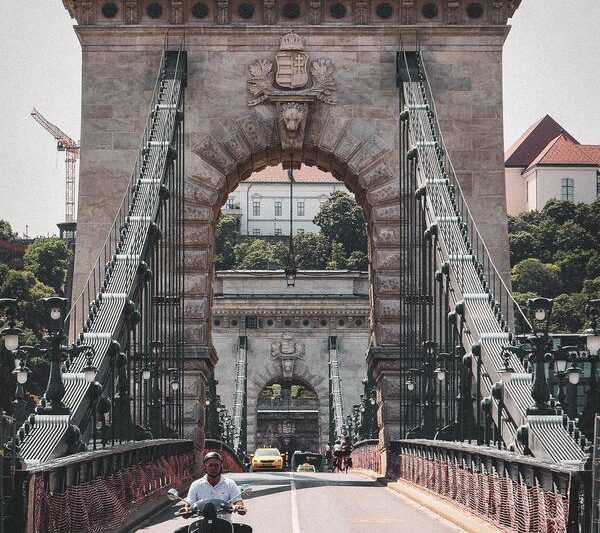
Occupying the landmark 1906 Art Nouveau Gresham Palace at the Pest end of the Chain Bridge, this five-star hotel is one of Central Europe’s finest. The 179 rooms feature soaring ceilings, Zsolnay porcelain accents, and views of the Danube or the Chain Bridge. The lobby’s original stained-glass dome and mosaic floors are architectural highlights in their own right. An indoor pool, full spa, and Kollázs brasserie round out the offering. The location — steps from the Chain Bridge with direct views of Buda Castle — is unmatched.
Aria Hotel Budapest
Hercegprímás utca 5, 1051 Budapest, Hungary
A music-themed boutique luxury hotel near St. Stephen’s Basilica, Aria Budapest centers its design around four wings themed to classical, opera, jazz, and contemporary music. The 49 rooms feature curated art, high-end amenities, and a personal Music Library with instruments and listening stations. The rooftop High Note SkyBar offers one of Budapest’s best panoramic views, overlooking the Basilica dome and the surrounding rooftops. A complimentary wine-and-cheese reception each afternoon is a signature touch.
Hotel Rum Budapest
Király utca 12, 1075 Budapest, Hungary
A mid-range design hotel in the heart of District V, Hotel Rum Budapest offers 59 stylishly minimalist rooms with a contemporary Hungarian aesthetic — warm wood tones, designer lighting, and locally sourced toiletries. The on-site restaurant and cocktail bar attract locals and guests alike. The location on Király utca puts you within walking distance of St. Stephen’s Basilica, the Jewish Quarter’s ruin bars, and the Danube embankment. Strong value for its quality and central position.
Editor-curated stays carried over from our original guide. Where we have reviewed the hotel, the card links to the review.
Tips from the field
Highlights
- Hungarian Parliament Building — Neo-Gothic Danube landmark housing the Crown Jewels
- Széchenyi Thermal Bath — Grand Neo-Baroque bathing complex with outdoor chess-playing pools
- Buda Castle & Fisherman's Bastion — UNESCO hilltop district with panoramic Danube views
- Tokaj Wine Region — UNESCO-listed cellars producing legendary Aszú dessert wine
- Ruin Bars — Converted abandoned buildings in Budapest's Jewish Quarter
- Danube River Cruises — Illuminated Parliament and bridges at sunset
- Central Market Hall — Budapest's largest traditional market
- Eger — Baroque town with Bull's Blood wine cellars and Ottoman minaret
- Lake Hévíz — World's largest biologically active natural thermal lake
- Hortobágy National Park — Great Plain with traditional Hungarian horsemanship
Best activities
- Hungary offers an extraordinary range of experiences anchored in thermal culture, wine, and history. In Budapest, soak in the Széchenyi or Rudas thermal baths, tour the Parliament's Crown Jewels, explore the Buda Castle district and Fisherman's Bastion panorama, and spend an evening in the ruin bars of the Jewish Quarter. Take a Danube river cruise at sunset for illuminated views of Parliament and the bridges. Walk Andrássy Avenue from the Opera House to Heroes' Square and the Vajdahunyad Castle in City Park. Visit the Central Market Hall for Hungarian paprika, salami, and lángos. Beyond Budapest, drive through the Tokaj wine region for cellar tastings of Aszú and dry Furmint. Explore the baroque town of Eger, known for Bull's Blood wine and its Ottoman-era minaret. Swim in Lake Hévíz, the world's largest natural thermal lake. Visit the Hortobágy puszta for traditional horsemanship shows on the Great Plain.
Local experiences
- Start early at Budapest's Central Market Hall for a breakfast lángos and to browse boxes of Hungarian paprika, salami, and Tokaji wine. Take the M1 metro (Continental Europe's oldest) down Andrássy Avenue to Heroes' Square, then walk back through City Park to Széchenyi Baths for a morning soak. In the afternoon, ride tram 2 along the Danube for running views of Parliament, Buda Castle, and the bridges. Cross to the Buda side for the castle funicular and Fisherman's Bastion views. In the evening, explore the ruin bars of District VII — start at Szimpla Kert, then wander. For a deeper experience, take a day trip to the Tokaj wine region for cellar tastings in Mád or Tarcal. Visit Eger's Valley of the Beautiful Women (Szépasszony-völgy) for affordable wine tasting in carved hillside cellars. On Lake Balaton's north shore, cycle between volcanic wine villages (Badacsony, Tihany) with Balaton views.
Practical tips
- Currency: Hungarian Forint (HUF). Cards are widely accepted in Budapest; carry cash for smaller towns, markets, and rural areas.
- Language: Hungarian (Magyar). English is spoken in Budapest's tourist areas and by younger Hungarians; limited elsewhere. German is a common second language among older generations.
- Public Transport: BKK operates Budapest's metro, tram, bus network. Single ticket ~450 HUF; 24/72-hour travel cards available. Validate before boarding.
- Budapest Card: Offers free public transport, free/discounted museum entries, and walking tours for 24, 48, or 72 hours.
- Thermal Baths: Bring swimsuit, towel, and flip-flops. Széchenyi and Rudas are best; book online to skip queues. Gellért is closed for renovation.
- Food Essentials: Goulash is a soup. Paprika is king. Try lángos (fried dough), kürtőskalács (chimney cake), and túró rudi (chocolate-covered curd bar).
- Wine: Visit Tokaj for Aszú, Eger for Bull's Blood, and Villány for reds. Wine tasting is far cheaper than in Western Europe.
- Tipping: 10-15% at restaurants (check if service is included). Round up for taxis.
- Weather: Pack layers for spring/fall; light clothes for summer; warm coat for winter.
Photography tips
- Golden Hour: Budapest's Danube riverfront is spectacular at dawn and dusk — the Parliament Building glowing in warm light from the Buda embankment is one of Europe's iconic shots.
- Iconic Spots:
- Parliament Building — shoot from Batthyány Square (Buda side) at sunrise for perfect reflections; at night from a river cruise
- Fisherman's Bastion — arrive at opening (9am) for crowd-free compositions; neo-Romanesque arches frame Parliament perfectly
- Chain Bridge — long-exposure night shots from the Pest embankment capture light trails across the Danube
- Gellért Hill — wide cityscapes at blue hour; the Liberty Statue silhouetted at sunset
- Széchenyi Baths — steaming outdoor pools in winter create atmospheric conditions
- Ruin bars — Szimpla Kert's chaotic interiors reward wide-angle exploration
- Beyond Budapest:
- Tokaj cellars — low-light barrel rooms; high ISO or tripod needed
- Hortobágy puszta — horsemen on the plain at golden hour; telephoto lens essential
- Lake Balaton — sunset reflected on Central Europe's largest lake
- Equipment: Wide-angle (14–24mm) for Parliament and bath interiors. Telephoto (70–200mm) for Danube panoramas and Hortobágy wildlife. Tripod essential for night shots — Budapest's illuminated landmarks deserve slow exposures.
Timing
- Peak Season (June–August & December for Christmas markets):
- Warmest weather; highest prices and biggest crowds at baths and Budapest sights
- Sziget Festival (August) sells out months ahead
- Christmas market season (late November–January 1) draws large crowds to central squares
- Shoulder Season (April–May & September–October):
- Best overall conditions — comfortable weather, moderate crowds, excellent wine tourism
- Budapest Spring Festival (April) and Wine Festival (September) add cultural depth
- Hotel rates 20–30% below summer peak
- Off-Season (January–March & November):
- Lowest prices; very cold but atmospheric
- Thermal baths are at their best (steam, fewer crowds)
- Museums uncrowded; opera and classical concert season in full swing
- Key Events:
- Budapest Spring Festival: April
- Sziget Music Festival: August
- Budapest Wine Festival: September
- Christmas Markets: late November – early January
Keeping it authentic
- Hungary's thermal bath culture is genuine and deeply rooted — Budapest sits on over 120 natural hot springs, and public bathing has been a daily tradition since the Ottoman occupation in the 16th century. The baths are not tourist attractions repurposed for foreign visitors
- they are the living rooms of local Budapesters, who visit for health, socializing, and chess. The ruin bars of District VII emerged organically from the quarter's post-Communist decay, not from a marketing campaign, and their best iterations still feel creative and unpolished. Outside Budapest, Hungary rewards curiosity: the Tokaj wine region produces some of the world's most complex dessert wines from volcanic cellars unchanged for centuries
- the Hortobágy puszta (Great Hungarian Plain) preserves a pastoral horse culture predating European settlement patterns
- and thermal lake Hévíz near Lake Balaton is the world's second-largest biologically active natural thermal lake. Hungarian cuisine — goulash, chicken paprikash, lángos, kürtőskalács — comes from genuine folk tradition, not modern reinvention.
Culture, customs and safety
Cultural heritage
Hungary preserves a distinctive Magyar heritage where ancient thermal springs have created Europe’s most sophisticated spa culture, with Budapest’s grand bathhouses serving as social and healing centers for over a millennium. This Danube crossroads nation transformed the humble paprika pepper into its culinary signature, defining dishes like goulash that reflect centuries of Turkish, German, and Slavic influences simmered into a unique cultural identity. From Béla Bartók’s revolutionary compositions rooted in archaic folk traditions to the passionate csárdás dances performed in traditional táncház clubs, Hungary maintains vibrant connections to its nomadic past while embracing its role as Central Europe’s cultural bridge.
Local customs & etiquette
Hungarians appreciate politeness and formality. Greet with a firm handshake and eye contact; use ‘Jó napot’ (good day) in shops and restaurants. When clinking glasses, Hungarians traditionally don’t clink beer glasses — this dates back to the 1848–49 revolution when Austrian generals toasted the execution of Hungarian leaders with beer. Wine clinking is fine. Tipping 10–15% is expected at restaurants — check whether service is included first. In thermal baths, swimsuits are required in mixed pools; flip-flops are recommended. Public transport tickets must be validated before boarding — inspectors are frequent and fines are steep. Hungary has a strict zero-tolerance policy for drinking and driving. Hungarian cuisine is hearty — goulash is actually a soup here, not a stew, and paprika is the defining spice of the kitchen.
Safety notes
Hungary is generally safe for travelers. Petty crime — primarily pickpocketing — is the main concern, concentrated in Budapest’s crowded tourist areas, public transport (particularly trams 2 and 4/6, and metro line M2), and train stations (Keleti, Déli, Nyugati). Keep bags secured and valuables out of sight. Use official taxis or ride-hailing apps (Bolt) — avoid unmarked cabs. In bars and restaurants, always check the menu and prices before ordering; tourist-area venues occasionally overcharge. Don’t leave drinks unattended in nightclubs. Hungary has zero tolerance for drinking and driving. Carry your passport or a copy at all times — police can request identification. Outside Budapest, Hungary is very safe. Emergency: 112. Police: 107. Ambulance: 104.