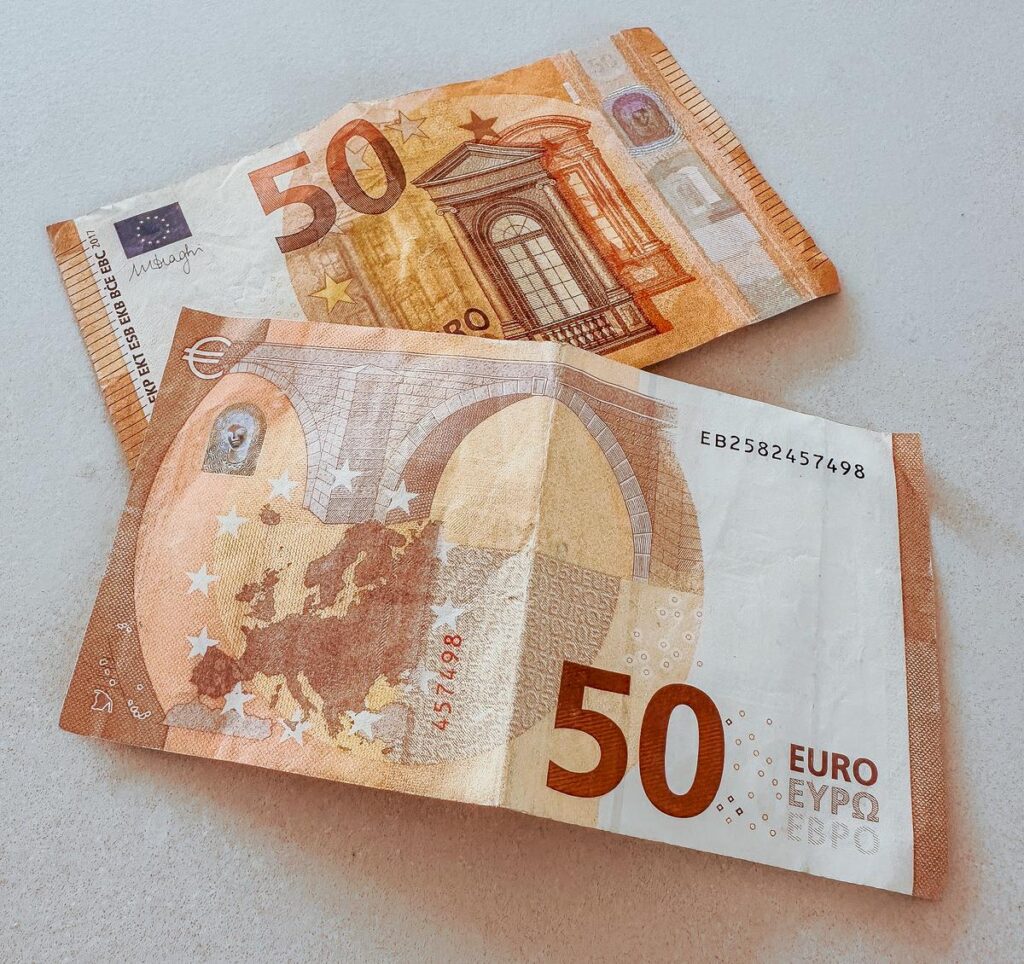
Germany uses the euro (EUR, symbol €). Germany replaced the Deutsche Mark with euro cash on 1 January 2002, and the euro is now the official currency of 21 EU countries after Bulgaria joined the euro area on 1 January 2026. Notes in current issue run 5, 10, 20, 50, 100 and 200 euros. US dollars are not accepted in German shops.
Cash or card in Germany? What changed in 2025
Germany’s reputation as a cash-only country is now out of date. In the Deutsche Bundesbank’s Payment behaviour in Germany in 2025 study, 55 percent of recorded purchases were settled without cash – the first time cashless payments outnumbered cash. Cash still accounted for 45 percent of payments, 6 percentage points lower than in 2023.
Acceptance still runs the other way, though. The same study found cash was accepted in 94 percent of in-person purchases, while cashless payment was possible for 86 percent. That leaves roughly one purchase in seven where notes and coins were the only option, so carry some cash even if you plan to tap for everything.
| Payment method | Share of purchases (2025) | Change vs 2023 |
|---|---|---|
| Cash | 45% | -6 percentage points |
| Debit card (girocard dominant) | 26% | – |
| Mobile payment (phone or watch) | 10% | +4 percentage points |
| E-payment methods (PayPal and similar) | 6% | Doubled |
What Is the Euro?

The Euro was introduced as a cash currency in Germany on January 1, 2002. It was most often used for cashless purchases by the banks and stock markets. Not many people were happy about the introduction of the Euro. Many people wanted to keep the Deutsche mark.
Twenty-one EU countries use the euro: Austria, Belgium, Bulgaria, Croatia, Cyprus, Estonia, Finland, France, Germany, Greece, Ireland, Italy, Latvia, Lithuania, Luxembourg, Malta, the Netherlands, Portugal, Slovakia, Slovenia and Spain. Croatia adopted the euro on 1 January 2023 and Bulgaria on 1 January 2026, so any guide still saying nineteen countries is out of date.
Six EU members still use their own currency: Czechia, Denmark, Hungary, Poland, Romania and Sweden. The European Central Bank has not issued a 500 euro note since 27 April 2019, although notes already in circulation remain legal tender. In practice many German shops and exchange offices will refuse one, so the 200 euro note is the largest you should plan to carry.
Paying in Germany

When you travel to Germany, you will undoubtedly need money. If you are a visitor, you may find that an online currency converter tool can come in handy to see how many Euros you would get for your local currency.
The euro to dollar rate moves daily, so check a live converter on the morning you travel rather than trusting a figure printed in a guide. The best rate you can get on the ground is almost always from a bank ATM, a Geldautomat.
You will find them everywhere around Germany, including banks, shopping centers, train stations, post offices, hotel lobbies, and the airport. You can also select English as your language on each of them, so you won’t have to worry about not understanding the machine.
In addition to the Euro as currency, you will also find that you can pay with credit cards; however, this payment method is not as common as it is in the US.
Converting Your Currency to the Euro in Germany

One of the first things you will need to do when planning your trip to Germany is convert your national currency to the Euro.
To do this, you can get it at your local bank before your departure or at the arrival airport in Germany at a currency conversion table. When converting currency at the airport table, remember that most are not open 24/7.
Airport counters are the worst place to do this. They quote a spread well below the mid-market rate and often add a fixed commission on top, so a bureau at the arrivals hall can cost you several percent on every note. If you land with no euros at all, change the minimum you need to reach your hotel and withdraw the rest from a bank ATM in town.
Using Your ATM Card
Another way to get Euro in Germany is to use your ATM card. You can find an ATM at any bank. Most accept foreign ATM cards, but not all.
If your ATM card is rejected, you will probably get a “card not in-network” prompt on the screen. Depending on your card provider, you can expect a foreign ATM charge of anywhere from 2 to 4 dollars per transaction.
The card most Germans actually pay with is the girocard, a domestic debit scheme that foreign cards are not part of. The Bundesbank found debit cards accounted for 26 percent of all 2025 payments, and the girocard was by far the most used of them. Carry a Visa or Mastercard as your primary card – acceptance for other networks is thinner. And do not assume every counter takes a card at all: the same study found cashless payment was possible for only 86 percent of purchases.
Does Germany accept US dollars?
No. The euro is the only currency you can spend in German shops, restaurants and on public transport, and that is true in every one of the German states. Convert before you travel or withdraw euros from a bank ATM once you land.
Here is a comparison of the different options for exchanging currency in Germany:
| Exchange Method | Exchange Rate | Convenience | Fees | Recommended Use |
|---|---|---|---|---|
| ATMs (Geldautomat) | Best, close to interbank rate | High, widely available | Low, some banks charge a foreign transaction fee | Withdrawing local currency as needed for everyday expenses |
| Banks | Good, close to interbank rate | Moderate, limited hours and locations | Low to moderate, varies by bank | Exchanging larger amounts or when ATMs are not available |
| Currency Exchange Counters at Airports | Poor, significantly lower than interbank rate | High, open long hours | High, poor rates and additional fees | Avoid if possible, only use for small amounts in an emergency |
| Reisebank | Poor, significantly lower than the interbank rate | Moderate, located in major cities and train stations | Moderate, better than airports but higher than banks | Exchanging money when banks are closed or in transit |
| Travelers’ Checks | Moderate, depends on the issuing bank | Low, not widely accepted | Moderate, some banks charge a fee for cashing | Not recommended, as they are not as widely accepted as in the past |
Tips for Exchanging Currency in Germany

Here are a few tips to help you when it comes to exchanging currency in Germany.
Understanding the Mid-Market Rate
Familiarize yourself with the mid-market rate before you leave on your trip. This is known as the true exchange rate and has no hidden fees.
You can use an online currency converter to see what money is worth ahead of your trip. This helps ensure you get a fair rate when purchasing your travel money.
Choose German Currency for ATM Charges

If you are offered to pay in your currency at an ATM, you may actually pay more than if you chose to pay your fees with German currency instead. When you pay in Euros, the local currency in Germany, you can reduce your overall costs and find the best possible rates.
Avoid Currency Exchanges at Airports or Lodging Facilities
Many airports and hotel lobbies raise the exchange rates and are also known for charging hidden fees. Don’t stop at the airport or your hotel to avoid this overly expensive option when exchanging your money for German currency. If you plan and spend your money wisely, Germany will be a GREAT vacation experience.
See Related: Things to Do in Berlin
Is the currency different in Berlin, Munich, Frankfurt or Hamburg?
No. There is no separate Berlin currency, Frankfurt currency or Hamburg currency. Every German city uses the euro and every price is quoted in euros. What changes from place to place is not the money but where cash is still required.
The Bundesbank’s 2025 study is specific about the gaps: cash is accepted almost everywhere overall, but it is accepted less often in local public transport and at self-service checkouts in retail stores. That is the practical rule for a city break. Keep 20 to 50 euros in small notes for transport ticket machines, market stalls, bakeries and smaller cafes, and use a card for hotels, restaurants, museums and supermarkets. If you are heading to Berlin, budget for the same mix.
Can you still exchange Deutsche Marks for euros?
Yes, and there is no deadline. The Deutsche Bundesbank exchanges Deutsche Mark banknotes and coins for euros at any of its branches, or by post to its Mainz branch, with no time limit, no upper amount and no fee. The fixed conversion rate set when Germany moved from the Deutsche Mark to the euro is 1 euro to 1.95583 Deutsche Marks.
If you post Deutsche Mark cash worth 15,000 euros or more, contact the Bundesbank in advance so it can tell you what documentation it needs.
Frequently asked questions
Short answers to the questions travelers ask most about money in Germany.
What currency does Germany use?
Germany uses the euro (EUR). Euro cash replaced the Deutsche Mark on 1 January 2002. The euro is the official currency of 21 EU countries as of 1 January 2026, when Bulgaria became the newest euro area member.
Does Germany accept US dollars?
No. The euro is the only currency accepted in German shops, restaurants and public transport. Convert before you travel, or withdraw euros from a bank ATM (Geldautomat) after you arrive – that gives the closest rate to the mid-market rate.
Should you use cash or card in Germany?
Both. According to the Deutsche Bundesbank’s Payment behaviour in Germany in 2025 study, 55 percent of purchases were settled cashlessly, the first time cashless overtook cash. But cash was accepted in 94 percent of in-person purchases while cashless was possible in only 86 percent, so keep 20 to 50 euros on you for the places that are still cash only.
Is the currency different in Berlin or Frankfurt?
No. Berlin, Munich, Frankfurt, Hamburg and every other German city use the euro. There is no city-level currency in Germany.
Can you still exchange Deutsche Marks for euros?
Yes. The Deutsche Bundesbank exchanges Deutsche Mark notes and coins for euros with no time limit, no upper amount and no fee, either at a branch or by post to its Mainz branch. The fixed rate is 1 euro to 1.95583 Deutsche Marks.
What is the largest euro note?
The largest note in current issue is 200 euros. The European Central Bank stopped issuing the 500 euro note on 27 April 2019. Existing 500 euro notes remain legal tender, but most German shops will not accept one.
Can you use the Swiss Franc in Germany?
No. The Swiss Franc is the official currency of Switzerland and Liechtenstein. Germany uses the euro, so Swiss Francs are not accepted in German shops.