Chile’s Marble Caves, locally known as the Capillas de Mármol, are sculpted marble formations on General Carrera Lake in the Aysén Region of Patagonia. Most visitors reach them by boat or kayak from Puerto Río Tranquilo. The trip is worth the effort when you can spend at least two nights in the area and keep one departure window flexible for wind or weather delays.
The Marble Caves are less suitable as a rushed excursion from Coyhaique. The road journey takes roughly four to five hours each way, while the water tour itself normally takes about 90 minutes to two hours. Travelers already following the Carretera Austral will get considerably more value from the visit than someone attempting to fit it between tightly scheduled flights.
Use this guide alongside our broader Chile travel guide. Current logistics were last verified on July 15, 2026, using information from Chile Travel, Aysén Patagonia, SERNATUR, and Chile’s Council of National Monuments. Recheck prices, road conditions, and departure status before traveling.
Affiliate disclosure: Some accommodation, tour, flight, and gear links below are affiliate links. ViaTravelers may earn a commission from a qualifying booking or purchase, at no additional cost to you. The recommendations are based on suitability for this trip; they do not imply personal testing or inspection.
Key Takeaways
- Best base: Puerto Río Tranquilo, where most conventional boat tours are arranged.
- Best overall season: December through March, when daylight is longer and road and tourism services are generally more reliable.
- Recommended stay: Two nights, giving you a backup departure window if the lake is too windy.
- Best option for most travelers: A shared boat tour. Choose a kayak tour for a more physical, close-range experience.
- Main planning risk: Wind and changing Patagonian weather can delay or cancel departures.
- Current price context: In 2026, official tourism sources listed basic boat tours from CLP 20,000 and one half-day kayak product at CLP 55,000. These are examples, not fixed market prices.
- Operator check: Verify adventure-tourism and accommodation providers in the official SERNATUR registry before paying.
Marble Caves Quick-Planning Facts
| Official name | Capilla de Mármol Nature Sanctuary; the wider formations are commonly called the Capillas de Mármol or Marble Caves |
|---|---|
| Location | General Carrera Lake, near Puerto Río Tranquilo, Aysén Region, Chile |
| Nearest practical airport | Balmaceda Airport, followed by an overland transfer through Coyhaique |
| Coyhaique to Puerto Río Tranquilo | Approximately 218–233 kilometers and about four to five hours, depending on the route, stops, and road conditions |
| Access to formations | Guided boat or kayak excursion; there is no conventional walking entrance |
| Typical water-tour duration | About 90 minutes to two hours for many boat tours; around four to five hours for a half-day kayak format |
| Best season | December through March |
| Recommended trip length | Two nights in or near Puerto Río Tranquilo |
| Price context | Boat tours listed from CLP 20,000; a current half-day kayak example was CLP 55,000 when verified July 15, 2026 |
| Accessibility | Adapted products exist, but arrangements must be confirmed directly and in advance |
What Are the Marble Caves in Chile?
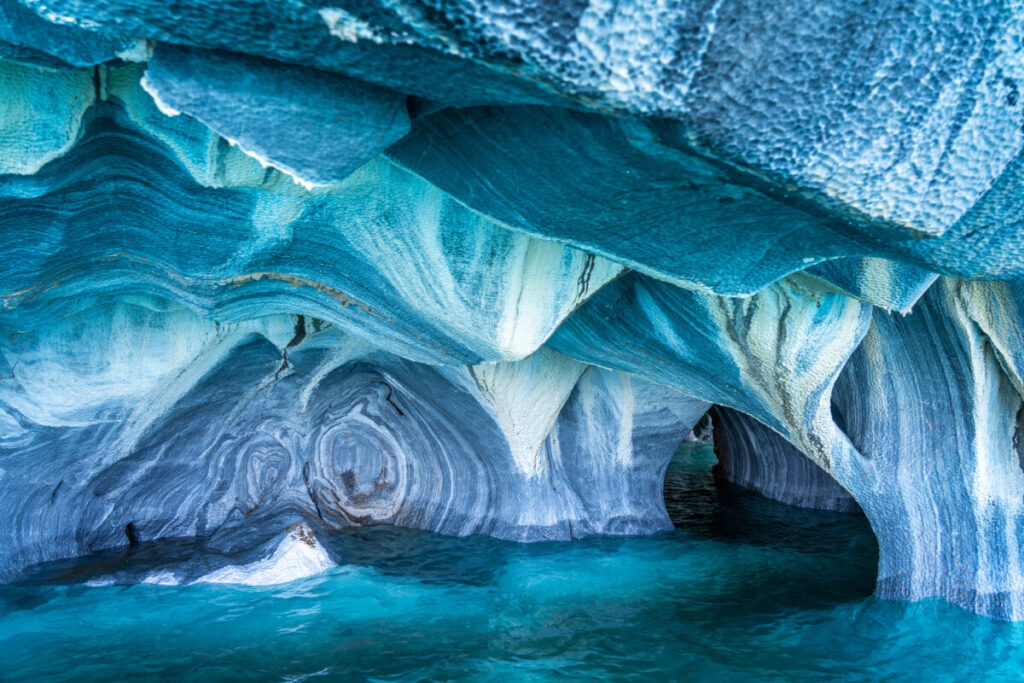
The Marble Caves are a group of caverns, arches, columns, tunnels, and isolated rock formations shaped into marble along the shore and islands of General Carrera Lake. Reflected lake water gives many surfaces a blue or turquoise appearance, although the rock also contains white, gray, brown, yellow, and pink mineral bands.
According to Chile’s Council of National Monuments, the marble itself is approximately 300 million years old. Following glacial retreat around 10,000–15,000 years ago, waves and the chemical action of lake water gradually dissolved and reshaped exposed marble. That is more precise than the often-repeated claim that the caves are simply “6,000 years old.”
The protected Capilla de Mármol was declared a Chilean Nature Sanctuary in 1994. Visitors should follow the guide’s instructions, avoid climbing on or marking the formations, and keep all waste in the boat or kayak.

Marble Chapel, Cathedral, and Cave: What the Names Mean
You will encounter several overlapping names. Capilla de Mármol is the official sanctuary name. Capillas de Mármol or “Marble Chapels” is commonly used for the broader group. Guides may identify three principal formations as the Marble Chapel, Marble Cathedral, and Marble Cave or tunnel. English-language travelers often use “Marble Caves” for the entire site.
Where Are the Marble Caves?
The formations lie on General Carrera Lake in Chile’s Aysén Region, close to Puerto Río Tranquilo on the Carretera Austral. General Carrera is Chile’s largest lake. It crosses the international border into Argentina, where it is known as Lago Buenos Aires.
Puerto Río Tranquilo is the most practical base because it has tour offices, lodging, restaurants, fuel, and bus connections. Most visitors arrange a conventional boat tour in town. Some kayak and small-group products use alternate launch sites such as Bahía Mansa, while Puerto Sánchez offers another approach to marble formations farther around the lake.
There is no normal trail into the main caves. The formations must be viewed from the water, and access depends on wind, wave height, water level, vessel size, and the guide’s safety judgment.

Marble Caves Image Gallery


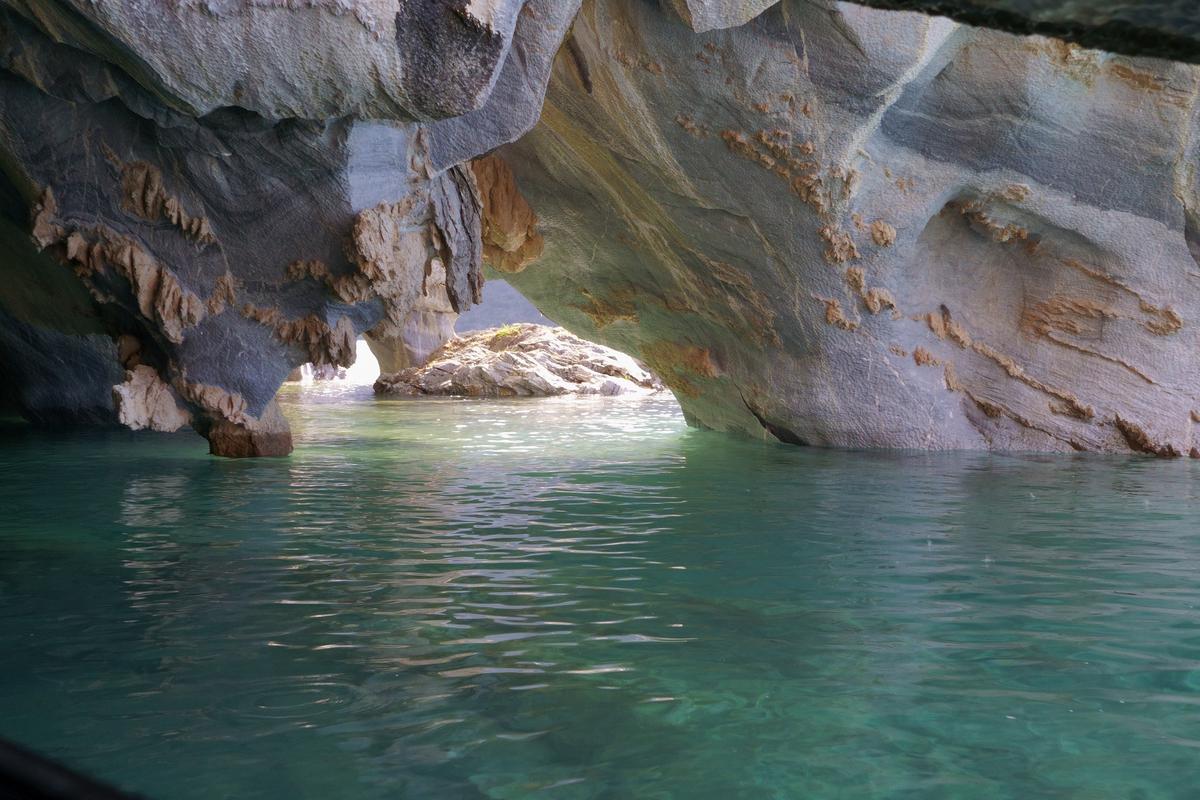


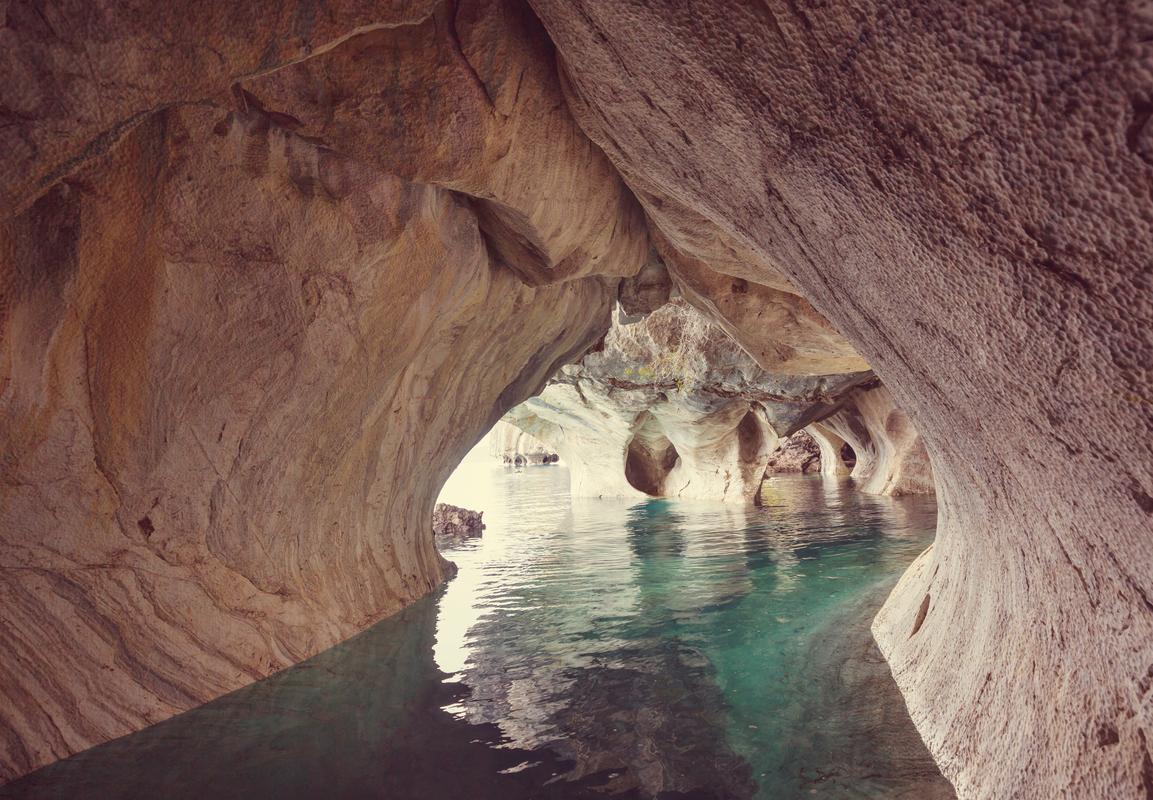
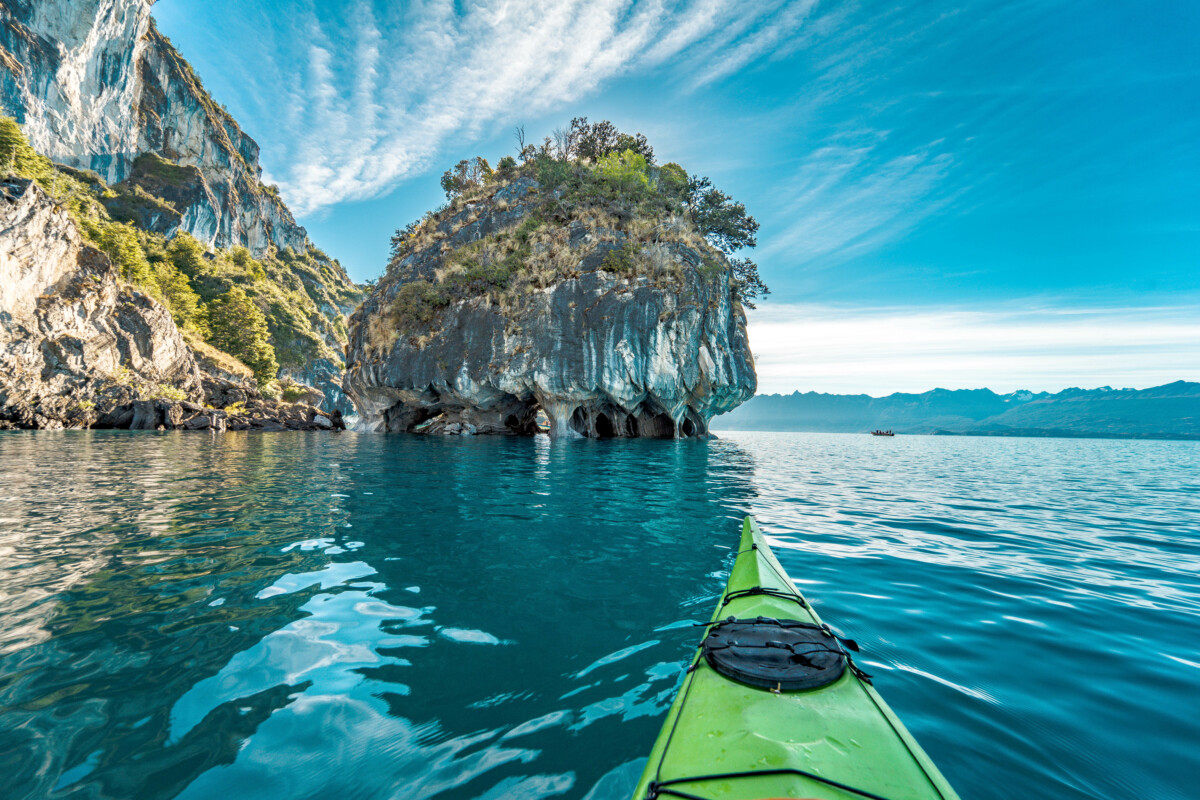
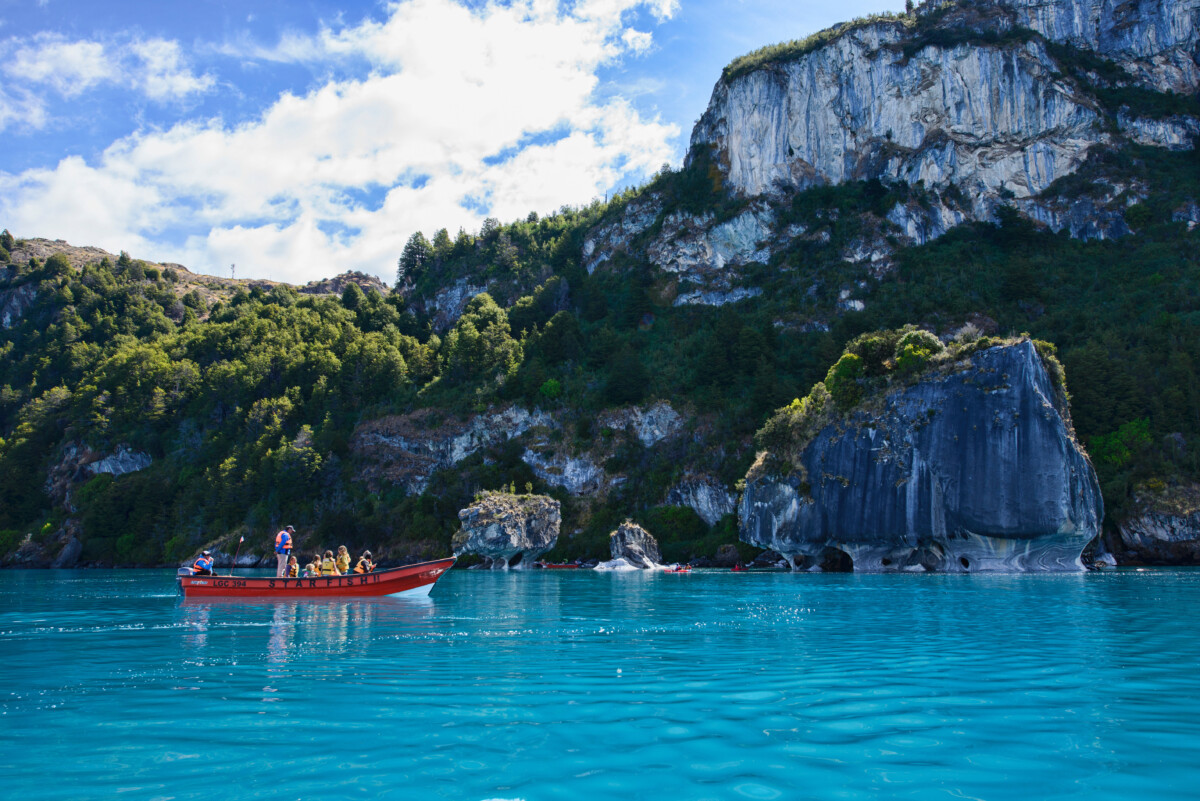


How to Get to the Marble Caves
The standard route is to fly to Balmaceda Airport, continue through Coyhaique, travel south on Ruta 7 to Puerto Río Tranquilo, and then join a boat or kayak excursion. There is no airport at Puerto Río Tranquilo and no direct rail route.
- Fly to Balmaceda Airport. Balmaceda is the principal air gateway for this section of the Aysén Region and is about an hour from Coyhaique.
- Continue to Puerto Río Tranquilo. Use a bus, shared transfer, rental vehicle, private driver, or organized day tour. Allow about four to five hours from Coyhaique before stops.
- Join a water excursion. Most boat departures are arranged in Puerto Río Tranquilo. Kayak operators may transfer guests to a separate launch point.
| Transport option | Best for | Advantages | Tradeoffs |
|---|---|---|---|
| Scheduled bus or shared transfer | Budget travelers and solo visitors | No driving; usually the lowest overland cost | Seasonal schedules, limited flexibility, and possible long waits |
| Rental vehicle | Carretera Austral road trips | Flexible stops and easier access to dispersed lodging | Gravel, changing conditions, fuel planning, and rental restrictions |
| Private transfer | Families and small groups | Door-to-door travel and control over stops | Higher cost |
| Full-day tour from Coyhaique | Travelers with no overnight time | Transport, navigation, and logistics packaged together | Very long day with roughly four to five hours of driving each way |
Check Road Conditions Before Leaving Coyhaique
Ruta 7 includes gravel and weather-exposed sections. Heavy rain, snow, ice, maintenance, landslides, or construction can extend the drive. Check the Aysén Ministry of Public Works road-status page, ask your accommodation or operator for a same-day update, and avoid planning a tight flight connection after the return drive.
Do not treat the four-hour estimate as a guaranteed journey time. Add daylight, fuel, food, and contingency time, especially outside the main summer season.
Best Time to Visit the Marble Caves
December through March is the most dependable period for a Marble Caves trip. Chile Travel recommends these months for the Carretera Austral because of longer daylight and generally more favorable conditions. That does not guarantee calm water; Patagonian wind can still stop departures during summer.

| Period | What to expect | Planning advice |
|---|---|---|
| December–March | Longer daylight, widest service availability, higher demand, and the best overall road-trip conditions | Book lodging early and retain a weather-buffer window |
| November and April | Fewer visitors, cooler conditions, and reduced or changing services | Confirm buses, lodging, restaurants, and water tours directly |
| May–October | Cold, short daylight, possible snow or ice, and substantially reduced visitor infrastructure | Travel only after receiving direct confirmation from transport, lodging, and tour providers |
Morning Water Versus Midday Light
Morning departures are often favored because wind may be lighter, but this is not a guarantee. Stronger overhead light later in the day can produce vivid reflections, while wind may also increase. The correct departure is the safest window recommended by the operator, not a rigid photography rule.
Check the Chilean Meteorological Directorate before departure, but rely on the local guide for the final on-water decision. Lake conditions can differ from a general regional forecast.
Boat, Kayak, or Full-Day Tour: Which Is Best?
| Option | Typical format | Best for | Main limitation |
|---|---|---|---|
| Shared motorboat | About 90 minutes to two hours | Most first-time visitors, families, and travelers with limited time | Less intimate than a kayak and dependent on vessel size and water level |
| Guided kayak | Often four to five hours including transfer, briefing, equipment, and paddling | Active travelers wanting closer access | Higher physical demand, greater exposure, and stricter weather or health limits |
| Private or small-group boat | Operator-specific | Photographers, families, and groups seeking more control | Higher price and limited availability |
| Full-day Coyhaique tour | Long overland day plus navigation | Travelers who cannot stay overnight | Exhausting drive and little protection from schedule disruptions |
1. Shared Boat Tour

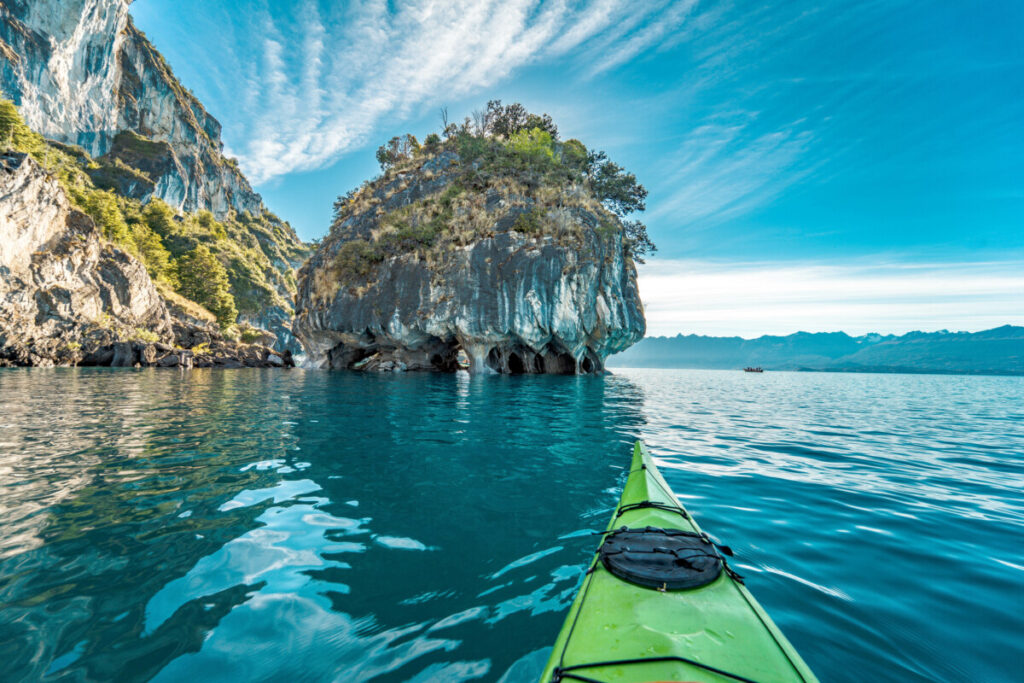
A shared boat is the practical choice for most visitors. It requires less time and physical effort than kayaking and is generally the lowest-cost option. Boats can approach the Chapel and Cathedral formations, and smaller vessels may enter selected openings when water and wind allow.
Before paying, ask for the complete duration, launch point, group capacity, language, life-jacket provision, child restrictions, cancellation policy, and whether the price includes transportation to a separate dock.
2. Guided Kayak Tour
Choose a kayak tour when the paddling experience matters as much as seeing the formations. A current Aysén Patagonia-listed product used Bahía Mansa, limited groups to two to six participants, classified the activity as medium intensity, and included a flotation device, dry jacket, spray skirt, dry bag, paddle, touring kayak, guide, and town transfer.
Provider restrictions vary. Ask about minimum age, swimming confidence, cold-water exposure, capsize procedures, medical restrictions, tandem versus single kayaks, and what clothing is supplied. Keep a dry change of clothes in the transfer vehicle.
3. Full-Day Tour From Coyhaique

A packaged Coyhaique tour removes the need to drive, coordinate the boat, and find lunch separately. It can work for travelers with no overnight availability, but it is not the most comfortable way to visit. Current sample itineraries involve about 4.5 hours of driving each way and can run from early morning until evening.
Review pickup time, actual return range, meal inclusions, cancellation terms, bathroom stops, road-surface expectations, and what happens if the navigation is canceled after the group reaches Puerto Río Tranquilo.
4. Independent Arrival With a Guided Water Tour
Independent travel is sensible for the overland portion: drive or take a bus to Puerto Río Tranquilo, choose your own accommodation, and book a local water operator. It does not mean attempting to enter the formations without a qualified guide. Lake conditions, conservation requirements, equipment, and safe approach routes require local knowledge.
Solo travelers can reduce costs by joining a shared departure. Review our guide to the best places to travel alone when building the rest of the itinerary.
Current Marble Caves Tour Price Context
Prices are not uniform. When checked on July 15, 2026, Chile Travel listed Marble Chapels tours from CLP 20,000. A half-day kayak product listed through Aysén Patagonia was CLP 55,000 per person, including technical equipment, guiding, a Puerto Río Tranquilo transfer, and food. A separate full-day Coyhaique package listed adults at CLP 80,000, including transport, navigation, lunch, and photo stops.
These figures are dated examples, not guaranteed rates. Confirm the currency, taxes, payment method, cancellation terms, transport, meals, entrance or dock charges, equipment, and refund policy in writing.
Accessibility
The standard dock, boat, and kayak experience should not be assumed to be step-free. SERNATUR has documented at least one inclusive product using a boat with secure wheelchair space and an adaptive single-wheel trekking chair, but availability, transfer support, toilets, boarding methods, and staff assistance must be confirmed before booking.
- Describe the traveler’s mobility, transfer, seating, balance, and assistance requirements before paying.
- Ask for photographs or measurements of the vehicle, dock, boarding point, boat space, and toilet facilities.
- Confirm whether companions or personal assistants are charged separately.
- Request a written weather-cancellation and refund policy.
Search for current providers in the SERNATUR registry and ask specifically about adapted departures.
Suggested Marble Caves Itineraries
One Day: Only When You Are Already in Puerto Río Tranquilo
- Join the safest available morning or midday boat departure.
- Keep the rest of the day free until the tour is completed.
- Afterward, walk the lakeshore, review the next section of Ruta 7, and refuel.
This plan is vulnerable to cancellation because it has no backup window.
Two Days: Best for Most Visitors
- Day 1: Travel from Coyhaique or another Carretera Austral stop, check in, compare registered operators, and reserve a departure.
- Day 2: Complete the boat or kayak tour. Keep a later departure or part of the following morning available as a weather backup.
Two nights reduce the risk of traveling several hours only to miss the attraction because of wind.
Three Days: Best for Kayaking or a Wider Lake Visit
- Day 1: Arrive and confirm conditions.
- Day 2: Take the main Marble Caves excursion.
- Day 3: Use a registered operator for a second lake experience, visit Puerto Sánchez, or continue toward another verified Carretera Austral stop.
A third day also creates a stronger buffer for photographers or travelers who have selected a more weather-sensitive kayak departure.
What to Pack for the Marble Caves

| Item | Why it matters |
|---|---|
| Waterproof shell | Protects against spray, wind, and sudden rain |
| Warm synthetic or wool midlayer | Boat and kayak exposure can feel cold even during summer |
| Sun hat and sunscreen | Water reflection increases sun exposure |
| Polarized sunglasses with retention strap | Reduces glare and lowers the chance of losing glasses overboard |
| Closed, grippy footwear | Helps on wet docks, gravel, and uneven roadside stops |
| Dry bag or waterproof phone case | Protects electronics from spray or capsize risk |
| Gloves and warm hat | Useful during cold departures and shoulder seasons |
| Water and snacks | Services can be limited outside town |
| Cash and payment backup | Connectivity or card terminals may fail |
| Motion-sickness medication | Useful for travelers prone to discomfort on choppy water; follow medical directions |
For a longer route, see our advice on packing for an extended trip, practical travel accessories, protective travel cases for camera gear, and carry-on essentials.
Face Sunscreen Example: EltaMD UV Clear SPF 46

EltaMD UV Clear is a broad-spectrum SPF 46 facial sunscreen positioned for sensitive and acne-prone skin. It is a face product rather than a complete solution for exposed arms, neck, and hands. For a boat or kayak day, check the label’s water-resistance directions and use an appropriate body sunscreen as well.
Sun Hat Example: Columbia Bora Bora II Booney

The Bora Bora II uses UPF 50-rated fabric outside its mesh section, a moisture-wicking sweatband, and an adjustable chin strap. The chin strap is more relevant here than fashion or packability because a loose hat can disappear quickly in lake wind.
Polarized Sunglasses Example: Bollé Anaconda

Polarized lenses can make it easier to see through glare on General Carrera Lake. Fit and verified UV protection matter more than brand. Add a floating or secure retention strap rather than relying on the arms alone.
Basic Midlayer Example: Gildan Fleece Crewneck

This crewneck is a low-cost midlayer example, not a technical recommendation. Cotton-rich clothing loses performance when wet and dries slowly. A synthetic fleece or wool layer is normally the better choice for kayaking, rain, or extended outdoor exposure.
Waterproof Boot Example: Columbia Newton Ridge

A full hiking boot is not necessary for a straightforward boat tour. It becomes more useful when the itinerary includes muddy viewpoints, longer roadside stops, or trekking. Prioritize fit, tested comfort, wet-surface traction, and enough toe room over a specific model.
Insect Repellent Example: Sawyer 20% Picaridin

Sawyer’s product contains 20% picaridin; it should not be described as a “natural” repellent. Follow the label’s age, application, storage, and reapplication instructions. Bug pressure at the exposed lake may differ from wooded campsites and hiking areas.
Practical Tips for Visiting the Marble Caves
Check Mobile Coverage Instead of Assuming One Carrier Is Best

Coverage around the lake and along Ruta 7 can be inconsistent. Do not assume that Entel, Movistar, WOM, or Claro will work everywhere on your route. Review the SUBTEL coverage maps, understanding that operator-supplied maps are indicative rather than a guarantee.
- Download offline maps before leaving Coyhaique.
- Save booking confirmations and operator phone numbers offline.
- Tell your accommodation when you expect to arrive.
- Carry a charged power bank and vehicle charger.
Keep the Tour Window Flexible
Book the cave excursion early in your stay rather than just before departure. Ask whether the operator will reschedule, refund, substitute another departure, or retain part of the payment if weather prevents navigation.
Consider travel insurance that addresses weather disruption and nonrefundable bookings, but review exclusions carefully. A policy does not automatically cover every lake cancellation or road delay.
Carry Warm, Waterproof Layers

Summer does not eliminate cold wind, spray, or rapid weather changes. Pack a base layer, insulating midlayer, and waterproof outer shell. Keep electronics in a dry bag and carry a spare clothing layer for a kayak excursion.
Carry Cash, Fuel, Food, and Schedule Margin

Puerto Río Tranquilo has visitor services and an ATM has been listed at the local COPEC station, but a single machine or card terminal is not a reliable financial plan. Carry a reasonable amount of Chilean pesos, retain a second payment method, refuel when practical, and keep food and water in the vehicle.
Verify your tour and accommodation in the SERNATUR tourism-services database. In Chile, lodging and adventure-tourism services are among the categories for which registration is mandatory.
Where to Stay Near the Marble Caves
Stay in Puerto Río Tranquilo when seeing the caves is the priority. A town stay reduces the risk of missing a departure because of a long morning drive. It also makes it easier to compare operators, receive weather updates, and move to a later sailing.
The existing properties below suit road-trip travelers but are not interchangeable. Check the map before booking: some are on other sections of General Carrera Lake or in Bahía Murta rather than within walking distance of Puerto Río Tranquilo’s tour offices.
Mallin Colorado Ecolodge

Mallin Colorado is a private lodge on General Carrera Lake offering rooms and cabins in a scenic, secluded setting. It is better suited to travelers with their own vehicle or a prearranged transfer than visitors seeking a walk-to-the-dock stay. Confirm the current drive to your selected Marble Caves departure before booking.
Chelenko Lodge

Chelenko Lodge offers lakefront cabins and is positioned for travelers who value lake views and an on-property stay. Current listings place it outside the central Puerto Río Tranquilo dock area, so account for the transfer to the selected tour departure. Verify restaurant hours, transport, hot-spring access, and seasonal services directly.
Cabañas Marianela in Bahía Murta

Cabañas Marianela is a self-catering option in Bahía Murta. A current listing placed it about 34 kilometers from the Marble Chapels, making it more suitable for a broader lake road trip than for travelers who want immediate access to Puerto Río Tranquilo’s departure offices. Confirm the exact route, check-in procedure, heating, kitchen equipment, and road conditions.
Longer Patagonia Extensions
The following places are not day trips from Puerto Río Tranquilo. They require separate road segments, flights, border procedures, or multi-day routing. Use them to extend a larger South America trip, not as additions to a one- or two-day Marble Caves visit.
Los Glaciares National Park, Argentina

Los Glaciares protects more than 726,000 hectares in Argentine Patagonia and includes the Perito Moreno Glacier and the mountain landscapes around El Chaltén. Reaching it from the Marble Caves involves a separate Argentine itinerary and border logistics. Check current park notices through Argentina’s National Parks Administration.
Mount Fitz Roy and Cerro Torre

The northern section of Los Glaciares National Park contains trails with views of Fitz Roy and Cerro Torre. This is a trekking destination rather than a brief roadside stop. Allow multiple nights in El Chaltén and check current trail, weather, and border information.
Torres del Paine National Park

Torres del Paine is far south of the Marble Caves and normally approached through Puerto Natales. Entrance systems, trail restrictions, seasonal guide requirements, and weather closures can change. Use CONAF’s official park page rather than relying on an older itinerary.
Tierra del Fuego National Park

Tierra del Fuego National Park is near Ushuaia, Argentina, and combines subantarctic forest, coast, lakes, and mountain scenery. It requires a separate far-southern itinerary. Check current visitor information through Argentina’s National Parks Administration.
Laguna San Rafael National Park

Laguna San Rafael is the most geographically coherent glacier extension on this list, but it still requires substantial planning. Boat routes commonly depart through Puerto Chacabuco or other authorized access points. Do not assume older Exploradores Glacier trekking descriptions remain valid: CONAF has restricted frontal glacier access because of instability. Check the official park page before booking.
Magellanic Penguins at Isla Magdalena

Monumento Natural Los Pingüinos protects Isla Magdalena and Isla Marta near Punta Arenas. At the July 15, 2026 verification, CONAF listed the monument as closed from April 1 through September 30, 2026 and displayed an avian-influenza warning. Check the current CONAF notice before planning travel around the colony.
Whitewater Rafting in Futaleufú

Futaleufú is in northern Chilean Patagonia, not northern Chile. Its river is internationally known for rafting and kayaking, making it a logical adventure stop on a longer Carretera Austral route. It remains far enough from Puerto Río Tranquilo to require separate travel days. Compare it with other world-class whitewater rafting destinations.
Are the Marble Caves Worth Visiting?
The Marble Caves are worth visiting when they fit naturally into a Carretera Austral trip or when you can dedicate two nights to Puerto Río Tranquilo. The combination of protected geology, changing reflected color, and water-level access is distinctive. The trip is less compelling when it requires a rushed out-and-back drive from Coyhaique with no weather buffer.
The sound plan is straightforward: stay near the departure point, book a registered operator, schedule the excursion early in the stay, verify roads and weather, and accept that the lake—not the booking confirmation—determines whether a departure is safe.
Frequently Asked Questions
Where are the Marble Caves in Chile?
The Marble Caves are on General Carrera Lake in Chile’s Aysén Region, near Puerto Río Tranquilo on the Carretera Austral. The lake crosses into Argentina, where it is called Lago Buenos Aires.
How do you get to the Marble Caves?
Most travelers fly to Balmaceda Airport, continue through Coyhaique, travel four to five hours south to Puerto Río Tranquilo, and join a guided boat or kayak excursion. There is no conventional walking entrance to the main formations.
How much does a Marble Caves tour cost?
When verified on July 15, 2026, Chile Travel listed basic boat excursions from CLP 20,000. An Aysén Patagonia-listed half-day kayak example was CLP 55,000 per person. Prices and inclusions vary, so confirm the current total directly.
Is a boat or kayak tour better?
A shared boat is better for most first-time visitors because it is faster, less physical, and usually less expensive. A guided kayak is better for active travelers who want closer access and accept greater exposure to cold, wind, and capsize risk.
What is the best time to visit the Marble Caves?
December through March is the most dependable period because daylight is longer and transport and tourism services are generally more available. Wind can still cancel departures in summer, so keep a backup window.
How long does a Marble Caves tour take?
Many boat tours take about 90 minutes to two hours. A half-day kayak experience may take four to five hours including transfers, equipment, briefing, and paddling. A day tour from Coyhaique can occupy most of the day.
Can you visit the Marble Caves in winter?
A winter visit may be possible only when transport, lodging, road conditions, and a local operator are all confirmed. Services are reduced, daylight is shorter, and snow, ice, cold, or wind can prevent travel or navigation.
Are the Marble Caves wheelchair accessible?
Standard access should not be assumed to be wheelchair accessible. SERNATUR has documented an adapted product with secure wheelchair space on a boat, but availability, boarding, transport, toilets, and assistance must be confirmed directly in advance.