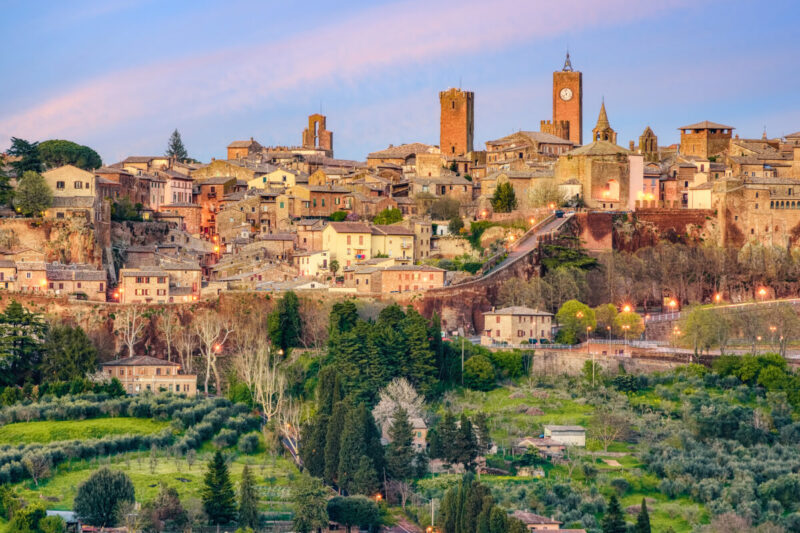
Centro Storico Orvieto occupies the flat summit of a volcanic tufa cliff rising sharply above the Paglia River valley in southern Umbria. The old town preserves a dense medieval street grid, Etruscan and Roman layers beneath its foundations, and some of the finest Gothic architecture in central Italy. Corso Cavour bisects the district from the funicular station to the cathedral precinct, linking the major piazzas and the principal monuments.
What is Centro Storico Orvieto known for?
Centro Storico Orvieto is internationally known for the Duomo di Orvieto, a 14th-century Gothic cathedral whose polychrome marble facade and Luca Signorelli frescoes in the Cappella di San Brizio rank among Italy’s most significant medieval artworks; the town is also renowned for its Etruscan underground network and the white wine Orvieto Classico DOC produced in the surrounding hills.
- Duomo di Orvieto facade with gold mosaic panels and Lorenzo Maitani bas-reliefs
- Cappella di San Brizio frescoes by Luca Signorelli (1499–1504)
- Pozzo di San Patrizio, the double-helix well commissioned by Pope Clement VII in 1527
- Orvieto Underground, a guided tour of Etruscan and medieval tunnels beneath the tufa
- Orvieto Classico DOC white wine, available throughout the centro storico
Best things to do in Centro Storico Orvieto
The essential experiences in Centro Storico Orvieto include touring the Duomo interior and its attached Museo dell’Opera del Duomo, descending Pozzo di San Patrizio’s 248 steps on the paired spiral staircases, and joining a guided Orvieto Underground tour that reveals Etruscan cisterns and medieval pigeon lofts carved into the cliff.
- Visit Museo Claudio Faina e Civico for Etruscan ceramics and bronzes facing the Duomo
- Walk the perimeter cliff path along Via della Cava and the western bastions for valley views
- Browse the weekly Thursday market on Piazza del Popolo
- Attend a classical concert in the Duomo or at Teatro Mancinelli on Corso Cavour
Where to eat and drink in Centro Storico Orvieto
Restaurants and enotecas along Corso Cavour and the lanes around Piazza della Repubblica serve classic Umbrian dishes including umbricelli al tartufo nero (thick hand-rolled pasta with black truffle), cinghiale in umido (braised wild boar), and local Orvieto Classico and Rosso Orvietano wines poured by the glass.
- Enotecas on Via della Cava and Piazza del Duomo stock Orvieto Classico from local producers
- Trattorie near Piazza della Repubblica offer umbricelli, pici, and lentil soups from the Castelluccio area
- Pasticcerie along Corso Cavour sell torciglione, the traditional almond-and-pine-nut serpent-shaped cake
Where to walk in Centro Storico Orvieto
The primary walking route runs along Corso Cavour from Piazza Cahen near the funicular terminus westward through Piazza della Repubblica to Piazza del Duomo, covering the town’s full length in about fifteen minutes and passing the key monuments, market square, and medieval tower houses.
- Via della Cava leads south from Corso Cavour past a pre-Roman well to quiet residential lanes
- The cliff-edge path near Fortezza dell’Albornoz offers unobstructed views over the valley toward Bolsena
- Vicolo del Campanile and surrounding medieval alleys preserve original tufa-block architecture
How to get to Centro Storico Orvieto
Orvieto railway station on the Rome–Florence main line (Ferrovia Lenta) sits at the base of the cliff; from the station a funicular climbs directly to Piazza Cahen at the edge of the centro storico, with bus line A continuing along Corso Cavour to Piazza del Duomo.
- Trenitalia regional and intercity trains stop at Orvieto station; Rome is roughly 75 minutes away
- Funicular Orvieto runs every 10 minutes connecting the station to Piazza Cahen
- A1 Autostrada exit Orvieto for drivers; limited ZTL parking inside the old town
Best time to visit Centro Storico Orvieto
April through June and September through October offer mild temperatures, manageable crowds, and open-air events including the Corpus Domini historical procession in June, when the Duomo’s Corporale relic is displayed and the town stages a medieval pageant that has been celebrated since 1263.
- June Corpus Domini procession features period costumes and fills Piazza del Duomo
- December brings a Christmas market and Umbria Jazz Winter festival to the centro storico
- July and August are hot and busier; early morning visits to the Duomo avoid tour groups