Centro Storico Perugia occupies the elongated ridge of Monte Subasio’s spur above the Tiber Valley, forming one of Italy’s best-preserved medieval hill-town cores. Its spine, Corso Vannucci, connects the city’s principal civic monuments within easy walking distance, while a network of medieval lanes, escalators, and stepped vicoli link the upper city to lower quarters. The neighborhood draws visitors for Etruscan archaeology, Gothic civic architecture, artisan chocolate, and a thriving university culture that keeps the old city lively year-round.
What is Centro Storico Perugia known for?
Centro Storico Perugia is internationally known for Piazza IV Novembre, the monumental heart of the city, dominated by the 13th-century Fontana Maggiore — sculpted by Nicola and Giovanni Pisano — and the Gothic Palazzo dei Priori, which houses the Galleria Nazionale dell’Umbria, Italy’s most important collection of Umbrian painting including works by Perugino and Pinturicchio. The neighborhood also anchors Eurochocolate, one of Europe’s largest chocolate festivals, held each October.
Best things to do in Centro Storico Perugia
The single most rewarding activity is a slow walk the length of Corso Vannucci from Piazza Italia to Piazza IV Novembre, pausing at the Palazzo dei Priori, the Collegio del Cambio with its Perugino frescoes, and the Collegio della Mercanzia. Beyond that central axis, key experiences include:
- Visiting the Galleria Nazionale dell’Umbria on the upper floors of Palazzo dei Priori
- Exploring the Rocca Paolina, the 16th-century Farnese fortress partly incorporated into escalators beneath Piazza Italia
- Descending to the Ipogeo dei Volumni, an Etruscan hypogeum just outside the historic core near Ponte San Giovanni
- Attending a concert or exhibition at the Teatro Morlacchi on Piazza Morlacchi
- Shopping for Perugina chocolates and local truffles along Corso Vannucci and in the covered Mercato Coperto
Where to eat in Centro Storico Perugia
The historic center offers Umbrian staples — strangozzi al tartufo nero, torta al testo stuffed with cured meats, and roast pigeon — at trattorias concentrated around Piazza Danti, Via Ulisse Rocchi, and the lanes off Corso Vannucci. Osteria A Priori on Via dei Priori is a well-regarded address for seasonal Umbrian cooking using local producers; the Mercato Coperto off Piazza Matteotti sells fresh truffles, pecorino, and cured meats for self-catering. Pasticceria Sandri on Corso Vannucci, open since 1860, remains the classic stop for pastries and espresso beneath its original painted ceiling.
Where to walk in Centro Storico Perugia
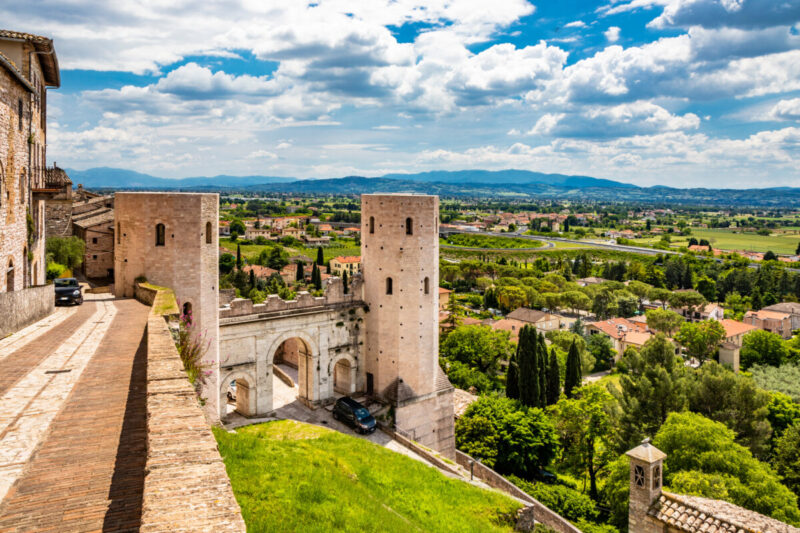
The most rewarding walk in the centro storico follows the western escarpment from Porta Marzia — the preserved Etruscan gate embedded in the Rocca Paolina — north along Via Bagliona and Via dei Priori to the Arco Etrusco (Arco di Augusto), one of the finest surviving Etruscan arches in Italy, then east along Via Ulisse Rocchi back to Piazza IV Novembre, covering the neighborhood’s full historical sweep in under two kilometers. A second useful route descends from Piazza Italia via the internal escalators through the Rocca Paolina to the lower Porta Marzia district, returning by the steep Via dell’Acquedotto medieval aqueduct walkway.
How to get to Centro Storico Perugia
The historic center sits atop a hill and is a Limited Traffic Zone; the practical arrival point for most visitors is Piazza Partigiani car park below the hill, connected to Piazza Italia by the free Rocca Paolina escalator system. Perugia Fontivegge is the main railway station, served by Trenitalia regional trains from Florence, Rome Termini (via Terontola or Foligno), and Assisi; a city minibus (Linea A or Linea E operated by Busitalia) connects the station to Piazza Italia in about ten minutes. Perugia Sant’Anna station on the FCU (Ferrovia Centrale Umbra) line is closer to the lower city. The Perugia International Airport (San Francesco d’Assisi) at Sant’Egidio is 12 km east, with taxi and bus links.
Best time to visit Centro Storico Perugia
April through June and September through October offer mild temperatures ideal for walking the hilltop streets without summer heat or winter fog; October coincides with Eurochocolate festival (typically third week) and the truffle season, making it the single busiest and most atmospheric month. Umbria Jazz, held each July in venues including the Arena Santa Giuliana and Piazza IV Novembre, draws large international crowds and energizes the entire centro storico for ten days.