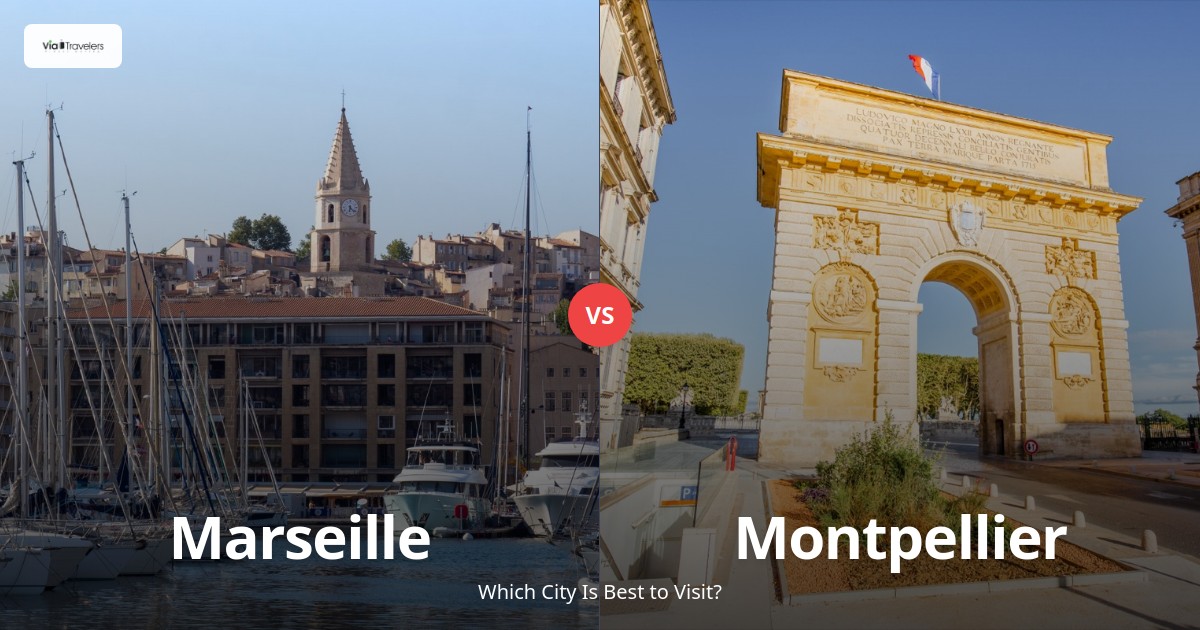
Écusson is the shield-shaped historic heart of Montpellier, bounded roughly by the inner boulevards and taking its name from the coat-of-arms outline formed by its medieval street plan. The quarter concentrates the city’s finest 17th- and 18th-century hôtels particuliers, its principal cultural institutions, and a labyrinth of pedestrian lanes linking grand squares to quiet courtyards. Visitors based here can reach virtually every major sight on foot.
What is Écusson known for?
Écusson is known above all as the political, cultural, and social centre of Montpellier, home to Place de la Comédie — the city’s main square anchored by the 19th-century Opéra Comédie and the Three Graces fountain — alongside the Musée Fabre, one of France’s most important fine-arts museums, and a network of aristocratic mansions now partly open to visitors. The quarter also contains the medieval Cathédrale Saint-Pierre, whose distinctive Gothic porch towers are among the most recognisable landmarks in Languedoc. Rue de la Loge and Rue Foch serve as the main commercial and ceremonial axes, lined with independent shops and brasseries.
Best things to do in Écusson
The single most rewarding activity in Écusson is a self-guided walk through its hôtel particulier courtyards and along the Promenade du Peyrou, the 17th-century royal esplanade capped by an equestrian statue of Louis XIV and a neoclassical water tower, offering panoramic views west across the city. Other concrete activities include touring the Musée Fabre’s collection of Courbet, Delacroix, and Frédéric Bazille paintings; visiting the Jardin des Plantes — France’s oldest botanical garden, founded in 1593 — just outside the western edge of the quarter; and exploring the Antigone district immediately to the east as a modernist contrast.
- Tour the Musée Fabre, boulevard Bonne Nouvelle, free on first Sunday of each month
- Walk the Promenade du Peyrou and inspect the Arc de Triomphe on Rue Foch
- Stroll through the Jardin des Plantes on Boulevard Henri IV
- Visit Cathédrale Saint-Pierre on Place Saint-Pierre for its Gothic nave
- Browse the covered Marché du Lez or the weekly markets on Place de la Comédie
Where to eat in Écusson
Écusson offers a full range of Montpellier dining from casual tapas bars on Rue de l’Ancien Courrier to traditional Languedoc restaurants serving tielle, brandade de morue, and grilled fish around Place de la Chapelle Neuve and Place Saint-Ravy. The streets around Rue des Étuves and Rue du Bras de Fer concentrate affordable bistros catering to students from the nearby University of Montpellier faculties. For coffee and pastry, the terraces flanking Place Jean-Jaurès are locally preferred over the more tourist-facing cafés on Place de la Comédie.
Where to walk in Écusson
The classic Écusson walk begins at Place de la Comédie, heads west along Rue de la Loge past the Gothic church of Notre-Dame-des-Tables (now the Musée de l’Histoire de Montpellier underground), continues up Rue Foch through the Arc de Triomphe, and terminates at the Promenade du Peyrou and its 18th-century aqueduct, covering the quarter’s ceremonial spine in under 25 minutes. A second loop threads south from Place Saint-Ravy through the narrow medieval lanes of Rue de l’Aiguillerie and Rue des Augustins, passing several restored hôtel particulier façades before reaching Place Castellane.
How to get to Écusson
Écusson is served directly by Montpellier’s tram network: line 1 (blue) stops at Comédie and Corum on the quarter’s northern and eastern edges, while line 3 (red) also calls at Comédie, connecting the old town to the main railway station, Gare de Montpellier-Saint-Roch, approximately ten minutes away by tram. The quarter itself is almost entirely pedestrianised, so visitors arrive on foot from surrounding tram stops or from nearby car parks on the inner boulevards.
Best time to visit Écusson
Late spring (April–June) and early autumn (September–October) offer the most comfortable conditions for walking Écusson’s stone-paved lanes, with mild temperatures, full museum opening hours, and active terrace life without the peak July–August crowds and heat. The Festival de Radio France Occitanie Montpellier in July and the Montpellier Danse festival bring performances to outdoor stages around Place de la Comédie and the Opéra Comédie, making midsummer culturally rewarding despite the heat.