
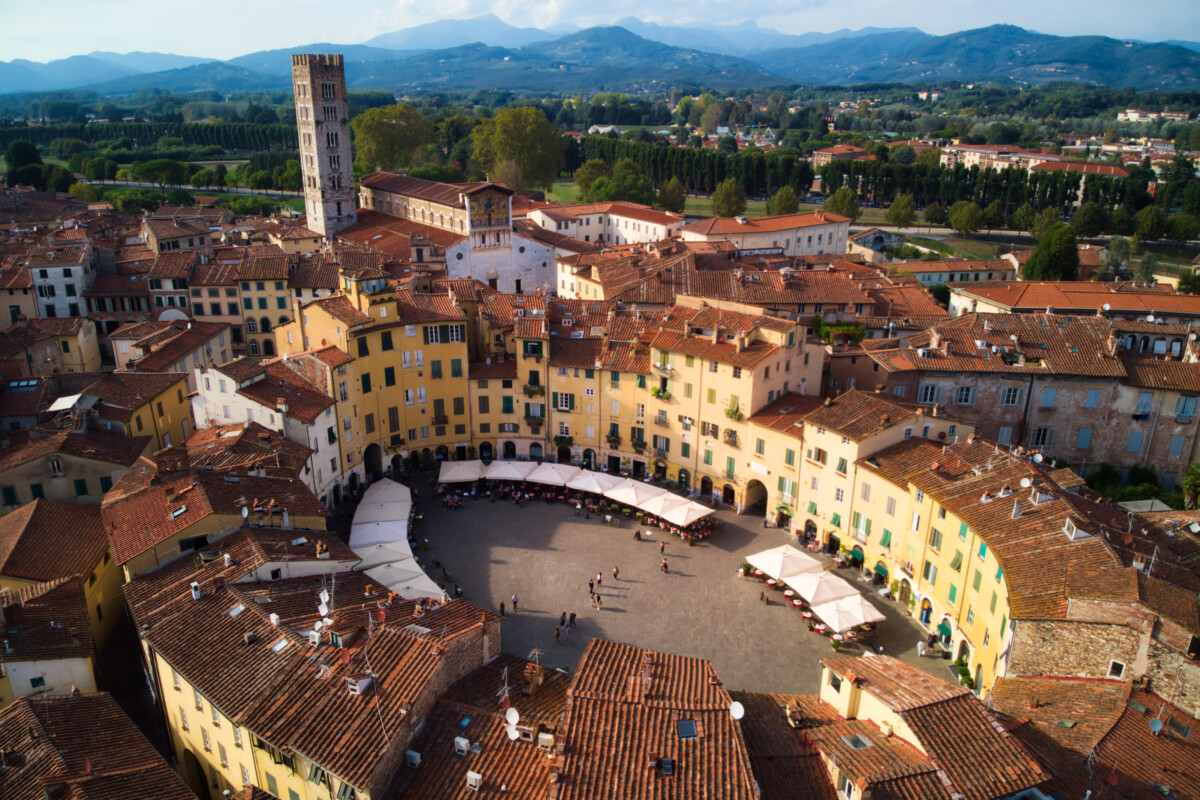
Lucca’s Historic Center sits within one of Italy’s best-preserved sets of Renaissance defensive walls, a 4.2-kilometer circuit of 16th- and 17th-century brick bastions that now serve as a tree-lined public promenade above the rooftops. The compact centro storico is largely traffic-free, layered with Roman street grids, medieval towers, and Romanesque marble façades concentrated within a walkable ellipse. Unlike Florence or Siena, Lucca receives fewer day-trippers, giving its piazzas and trattorias a lived-in, local rhythm year-round.
What is the Historic Center of Lucca known for?
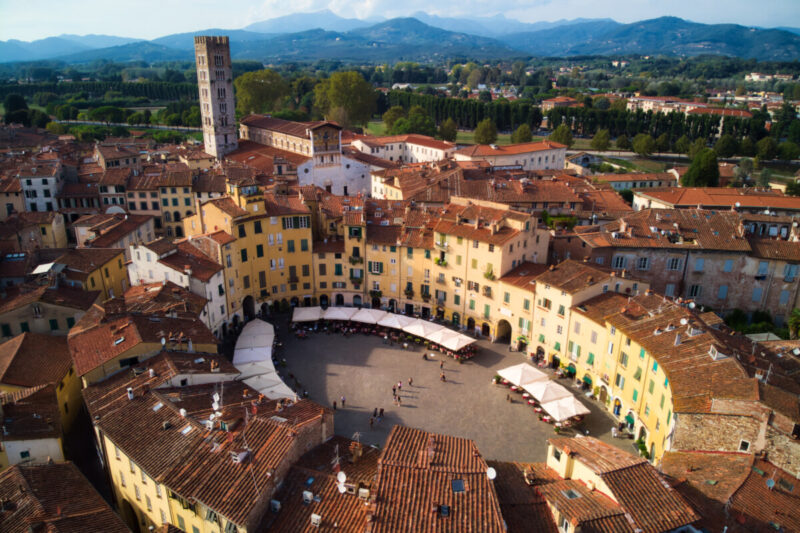
Lucca’s Historic Center is internationally recognized for its unbroken Renaissance city walls, the oval Piazza dell’Anfiteatro built over a Roman amphitheater, and a cluster of Romanesque churches including the Cattedrale di San Martino, San Michele in Foro, and San Frediano — all featuring distinctive white-and-green marble banding and open loggias. The city is also the birthplace of composer Giacomo Puccini, whose childhood home on Via di Poggio is now a museum.
Best things to do in Lucca’s Historic Center
Walking or cycling the full perimeter of the Mura di Lucca takes roughly 45 to 60 minutes and offers elevated views over terracotta rooftops and into private gardens below. Beyond the walls, key experiences include:
- Climbing the Torre Guinigi, a medieval tower with holm oak trees growing from its roof terrace, for panoramic city views.
- Exploring Piazza dell’Anfiteatro, whose curved medieval buildings trace the exact outline of the ancient Roman arena beneath.
- Visiting the Cattedrale di San Martino to see the Volto Santo, a venerated wooden crucifix, and Jacopo della Quercia’s tomb of Ilaria del Carretto.
- Attending a performance or exhibit at the Teatro del Giglio, Lucca’s 18th-century opera house on Piazza del Giglio.
- Renting a bicycle from one of the rental shops near Piazzale Verdi to tour the centro storico car-free streets.
Where to eat and drink in Lucca’s Historic Center
Lucca’s food culture centers on earthy Garfagnana-influenced Tuscan cooking: dishes like tordelli lucchesi (fresh pasta stuffed with meat and topped with ragù), farro soup, and buccellato, a sweet anise-and-raisin bread sold in ring form that is Lucca’s signature pastry. Via Fillungo, the main pedestrian shopping street, is lined with historic cafes including the Liberty-style Caffè Di Simo, a 19th-century institution. The market halls of Piazza del Carmine host a daily food market where locals shop for produce, cheese, and cured meats. For a sit-down meal, the area around Piazza San Salvatore and Via delle Trombe concentrates traditional trattorias serving local wine from the Colline Lucchesi DOC zone.
How to get to Lucca’s Historic Center
Lucca is served by Lucca railway station (Stazione di Lucca) on the Viareggio–Firenze line, placing it roughly 80 minutes by regional Trenitalia train from Florence Santa Maria Novella and 30 minutes from Pisa Centrale. The station sits immediately outside the southern walls at Porta San Pietro, making the Historic Center reachable on foot in under five minutes from the platform. Buses operated by Autolinee Toscane connect Lucca to Pisa, Florence, and Viareggio. By car, the A11 Autostrada exits at Lucca Est or Lucca Ovest; parking is available outside the walls at Parcheggio Palatucci near Porta Sant’Anna.
Where to walk in Lucca’s Historic Center
The most rewarding walking route begins at Piazza Napoleone, passes through Piazza San Giovanni to the Cattedrale di San Martino, continues north along Via Fillungo to the Torre Guinigi, then loops through Piazza dell’Anfiteatro before returning west via Via Santa Croce to San Michele in Foro. A second classic route follows the entire top of the Mura di Lucca starting from Piazzale Verdi on the western side, proceeding clockwise past the Baluardo San Donato, Baluardo Santa Croce, and Baluardo San Regolo before completing the circuit.
Best time to visit Lucca’s Historic Center
April through June and September through October offer mild temperatures between 15°C and 25°C, manageable crowds, and full access to outdoor piazzas and wall promenades, making these months the most practical for visiting. July and August bring heat above 30°C and peak Italian domestic tourism; the Lucca Summer Festival, held in Piazza Napoleone, draws large international concert crowds in late June and July. The Lucca Comics and Games festival in late October transforms the centro storico into one of Europe’s largest comics conventions, requiring advance hotel booking.