Montalcino’s historic center crowns a 564-meter hill in the Val d’Orcia, enclosed by intact 13th- and 14th-century walls that encircle a compact grid of medieval streets, Romanesque churches, and enotecas pouring Brunello di Montalcino, one of Italy’s most celebrated red wines. The town’s strategic elevation commands panoramic views over the surrounding vineyards, olive groves, and the UNESCO-listed Val d’Orcia landscape. Fewer than 5,000 residents live within and around the walls, keeping the atmosphere intimate year-round.
What is the Historic Center of Montalcino known for?
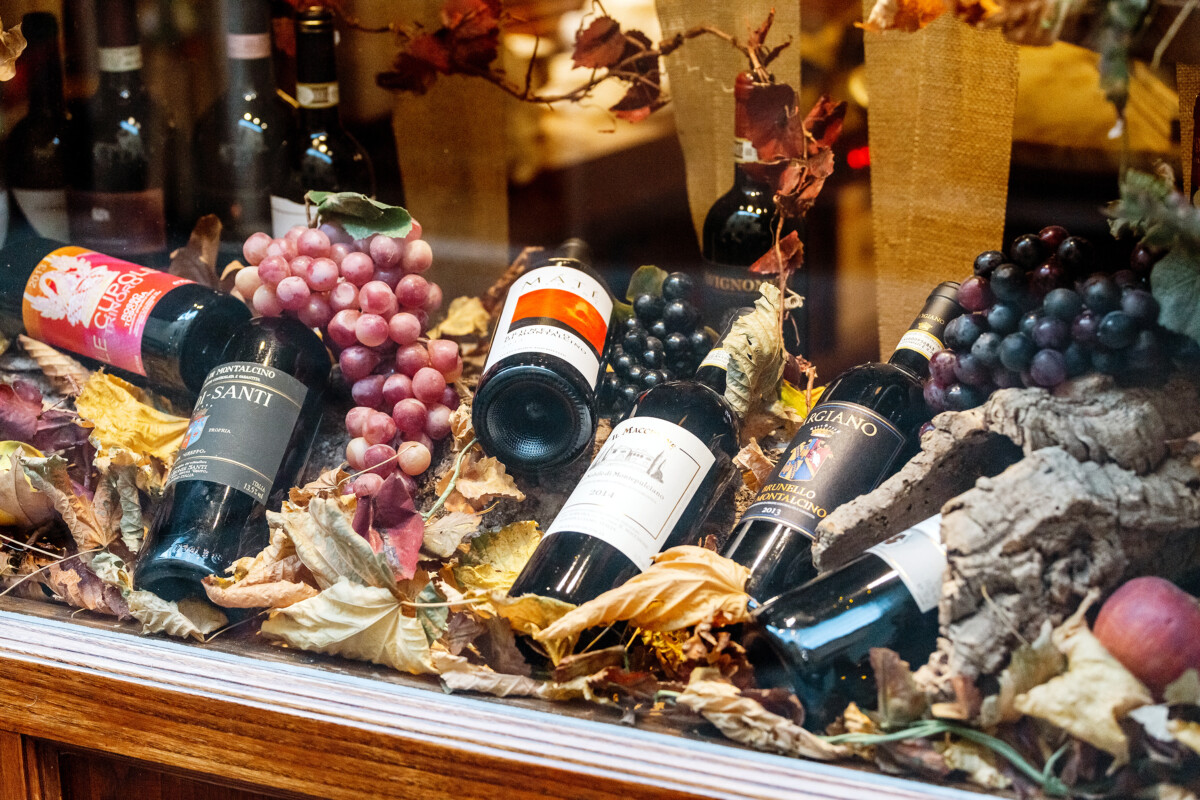
Montalcino is known above all as the production zone of Brunello di Montalcino DOCG, a Sangiovese Grosso wine aged a minimum of five years before release, alongside its exceptionally well-preserved 14th-century Fortezza and its medieval street plan that has changed little since the Sienese Republic controlled the town. The Fortezza itself functions as a working enoteca where visitors can taste Brunello, Rosso di Montalcino DOC, and Moscadello di Montalcino. The Museo Civico e Diocesano d’Arte Sacra on Via Ricasoli holds a notable collection of Sienese paintings and polychrome wooden sculptures.
Best things to do in Montalcino’s historic center
Walking the full circuit of the medieval walls, visiting the Fortezza’s battlements for 360-degree Val d’Orcia views, and touring the Museo Civico e Diocesano d’Arte Sacra are the essential activities inside the walls, while the historic center’s density of enotecas makes structured wine tasting straightforward without leaving town.
- Climb the Fortezza towers for panoramic views over Val d’Orcia and Monte Amiata
- Taste Brunello and Rosso di Montalcino at the Fortezza enoteca
- Visit the Museo Civico e Diocesano d’Arte Sacra on Via Ricasoli
- Attend the weekly Friday morning market in and around Piazza del Popolo
- Walk the perimeter of the 14th-century walls on the internal wall path
Where to eat and drink in Montalcino
The historic center’s restaurants and enotecas concentrate along Via Mazzini, Costa del Municipio, and around Piazza del Popolo, with menus built around Cinta Senese pork, pici pasta with wild boar ragù, and local pecorino, all paired with Brunello or the more approachable Rosso di Montalcino.
- Enoteca Osticcio on Via Mazzini: broad Brunello producer selection by the glass
- Ristorante Re di Macchia on Via Soccorso Saloni: Sienese regional cuisine
- Caffè Fiaschetteria Italiana on Piazza del Popolo: historic café open since 1888
- Local dish: pici all’aglione or pici al ragù di cinghiale (wild boar)
- Local cheese: Pecorino di Pienza available at alimentari on Via Mazzini
Where to walk in Montalcino’s historic center
The most rewarding walk inside the walls runs from Piazza del Popolo south along Via Mazzini past the Fortezza, then along the western wall path returning north to the Church of Sant’Agostino and the Museo Civico, covering the town’s principal monuments in under two kilometers on largely flat or gently sloping ground.
- Via Mazzini: main commercial street linking Piazza del Popolo to the Fortezza
- Internal wall path: shaded promenade with vineyard views, accessible near the Fortezza
- Piazza Cavour: quieter square in the northern sector near Sant’Agostino church
How to get to Montalcino’s historic center
Montalcino has no train station; the most practical approach is by car via the SR2 Cassia from Siena (approximately 40 km south) or by Tiemme regional bus from Siena’s Piazza Gramsci bus terminal, with services running several times daily and a journey time of roughly one hour to Montalcino’s Piazza Cavour stop inside the walls.
- Tiemme bus line from Siena Piazza Gramsci to Montalcino, ~1 hour
- By car: SR2 Cassia sud from Siena, then SP45 to Montalcino
- Nearest train station: Torrenieri-Montalcino on the Siena–Grosseto line, 10 km away
- Parking: free lots outside Porta Cerbaia and near the Fortezza
Best time to visit Montalcino’s historic center
Late September through early November is the optimal period, combining the Brunello harvest season, mild temperatures averaging 15–20 °C, and the Sagra del Tordo festival held annually on the last Sunday of October in the Fortezza, featuring medieval pageantry and archery competitions between the town’s four districts.