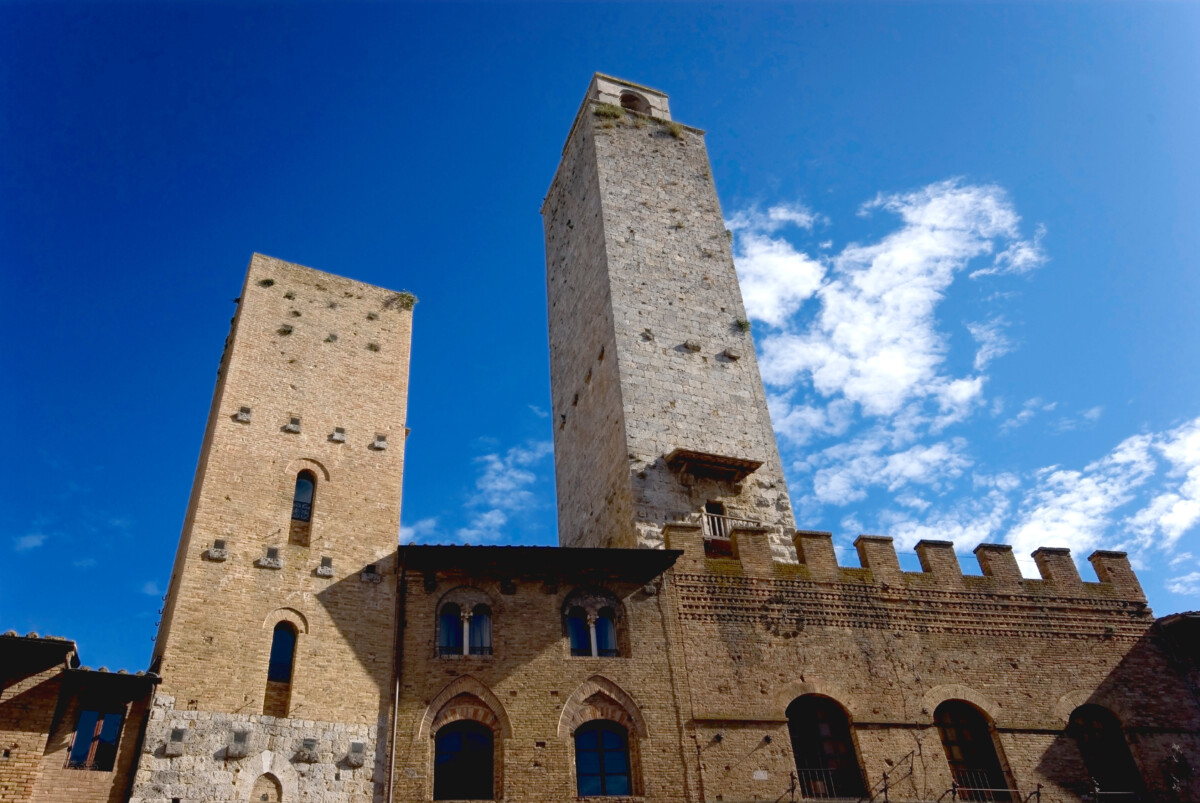
San Gimignano’s historic center occupies the summit of a limestone hill in the Val d’Elsa, 56 km south of Florence and 38 km northwest of Siena. The town’s skyline of medieval stone towers—once symbols of family wealth and power—has earned it the nickname “Manhattan of the Middle Ages.” The entire centro storico is enclosed within 13th-century walls and has been a UNESCO World Heritage Site since 1990.
What is San Gimignano Historic Center known for?
San Gimignano is known above all for its 14 surviving medieval towers, the Collegiata di Santa Maria Assunta (a Romanesque cathedral with frescoes by Ghirlandaio and Barna da Siena), and Vernaccia di San Gimignano DOCG, Italy’s first wine to receive DOC status in 1966. The town preserves one of the most complete medieval urban fabrics in Tuscany, with two interlocking main squares, intact city gates, and a documented street plan essentially unchanged since the 13th century.
Best things to do in San Gimignano Historic Center
Climbing the Torre Grossa—the tallest surviving tower at 54 meters, attached to the Palazzo del Popolo—gives panoramic views over the Val d’Elsa and is the only tower open to the public. Other essential experiences include viewing the fresco cycles inside the Collegiata, visiting the Museo Civico inside the Palazzo del Popolo, and walking the perimeter of the medieval walls for changing perspectives on the tower cluster.
- Climb Torre Grossa for 360-degree Val d’Elsa views
- Visit the Collegiata frescoes by Ghirlandaio (New Testament cycle, 1475)
- Explore the Museo Civico and its Pinacoteca collection
- Walk Viale delle Rimembranze along the outer walls
- Browse Gelateria Dondoli on Piazza della Cisterna, winner of multiple World Gelato Championships
Where to eat and drink in San Gimignano Historic Center
Vernaccia di San Gimignano DOCG—a crisp, mineral white wine made from the indigenous Vernaccia grape—is the essential local drink and can be tasted at enotecas along Via San Giovanni and Via San Matteo. Traditional Sienese-influenced dishes include wild boar (cinghiale) pasta, pici cacio e pepe, and ribollita. Osteria del Carcere on Via del Castello and the restaurants around Piazza della Cisterna serve straightforward Tuscan menus anchored to local produce.
- Vernaccia di San Gimignano DOCG white wine from local enotecas
- Pici pasta with wild boar ragù (cinghiale)
- Award-winning gelato at Gelateria Dondoli, Piazza della Cisterna
- Saffron-based dishes—San Gimignano has a historic saffron-growing tradition
Where to walk in San Gimignano Historic Center
The main pedestrian axis runs north–south along Via San Giovanni from Porta San Giovanni (the southern gate) through Piazza della Cisterna and Piazza del Duomo, then continuing as Via San Matteo to Porta San Matteo. This spine connects the principal monuments, towers, shops, and squares in a single walkable corridor of roughly 600 meters.
How to get to San Gimignano Historic Center
San Gimignano has no rail connection; the nearest train stations are Poggibonsi-San Gimignano on the Empoli–Siena line (Trenitalia), from which Tiemme bus line 130 runs regularly to San Gimignano’s Porta San Giovanni bus terminus. From Florence, take a train to Poggibonsi and connect by bus; total journey approximately 75–90 minutes. From Siena, the same Poggibonsi interchange applies, taking roughly 60 minutes.
- Tiemme bus line 130: Poggibonsi station to Porta San Giovanni
- Trenitalia Empoli–Siena line to Poggibonsi-San Gimignano station
- Parking areas outside the walls at Parcheggio Giubileo and Parcheggio Rocca
Best time to visit San Gimignano Historic Center
Late April through June and September through October offer mild temperatures (14–22°C), manageable crowds, and active local events including the Estate Sangimignanese summer festival. July and August bring the heaviest tourist volumes and heat. Winter (November–February) sees fewer visitors and many restaurants operating on reduced schedules, but the towers and Collegiata remain open year-round.