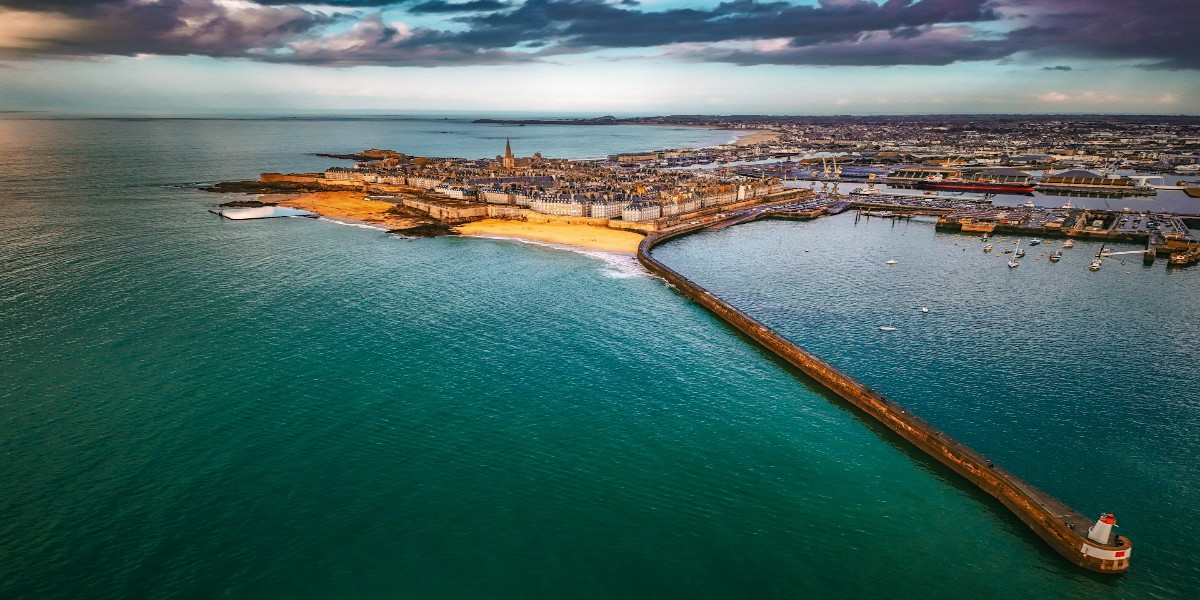
Intra-Muros is the fortified historic core of Saint-Malo, a port city on the Ille-et-Vilaine coast of Brittany, France. Enclosed by continuous granite ramparts dating largely from the 17th and 18th centuries, the district was almost entirely rebuilt after Allied bombing in 1944 destroyed roughly 80 percent of its structures. The reconstruction closely followed the original street plan and architectural style, preserving the dense, vertical granite aesthetic that defines the quarter today.
What is Intra-Muros Saint-Malo known for?
Intra-Muros is best known for its complete circuit of walkable ramparts, its identity as the home port of corsairs licensed by the French crown, and the Cathédrale Saint-Vincent de Saint-Malo, whose origins date to the 12th century and whose nave survived the 1944 bombardments. The district also celebrates native sons Jacques Cartier, the explorer who claimed Canada for France, and writer François-René de Chateaubriand, buried on the tidal islet of Grand Bé visible from the walls.
Best things to do in Intra-Muros Saint-Malo
Walking the full rampart circuit — approximately 1.8 kilometres — is the essential activity, offering unobstructed views over the Plage de Bon-Secours, the Îles des Ebihens, and the fort islands of Grand Bé and Petit Bé at low tide. Other concrete experiences include:
- Visiting the Musée d’Histoire de Saint-Malo inside the Château de Saint-Malo, which houses corsair-era artefacts and navigational instruments.
- Entering Cathédrale Saint-Vincent to see its mid-20th-century stained glass installed during post-war reconstruction.
- Walking to Grand Bé island across the sand at low tide to visit Chateaubriand’s tomb.
- Exploring the Maison de Corsaire on Rue d’Asfeld, a preserved 18th-century corsair merchant house open for guided tours.
Where to eat in Intra-Muros Saint-Malo
The streets around Place Chateaubriand and Grande Rue concentrate the highest density of restaurants and crêperies, where Breton galettes (buckwheat crêpes with savoury fillings) and fresh oysters from the Bay of Cancale are the signature local dishes. Seafood platters featuring local spider crab and scallops are widely available, and kouign-amann, the caramelised Breton butter cake, appears in most boulangeries. Rue Jacques Cartier and Rue de la Soif are informal bar and restaurant streets popular with evening crowds.
Where to walk in Intra-Muros Saint-Malo
The principal walking axis runs from Porte Saint-Vincent, the main gate on the landward side, eastward along Grande Rue to Place Chateaubriand, then north to the rampart staircase at the Tour Bidouane, continuing west along the sea-facing walls past the Bastion de la Hollande to the Porte des Bés. Secondary walking focuses on the tightly packed streets between Rue Porcon de la Barbinais and Rue de Dinan, where rebuilt granite townhouses replicate the original corsair-merchant urban grain.
How to get to Intra-Muros Saint-Malo
Saint-Malo has a mainline SNCF rail station, Gare de Saint-Malo, roughly 500 metres from Porte Saint-Vincent; direct TGV and Intercités services connect to Paris Montparnasse in approximately three hours. Local Bus network Kéolis Saint-Malo operates urban lines stopping near the walls. Brittany Ferries runs a regular passenger and vehicle service between Saint-Malo and Portsmouth, England, docking at the ferry terminal adjacent to the walled city. By road, the N137 and N176 national routes provide access from Rennes and the broader Breton road network.
Best time to visit Intra-Muros Saint-Malo
July and August bring the largest crowds and the warmest temperatures (average highs around 22–24 °C), coinciding with the Festival Étonnants Voyageurs literary event in late May and the Route du Rhum transatlantic race departures in November every four years. Spring (April–June) and early autumn (September–October) offer navigable crowds, lower accommodation rates, and the dramatic tidal range — among the largest in Europe at up to 13 metres — that exposes the sand causeway to Grand Bé most clearly.