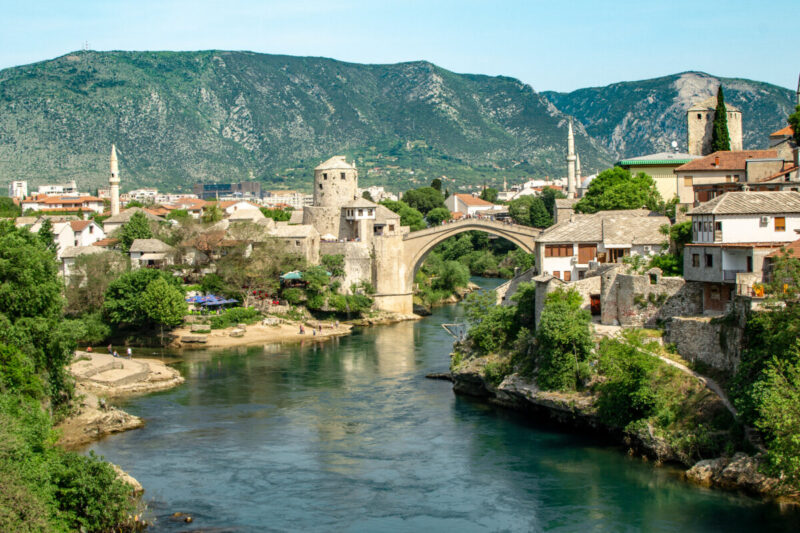
Old Town Mostar occupies the west bank of the Neretva River in the city of Mostar, Herzegovina, and preserves one of the most intact Ottoman urban landscapes in the Balkans. The quarter is anchored by Stari Most, the reconstructed 16th-century stone arch bridge, and extends through a dense grid of hans, mosques, and craft workshops. Rebuilt after wartime destruction and inscribed as a UNESCO World Heritage Site in 2005, the old town draws visitors seeking Bosnian history, Islamic architecture, and the living craft tradition of coppersmithing.
What is Old Town Mostar known for?
Old Town Mostar is known above all for Stari Most, the single-arch limestone bridge originally completed in 1566 under the Ottoman sultan Suleiman the Magnificent, destroyed in 1993, and meticulously reconstructed using original techniques and local Tenelija limestone, reopening in 2004. Beyond the bridge, the quarter is recognized for Kujundžiluk, the cobblestone bazaar street lined with copper workshops, for the Koski Mehmed-Pasha Mosque with its minaret overlooking the Neretva, and for the cluster of 16th- and 17th-century Ottoman residential architecture in the Bišćevića and Kajtaz houses.
Best things to do in Old Town Mostar
The single most iconic activity is watching or participating in the traditional bridge-diving practiced by the Mostari diving club, a tradition formalized for centuries in which trained divers leap roughly 21 meters into the Neretva from the crown of Stari Most. Other essential experiences include:
- Touring the Koski Mehmed-Pasha Mosque (1617) and climbing its minaret for panoramic views of the bridge and river canyon.
- Visiting the Old Bridge Museum inside the Tara Tower at the bridge’s east end, which documents the original construction and wartime destruction.
- Walking through the Bišćevića Ćošak Ottoman house, a preserved 17th-century residential complex open to visitors near Bišćevića Street.
- Browsing the copper workshops on Kujundžiluk where artisans still hand-engrave džezva coffee pots and decorative plates.
- Exploring the Crooked Bridge (Kriva Ćuprija), a smaller Ottoman stone bridge over the Radobolja stream, predating Stari Most.
Where to eat in Old Town Mostar
Restaurants in the old town concentrate along the riverbanks and the lanes branching off Kujundžiluk, serving Bosnian cuisine that reflects Ottoman culinary heritage — particularly ćevapi, burek, and slow-cooked lamb dishes. Ćevapi here are typically served in somun flatbread with raw onion and kajmak cream cheese. Sadrvan restaurant in the courtyard near the Koski Mehmed-Pasha Mosque is a long-established venue for grilled meats and local wine. Street vendors on Kujundžiluk sell tufahija, a Bosnian dessert of poached apple stuffed with walnuts, and baklava from copper trays.
Where to walk in Old Town Mostar
The primary walking route begins at the Franciscan Church of Saints Peter and Paul on the west side, crosses Stari Most, continues up through Kujundžiluk bazaar to the Koski Mehmed-Pasha Mosque, then loops back via the riverside terrace cafes to the Crooked Bridge over the Radobolja. A second route leads from the east bridgehead up Mala Tepa street past the Old Bazaar into the quieter residential lanes around Kajtaz House, ending at the Muslibegović House Hotel, a protected Ottoman mansion on Osmana Dikića Street.
Best time to visit Old Town Mostar
Late April through early June and September through October offer the most comfortable conditions, with daytime temperatures between 18–26°C, significantly smaller crowds than peak summer, and the Neretva at photogenic levels. July and August are the busiest months, when the traditional bridge-diving competition takes place and the old town is at maximum capacity; early mornings before 8 a.m. remain relatively quiet even in summer. Winter visits from December to February are cold but uncrowded, and the limestone architecture photographs well under low winter light.
How to get to Old Town Mostar
Mostar is connected by direct train service to Sarajevo, with the journey taking approximately 2.5 hours on a scenic line through the Neretva canyon; the Mostar train station is roughly 1 kilometer north of the old town. Regional buses operated from the Mostar bus station on Trg Ivana Krndelja serve Split, Dubrovnik, and Sarajevo. From the station, the old town is walkable in 15–20 minutes heading south along Bulevar or via taxi.