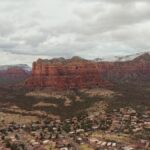
A prominent and easily recognizable red rock formation resembling a massive bell, known as one of Sedona‘s strongest vortex sites. A popular spot for hiking, meditation, and sightseeing directly off Highway 179.
A place worth knowing
Bell Rock
A bell-shaped red rock butte offering easy to challenging hiking routes with stunning desert panoramas
Nature · Hiking trail in SedonaUpdated
- Google rating4.8/5
- Typical visit1-2 hours
- EntranceFree

Why it matters
A bell-shaped red rock butte offering easy to challenging hiking routes with stunning desert panoramas
Global Influence
- Bell Rock draws spiritual pilgrims, hikers, and photographers from dozens of countries annually, establishing Sedona as one of the foremost wellness tourism destinations in North America.
- The 1987 Harmonic Convergence event at Bell Rock was broadcast internationally and helped launch a global New Age movement centered on earth-energy sites and collective meditation practices.
- Travel publications including National Geographic, Condé Nast Traveler, and Lonely Planet consistently rank Bell Rock among the most visually striking natural landmarks in the American Southwest.
- Bell Rock’s distinctive silhouette has appeared in countless films, documentaries, and travel media, reinforcing Arizona’s identity as a land of extraordinary natural wonder on the world stage.
Historical Impact
- The vortex concept associated with Bell Rock was popularized in 1980 by psychic Page Bryant, whose teachings catalyzed an entirely new category of spiritual tourism that transformed Sedona’s economy and cultural identity over the following decades.
- The Harmonic Convergence of August 16–17, 1987, drew thousands to Bell Rock in one of the first globally coordinated mass meditation events, demonstrating the site’s extraordinary power to mobilize international audiences.
- The Coconino National Forest’s stewardship of Bell Rock under the Red Rock Ranger District has shaped federal recreation policy, serving as a model for managing high-traffic spiritual and natural landmarks on public lands.
- Bell Rock sits within a landscape inhabited by Sinagua and Yavapai peoples for thousands of years, and the broader red rock landscape holds deep ancestral significance for Indigenous communities of the region.
Preservation Efforts
- The U.S. Forest Service requires a Red Rock Pass for all trailhead parking, with revenue directed toward trail maintenance, erosion control, and habitat restoration around the Bell Rock corridor.
- Designated trails and visitor signage help concentrate foot traffic and prevent off-trail damage to the fragile cryptobiotic soil crusts and native vegetation surrounding the formation.
- Leave No Trace education programs are actively promoted at Bell Rock trailhead kiosks, encouraging visitors to pack out waste, stay on marked paths, and respect the natural and spiritual character of the site.
- Ongoing collaboration between the Coconino National Forest, the City of Sedona, and local conservation groups has resulted in improved parking infrastructure and shuttle services designed to reduce vehicle emissions and trail overcrowding.
Historical Significance
Bell Rock’s geological story begins roughly 275 million years ago during the Permian period, when alternating marine and aeolian environments deposited the iron-rich sandstone layers that now glow red in the Arizona sun. Bell Rock’s modern cultural chapter began in 1980 when psychic Page Bryant identified it as a major energy vortex. The 1987 Harmonic Convergence solidified its place in contemporary spiritual history, attracting thousands of participants and generating international media coverage that permanently elevated Sedona’s profile as a destination for inner transformation.Cultural Importance
Bell Rock occupies a unique position at the intersection of geological wonder, New Age spirituality, and outdoor recreation. The upflow vortex classification attracts seasoned meditators, curious tourists, adventure hikers, and photographers chasing golden-hour light. The formation’s cultural significance is reinforced annually by retreats, yoga gatherings, and vortex tours that weave together Indigenous landscape reverence, New Age philosophy, and experiential wellness in a way that few natural landmarks in the world can match.Visitor Experience
Visitors approaching Bell Rock along Highway 179 are greeted with an immediate and dramatic view of the formation rising above the scrub oak and juniper desert. The Bell Rock Pathway circumnavigates the base and connects to the Courthouse Butte Loop, offering a rewarding 3.5-mile circuit. More ambitious hikers can follow use-trails up the formation’s lower terraces, accessing extraordinary vistas of the Village of Oak Creek and the Verde Valley. At the base, it is common to encounter visitors seated in quiet meditation — a reminder that Bell Rock functions simultaneously as a hiking destination and a sanctuary for contemplative practice.Tips for Visitors
Purchase a Red Rock Pass ($5 daily, $15 weekly) before arriving. Arriving before 8:00 AM guarantees a parking spot and a more solitary experience. Wear sturdy hiking shoes with grip if you plan to scramble above the base. Bring at least two liters of water per person — Sedona’s high desert climate is deceptively drying. If visiting for meditative or vortex purposes, early morning or late afternoon on a weekday offers the quietude most conducive to that experience.Accessibility
The Bell Rock Pathway along the formation’s base is wide, well-graded, and navigable for most visitors, including those with strollers or mobility considerations, for approximately the first mile. The trailhead features paved parking, vault toilets, informational kiosks, and trail maps. The Village of Oak Creek provides restaurants, shops, and additional amenities within a five-minute drive. Dogs are permitted on the trail on a leash no longer than six feet.Best Time to Visit
Sedona’s shoulder seasons — mid-March through May and mid-September through November — offer the most comfortable temperatures for hiking Bell Rock, with daytime highs typically between 65°F and 85°F. Summer monsoon season brings afternoon thunderstorms and dramatic cloud formations but can make trail surfaces slippery; morning hikes are advisable. Whatever the season, arriving at dawn positions visitors to witness one of the most spectacular light shows in the Southwest as the rising sun saturates Bell Rock’s sandstone with deep crimson and amber tones.Overall Impressions
Bell Rock is one of those rare places that consistently exceeds visitor expectations regardless of the lens through which it is approached. As a geological landmark, its scale, color, and symmetry are extraordinary. As a hiking destination, its accessible base trail and optional scramble routes serve a broad spectrum of fitness levels. As a spiritual site, its reputation is unmatched in the American Southwest. It is a place that invites return visits and rewards patient attention — whether measured in footsteps up a sandstone ledge or minutes spent in stillness at its base.- Universal Appeal and Cultural Authenticity (88/100)
- Accessible trail system accommodates beginners through experienced scramblers.
- Visible directly from Highway 179, requiring no navigation to appreciate.
- Draws visitors across spiritual, recreational, photographic, and geological interest categories.
- Cultural Richness and Educational Value (82/100)
- Site of the globally significant 1987 Harmonic Convergence gathering.
- Central node in Sedona’s internationally recognized vortex tourism ecosystem.
- Embedded in a broader red rock landscape with thousands of years of Indigenous human presence.
- Preservation and Integrity (78/100)
- Red Rock Pass fee system funds active trail and habitat maintenance.
- Designated trail corridors protect fragile desert soil communities from trampling.
- Ongoing Forest Service and city partnerships manage growing visitation sustainably.
- Accessibility and Visitor Engagement (85/100)
- Trailhead is directly accessible from Highway 179 with paved parking and restrooms.
- Base pathway is largely navigable for visitors of varying physical ability.
- Village of Oak Creek nearby provides full visitor amenities and services.
Story and significance
About
A prominent and easily recognizable red rock formation resembling a massive bell, known as one of Sedona’s strongest vortex sites. A popular spot for hiking, meditation, and sightseeing directly off Highway 179.
Historical significance
Bell Rock matters for its role in regional outdoor recreation and as part of Sedona’s visual landscape that has drawn tourists and influenced conservation efforts. It is also meaningful in the context of regional natural history and Indigenous connections to the landscape, informing stewardship and public use discussions.
Historical context
Bell Rock emerged through long-term sedimentation and erosion processes typical of the region’s geology, producing the rounded, bell-like profile visible today. The area’s human history includes Indigenous habitation of the greater region and modern development of trails, parks and visitor infrastructure as Sedona became a recreational destination.
Cultural context
Bell Rock is a well-known Sedona sandstone formation popular with hikers, mountain bikers and spiritual tourists who visit for its scenic views and ease of access. It functions as a recreation area and photo destination and is part of the broader Sedona identity centered on striking red-rock landscapes.
Architecture
Being a natural landmark, Bell Rock’s significance is geological rather than architectural: smooth, weathered sandstone beds, jointing patterns and erosional forms create its distinctive rounded silhouette. The formation illustrates sedimentary layering and differential erosion common to the Vermilion Cliffs and surrounding formations.
Local significance
Bell Rock is a prominent, accessible landmark in the Sedona area with everyday importance to locals as a convenient hiking, biking and sightseeing spot offering panoramic views and outdoor recreation close to town. Residents and regional guides rely on its trails for exercise, photography and introducing visitors to the characteristic red-rock scenery that defines Sedona’s tourism and outdoor lifestyle. Its recognizability and relative ease of access make it a frequent destination in local leisure and a symbol of the community’s connection to the natural landscape.
How we rate it
Universal appeal & authenticity10/10
Cultural richness & educational value10/10
Preservation & integrity10/10
Accessibility & visitor engagement10/10
Editorial scores on a 10-point scale, judged against places of the same kind.




Where to find it
- Address
- State Route 179, Sedona, AZ 86351, United States
- Phone
- +1 928-203-2900
- Destination
- Sedona