Plan your visit with our complete Sedona travel guide featuring top sights, itineraries, and local travel tips.
A place worth knowing
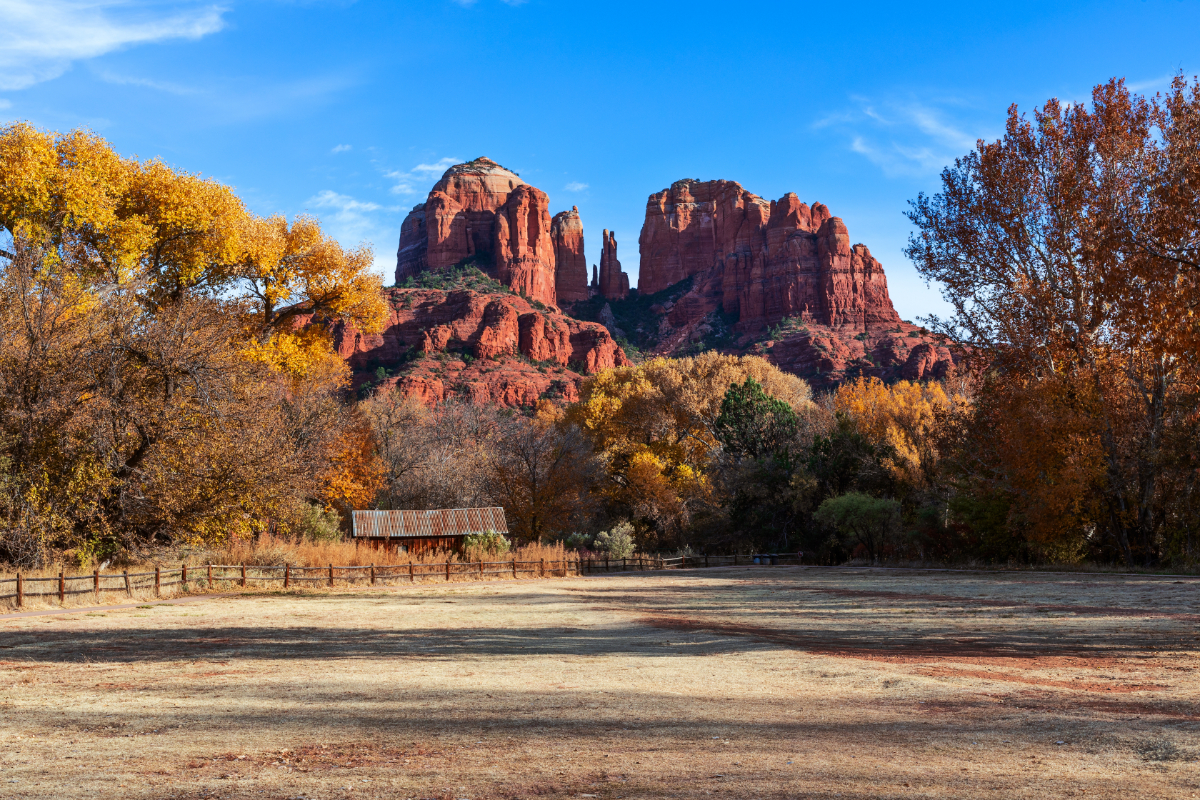
Cathedral Rock
Nature · Hiking trail in SedonaUpdated
- Google rating4.8/5
- Typical visit1-2 hours
- EntranceFree
Why it matters
A short, steep scramble to the top of one of Sedona's most photographed red rock formations
Global Influence
- Cathedral Rock is consistently ranked among the top ten most photographed natural formations in North America, with its image appearing in major international travel publications, luxury tourism campaigns, and digital media reaching an estimated global audience of hundreds of millions annually.
- Sedona’s identity as a world-class spiritual and wellness tourism destination is inextricably linked to Cathedral Rock — the vortex narrative has been exported globally, inspiring wellness retreats, yoga teacher training programs, and new age pilgrimage itineraries across Europe, Japan, Australia, and Latin America.
- The formation has served as a backdrop for numerous Hollywood productions, national advertising campaigns, and environmental documentaries, cementing its status as a symbol of the American Southwest’s natural grandeur on the world stage.
- International visitation to Sedona — drawing over three million tourists annually from more than 60 countries — generates approximately $900 million in economic impact for the Verde Valley region, with Cathedral Rock as the single most-visited natural attraction driving that tourism economy.
Historical Impact
- The Schnebly Hill Formation sandstone that composes Cathedral Rock was deposited approximately 300 million years ago during the Permian period from ancient desert dunes, making the butte a direct geological record of prehistoric Pangaean landscapes preserved in vivid iron oxide hues.
- Sinagua people occupied the Oak Creek Canyon corridor and Red Rock Crossing area below Cathedral Rock from roughly 650 CE to 1425 CE, leaving behind cliff dwellings, petroglyphs, and agricultural terraces that attest to the formation’s long centrality in Indigenous sacred geography.
- The Yavapai-Apache Nation regards Cathedral Rock and its surrounding landscape as a living spiritual entity; oral traditions describe the buttes as transformed ancestors and the land as inherently animate, a worldview that continues to influence tribal cultural preservation efforts today.
- The area gained national prominence in the early 20th century when the Western film industry used Sedona’s red rock backdrop extensively, establishing Cathedral Rock’s visual legacy in American popular culture decades before mass tourism arrived.
Preservation Efforts
- The USDA Forest Service manages Cathedral Rock under the Coconino National Forest Red Rock Ranger District, requiring a Red Rock Pass for all parking areas, with proceeds directly funding trail maintenance, erosion control, and restoration of heavily impacted zones.
- The Sedona Shuttle service was established after documented habitat destruction from vehicles parking on vegetation in overflow areas, reducing the trailhead’s ecological footprint significantly since its introduction.
- The Coconino National Forest has implemented designated social trail closures and rock armor stabilization on Cathedral Rock’s most heavily eroded slickrock sections, working in partnership with the Arizona Trail Association and volunteer stewardship groups.
- Leave No Trace principles are actively promoted at Cathedral Rock through on-site signage, ranger patrols during peak season, and partnerships with Sedona’s lodging sector — part of a broader Red Rock Country sustainable tourism strategy.
Historical Significance
Cathedral Rock’s geological story begins roughly 300 million years ago, when vast Permian-era sand dunes blanketed what is now northern Arizona. Compacted and cemented by iron oxide over millennia, these ancient dunes became the Schnebly Hill Formation. Sinagua people occupied the Oak Creek Canyon corridor from roughly 650 CE to 1425 CE, leaving behind petroglyphs and cliff dwellings. The Yavapai-Apache Nation preserves oral traditions about the Red Rocks as sacred ancestral figures that inform tribal heritage programs operating to this day.Cultural Importance
For the global wellness community, Cathedral Rock is ground zero of the Sedona Vortex phenomenon — a spiritual tourism movement that began in the 1980s. The upflow vortex classification is said to amplify inner strength and connection to higher consciousness, making it a magnet for yoga practitioners, reiki healers, and meditation retreat leaders from every continent. The Red Rock Crossing view of Cathedral Rock reflected in Oak Creek is arguably the single most replicated natural image in Arizona’s photographic history.Visitor Experience
The Cathedral Rock Trail covers approximately 1.5 miles round-trip with 742 feet of elevation gain. After a gentle approach across sandstone slabs, the trail transitions into a steep hands-and-feet scramble with iron rungs at the most technical sections. The reward at the saddle viewpoint is extraordinary: a 360-degree panorama encompassing Oak Creek Canyon, the Mogollon Rim, and dozens of Sedona’s iconic formations. Sunrise and sunset light transforms the already dramatic landscape into something transcendent.Tips for Visitors
Arriving before 6:30 AM is essential during spring, fall, and holiday periods — the trailhead parking lot fills completely by that time. The Sedona Shuttle operating Thursday through Sunday provides a reliable alternative. Wear sturdy closed-toe shoes with grip soles; sandals are genuinely dangerous on the final scramble. Sun protection is non-negotiable and a minimum of 2 liters of water per person is recommended.Accessibility
Cathedral Rock Trail is not accessible for visitors with mobility limitations. However, the Red Rock Crossing area at Crescent Moon Ranch Recreation Area provides wheelchair-accessible pathways to the creek’s edge with unobstructed views of Cathedral Rock’s reflection in the water. The Back O’ Beyond trailhead has vault toilet facilities but no running water or food vendors.Best Time to Visit
October through November and March through April represent Cathedral Rock’s optimal visiting windows — mild temperatures (55–75°F), lower humidity, and golden light create ideal conditions. Summer monsoon season (July–September) brings afternoon thunderstorms that can make exposed slickrock dangerously slippery; morning hikes are strongly advised. Winter visits offer solitude and the occasional dramatic contrast of snow-dusted red sandstone.Overall Impressions
Cathedral Rock earns its reputation as one of Arizona’s premier natural experiences through the convergence of geological spectacle, spiritual resonance, physical challenge, and photographic perfection. Managed thoughtfully by the USDA Forest Service with the Red Rock Pass, the Sedona Shuttle, and active trail restoration programs, Cathedral Rock represents a model of balancing mass tourism with meaningful conservation.- Universal Appeal and Cultural Authenticity (93/100)
- Recognized globally as one of the American Southwest’s most iconic natural landmarks, drawing visitors from over 60 countries annually.
- Authentic Indigenous sacred significance predating tourism by over a millennium, with ongoing Yavapai-Apache cultural connections actively maintained.
- The vortex narrative draws on genuine place-based spiritual traditions that give Cathedral Rock cross-cultural resonance worldwide.
- Cultural Richness and Educational Value (88/100)
- Geological interpretation signage and ranger programs explain 300-million-year formation history, connecting visitors to deep planetary timescales.
- The proximity of Sinagua archaeological sites and the active presence of the Yavapai-Apache Nation provide substantive Indigenous heritage context.
- The intersection of geology, ecology, Indigenous history, wellness culture, and visual art history makes Cathedral Rock an unusually multi-layered educational destination.
- Preservation and Integrity (85/100)
- Red Rock Pass fee system, active trail restoration, and social trail closures demonstrate a committed and funded conservation management approach.
- The Sedona Shuttle program directly addresses the most damaging visitor impact vector — trailhead vehicle overflow — with measurable results since implementation.
- Ongoing cryptobiotic soil restoration and rock armor stabilization show long-term landscape integrity as an active management priority.
- Accessibility and Visitor Engagement (80/100)
- The short trail distance (1.5 miles round-trip) makes the summit experience achievable for a wide range of fitness levels.
- Red Rock Crossing at Crescent Moon Ranch provides an accessible alternative for visitors unable to complete the trail scramble.
- Shuttle service, clear signage, and online information resources lower logistical barriers for first-time visitors.
One of the most photographed sights in Arizona, this iconic sandstone butte is a challenging hike but rewards visitors with stunning panoramic views and is considered a powerful upflow vortex.
Story and significance
About
One of the most photographed sights in Arizona, this iconic sandstone butte is a challenging hike but rewards visitors with stunning panoramic views and is considered a powerful upflow vortex.
Historical significance
Cathedral Rock is regionally important as a natural landmark that has shaped local tourism, outdoor recreation and cultural identity in the Sedona area. The formation also figures in Indigenous cultural landscapes and in narratives about conservation and outdoor appreciation that have influenced land use and access policies.
Historical context
The rock formations around Sedona are the product of sedimentary deposition and erosion over hundreds of millions of years, with the current sculpted buttes and spires forming during geologic uplift and weathering. Human engagement with the site spans Indigenous presence in the region, early settlement, and later recreational and tourism development centered on Sedona’s natural beauty.
Cultural context
Cathedral Rock is an iconic red sandstone formation in the Sedona area that holds cultural and recreational importance for hikers, photographers and spiritual visitors drawn to Sedona’s landscape. Locals and visitors regard it as a symbol of the region’s dramatic scenery and as a backdrop for outdoor activities and contemplative experiences.
Architecture
As a natural feature, Cathedral Rock’s significance lies in its stratified red sandstone, vertical jointing and the prominent spire-like silhouettes created by erosion. The composition, color contrasts and dramatic profiles are characteristic of the Colorado Plateau’s sandstone mesas and buttes rather than constructed architecture.
Local significance
Cathedral Rock is one of Sedona’s iconic red-rock formations and holds strong cultural, recreational and spiritual significance for residents and the wider local community. It is a popular destination for hikers, photographers and outdoor enthusiasts from the region, and many locals regard the formation as part of Sedona’s landscape identity and attraction for visitors. The site is often woven into community life through outdoor recreation culture, local guiding services and a sense of place tied to the distinctive geology and scenic vistas of the area.
How we rate it
Universal appeal & authenticity10/10
Cultural richness & educational value10/10
Preservation & integrity10/10
Accessibility & visitor engagement10/10
Editorial scores on a 10-point scale, judged against places of the same kind.


Where to find it
- Address
- 500 Back O Beyond Road, Sedona, AZ 86336, United States
- Map
- Open in Maps ↗ Directions ↗ Verified location
- Coordinates
- 34.82, -111.7932
- Phone
- +1 928-203-2900
- Destination
- Sedona