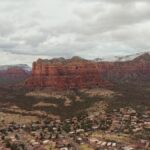
The largest natural sandstone arch in the Sedona area, offering breathtaking views of the Red Rock country. A popular hiking destination accessible via a moderate 1.8-mile round-trip hike, providing excellent photo opportunities.
A place worth knowing
Devil’s Bridge
Nature · Hiking trail in SedonaUpdated
- Google rating4.8/5
- Typical visit1-2 hours
- EntranceFree

Why it matters
A rewarding hike to Sedona's largest natural sandstone arch with breathtaking views of the red rock landscape
Global Influence
- Devil’s Bridge has become one of the most photographed natural landmarks in Arizona, drawing visitors from every continent who seek the iconic arch-crossing photo that has spread across global social media platforms.
- The image of a hiker standing atop the arch against Sedona’s flaming red rock backdrop is among the most recognized and reshared travel images from the American Southwest, generating millions of impressions annually on Instagram, Pinterest, and TikTok.
- International travel publications including Lonely Planet, National Geographic Traveler, and Condé Nast Traveler have featured Devil’s Bridge as a bucket-list destination, cementing its status as a globally recognized icon of American natural beauty.
- The trail consistently ranks among the top-10 most visited hikes in Arizona, attracting hundreds of thousands of visitors per year and fueling Sedona’s multi-million-dollar tourism economy.
Historical Impact
- The arch formed over tens of millions of years through aeolian and fluvial erosion of the Permian-age Schnebly Hill Formation — a sequence of ancient desert dune and shallow marine sediments that give Sedona’s rocks their vivid iron-oxide red coloration.
- Unlike water-carved bridges formed by stream undercutting, Devil’s Bridge is a true natural arch shaped primarily by freeze-thaw weathering, wind abrasion, and differential erosion of harder and softer sandstone layers.
- The surrounding Red Rock Secret Mountain Wilderness, designated by Congress under the Wilderness Act, protects over 47,000 acres of primitive landscape including Devil’s Bridge, preserving it in a roadless, undeveloped state.
- The arch’s accessibility via a maintained trail has made it a pivotal site for public education about desert geology, Permian paleoenvironments, and the geological forces that shaped the Colorado Plateau region.
Preservation Efforts
- The Coconino National Forest actively manages Devil’s Bridge Trail No. 120 through trail maintenance programs, signage, and a mandatory Red Rock Pass fee system that funds on-the-ground conservation.
- The wilderness designation prohibits mechanized and motorized equipment within the Red Rock Secret Mountain Wilderness boundary, protecting the arch and surrounding ecosystem from development pressure.
- USFS rangers and volunteer groups including the Friends of the Forest and Arizona Trail Association conduct regular trail maintenance, erosion-control projects, and visitor education patrols.
- Visitors are strongly encouraged to practice Leave No Trace principles — staying on designated trails to protect biological soil crust, packing out all waste, and minimizing noise.
Historical Significance
Devil’s Bridge stands as a living record of the Colorado Plateau’s ancient past. The arch’s red Coconino sandstone originated as vast Permian-era sand dunes that accumulated over 270–280 million years ago, later cemented into rock and uplifted by tectonic forces. The surrounding Red Rock Secret Mountain Wilderness was formally protected by Congress, recognizing the irreplaceable geological and ecological value of this landscape. The trail itself was originally a jeep road, later converted to a hiking trail to reduce vehicle impact and protect the wilderness character of the area.Cultural Importance
In the modern era, Devil’s Bridge has transcended its status as a geological curiosity to become a cultural phenomenon. The arch-crossing photograph has become one of the defining images of adventure travel in the American Southwest. The site holds spiritual significance in the broader Sedona context, where vortex energy sites and the awe-inspiring natural landscape have drawn seekers of all backgrounds for decades. Indigenous peoples of the region, including the ancestral Yavapai and Apache, lived in and moved through this landscape for centuries before European contact.Visitor Experience
The hike to Devil’s Bridge is classified as moderate, accessible to a wide range of fitness levels while delivering a sense of genuine adventure. The trail begins through open desert scrub of juniper, manzanita, and prickly pear cactus, gradually revealing increasingly dramatic red rock formations. The final approach involves a series of steep natural stone steps and minor scrambling. Upon reaching the arch, hikers can walk across its flat-topped spine — a thrilling 54-foot crossing with sheer drops on both sides — and sweeping panoramic views of the Verde Valley, Wilson Mountain, and Sedona’s trademark red buttes. During peak season, queues to cross the arch can extend to 45–60 minutes.Tips for Visitors
Arrive no later than 7:00 AM on weekends and holidays during spring and fall to secure parking — the main trailhead lot fills well before 8:00 AM. Carry at least two liters of water per person. Wear closed-toe hiking shoes with good grip for the rocky final approach. Obtain a Red Rock Pass ($5/day, $20/week) before arriving. If the main trailhead is full, the Mescal or Dry Creek Vista trailheads add 1–2.5 miles to the round-trip but are almost always accessible. Never attempt the arch crossing in wet or icy conditions as the sandstone becomes dangerously slippery.Accessibility
Devil’s Bridge Trail is not wheelchair accessible. The rocky, uneven terrain, steep stone staircase on the final approach, and the exposed arch crossing require sure footing and moderate physical fitness. Dogs are permitted on leash throughout the trail. The 4WD access road to the main trailhead is a rough dirt road not suitable for standard passenger vehicles, though the alternative trailheads at Mescal and Dry Creek Vista are accessible by any vehicle.Best Time to Visit
Spring (March–May) and fall (September–November) offer the most comfortable hiking temperatures (55–80°F) and the most dramatic light for photography. Winter visits are underrated — crowds are dramatically thinner and occasional dustings of snow on the red rocks create extraordinarily photogenic conditions. Summer is viable only in the very early morning before temperatures exceed 95–100°F. Weekdays across all seasons yield significantly smaller crowds and shorter wait times at the arch.Overall Impressions
Devil’s Bridge delivers one of the most rewarding and memorable hiking experiences in the entire American Southwest. The combination of an accessible trail, a genuinely dramatic geological feature, and the unique privilege of walking across the arch distinguishes it from virtually every other day hike in Arizona. An early start transforms the experience into something quiet, almost meditative. The views from the arch — of Sedona’s crimson towers, the forested plateaus, and the vast open sky — are genuinely breathtaking.- Accessibility and Visitor Engagement (85/100)
- Moderate difficulty makes the arch reachable by a broad demographic of hikers.
- Multiple trailhead access options provide flexibility for visitors of all vehicle types.
- Peak-season crowding and limited parking reduce the overall visitor experience quality during high-demand periods.
- Cultural Richness and Educational Value (78/100)
- The site offers outstanding informal education in desert geology, Permian paleoenvironments, and erosional geomorphology.
- Deep cultural layers — Indigenous land use, vortex spirituality, and adventure travel culture — enrich the site beyond pure natural scenery.
- Formal interpretive infrastructure is limited relative to the site’s educational potential and visitor volume.
- Preservation and Integrity (82/100)
- The Wilderness Act designation provides strong federal protection against development and commercial exploitation.
- The Red Rock Pass fee system generates dedicated funding for trail maintenance and erosion control.
- Extraordinary visitor volume on a fragile sandstone arch poses an ongoing long-term preservation challenge.
- Universal Appeal and Cultural Authenticity (90/100)
- The arch-crossing experience is genuinely bucket-list worthy and emotionally resonant for visitors from virtually every cultural background.
- The landscape’s raw, unmediated beauty preserves an authentic wilderness encounter.
- Viral social media saturation has enhanced global awareness while subtly commodifying the experience.
Story and significance
About
The largest natural sandstone arch in the Sedona area, offering breathtaking views of the Red Rock country. A popular hiking destination accessible via a moderate 1.8-mile round-trip hike, providing excellent photo opportunities.
Historical significance
Devil’s Bridge is significant as a natural landmark that contributes to Sedona’s reputation for dramatic rock formations and outdoor tourism, influencing trail development and visitor patterns. It also forms part of the broader geological and cultural landscape that includes Indigenous histories, recreational use, and local conservation efforts.
Historical context
Natural arches like Devil’s Bridge formed through long-term weathering and erosion of sandstone, where weaker rock eroded away and harder sections remained to create the arch. The area has been used historically by Indigenous peoples and more recently developed with trail access as Sedona’s recreation infrastructure expanded to accommodate growing visitor numbers.
Cultural context
Devil’s Bridge (a natural sandstone arch near Sedona) is a popular destination for hikers seeking a photogenic and adventurous experience; crossing or photographing the narrow arch is a common activity for visitors. The site is part of local outdoor culture and is frequented by people interested in hiking, landscape photography and scenic overlooks.
Architecture
As a geologic feature, Devil’s Bridge’s interest lies in its natural arch form, created by differential erosion, fractures and rockfall that leave a freestanding span of sandstone. The arch’s proportions and the textures of the sandstone offer a striking natural “structure” shaped by geological processes rather than human design.
Local significance
Devil’s Bridge is a frequently visited natural sandstone arch near Sedona that figures strongly in local outdoor culture as a dramatic photo spot and hiking objective often used to showcase the region’s geology. For residents, it’s a familiar recreational landmark where people take visitors, hike at sunrise or sunset and engage with the land in a way that supports the local guiding and outdoor-recreation economy. Its popularity also factors into local conversations about trail management, parking and balancing access with conservation in a high-use landscape.
How we rate it
Universal appeal & authenticity10/10
Cultural richness & educational value10/10
Preservation & integrity10/10
Accessibility & visitor engagement10/10
Editorial scores on a 10-point scale, judged against places of the same kind.



Where to find it
- Address
- Dry Creek Road, Sedona, AZ 86336, United States
- Map
- Open in Maps ↗ Directions ↗ Verified location
- Coordinates
- 34.9032, -111.814
- Phone
- +1 928-203-2900
- Destination
- Sedona