MenuClose

A place worth knowing

Galata Bridge

Historical landmarks · Bridge in IstanbulUpdated

  • Google rating4.6/5 (65,000 reviews)
  • Typical visitHalf hour before sunset, longer if dining at the restaurants underneath.
  • EntranceFree
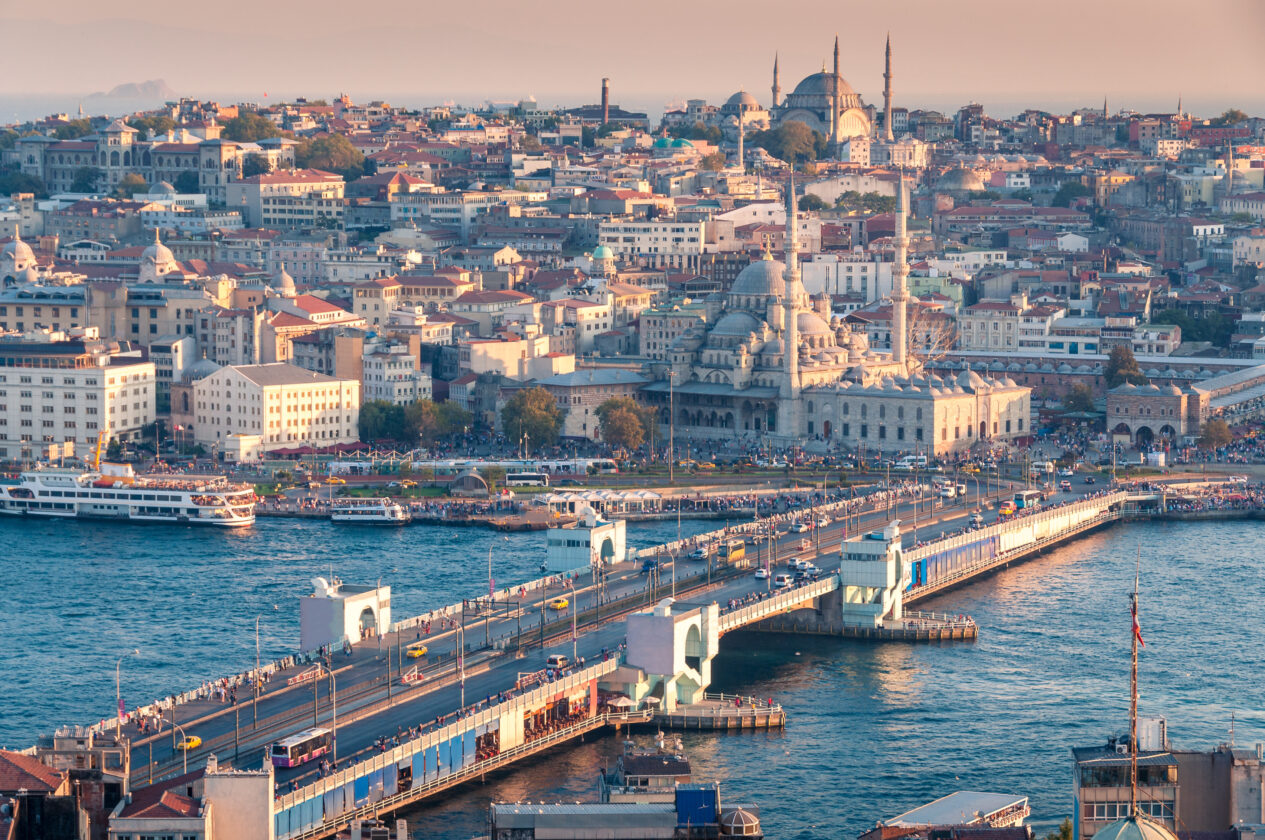
Istanbul Galata Bridge sunset over historic center with Bosphorus, mosques and minarets.
Olga K / Adobe Stock
  • Today (Friday)Open 24 hours
  • Typical visitHalf hour before sunset, longer if dining at the restaurants underneath.
  • EntranceFree
  • Google rating4.6/5 65,000 reviews
  • WebsiteOfficial site ↗
Opening hours all week
Monday
Open 24 hours
Tuesday
Open 24 hours
Wednesday
Open 24 hours
Thursday
Open 24 hours
Friday
Open 24 hours
Saturday
Open 24 hours
Sunday
Open 24 hours
Accessibility
"{"surfaces": "Upper level smooth pavement, lower restaurant level may have uneven surfaces", "warnings": "Can be very crowded during peak times, fishing lines may obstruct some paths", "transport": "Tram stops at both ends (Eminonu and Karakoy) with level boarding", "assistance": "Restaurant staff generally helpful with seating arrangements", "facilities": "Accessible restaurants on lower level, most have step-free access", "wheelchair_access": "Bridge has ramps at both ends, wide sidewalks suitable for wheelchairs"}"
The short answer

Why it matters

An iconic double-deck bridge spanning the Golden Horn with fishermen lining the upper promenade and seafood restaurants filling the lower arcade.

The Galata Bridge spans the Golden Horn in Istanbul, serving as both a physical link between the city’s historic peninsula and newer districts and a symbolic bridge between tradition and modernity in Turkish society. The current structure, completed in 1994 as the fifth bridge in this location, maintains the spirit of its predecessors dating back to the Byzantine era. Its distinctive double-deck design buzzes with constant activity: the upper level carries vehicular and tram traffic along with pedestrian walkways lined with fishermen casting lines into the waters below, while the lower level houses a series of fish restaurants and cafés where locals and visitors alike gather to enjoy fresh seafood with spectacular waterfront views. More than just infrastructure, the bridge functions as a vibrant public space where Istanbul’s diverse populations converge—a place where business people hurry past tourists photographing sunset panoramas, where elderly men drink tea beside young couples taking selfies, and where the call to prayer mingles with the cries of seagulls and ferry horns. Standing on Galata Bridge offers an unparalleled vantage point to witness Istanbul’s remarkable juxtapositions: ancient mosques and modern skyscrapers, European and Asian shores, secular and religious life all coexisting in vibrant harmony.

Cultural Context

Istanbul’s iconic bridge symbolizing connection between Europe and Asia, old and new, traditional and modern, featured extensively in Turkish literature as metaphor for cultural bridging and urban life

Historical Context

Current fifth bridge built 1994 replacing fire-damaged 1912 German-built predecessor, bridges at site since early 1800s connecting Ottoman imperial center Eminonu with cosmopolitan Galata foreign quarter

Context

Story and significance

About

A low-slung bridge spanning the Golden Horn between Karaköy (European side) and Eminönü, connecting the historic old city to the commercial Beyoğlu district. The current structure was completed in 1994, replacing an earlier pontoon bridge from 1912. Two levels: the upper deck carries road traffic, trams, and a pedestrian promenade lined with fishermen casting lines into the water below; the lower deck is filled with fish restaurants. The bridge is a focal point for observing Istanbul’s daily rhythm — ferries, seagulls, the skyline of mosques and minarets, and the constant flow of boat traffic on the Golden Horn.

Historical significance

The Galata Bridge holds profound historical significance as a vital connector between the old city of Istanbul and its expanding neighborhoods since the early 19th century. The first Galata Bridge was constructed in 1845 during the Ottoman Empire under the reign of Sultan Abdülmecid I, symbolizing modernization efforts and the city’s evolving infrastructure. Over the years, the bridge has been rebuilt multiple times, with the current version completed in 1994, reflecting advances in engineering while preserving its historical role. The bridge has witnessed numerous pivotal moments in Istanbul’s history, including serving as a strategic point during political upheavals and social movements. It played a role during the 1955 Istanbul pogrom, where tensions escalated along the waterfront areas. Moreover, it has been a cultural meeting point where diverse communities intersect, echoing Istanbul’s identity as a bridge between Europe and Asia. The Galata Bridge has inspired countless artists, writers, and filmmakers, becoming a symbol of Istanbul’s resilience and continuity through changing political and social landscapes. Its legacy extends beyond mere infrastructure; it embodies the city’s layered history and multicultural heritage, standing as a testament to Istanbul’s enduring spirit as a crossroads of civilizations.

Historical context

Current fifth bridge built 1994 replacing fire-damaged 1912 German-built predecessor, bridges at site since early 1800s connecting Ottoman imperial center Eminonu with cosmopolitan Galata foreign quarter

Cultural context

Istanbul’s iconic bridge symbolizing connection between Europe and Asia, old and new, traditional and modern, featured extensively in Turkish literature as metaphor for cultural bridging and urban life

Architecture

Modern 490-meter drawbridge with unique two-level design featuring restaurants and cafes below, pedestrian and tram levels above, functional architecture creating social space over Golden Horn waters

Local significance

Living social hub where fishermen line railings daily selling catch to restaurants below, essential transport link for millions, tourist attraction offering quintessential Istanbul experience of cultures meeting over water

Experience

Make the most of it

Local tips
  • Late night openings often have special events
  • Check for combo tickets with nearby attractions
  • Special exhibitions require separate tickets
  • Gift shops have unique souvenirs
  • Visit during weekdays for fewer crowds
  • Members get free entry and skip lines
  • Museum cafes frequently serve quality local food
Hidden gems nearby
  • Rooftop terraces often have great city views
  • Staff recommendations for must-see pieces
  • Lesser-known wings have amazing collections
  • Secret passages between galleries
  • Free guided tours at specific times
  • Hidden courtyards ideal for photos
  • Archive rooms sometimes open for special tours
Special features
  • The Galata Bridge is renowned for its unique multi-level design, which combines functionality with vibrant urban life. The bridge consists of two decks: the lower level houses a variety of restaurants, cafes, and fish markets, creating a lively atmosphere where locals and tourists alike gather to enjoy traditional Turkish seafood and panoramic views of the Golden Horn. The upper deck serves as a roadway and pedestrian crossing, facilitating the daily commute between the historic peninsula of Istanbul and the modern districts across the water. A distinctive feature of the bridge is the constant presence of anglers lining its sides, casting their lines into the waters below, a practice deeply embedded in Istanbul’s cultural fabric. The bridge’s illumination at night enhances its architectural silhouette against the city skyline, making it a picturesque landmark. Additionally, the Galata Bridge offers sweeping views of iconic landmarks such as the Süleymaniye Mosque, the Topkapi Palace, and the Galata Tower, blending Istanbul’s rich historical heritage with its dynamic contemporary life. Its role as a social and commercial hub, combined with its striking position over the Golden Horn, makes the Galata Bridge a symbol of Istanbul’s unique geographical and cultural crossroads. The bridge’s blend of utility, tradition, and vibrant public space distinguishes it as a living monument within the urban landscape of Istanbul.
Editorial scores

How we rate it

Authenticity8/10
Accessibility score9/10
Family-friendly score6/10
Off-the-beaten-path5/10

Editorial scores on a 10-point scale, judged against places of the same kind.

Updated Data: Editorial research · Google Places ratings · Verified coordinates