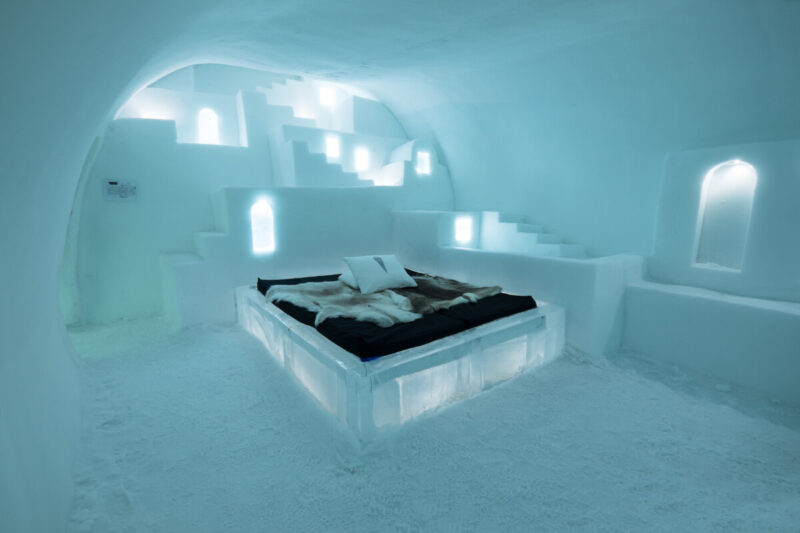
Northern Lights’ world’s best viewing at Aurora Sky Station in Abisko National Park within Aurora oval where surrounding mountains maintain clear skies with minimal light pollution, visible September-March with spectacular 10-11pm displays throughout Swedish Lapland covering nearly quarter of the country. Midnight Sun phenomenon above Arctic Circle where sun stays visible 56 days straight in parts of Swedish Lapland (mid-May to mid-July Kiruna), creating extended daylight summer experiences unique to northern latitudes. Stockholm’s “Venice of the North” featuring 30,000-island archipelago with distinctive red-yellow timber summerhouses and unspoiled natural islands accessible via essential boat trips year-round, plus ABBA Museum’s Djurgården Park location enabling hologram dancing, track recording, and periodic artist telephone connections. Gothenburg’s unusual free bastu sauna built from recycled port equipment metal sheets with North Sea swimming opportunities, plus Göta Canal classic cruises stretching Stockholm-Gothenberg via historic ships through stunning landscapes. Kiruna’s northernmost city (22,000 people) serving as perfect base for Sweden’s great white north exploration including original Ice Hotel (opens mid-December), while Skansen Museum’s Djurgården island location showcases Swedish national culture through handicraft shops, old Swedish buildings, frequent festivals creating diverse destination spanning natural aurora-midnight phenomena to cultural heritage across this Nordic kingdom.
Sweden
Country in Europe, Sweden, EuropeUpdated
- Overall6/10
- Best forLuxury travelers, Solo travelers
- CurrencySEK
Abisko’s Aurora Sky Station sits inside the aurora oval — surrounding mountains block clouds, making it the most reliable Northern Lights viewing on earth.

At a glance
- Swedish (official)
- five recognised minority languages (Finnish
- Meänkieli
- Sámi
- Boreal forests
- Baltic archipelago
- Northern lakes
- Midnight sun
- Northern Lights
- Design
- Nature
- Sustainability
- Winter Sports
- History
How Sweden scores
Character
Editorial scores on a 10-point scale, weighed against destinations of the same kind.
Travel safety snapshot
SafePlace indicators use their source 100-point scale; higher is more favourable. Planning context, not a live travel advisory — check official government guidance before you go.
When to go
Best months to visit: January, February, March, May, June, July, August, September and December.
- January: -3.6 to 0.9 degrees Celsius, 47.9 millimetres of rain, best-time score 4 out of 5.
- February: -3.5 to 2 degrees Celsius, 34.6 millimetres of rain, best-time score 4 out of 5.
- March: -1.8 to 5.4 degrees Celsius, 37.3 millimetres of rain, best-time score 4 out of 5.
- April: 0.8 to 9.8 degrees Celsius, 29.7 millimetres of rain, best-time score 3 out of 5.
- May: 5.8 to 15.8 degrees Celsius, 46.8 millimetres of rain, best-time score 4 out of 5.
- June: 11.5 to 21.1 degrees Celsius, 60.5 millimetres of rain, best-time score 5 out of 5.
- July: 13.5 to 22.2 degrees Celsius, 64.8 millimetres of rain, best-time score 5 out of 5.
- August: 13 to 21 degrees Celsius, 77.1 millimetres of rain, best-time score 5 out of 5.
- September: 10 to 16.9 degrees Celsius, 47.6 millimetres of rain, best-time score 4 out of 5.
- October: 5.4 to 10.6 degrees Celsius, 65.6 millimetres of rain, best-time score 3 out of 5.
- November: 1.3 to 5.2 degrees Celsius, 47.1 millimetres of rain, best-time score 3 out of 5.
- December: -1.8 to 2.2 degrees Celsius, 46.8 millimetres of rain, best-time score 4 out of 5.
Month-by-month conditions and packing advice
- January
- Very cold, occasional rain January in Sweden: different off-peak strengths can include winter auroras, late-spring city trips, or early-fall scenery. Crowds: January in Sweden is workable with normal seasonal planning; build in layers, weather checks, and a mix of indoor and outdoor activities. Pack: Pack warm layers, a coat, and comfortable shoes for cold mornings and evenings.
- February
- Very cold, occasional rain February in Sweden: different off-peak strengths can include winter auroras, late-spring city trips, or early-fall scenery. Crowds: February in Sweden is workable with normal seasonal planning; build in layers, weather checks, and a mix of indoor and outdoor activities. Pack: Pack warm layers, a coat, and comfortable shoes for cold mornings and evenings.
- March
- Cold, occasional rain March in Sweden: different off-peak strengths can include winter auroras, late-spring city trips, or early-fall scenery. Crowds: March in Sweden is workable with normal seasonal planning; build in layers, weather checks, and a mix of indoor and outdoor activities. Pack: Pack warm layers, a coat, and comfortable shoes for cold mornings and evenings.
- April
- Cold, mostly dry April in Sweden: transition weather, shorter days, or limited northern activities make planning more constrained. Crowds: April in Sweden is workable with normal seasonal planning; build in layers, weather checks, and a mix of indoor and outdoor activities. Pack: Pack warm layers, a coat, and comfortable shoes for cold mornings and evenings.
- May
- Cool to mild, occasional rain May in Sweden: different off-peak strengths can include winter auroras, late-spring city trips, or early-fall scenery. Crowds: May in Sweden is workable with normal seasonal planning; build in layers, weather checks, and a mix of indoor and outdoor activities. Pack: Pack layered clothing and comfortable walking shoes.
- June
- Mild to warm, occasional rain June in Sweden: long summer daylight supports Stockholm, islands, lakes, hiking, festivals, and northern landscapes. Crowds: June in Sweden is comfortable for sightseeing, neighborhoods, food stops, day trips, and outdoor time with limited weather friction. Pack: Pack layered clothing and comfortable walking shoes.
- July
- Mild to warm, occasional rain July in Sweden: long summer daylight supports Stockholm, islands, lakes, hiking, festivals, and northern landscapes. Crowds: July in Sweden is comfortable for sightseeing, neighborhoods, food stops, day trips, and outdoor time with limited weather friction. Pack: Pack layered clothing and comfortable walking shoes.
- August
- Mild to warm, some rain August in Sweden: long summer daylight supports Stockholm, islands, lakes, hiking, festivals, and northern landscapes. Crowds: August in Sweden is workable with normal seasonal planning; build in layers, weather checks, and a mix of indoor and outdoor activities. Pack: Pack layered clothing and comfortable walking shoes. Add a rain jacket or compact umbrella.
- September
- Cool to mild, occasional rain September in Sweden: different off-peak strengths can include winter auroras, late-spring city trips, or early-fall scenery. Crowds: September in Sweden is workable with normal seasonal planning; build in layers, weather checks, and a mix of indoor and outdoor activities. Pack: Pack layered clothing and comfortable walking shoes.
- October
- Cool to mild, occasional rain October in Sweden: transition weather, shorter days, or limited northern activities make planning more constrained. Crowds: October in Sweden is workable with normal seasonal planning; build in layers, weather checks, and a mix of indoor and outdoor activities. Pack: Pack layered clothing and comfortable walking shoes.
- November
- Cold, occasional rain November in Sweden: transition weather, shorter days, or limited northern activities make planning more constrained. Crowds: November in Sweden is workable with normal seasonal planning; build in layers, weather checks, and a mix of indoor and outdoor activities. Pack: Pack warm layers, a coat, and comfortable shoes for cold mornings and evenings.
- December
- Cold, occasional rain December in Sweden: different off-peak strengths can include winter auroras, late-spring city trips, or early-fall scenery. Crowds: December in Sweden is workable with normal seasonal planning; build in layers, weather checks, and a mix of indoor and outdoor activities. Pack: Pack warm layers, a coat, and comfortable shoes for cold mornings and evenings.
Know before you go
About
Sweden, the largest of the Nordic countries, is a Scandinavian nation stretching from the Baltic coast to the Arctic, known for its forests, lakes, design-forward cities, and high quality of life. Its capital, Stockholm, is spread across 14 islands and often called the “Venice of the North,” anchored by the cobbled medieval old town of Gamla Stan. The city’s standout attractions include the Vasa Museum, displaying a remarkably preserved 17th-century warship salvaged largely intact, and the ABBA Museum on the green island of Djurgarden. Beyond Stockholm lies an archipelago of some 30,000 islands, while the west-coast port of Gothenburg offers canals, seafood, and the Liseberg amusement park. In the far north, Swedish Lapland draws visitors for the Northern Lights, the Aurora Sky Station at Abisko, and the famous Icehotel in Jukkasjarvi. With a strong outdoor tradition supported by the right-to-roam, plus Viking history, midnight-sun summers, and globally influential culture, Sweden blends cosmopolitan style with vast, pristine wilderness.
Best time to visit
Summer (June–August) for Midnight Sun, hiking, and archipelago exploration; Winter (December–March) for Northern Lights, skiing, and ICEHOTEL
Season by season
Summer (Jun–Aug): Midnight Sun, 20–25 °C in the south, festivals, archipelago sailing. Autumn (Sep–Nov): golden foliage, Northern Lights begin, mushroom foraging. Winter (Dec–Mar): snow, skiing, Northern Lights peak, ICEHOTEL, Christmas markets. Spring (Apr–May): blossoms, longer days, fewer crowds, whale watching on the west coast.
Crowds
High in Stockholm in summer and Lapland in winter; moderate in spring/autumn
Getting there and around
Getting there
Stockholm Arlanda Airport (ARN) connects to the city center via the Arlanda Express train (20 minutes).
Getting around
SJ trains connect major cities efficiently. Stockholm has an excellent metro with decorated art stations. Domestic flights reach Lapland in 90 minutes.
Top experiences in Sweden
Gamla Stan, Stockholm
Stockholm’s medieval Old Town, dating to the 13th century, with narrow cobblestone streets, colourful merchants’ houses, Stortorget square, the Royal Palace, and the Nobel Prize Museum.
Vasa Museum, Stockholm
Home to the near-perfectly preserved 17th-century warship Vasa, which sank on its maiden voyage in 1628 and was recovered 333 years later — one of Scandinavia’s most visited museums.
ICEHOTEL, Jukkasjärvi
A seasonally rebuilt hotel made entirely of ice and snow from the Torne River, featuring artist-designed art suites, an ice bar, and a permanent year-round wing kept at −5 °C.
Gothenburg Archipelago
Car-free islands accessible by ferry from Sweden’s second city, with fishing villages, seal safaris, and swimming rocks.
Abisko National Park
Prime Northern Lights location in Swedish Lapland with the Aurora Sky Station and the start of the Kungsleden hiking trail.
Editor-curated picks carried over from our original guide. Where a full place guide exists, the card links to it.
Where to stay
ICEHOTEL
Södra Blasieholmshamnen 8, 103 27 Stockholm, Sweden
The original ice hotel in Jukkasjärvi, rebuilt every winter from Torne River ice. Art suites are sculpted by global artists.
Ett Hem, Stockholm
Marknadsvägen 63, 981 91 Jukkasjärvi, Sweden
12-room Arts and Crafts townhouse hotel in Lärkstaden with a greenhouse kitchen and a residents-only atmosphere.
Treehotel, Harads
Brunnsgatan 2, 831 30 Östersund, Sweden
Suspended forest rooms in Swedish Lapland — the Mirrorcube and Bird’s Nest are architectural icons among the pines.
Editor-curated stays carried over from our original guide. Where we have reviewed the hotel, the card links to the review.
Tips from the field
Highlights
- Gamla Stan — Stockholm's medieval Old Town
- Vasa Museum — a perfectly preserved 17th-century warship
- ICEHOTEL in Jukkasjärvi — sleep in sculpted ice suites
- Abisko & the Northern Lights — Europe's best aurora viewing
- Visby, Gotland — UNESCO medieval walled city
- Kungsleden (King's Trail) — Sweden's premier long-distance hike
- Stockholm Archipelago — 30,000 islands by boat
Best activities
- Chase the Northern Lights in Abisko, hike the King's Trail (Kungsleden), explore Stockholm's archipelago by boat, ski in Åre, visit the Vasa Museum, stay at the ICEHOTEL, kayak the west-coast islands, take a fika break in Gamla Stan.
Local experiences
- Join a traditional fika at a Stockholm konditori, forage for berries and mushrooms under Allemansrätten, attend a Midsommar celebration with maypole dancing, go dog-sledding in Lapland, or take a morning swim in a frozen lake followed by a wood-fired sauna.
Practical tips
- Sweden is nearly cashless — card and mobile payments work everywhere. Allemansrätten (Right of Public Access) allows camping and hiking on most land.
Photography tips
- Northern Lights: use a sturdy tripod, f/2.8 or wider, ISO 1600–3200, and 10–20 second exposures. Stockholm's Gamla Stan glows at golden hour reflected in the water. The Midnight Sun above the Arctic Circle offers 24-hour soft light in June–July. Autumn birch forests in Lapland turn brilliant gold in September. Winter offers blue-hour light and snow-covered landscapes.
Timing
- Plan 7–10 days for Stockholm, Gothenburg, and southern Sweden. Add 3–5 days for a Lapland Northern-Lights trip. The King's Trail (Kungsleden) takes 2–4 weeks for the full 440 km but can be done in sections.
Keeping it authentic
- Regional identity varies from cosmopolitan Stockholm and Gothenburg to the Sámi reindeer-herding traditions of Lapland. Allemansrätten (Right of Public Access) grants everyone the freedom to roam, camp, and forage in nature — a centuries-old principle that shapes the Swedish relationship with the outdoors. Midsommar celebrations, crayfish parties, and fika culture are genuine everyday traditions rather than tourist constructs.
Culture, customs and safety
Cultural heritage
Viking voyages, Nobel Prize heritage, ABBA, and the concept of lagom (just the right amount) that shapes Swedish life.
Local customs & etiquette
Fika (coffee break) is sacred — never skip it. Remove shoes indoors. Swedes value punctuality and personal space.
Safety notes
Very safe overall. Pickpocketing occurs in Stockholm tourist areas (Gamla Stan, T-Centralen). Some suburbs have higher crime rates.