Yes, this Paris wine and cheese tasting is worth it if you want an instructional food experience rather than another cheese plate at a wine bar. My session with Paroles de Fromagers combined a visit to an aging cellar with a guided tasting that explained how milk, rind, maturity, texture, acidity, and sweetness change a pairing.
The strongest part was not the quantity of wine or cheese. It was learning a method I could use again: taste each item separately, combine them, then return to the wine and notice what changed. The experience is a good fit for curious food travelers, but it is not a full meal, and the cellar’s stair access will rule it out for some visitors.
Venue update: My session and the photographs in this review are from the Paroles de Fromagers shop in Paris’s 10th arrondissement, at 41 Rue du Faubourg du Temple near Canal Saint-Martin. The current Viator listing directs guests to the Musee Vivant du Fromage, at 39 Rue Saint-Louis en l’Ile. Paroles de Fromagers operates more than one Paris location, so follow the meeting instructions on your booking confirmation rather than an old photo, map pin, or review.
Paris Wine and Cheese Tasting at a Glance
| Detail | What to Expect |
|---|---|
| Operator | Paroles de Fromagers |
| Format | Small-group, English-language cellar visit and guided wine-and-cheese pairing class |
| Duration | Approximately 1 hour 30 minutes |
| Current inclusions | Seven cheeses, three wines, bread, an English-speaking cheese expert, and a cellar visit |
| Current meeting point | Musee Vivant du Fromage, 39 Rue Saint-Louis en l’Ile, 75004 Paris |
| Nearest Metro | Pont Marie on Line 7 or Saint-Paul on Line 1 |
| Group size | The current Viator listing states a maximum of 12 travelers |
| Accessibility | The cellar is reached by stairs and the current listing says it is not wheelchair accessible |
| What to wear | Bring a light layer because the cellar can be cold; a hygienic protective suit is provided |
| Alcohol age | The current minimum age to drink alcohol is 18 |
| Cancellation | The current Viator policy offers a full refund when canceled at least 24 hours in advance |
| Price | Varies by date, currency, and booking channel; check the live total before payment |
Affiliate disclosure: ViaTravelers may earn a commission if you book through the Viator link below. That commercial relationship does not affect the editorial verdict or the limitations described in this review.
Why This Tasting Is Worth It
Direct answer: This tasting is worth booking for travelers who want to understand French cheese and pairing – not simply consume it. The cellar visit, fromager-led instruction, and side-by-side comparisons create more value than ordering an unguided cheese board. It is less suitable if you need step-free access, avoid dairy, or expect a full dinner.
The class worked because it gave the food a structure. Rather than receiving several unnamed pieces of cheese at once, we discussed how rind treatment, age, milk type, texture, salt, acidity, and aroma affected each sample. We then tested what happened when a wine met the fat, salt, or tang of the cheese.
- Best feature: Access to a real aging cellar and an instructor who can explain what is happening there.
- Best takeaway: A repeatable process for evaluating wine and cheese together.
- Best audience: First-time French cheese explorers and experienced food travelers who still enjoy asking detailed questions.
- Main limitation: The tasting portions are educational samples, not a substitute for lunch or dinner.
- Practical limitation: The cellar requires stairs and can be cold.
My Experience in the Paris Cheese Cellar
Descending Into the Cellar
My tasting took place at the 10th-arrondissement Paroles de Fromagers shop near Canal Saint-Martin. The street-level store had an extensive cheese counter, but the more memorable setting was below it: a cool stone cellar lined with cheeses at different stages of maturity.

The temperature dropped as we went downstairs. The air was humid and carried earthy, nutty, and occasionally pungent aromas from the aging rinds. That sensory shift made it clear that affinage – the controlled maturation of cheese – is active work rather than passive storage.


Why the Cellar Visit Adds Value
Seeing the cheeses before tasting them helped connect appearance with process. A dry natural rind, orange washed rind, powdery bloom, or deeply pitted surface is not merely cosmetic. Each points toward different handling, microorganisms, moisture levels, and aging conditions.

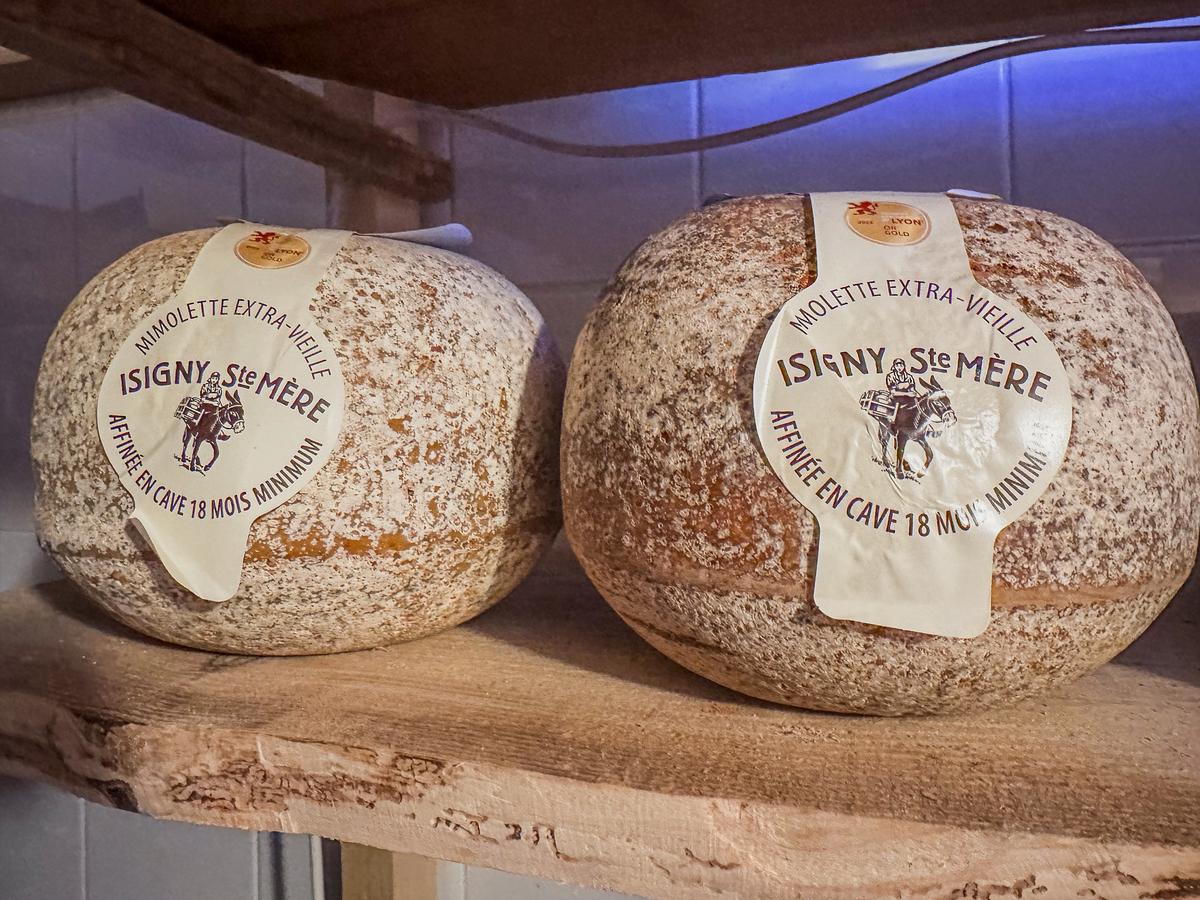
The extended aging visible on these Mimolette wheels is a useful example. Time changes far more than firmness: moisture decreases, aromas concentrate, textures become denser or more brittle, and flavors can move from mild and milky toward nutty, savory, or caramelized.
At the Tasting Table
Up close, the tasting spread showed how broad the category of French cheese really is. The pieces varied in color, rind, moisture, density, and aroma. That variation made the lesson more useful than a flight composed only of safe, mild cheeses.

Our host did not treat the rind and center of a cheese as interchangeable. We were encouraged to smell the cheese, break or cut it open, and compare the outer portion with the paste closer to the center. That small exercise revealed changes in texture and intensity within a single piece.

How the Wine and Cheese Pairing Lesson Worked

We began with a pale Sauvignon Blanc from the Loire Valley. Before adding cheese, I noticed citrus, pineapple, and a mineral edge. Establishing that baseline mattered because the wine tasted different after a rich or salty bite.
The most useful lesson was procedural. Instead of memorizing a rigid chart, we followed the same sequence with each pairing:
| Step | What to Notice | Why It Matters |
|---|---|---|
| 1. Look at the wine | Color, depth, and clarity against a neutral background | It creates an initial reference point, although appearance alone does not determine quality. |
| 2. Smell before and after swirling | Initial aromas and any notes that become easier to detect after movement | It separates the wine’s aroma profile from the influence of the cheese. |
| 3. Assess the cheese | Rind aroma, center aroma, texture, salt, acidity, moisture, and finish | A cheese may change substantially from its outer edge to its center. |
| 4. Taste each separately | The wine’s acidity, sweetness, tannin, fruit, and finish; then the cheese’s dominant traits | You need a baseline before deciding what the pairing changes. |
| 5. Taste them together | Whether either component becomes softer, sharper, sweeter, flatter, or more aromatic | This reveals whether the pairing is balanced, complementary, or intentionally contrasting. |
| 6. Return to the wine | The second sip after swallowing the cheese | The clearest change often appears when you revisit the wine rather than during the combined bite. |
A few practical principles emerged from those comparisons:
- Match intensity before color. A delicate cheese can disappear beside a powerful wine, while a strong washed rind can flatten something too light.
- Use acidity to refresh the palate. A bright wine can make a rich, creamy cheese feel less heavy.
- Use sweetness as a counterweight. Sweet wine can soften the impression of salt, tang, or pungency.
- Do not assume red wine is always the default. White, sparkling, sweet, and fortified wines can be easier partners for many cheeses.
- Treat regional pairings as a starting point, not a law. Personal preference still decides whether a combination succeeds.
Cheeses and Wines That Stood Out
The exact tasting flight changes with season, availability, and the instructor’s plan. The following cheeses and wines are examples from my session, not a guaranteed menu for future bookings.
Maroilles: Pungent Aroma, More Measured Flavor
Maroilles was one of the most assertive cheeses on the table. Its washed rind produced an earthy, almost meaty aroma, but the flavor was more balanced than its smell suggested, with a lingering savory and nutty character.
The French INAO traces Maroilles to the 10th century and describes it as a soft cow’s-milk cheese matured in a humid cellar, where it is repeatedly brushed and washed with salt water. It has held protected designation of origin status since 1996.
Comte: Nutty Flavor and Tyrosine Crystals
The Comte was firmer and more restrained, with buttery and nutty notes. Tiny crystals created a light crunch against the dense paste. These are not grains of salt: the official Comte organization identifies them as tyrosine, an amino acid that can crystallize during extended maturation.
Syrah and Ripe Camembert
In my flight, a Rhone Valley Syrah brought black-fruit and spice notes to a ripe Camembert. It was a relatively forceful pairing, but the cheese’s creamy texture helped absorb the wine’s intensity. This was a useful reminder that balance can come from contrast rather than similarity.
Sauternes and Tangy Goat Cheese
The most surprising pairing was tangy goat cheese with sweet, honeyed Sauternes. The sweetness did not erase the cheese’s acidity; it rounded the sharpest edge and made the combined finish feel longer. It was also the clearest demonstration that a successful pairing can be built on opposition.
Practical Booking Advice
Confirm the Meeting Point
The most important update is the address. The current Viator listing gives the Musee Vivant du Fromage at 39 Rue Saint-Louis en l’Ile in the 4th arrondissement. The nearest practical Metro options are Pont Marie and Saint-Paul.
My experience took place at the 10th-arrondissement shop shown in these photographs. Do not navigate there solely because you recognize it from this review. Check the latest confirmation email or voucher on the day of the class.
Accessibility and Cellar Conditions
The current listing says the cellar is accessible only by stairs and is not wheelchair accessible. Contact the operator before paying if you need step-free access or another accommodation; do not assume that access to the museum’s public level means access to the tasting cellar.
Cellars are kept cool for the cheese, not the guests. Bring a light layer even in summer. The operator currently provides a hygienic protective suit for the cellar visit.
Food, Alcohol, and Dietary Needs
The current format includes seven cheese samples, three wines, and bread. Treat it as a substantial tasting rather than lunch or dinner. Eating a light meal beforehand is sensible, especially when drinking alcohol, but arriving completely full can make it harder to appreciate the later cheeses.
The current minimum age for alcohol is 18. Cheese and wine are central to the class, so contact the operator before booking if you need a nonalcoholic substitute or have a dairy allergy, lactose intolerance, pregnancy-related concern, or another dietary restriction. Do not assume that an equivalent alternative is available unless it is confirmed.
Timing, Price, and Cancellation
Allow about 90 minutes for the class and arrive early enough to find the correct entrance. The activity currently ends where it starts.
Prices can change with the date, currency, and booking channel. Compare the live total and cancellation terms rather than relying on an old price quoted in a review. The current Viator listing allows cancellation up to 24 hours in advance for a full refund, but the terms attached to your booking control.
Who Should Book This Tasting?
This Is a Good Fit For
- Travelers who want to understand French cheese rather than only sample it
- Couples, friends, and solo travelers who prefer a structured small-group activity
- People curious about cheesemaking, affinage, rind styles, and regional differences
- Wine beginners who want an approachable introduction to pairing
- Experienced food travelers who will ask detailed questions and compare the samples closely
- Visitors who schedule the class early enough in their trip to use what they learn in shops and restaurants
Choose Another Experience If
- You want a full meal, large pours, or a long social evening rather than a lesson
- You need guaranteed step-free access
- You cannot comfortably spend time in a cool cellar
- You avoid dairy and the operator cannot confirm a meaningful alternative
- You do not drink alcohol and no suitable substitution is available
- You prefer a neighborhood food tour with several stops instead of one focused venue
Tips for Getting More From the Class
- Verify the address on your voucher. Paroles de Fromagers has more than one Paris location, and older reviews may show a different cellar.
- Bring a layer. The cellar temperature is controlled for cheese maturation.
- Eat lightly beforehand. The portions are a tasting, but drinking wine on an empty stomach is unhelpful.
- Avoid strong perfume or cologne. Fragrance can interfere with your ability – and other guests’ ability – to assess aromas.
- Record the names. Photograph bottle labels and cheese cards when permitted, or write brief notes about milk type, region, age, and rind.
- Revisit the wine. The second sip after the cheese often reveals more than the first combined bite.
- Describe changes, not just preferences. Instead of stopping at “I like it,” ask whether the wine became sweeter, flatter, softer, sharper, or more aromatic.
- Schedule the class early in your stay. The vocabulary and pairing principles become more useful when you still have time to visit markets, fromageries, and wine bars.
Final Verdict

I would book this Paris wine and cheese tasting again for the instruction and cellar access, not for sheer quantity. The class gave me a clearer way to assess cheese, a better understanding of what aging changes, and a practical method for deciding why one wine works better than another.
The venue update and stair access deserve attention before payment. Once those details work for you, the experience offers a focused introduction to French cheese without requiring prior knowledge or a formal wine background.
Not every famous cheese is famous for being good. If the tasting leaves you curious about the other end of the scale, we ranked the cheeses most often called the worst in the world – Casu Marzu and Vieux Lille among them.
To compare this class with other formats, use our Paris wine tasting guide. Our French cuisine guide adds context on the dishes, products, and regional traditions you will encounter, while the France travel guide can help place the experience within a longer trip.
Frequently Asked Questions
Is a Paris wine and cheese tasting worth it?
Yes, if you want a guided lesson and cellar access rather than only a cheese plate. The class is less suitable if you need step-free access, avoid dairy, or expect a full meal.
What is included in the Paroles de Fromagers tasting?
Current listings describe seven cheeses, three wines, bread, an English-speaking cheese expert, and a cellar visit. The exact cheeses and wines can change with availability and the session.
Where does the tasting meet?
The current Viator listing gives Musee Vivant du Fromage, 39 Rue Saint-Louis en l’Ile, 75004 Paris. My photos are from the 10th-arrondissement shop, so follow your booking confirmation.
How long does the tasting last?
The current experience lasts about 90 minutes. Arrive early enough to find the correct entrance because the class returns to its starting point and late-arrival policies can vary.
Is the cheese cellar wheelchair accessible?
The current listing says the cellar is reached only by stairs and is not wheelchair accessible. Contact the operator before booking if you need step-free access or another accommodation.
Do I need to know about wine or cheese?
No. The class is designed as an introduction. You will get more value by asking questions and comparing each wine and cheese before and after pairing.
Can non-drinkers or travelers with dietary restrictions join?
Cheese and wine are central to the experience. Ask the operator before booking about nonalcoholic substitutions, pregnancy considerations, dairy allergies, lactose intolerance, or other dietary needs; do not assume alternatives are available.