

Hauntingly beautiful Balkan nation where Ottoman minarets and Austro-Hungarian facades create Europe’s most culturally diverse capital, offering powerful history, warm hospitality, pristine mountains, and medieval towns at budget-friendly prices.
The destination guide
Bosnia And Herzegovina

Travel guides for Bosnia And Herzegovina
Destination stories (1)
More guides featuring Bosnia And Herzegovina (1)
At a glance
CurrencyBAM
Time zoneCentral European Time (CET), UTC+1; Central European Summer Time (CEST), UTC+2 during DST
Languages
- Croatian
Setting
- Mountain landscapes
- River valleys
- Ottoman bridges
- Historic old towns
Population3.3M3,300,000 residents
VisaDuration: Up to 90 days total within a 6-month period · Documents: Valid U.S. passport and a return or onward ticket if requested by the airline or authorities
How Bosnia And Herzegovina scores
7/10OverallGood
Weather6/10
Value for money8/10
Safety6/10
Food & cuisine7/10
Culture & arts6/10
Cultural experience7/10
History9/10
Nature & outdoors10/10
Adventure4/10
Nightlife5/10
Shopping5/10
Family friendly8/10
Romance6/10
Editorial scores on a 10-point scale, weighed against destinations of the same kind.
Travel safety snapshot
Overall68/100Moderate rating
Women travellers64/100
LGBTQ+ travellers55/100
Theft60/100
Medical care70/100
Physical harm66/100
Political freedom68/100
SafePlace indicators use their source 100-point scale; higher is more favourable. Planning context, not a live travel advisory — check official government guidance before you go.
When to go
Best months to visit: April, May, June, July, August, September and October.
- January: -7.5 to -0.6 degrees Celsius, 87.8 millimetres of rain, best-time score 2 out of 5.
- February: -5.5 to 2.1 degrees Celsius, 86.7 millimetres of rain, best-time score 2 out of 5.
- March: -3.9 to 4.2 degrees Celsius, 104.8 millimetres of rain, best-time score 3 out of 5.
- April: -0.1 to 8.7 degrees Celsius, 99.4 millimetres of rain, best-time score 4 out of 5.
- May: 4.3 to 12.3 degrees Celsius, 142.7 millimetres of rain, best-time score 5 out of 5.
- June: 9.7 to 17.6 degrees Celsius, 113.3 millimetres of rain, best-time score 5 out of 5.
- July: 11.2 to 19.3 degrees Celsius, 107.8 millimetres of rain, best-time score 5 out of 5.
- August: 11.5 to 19.5 degrees Celsius, 67.5 millimetres of rain, best-time score 5 out of 5.
- September: 7.2 to 15 degrees Celsius, 82.7 millimetres of rain, best-time score 5 out of 5.
- October: 3.6 to 11.1 degrees Celsius, 79.2 millimetres of rain, best-time score 4 out of 5.
- November: -1.1 to 5.5 degrees Celsius, 112.9 millimetres of rain, best-time score 2 out of 5.
- December: -4.7 to 1.6 degrees Celsius, 102.3 millimetres of rain, best-time score 3 out of 5.
Month-by-month conditions and packing advice
- January
- Very cold, some rain Cold winter weather, few tourists. Crowds: January in Bosnia And Herzegovina is best for winter-ready travelers; outdoor plans need warm gear, shorter daylight expectations, and weather-aware transport planning. Pack: Pack insulated layers, warm footwear, gloves, and a serious winter coat. Add a rain jacket or compact umbrella.
- February
- Cold, some rain Chilly and quiet, good for museums. Crowds: February in Bosnia And Herzegovina is best for winter-ready travelers; outdoor plans need warm gear, shorter daylight expectations, and weather-aware transport planning. Pack: Pack insulated layers, warm footwear, gloves, and a serious winter coat. Add a rain jacket or compact umbrella.
- March
- Cold, some rain Beginning to warm up, spring blossoms. Crowds: March in Bosnia And Herzegovina is workable with normal seasonal planning; build in layers, weather checks, and a mix of indoor and outdoor activities. Pack: Pack warm layers, a coat, and comfortable shoes for cold mornings and evenings. Add a rain jacket or compact umbrella.
- April
- Cold, some rain Pleasant spring weather, great for walking. Crowds: April in Bosnia And Herzegovina is workable with normal seasonal planning; build in layers, weather checks, and a mix of indoor and outdoor activities. Pack: Pack warm layers, a coat, and comfortable shoes for cold mornings and evenings. Add a rain jacket or compact umbrella.
- May
- Cool to mild, rainy Excellent weather before the summer crowds. Crowds: May in Bosnia And Herzegovina is one of the wetter periods, so museums, food stops, flexible reservations, and backup indoor plans make the trip easier. Pack: Pack layered clothing and comfortable walking shoes. Add a rain jacket or compact umbrella.
- June
- Cool to mild, some rain Warm, sunny, and lively. Crowds: June in Bosnia And Herzegovina is workable with normal seasonal planning; build in layers, weather checks, and a mix of indoor and outdoor activities. Pack: Pack layered clothing and comfortable walking shoes. Add a rain jacket or compact umbrella.
- July
- Cool to mild, some rain Peak summer heat and peak tourist season. Crowds: July in Bosnia And Herzegovina is workable with normal seasonal planning; build in layers, weather checks, and a mix of indoor and outdoor activities. Pack: Pack layered clothing and comfortable walking shoes. Add a rain jacket or compact umbrella.
- August
- Cool to mild, occasional rain Very warm, many festivals and outdoor dining. Crowds: August in Bosnia And Herzegovina is workable with normal seasonal planning; build in layers, weather checks, and a mix of indoor and outdoor activities. Pack: Pack layered clothing and comfortable walking shoes.
- September
- Cool to mild, some rain Perfect shoulder season with great weather. Crowds: September in Bosnia And Herzegovina is workable with normal seasonal planning; build in layers, weather checks, and a mix of indoor and outdoor activities. Pack: Pack layered clothing and comfortable walking shoes. Add a rain jacket or compact umbrella.
- October
- Cool to mild, some rain Crisp autumn air and beautiful colors. Crowds: October in Bosnia And Herzegovina is workable with normal seasonal planning; build in layers, weather checks, and a mix of indoor and outdoor activities. Pack: Pack layered clothing and comfortable walking shoes. Add a rain jacket or compact umbrella.
- November
- Cold, some rain Cooling down rapidly, often rainy. Crowds: November in Bosnia And Herzegovina is workable with normal seasonal planning; build in layers, weather checks, and a mix of indoor and outdoor activities. Pack: Pack warm layers, a coat, and comfortable shoes for cold mornings and evenings. Add a rain jacket or compact umbrella.
- December
- Very cold, some rain Cold but festive holiday atmosphere. Crowds: December in Bosnia And Herzegovina is workable with normal seasonal planning; build in layers, weather checks, and a mix of indoor and outdoor activities. Pack: Pack warm layers, a coat, and comfortable shoes for cold mornings and evenings. Add a rain jacket or compact umbrella.
Know before you go
About
Bosnia and Herzegovina, a mountainous country in the western Balkans of Southeast Europe, is renowned for its dramatic blend of Ottoman, Austro-Hungarian, and Mediterranean influences, emerald rivers, and a layered, multicultural history. Its most iconic landmark is the Stari Most (Old Bridge) in Mostar, a graceful Ottoman single-arch stone bridge first built in 1566, destroyed during the 1990s war and faithfully rebuilt and reopened in 2004 as a UNESCO World Heritage Site and symbol of reconciliation. The capital, Sarajevo, nicknamed the “Jerusalem of Europe,” packs mosques, synagogues, and Orthodox and Catholic churches into its cobbled Ottoman bazaar, Bascarsija. Beyond the cities, travelers explore the stone village of Pocitelj, the cliffside Blagaj Tekija dervish monastery at the source of the Buna River, and the turquoise Kravice Waterfalls. Affordable, scenic, and deeply atmospheric, Bosnia and Herzegovina rewards visitors with rugged nature and poignant living history.
Neighbourhoods
Sarajevo, Mostar, Banja Luka, Tuzla
Best time to visit
Spring (April–May) and autumn (September–October) deliver comfortable temperatures (15–25°C / 59–77°F), fewer crowds, and spectacular scenery — spring brings wildflowers and peak waterfall flows, while autumn offers golden foliage and harvest festivals. Summer (June–August) is peak season with long sunny days perfect for rafting and hiking, though Mostar regularly exceeds 35°C (95°F). Winter transforms the country: Sarajevo’s Olympic mountains (Jahorina, Bjelašnica) offer affordable skiing, and the capital takes on a cozy, atmospheric quality with fewer tourists and steaming Bosnian coffee in snow-dusted Old Town cafés.
Season by season
Spring (April–May):
Weather: 12–22°C (54–72°F), occasional rain
Highlights: Wildflowers, peak waterfall flows at Kravice and Una, Sarajevo Film Festival (March)
Best For: Hiking, waterfall visits, Old Town exploration
Summer (June–August):
Weather: 25–35°C (77–95°F), hot in Herzegovina
Highlights: River rafting season, outdoor festivals, long evenings in Baščaršija
Best For: Adventure sports, swimming at Kravice, Una rafting
Fall (September–October):
Weather: 12–22°C (54–72°F), golden foliage
Highlights: Harvest festivals, quieter Old Towns, comfortable hiking temperatures
Best For: Photography, food tourism, uncrowded sightseeing
Winter (December–February):
Weather: -2–5°C (28–41°F), snow in mountains
Highlights: Affordable skiing at Jahorina/Bjelašnica, cozy Bosnian coffee culture
Best For: Skiing, budget travel, atmospheric winter cityscapes
Crowds
Low (moderate in Mostar Old Town during summer)
Getting there and around
Getting there
Croatia is a popular European destination accessed primarily by air during peak season (May-September). Main international airports are Zagreb (ZAG), Split (SPU), and Dubrovnik (DBV). While few direct flights exist from North America, most U.S./Canadian travelers connect through major European cities. Airlines include Croatia Airlines, Lufthansa, and budget carriers connecting to UK and Europe. Overland travel via bus and train from neighboring Italy, Slovenia, and Hungary is viable. Ferry services connect Croatian coastal cities with Italy.
Getting around
Buses are the primary intercity transport — regular services connect Sarajevo, Mostar, Banja Luka, and smaller towns. The Sarajevo–Mostar train (2–3 hours) is one of Europe’s most scenic railway journeys, following the Neretva River gorge through dramatic limestone canyons. Renting a car provides the most flexibility for countryside exploration (Una National Park, Jajce, Lukomir village), but road quality varies — secondary routes can be narrow and poorly lit. Within cities, walking covers most of the historic centers. Taxis are affordable; agree on a fare or ensure the meter is running. Ride-hailing apps have limited coverage outside Sarajevo.
Top experiences in Bosnia And Herzegovina
Stari Most (Old Bridge), Mostar
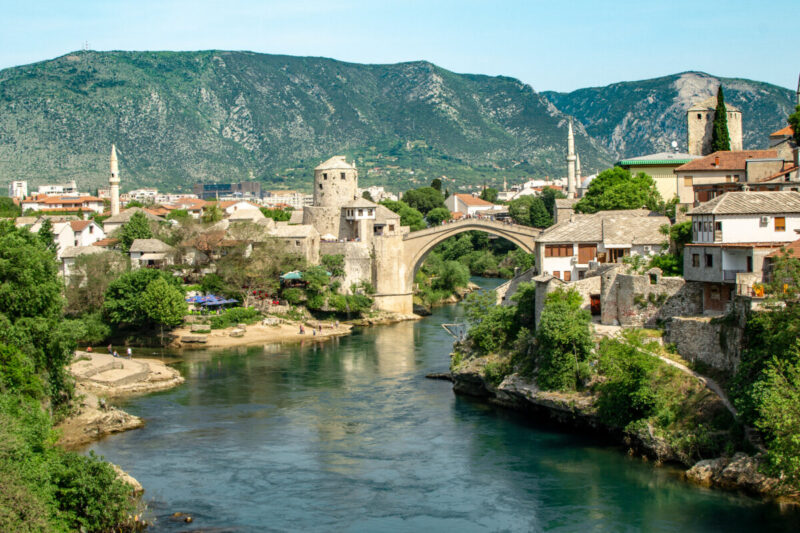
Mostar’s 16th-century Ottoman bridge arches 24 meters above the emerald Neretva River, connecting the city’s east and west banks. Originally built in 1566 by architect Mimar Hayruddin under Suleiman the Magnificent, the bridge was destroyed during the Bosnian War in 1993 and meticulously reconstructed in 2004 using original stones and Ottoman building techniques, earning UNESCO World Heritage status. Local divers continue the centuries-old tradition of leaping from the bridge into the icy river below. The surrounding Old Town features cobblestone lanes, coppersmith workshops, and the Koski Mehmed Pasha Mosque, whose minaret provides the best overhead view.
Baščaršija, Sarajevo
Sarajevo’s Ottoman-era bazaar quarter is the cultural heart of the capital, where the call to prayer from the Gazi Husrev-beg Mosque mingles with the sound of coppersmiths hammering in Kazandžiluk (Coppersmith Street). Founded in the 15th century, the quarter retains its original grid of covered marketplaces, caravanserais, and artisan alleys. The Sebilj fountain at the central square marks the traditional boundary between Ottoman and Austro-Hungarian Sarajevo. Within a few hundred meters, you can walk from Ottoman mosques to Habsburg-era government buildings to the Latin Bridge, where the assassination of Archduke Franz Ferdinand triggered World War I.
Kravice Waterfalls
Located about 40 km south of Mostar, the Kravice Waterfalls cascade 25 meters across a wide travertine arc into a natural pool on the Trebižat River. Often compared to a miniature Niagara, the falls are surrounded by lush vegetation and are swimmable in summer. The site includes wooden walkways, picnic areas, and small cafés. Spring (April–May) sees the highest water volume after snowmelt, making the falls most dramatic. In summer, the pool becomes a popular swimming and kayaking spot. Combined with a visit to nearby Počitelj (a medieval fortified village) and Blagaj Tekija (a Dervish monastery at the source of the Buna River), it makes an excellent day trip from Mostar.
Tunnel of Hope, Sarajevo
During the 1992–1996 Siege of Sarajevo — the longest siege in modern warfare — this 800-meter tunnel beneath the airport runway was the city’s only lifeline to the outside world, smuggling food, fuel, arms, and people. Today, 25 meters of the original tunnel remain open for visitors, along with a museum in the family house where the tunnel entrance was concealed. The exhibits include wartime photographs, personal stories, and artifacts that convey the resourcefulness and resilience of Sarajevo’s inhabitants. Combined with the War Childhood Museum in the city center, it provides essential context for understanding modern Bosnia.
Una National Park
In northwestern Bosnia near the Croatian border, Una National Park protects the crystal-clear turquoise waters of the Una and Unac rivers, travertine waterfalls, and deep limestone gorges. The star attraction is Štrbački Buk, a dramatic 24-meter waterfall surrounded by forested hills. Martin Brod, a village at the park’s entrance, features a medieval fortress and Franciscan monastery above the confluence of the Una and Unac. The park offers rafting, kayaking, hiking, and wild swimming. Less visited than other Balkan national parks, Una rewards travelers willing to explore beyond the Sarajevo–Mostar corridor.
Editor-curated picks carried over from our original guide. Where a full place guide exists, the card links to it.
Worth booking ahead in Bosnia And Herzegovina
Hand-picked from the operators our guides already send readers to. Prices and availability are live on the partner site.
BrowseViator
Tours and tickets in Bosnia And Herzegovina on Viator (opens Viator in a new tab)
Viator's full list of bookable tours and tickets in Bosnia And Herzegovina.
BrowseGetYourGuide
Experiences in Bosnia And Herzegovina on GetYourGuide (opens GetYourGuide in a new tab)
Everything GetYourGuide sells in Bosnia And Herzegovina, with the cancellation terms on each listing.
Where to stayBooking.com
Stays in Bosnia And Herzegovina (opens Booking.com in a new tab)
Live rates and availability for Bosnia And Herzegovina on Booking.com; filter by neighbourhood once you know where your days start.
We earn a commission if you book through these links, at no extra cost to you. It is how we keep the guides free and independent.
Where to stay
Hotel & Spa Nevi, Sarajevo
Ferhadija 24, 71000 Sarajevo, Bosnia and Herzegovina
A boutique hotel in Baščaršija, Nevi occupies a restored Ottoman-era building with 12 individually designed rooms blending traditional Bosnian woodwork with modern amenities. The on-site spa, rooftop terrace with Old Town views, and Bosnian cuisine restaurant make it a standout. The location puts you within walking distance of the Sebilj fountain, the Gazi Husrev-beg Mosque, and the Latin Bridge. Rates are remarkably affordable by European standards — one of Sarajevo’s best value luxury options.
Hotel Kriva Ćuprija, Mostar
Onešćukova 23, 88000 Mostar, Bosnia and Herzegovina
Named after Mostar’s smaller ‘Crooked Bridge,’ this family-run hotel sits in the heart of the Old Town beside the Radobolja Creek, with views directly toward the Stari Most. The 18 rooms feature traditional Bosnian furnishings and modern comforts. The hotel’s terrace restaurant serves authentic Herzegovinian cuisine — grilled meats, stuffed peppers, and local wine — overlooking the water. The location is unbeatable for experiencing Mostar’s Old Town both day and night, when the crowds thin and the stone streets glow under lamplight.
Hotel & Spa Kostelski Buk, Martin Brod
Martin Brod bb, 77230 Drvar, Bosnia and Herzegovina
A countryside retreat at the entrance to Una National Park, Kostelski Buk sits alongside the Una River with direct views of cascading travertine waterfalls. The 24 rooms are simple but comfortable, with balconies overlooking the river. The hotel’s restaurant specializes in freshwater trout and grilled lamb, and the property offers kayak and raft rental. It’s an ideal base for exploring the park’s waterfalls, hiking trails, and rafting routes. The remote location provides a genuine escape from the more visited Sarajevo–Mostar corridor.
Editor-curated stays carried over from our original guide. Where we have reviewed the hotel, the card links to the review.
Tips from the field
Highlights
- Stari Most, Mostar — Rebuilt 16th-century Ottoman bridge over the emerald Neretva River
- Baščaršija, Sarajevo — Living Ottoman bazaar with coppersmiths, mosques, and Bosnian coffee
- Kravice Waterfalls — 25-meter cascade with natural swimming pool
- Tunnel of Hope — Sarajevo's wartime lifeline beneath the airport runway
- Scenic Railway — Sarajevo to Mostar through the Neretva River gorge
- Una National Park — Crystal-clear turquoise rivers and travertine falls
- Blagaj Tekija — Dervish monastery at the cliff-face source of the Buna River
- Olympic Mountains — Affordable skiing at Jahorina and Bjelašnica above Sarajevo
- Počitelj — Medieval fortified village perched above the Neretva valley
- Lukomir — Highest inhabited village in Bosnia with traditional highland culture
Best activities
- Bosnia and Herzegovina rewards travelers seeking history, natural beauty, and off-the-beaten-path exploration. In Sarajevo, walk through the Baščaršija's Ottoman bazaar, visit the Tunnel of Hope and War Childhood Museum, ride the Trebević cable car to the abandoned Olympic bobsled track, and watch sunset from the Yellow Fortress. In Mostar, cross the Stari Most, watch bridge divers, explore the Old Town's cobblestone alleys, and climb the Koski Mehmed Pasha Mosque minaret for panoramic views. Take the spectacularly scenic Sarajevo–Mostar train through the Neretva River gorge. Day trip to Kravice Waterfalls for swimming and Počitelj for its Ottoman fortress. Raft the Una River through turquoise gorges in Una National Park. Drive to Lukomir, the highest inhabited village in Bosnia, for mountain scenery and traditional Bosnian highland culture. Swim in the Buna River at the Blagaj Tekija, a Dervish monastery built into a cliff face.
Local experiences
- Start the morning in Sarajevo's Baščaršija with a Bosnian coffee at a traditional kafana — order a džezva with rahat lokum and linger over conversation. Walk to the Markale Market for seasonal produce, then try ćevapi at Željo (locals argue over which branch is best). Ride the Trebević cable car to the abandoned Olympic bobsled track and hike through the forest along its graffiti-covered curves. In Mostar, cross the Stari Most at dawn before crowds arrive, then climb the Koski Mehmed Pasha minaret for the bridge-and-river panorama. Watch bridge divers practice their leaps in the afternoon. Day trip to Blagaj Tekija for lunch beside the Buna River spring, and to Počitelj's hilltop fortress for sunset views over the Neretva valley. Take the Sarajevo–Mostar train for the scenic gorge journey. In winter, ski Jahorina's Olympic-grade slopes (45 minutes from Sarajevo) for a fraction of Alpine resort prices.
Practical tips
- Currency: Convertible Mark (BAM/KM), pegged to the Euro at approximately 1.96 BAM = 1 EUR. Cards accepted at hotels and larger restaurants; carry cash for markets, cafés, and rural areas.
- Language: Bosnian, Croatian, and Serbian (mutually intelligible). English is spoken in tourist areas of Sarajevo and Mostar; limited elsewhere.
- Getting There: Sarajevo Airport (SJJ) has connections to European cities. Buses from Croatia (Dubrovnik, Split) and Serbia (Belgrade) are frequent and affordable.
- Scenic Train: The Sarajevo–Mostar rail line is one of Europe's most beautiful train journeys (2–3 hours, ~$8).
- Food: Try ćevapi at Željo in Baščaršija (Sarajevo) and burek at any local pekara. Bosnian coffee is a must.
- Landmines: Stay on marked paths, particularly in rural and mountainous areas.
- Driving: Road conditions vary. Mountains roads require caution. An international driving permit is recommended.
- Tipping: 10% at restaurants is standard.
- Weather: Pack layers for spring/fall and mountain areas. Summer in Mostar is very hot (35°C+). Sarajevo winters are cold with regular snow.
Photography tips
- Golden Hour: Mostar's Stari Most in warm evening light is one of the Balkans' most iconic shots — shoot from the riverbank downstream for the full arch reflected in the Neretva.
- Iconic Spots:
- Stari Most, Mostar — from downstream left bank at sunset; from the Koski Mehmed Pasha minaret for overhead perspective
- Baščaršija, Sarajevo — Sebilj fountain with pigeons; coppersmiths at work in the bazaar alleys
- Yellow Fortress, Sarajevo — panoramic cityscape at sunset with minarets and mountains
- Kravice Waterfalls — wide-angle to capture the full arc; use slow shutter (1–2 sec) for silky water
- Trebević abandoned bobsled track — haunting, graffiti-covered curves through forest
- Blagaj Tekija — the Dervish monastery against the cliff face at the Buna River source
- Lukomir village — highland plateau with traditional stone houses and mountain backdrop
- Nature: Una National Park's turquoise rivers and travertine formations require polarizing filters to cut glare.
- Equipment: Wide-angle (14–24mm) for bridges, waterfalls, and mosque interiors. Telephoto (70–200mm) for mountain landscapes and bridge diver action shots. Tripod for waterfall long exposures.
Timing
- Peak Season (June–August):
- Warmest weather; highest prices (still affordable by European standards)
- Mostar can be extremely crowded around the Old Bridge midday
- Best river rafting conditions
- Shoulder Season (April–May & September–October):
- Ideal conditions — moderate weather, fewer crowds, best waterfall volume in spring
- Sarajevo Film Festival in March/April adds cultural interest
- Hotel rates 20–40% below peak
- Off-Season (November–March):
- Coldest and quietest period
- Ski season at Jahorina and Bjelašnica (December–March)
- Budget-friendly with authentic local atmosphere
- Some rural attractions (Kravice) have reduced access
- Key Events:
- Sarajevo Film Festival: March/April
- Mostar Bridge Diving Competition: July
- Sarajevo Jazz Festival: November
- Jahorina Ski Season: December–March
Keeping it authentic
- Bosnia and Herzegovina remains one of Europe's most authentic travel destinations — tourism infrastructure is developing but has not yet smoothed away the country's rough, compelling edges. Sarajevo's Ottoman quarter, the Baščaršija, is a living marketplace where coppersmiths still hand-stamp devisional and coffeeshop owners roast beans the same way their grandfathers did. Mostar's bridge divers are continuing a tradition predating the Ottoman Empire, not performing for tourists. The country's wartime history is not sanitized for visitors — bullet holes mark apartment buildings, and the Tunnel of Hope and War Childhood Museum present the siege of Sarajevo without filter. Bosnian cuisine — ćevapi (grilled minced meat), burek (phyllo pastry with meat or cheese), and bosanski lonac (a slow-cooked pot of meat and vegetables) — is genuinely folk-rooted, not reinvented for foreign palates. The country is extraordinarily affordable by Western European standards, and locals are known for exceptional warmth toward visitors.
Culture, customs and safety
Cultural heritage
Bosnia and Herzegovina’s cultural heritage reflects centuries of Ottoman, Austro-Hungarian, and Yugoslav influences creating unique multicultural traditions. Sarajevo’s Baščaršija preserves Ottoman crafts including copper working and traditional coffee culture, while Mostar’s Old Bridge symbolizes cultural connections. The nation maintains three religious traditions side by side, with mosques, Orthodox churches, and Catholic cathedrals sharing neighborhoods. Traditional sevdalinka music expresses Bosnian soul, while ćevapi and burek represent culinary heritage shared across communities.
Local customs & etiquette
Bosnia and Herzegovina is a multi-ethnic, multireligious country where Bosniaks (predominantly Muslim), Croats (predominantly Catholic), and Serbs (predominantly Orthodox) coexist. Respect for all three communities and sensitivity to the 1990s war is essential — avoid making light of the conflict. Remove shoes when entering mosques and cover shoulders and knees. Bosnian coffee (served in a džezva with sugar cubes and lokum/Turkish delight) is a social ritual — it’s customary to sip slowly and enjoy the conversation. Greeting strangers with ‘Dobar dan’ (good day) is polite. Tipping 10% is standard at restaurants. Drinking rakija (fruit brandy) is a common social custom. Smoking remains very common in cafés. Hospitality is deeply important: expect offers of coffee or food when visiting local homes.
Safety notes
Bosnia and Herzegovina is generally safe for travelers, with crime rates lower than many Western European countries. The primary safety concern is landmines — unexploded ordnance from the 1990s war remains in remote rural and mountainous areas. Always stay on marked trails and paved roads; never walk through abandoned areas, overgrown fields, or near ruined buildings outside established paths. In cities, petty crime (pickpocketing) can occur in crowded areas like Baščaršija and Mostar’s Old Town — keep valuables secure. Driving requires caution: road quality varies, mountain roads can be narrow and poorly lit, and local driving standards are inconsistent. Travel insurance is essential as Bosnia is not an EU member. Carry your passport at all times. Emergency: 112. Police: 122. Ambulance: 124.

Activities