
MenuClose

A place worth knowing

Parthenon

Historical landmarks · Historical landmark in AthensUpdated

  • Google rating4.8/5 (95,000 reviews)
  • Typical visit1.5 to 3 hours average visit (longer if exploring the entire Acropolis complex and museum)
  • EntranceFree
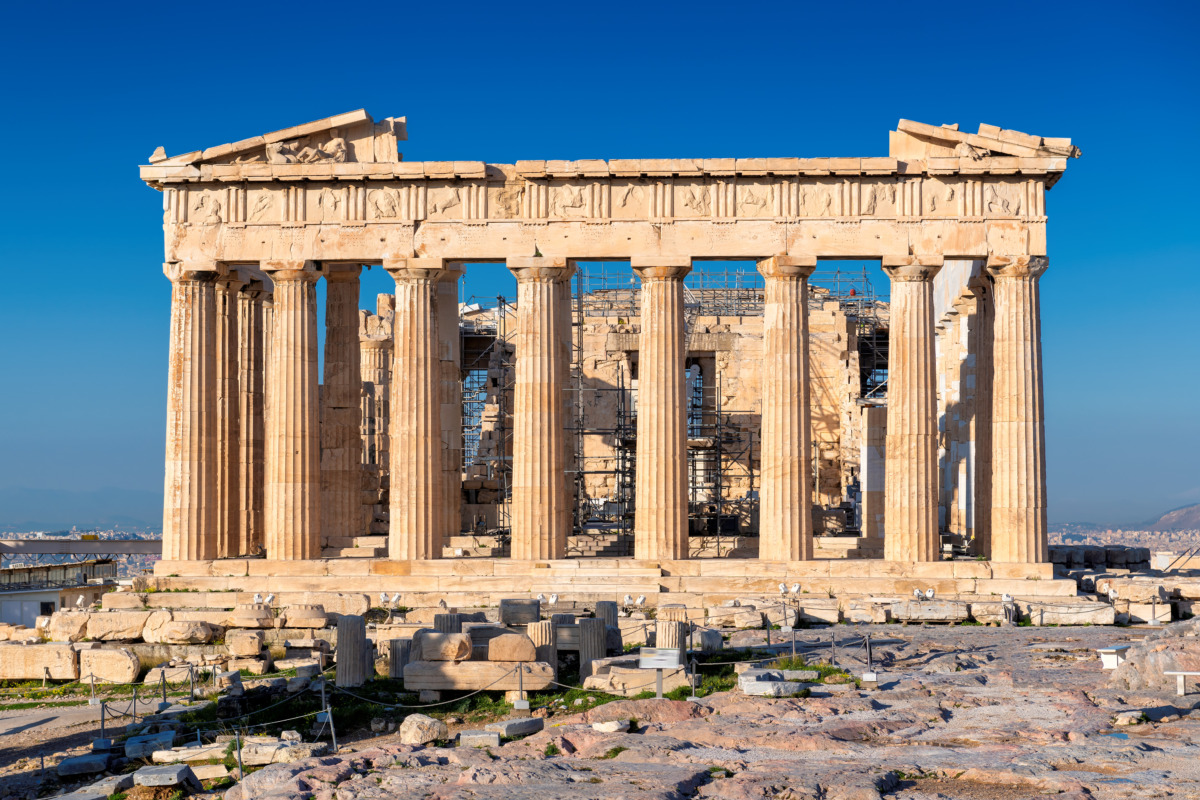
Front and classical architecture of the Parthenon Temple in Athens, Greece
lucky-photo / Adobe Stock
  • Today (Thursday)8:00 AM – 8:00 PM
  • Typical visit1.5 to 3 hours average visit (longer if exploring the entire Acropolis complex and museum)
  • EntranceFree
  • Google rating4.8/5 95,000 reviews
  • WebsiteOfficial site ↗
Opening hours all week
Monday
8:00 AM – 8:00 PM
Tuesday
8:00 AM – 8:00 PM
Wednesday
8:00 AM – 8:00 PM
Thursday
8:00 AM – 8:00 PM
Friday
8:00 AM – 8:00 PM
Saturday
8:00 AM – 8:00 PM
Sunday
8:00 AM – 8:00 PM
Accessibility
"{"paths": "Concrete wheelchair-friendly routes to main monuments", "museum": "Acropolis Museum fully accessible with wheelchairs available", "elevator": "Panoramic elevator available for wheelchairs – book day ahead", "location": "Elevator 350 meters from main entrance on Pelopida Street", "freeEntry": "Disabled visitors and one caregiver enter free", "golfCarts": "Available for mobility-impaired visitors to reach summit", "limitations": "Cannot enter Parthenon or Erechtheion interiors"}"
The short answer

Why it matters

Crowning jewel of the Acropolis, this 5th-century BC Doric temple dedicated to Athena remains Western civilization's greatest architectural symbol.

Crowning Athens‘ Acropolis, the Parthenon stands as the defining monument of Classical Greek civilization and Western democracy. Built between 447-432 BCE during Pericles’ Golden Age, this Doric temple dedicated to Athena embodies perfect mathematical proportion with its subtle architectural refinements – including columns that curve slightly outward to create the illusion of perfect straightness. Once home to the colossal gold and ivory statue of Athena Parthenos, the temple has survived invasions, explosions, and environmental damage over its 2,500-year history. Today, its weathered marble columns continue to inspire awe, while ongoing restoration efforts preserve this UNESCO World Heritage site that fundamentally shaped Western architecture and symbolizes the birth of democratic principles.

Cultural Context

The Parthenon holds profound cultural significance as a symbol of Ancient Greek identity, democracy, and religious devotion. Dedicated to Athena Parthenos, the virgin goddess and patron deity of Athens, it was the focal point of religious ceremonies and festivals such as the Panathenaia, which celebrated the city’s patron goddess with grand processions, sacrifices, and athletic competitions. The Parthenon embodies the values of harmony, balance, and civic pride that were central to Athenian society during its Golden Age. It also represents the cultural achievements of Classical Greece, influencing Western art, philosophy, and political thought for centuries. Local customs surrounding the site today include reverence for its historical and spiritual significance, with Athenians and visitors alike viewing it as a symbol of national heritage and identity. The Parthenon continues to inspire cultural pride and serves as a reminder of the enduring legacy of ancient Greek civilization in shaping modern democratic ideals and artistic expression. Its presence on the Acropolis is a living testament to the cultural traditions and spiritual beliefs that defined Athens for millennia.

Historical Context

Constructed between 447 and 432 BCE during the height of the Athenian Empire under the leadership of Pericles, the Parthenon was built to replace an earlier temple destroyed by the Persians in 480 BCE. It was designed as a monumental tribute to Athena and a symbol of Athens’ political and military supremacy following the Persian Wars. The Parthenon’s history is marked by its transformation through various phases: originally a temple housing the colossal statue of Athena Parthenos crafted by Phidias, it later served as a Christian church dedicated to the Virgin Mary in the Byzantine era and subsequently as a mosque under Ottoman rule. The building suffered significant damage during the Venetian siege of 1687 when an ammunition dump inside was ignited. Throughout its history, the Parthenon has been a witness to the rise and fall of empires, reflecting the complex layers of Athens’ past. Its evolution from a sacred religious site to a cultural monument illustrates the dynamic historical narratives embedded within its stones. Today, it stands not only as a relic of Classical antiquity but also as a symbol of resilience and historical continuity.


Context

Story and significance

About

The defining temple of Athens’ Acropolis, built between 447 and 432 BC under the direction of Pericles, with architects Ictinus and Callicrates and sculptor Phidias. The Doric temple was dedicated to Athena Parthenos (Athena the Virgin), the city’s patron goddess. The original interior housed a 12-metre chryselephantine (gold and ivory) statue of Athena by Phidias, now lost. The structure measures roughly 69.5 by 30.9 metres, supported by 46 outer columns. Much of the original sculptural decoration — the Elgin Marbles — is housed in the British Museum. A major restoration programme has been underway since the 1980s.

Historical significance

The Parthenon is historically significant as a symbol of the political and cultural ascendancy of Athens during the 5th century BCE, epitomizing the city-state’s leadership in the development of democracy, philosophy, and the arts. Commissioned during the Golden Age under Pericles, it celebrated the victory over the Persians and the unity of the Athenian polis. The temple’s construction marked a high point in Classical Greek architecture and artistic achievement, influencing countless subsequent architectural works across Europe and beyond. Throughout history, the Parthenon has played diverse roles—from a pagan temple to a Christian church and later an Ottoman mosque—reflecting the shifting religious and political landscapes of the region. Its partial destruction during the Venetian siege in 1687 and the controversial removal of sculptures in the 19th century have also made it a focal point in discussions of cultural heritage and repatriation. The Parthenon’s legacy extends into modern times as an enduring icon of Western civilization’s origins, democracy, and artistic excellence, making it a vital historical monument with global significance. Its preservation continues to be a priority for historians, archaeologists, and cultural institutions worldwide.

Historical context

Constructed between 447 and 432 BCE during the height of the Athenian Empire under the leadership of Pericles, the Parthenon was built to replace an earlier temple destroyed by the Persians in 480 BCE. It was designed as a monumental tribute to Athena and a symbol of Athens’ political and military supremacy following the Persian Wars. The Parthenon’s history is marked by its transformation through various phases: originally a temple housing the colossal statue of Athena Parthenos crafted by Phidias, it later served as a Christian church dedicated to the Virgin Mary in the Byzantine era and subsequently as a mosque under Ottoman rule. The building suffered significant damage during the Venetian siege of 1687 when an ammunition dump inside was ignited. Throughout its history, the Parthenon has been a witness to the rise and fall of empires, reflecting the complex layers of Athens’ past. Its evolution from a sacred religious site to a cultural monument illustrates the dynamic historical narratives embedded within its stones. Today, it stands not only as a relic of Classical antiquity but also as a symbol of resilience and historical continuity.
Cultural context

The Parthenon holds profound cultural significance as a symbol of Ancient Greek identity, democracy, and religious devotion. Dedicated to Athena Parthenos, the virgin goddess and patron deity of Athens, it was the focal point of religious ceremonies and festivals such as the Panathenaia, which celebrated the city’s patron goddess with grand processions, sacrifices, and athletic competitions. The Parthenon embodies the values of harmony, balance, and civic pride that were central to Athenian society during its Golden Age. It also represents the cultural achievements of Classical Greece, influencing Western art, philosophy, and political thought for centuries. Local customs surrounding the site today include reverence for its historical and spiritual significance, with Athenians and visitors alike viewing it as a symbol of national heritage and identity. The Parthenon continues to inspire cultural pride and serves as a reminder of the enduring legacy of ancient Greek civilization in shaping modern democratic ideals and artistic expression. Its presence on the Acropolis is a living testament to the cultural traditions and spiritual beliefs that defined Athens for millennia.

Architecture

The Parthenon is a masterpiece of Doric architecture, embodying the principles of Classical Greek design with its proportional harmony, refined sculptural decoration, and innovative construction techniques. It features a rectangular floor plan measuring approximately 69.5 by 30.9 meters, surrounded by a peristyle of 46 Doric columns, each subtly curved through entasis to correct optical illusions. The architects Iktinos and Kallikrates employed advanced mathematical ratios to achieve visual perfection, including slight inward tilts of columns and a gently curved stylobate to enhance aesthetic balance. Constructed primarily from Pentelic marble quarried from nearby Mount Pentelicus, the Parthenon showcases exquisite craftsmanship in its sculptural elements, including the metopes depicting mythological battles, the frieze illustrating the Panathenaic procession, and the iconic pediments portraying the birth of Athena and the contest between Athena and Poseidon. The interior housed the monumental chryselephantine statue of Athena by Phidias, combining gold and ivory. The Parthenon’s architectural innovations set new standards for temple construction and have influenced Western architecture for millennia, making it a cornerstone of architectural history and a symbol of Classical Greek aesthetic ideals.

Local significance

For Athenians, the Parthenon is much more than an archaeological monument; it is a powerful emblem of local identity, cultural heritage, and historical continuity. Situated atop the Acropolis, it dominates the city skyline and serves as a daily reminder of Athens’ illustrious past and its foundational role in Western civilization. The Parthenon influences community life by fostering a sense of pride and belonging, frequently featured in educational curricula, public celebrations, and artistic expressions within Greece. Local legends emphasize Athena’s protective role over the city, and the temple’s historical presence is deeply intertwined with Athens’ spiritual and civic narratives. The site also plays a vital role in contemporary cultural tourism, contributing to the local economy and international recognition of Athens as a cradle of democracy and classical art. Preservation efforts engage local communities, reflecting a collective responsibility to safeguard this heritage for future generations. The Parthenon remains a living symbol of Athens’ enduring spirit, linking the modern city with its ancient roots and continuing to inspire both residents and visitors with its profound cultural resonance.

Experience

Make the most of it

Local tips
  • Best photos taken early morning or late afternoon for golden light
  • Visit Acropolis Museum after to see original sculptures and context
  • Combination ticket discontinued April 2025 – buy individual site tickets
  • Winter free Sundays (1st & 3rd) are extremely crowded – arrive early
  • Elgin Marbles controversy ongoing – UK refuses to return sculptures to Greece
  • Original Athena Parthenos statue was gold and ivory – long since lost
  • Parthenon originally painted in vivid colors – now appears white from weathering
  • Restoration using original marble from Mount Pentelicus quarries
Hidden gems nearby
  • No straight lines or right angles in entire structure – architectural optical illusion
  • Frieze may depict Battle of Marathon with 192 figures matching Greek war dead
  • Doric columns have entasis (slight bulge) to counteract visual thinning effect
  • Corner columns thicker than others to prevent sky-silhouette thinning
  • Golden Ratio (1:1.618) governs overall temple proportions
  • Served as Athens treasury – Athena statue could be stripped for gold in emergencies
  • Built by mixed workforce of citizens, slaves, foreigners earning equal pay
  • 46 outer columns and 19 inner columns with precise mathematical relationships
Special features
  • Among the Parthenon’s most distinctive features is the chryselephantine statue of Athena Parthenos, crafted by Phidias, which stood approximately 12 meters tall and was made from gold and ivory, symbolizing both divine majesty and artistic mastery. The temple’s sculptural program is notable for its complexity and narrative richness, including 92 metopes depicting various mythological battles such as the Centauromachy and Gigantomachy, which allegorically represented the triumph of order over chaos. The continuous Ionic frieze wrapping the inner chamber vividly illustrates the Panathenaic procession, a central Athenian religious festival, providing a rare and detailed glimpse into ancient civic life and ritual. The Parthenon’s pediments are remarkable for their dynamic compositions, capturing the birth of Athena from Zeus’ head on the east and the contest between Athena and Poseidon on the west. Additionally, the building’s subtle optical refinements, such as the entasis of columns and curvature of the stylobate, demonstrate a sophisticated understanding of visual perception. Despite centuries of damage and removal of sculptures, including those taken in the early 19th century, the Parthenon’s remaining features continue to captivate scholars and visitors alike, offering an unparalleled insight into ancient Greek religious art and architectural ingenuity.
Editorial scores

How we rate it

Authenticity9/10
Accessibility score6/10
Family-friendly score7/10
Off-the-beaten-path2/10

Editorial scores on a 10-point scale, judged against places of the same kind.

Updated Data: Editorial research · Google Places ratings · Verified coordinates