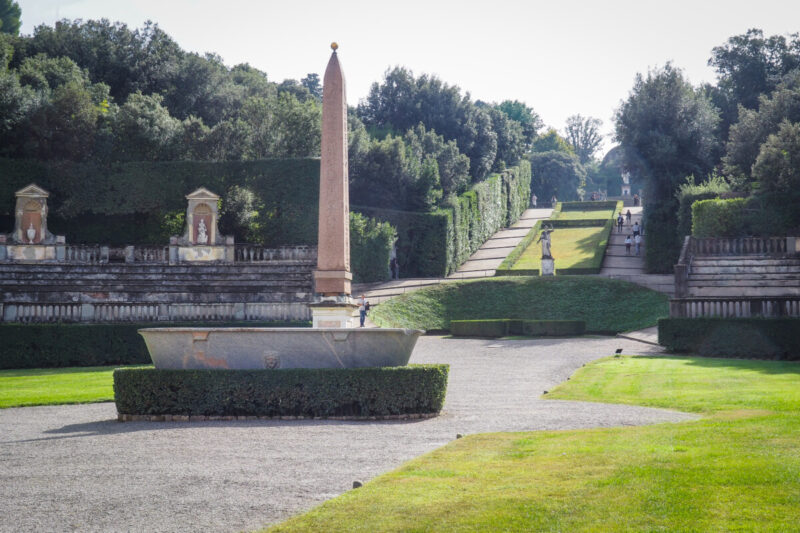
The Boboli Gardens span 11 acres behind the Pitti Palace, featuring Renaissance sculpture, geometric hedges, and shaded walkways across terraced hillsides with sweeping views over Florence. Designed in the 16th century for the Medici family, the gardens served as a prototype for many European royal gardens. Highlights include the Amphitheatre with its Egyptian obelisk, the Neptune Fountain, and the Grotta Grande by Buontalenti with original works by Giambologna.
A place worth knowing
The Boboli Gardens
Parks · Garden in FlorenceUpdated
- Google rating4.4/5 (40,000 reviews)
- Typical visit1-2 hours
- EntranceFree

Why it matters
A 4.5-hectare Renaissance garden behind Pitti Palace, featuring terraced hillside paths, ancient Roman and Renaissance sculptures, grottos, the Amphitheatre, and sweeping views over the Florence skyline and Tuscan hills.
Story and significance
About
The Boboli Gardens represent the epitome of Italian Renaissance garden design, a verdant oasis amidst Florence’s historic heart. Crafted in the 16th and 17th centuries, these meticulously manicured gardens are a symphony of sculptural art, majestic fountains, and lush, geometrically arranged walkways – each element is a testament to human ingenuity harmonized with natural beauty.
Visitors can lose themselves in the ornate, open-air gallery dotted with classical and Mannerist sculptures that whisper tales of a bygone era. An exploration of Boboli is not merely a walk but a journey through the imagination and aspirations of the Renaissance, offering up to 1.5 hours of cultural enrichment and soulful reflection amidst nature’s calm.
Historical significance
Boboli Gardens are historically important as a model for European court gardens and for their association with the Medici court’s cultural program. Their layout, statuary and garden architecture provide tangible evidence of elite taste, patronage and the diffusion of landscape design from Italy across the continent.
Historical context
Created and shaped from the 16th century onward as the grand ducal gardens for the Medici and later rulers, the grounds were developed in stages reflecting changing tastes in formal Renaissance and later Baroque landscape design. Over centuries the gardens accumulated sculptures, grottoes and engineered vistas that document evolving garden arts.
Cultural context
The Boboli Gardens are a principal public and museum garden behind the Pitti Palace, used by locals and visitors for recreation, study of historic landscape design and open-air cultural programming. The gardens are a major attraction for those interested in horticulture, sculpture and the relationship between palace and landscape.
Architecture
As a designed landscape, Boboli exemplifies formal Italian garden principles: axial layouts, terraces, monumental stairways, fountains and sculptural ensembles integrated with built grottoes and belvederes. The gardens’ engineered features, such as waterworks and staged viewpoints, are central to their artistic and spatial effect.
Local significance
The Boboli Gardens are an important green lung and cultural playground for Florentines, historically tied to the city’s noble past but now used by locals for relaxation, exercise and open-air events. The gardens’ combination of sculptures, paths and formal landscaping is part of local leisure patterns—families, students and older residents come for walks, sun, and occasional concerts—making the site a shared recreational and cultural asset rather than only a tourist attraction.






Where to find it
- Address
- Piazza de' Pitti 1, 50125 Firenze FI, Italy
- Map
- Open in Maps ↗ Directions ↗ Verified location
- Coordinates
- 43.7625, 11.2485
- Phone
- +39 055 2298732
- Destination
- Florence