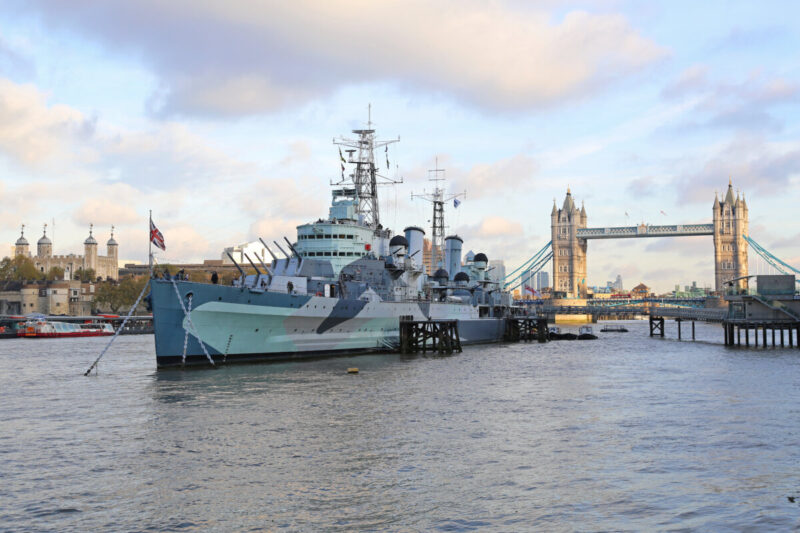
Tower Bridge stands as London‘s most recognizable landmark, a marvel of Victorian engineering that has spanned the Thames since 1894. This working bascule bridge combines function with tourism, opening around 800 times yearly for river traffic while welcoming visitors to explore its secrets. The experience includes panoramic views from the high-level walkways with thrilling glass floors 42 meters above the river, offering unique perspectives of London life below. The atmospheric Victorian Engine Rooms reveal the original steam-powered machinery that lifted the massive bascules for over 80 years. Often confused with London Bridge, Tower Bridge’s neo-Gothic towers house exhibitions telling the stories of the architects, engineers, and workers who built and maintained this icon.
Cultural Context
Tower Bridge is deeply embedded in London’s cultural identity and serves as a symbol of the city’s rich heritage and resilience. Since its completion in 1894, the bridge has been a focal point for numerous cultural events and public celebrations, including the Queen’s Jubilee and the London Marathon. It is often featured in films, literature, and art, representing a blend of Victorian grandeur and modern urban life. The bridge’s location near the historic Tower of London further enhances its cultural resonance, linking it to centuries of British history and tradition. Locally, Tower Bridge is a place where Londoners and visitors alike gather to witness the raising of its bascules, a spectacle that highlights the city’s maritime history and ongoing relationship with the River Thames. The bridge also hosts exhibitions and educational programs within its towers and engine rooms, fostering a deeper appreciation for London’s industrial past. Its image is frequently used in marketing and promotional materials, reinforcing its status as an enduring emblem of London’s spirit and innovation. The cultural practices surrounding Tower Bridge, from community events to its role in daily commutes, underscore its importance as more than just infrastructure, but as a living part of London’s cultural fabric.
Historical Context
Tower Bridge was constructed between 1886 and 1894 to address the growing need for a new crossing over the River Thames that would accommodate both road traffic and river navigation. Designed by architect Sir Horace Jones and engineer Sir John Wolfe Barry, the bridge was built during the height of the Victorian era, reflecting the industrial prowess of the time. The project was initiated due to increased commercial activity in the East End of London, which required a crossing that would not impede access to the Port of London. The bridge’s opening was officially conducted on June 30, 1894, by the Prince of Wales, later King Edward VII, marking a significant moment in London’s urban development. Over the decades, Tower Bridge has witnessed key historical events, including surviving the Blitz during World War II and adapting to modern transportation demands. Its evolution from a steam-powered bascule bridge to an electrically operated one in the 1970s illustrates technological progress. The bridge also played a role in royal celebrations and public ceremonies, reinforcing its place in London’s historical narrative. Tower Bridge remains a testament to Victorian engineering ingenuity and London’s expansion as a global metropolis during the late 19th and early 20th centuries.