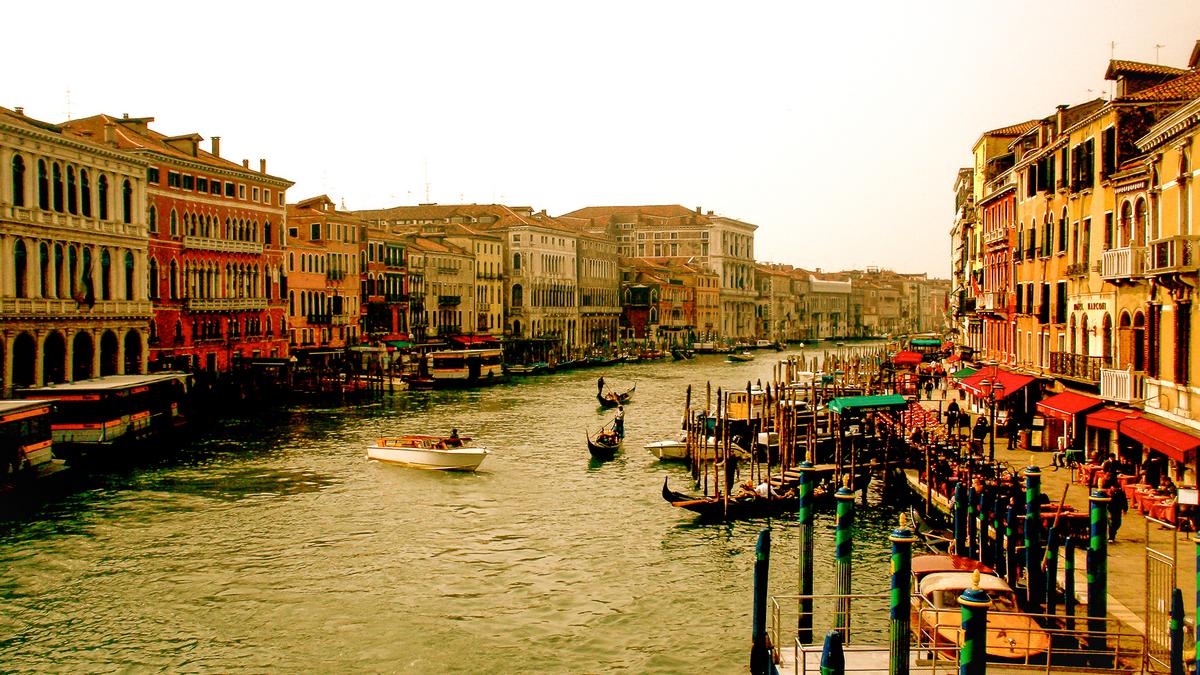
Venice’s Grand Canal is the city’s main water-traffic corridor: a reverse-S route about 3.8 kilometers (2.4 miles) long between the western transport hub near Piazzale Roma and Santa Lucia station and St Mark’s Basin. For a first visit, board ACTV Line 1 at Piazzale Roma or Ferrovia and ride toward San Marco. The journey takes roughly 40 minutes, depending on the departure, and gives you the clearest overview of the canal’s palaces, museums, bridges, churches, and everyday boat traffic.
A gondola offers a more intimate ride through smaller canals, but its route usually covers only part of the Grand Canal. Use the vaporetto for the full orientation trip, then add a gondola if you want a slower experience at water level. This route also works well as the starting point for a day of things to do in Venice.

Grand Canal Venice at a glance
| Planning detail | What to know |
|---|---|
| Italian name | Canal Grande |
| Length | About 3.8 kilometers (2.4 miles) |
| Width and depth | Roughly 30 to 70 meters wide and about 5 to 5.5 meters deep |
| Pedestrian bridges | Four: Ponte della Costituzione, Ponte degli Scalzi, Rialto Bridge, and Accademia Bridge |
| Best first ride | ACTV Line 1 from Piazzale Roma or Ferrovia toward San Marco |
| Typical Line 1 travel time | About 36 to 41 minutes from Ferrovia to San Marco Vallaresso, depending on the departure pattern |
| Standard ACTV fare | From €9.50 for a 75-minute ticket; time-based passes start at €25 for one day |
| Official gondola base tariff | €90 for 30 minutes from 9:00 a.m. to 7:00 p.m.; €110 for 35 minutes from 7:00 p.m. to 4:00 a.m.; up to five passengers |
- Line 1 is the best value for seeing nearly the whole canal in sequence.
- Board at Piazzale Roma to include the western end near Ponte della Costituzione, or at Ferrovia if you arrive by train.
- A single 75-minute ACTV ticket covers the uninterrupted ride, but a day pass is cheaper than buying three separate €9.50 tickets.
- There is no continuous pedestrian path along the Grand Canal, so the water gives you the only complete view.
- Ask about the exact route before booking a gondola; many rides enter the Grand Canal only briefly.
In this guide
- Best way to see the Grand Canal
- Stop-by-stop vaporetto route
- Landmarks and museums
- The four Grand Canal bridges
- Gondola rides and guided tours
- History and architecture
- Practical planning tips
- Frequently asked questions
Best way to see the Grand Canal
ACTV Line 1 is the strongest choice for most first-time visitors. It stops throughout the Grand Canal, follows the waterway in sequence, and costs the same as an ordinary public-transport trip. The current timetable, effective May 30, 2026, shows frequent daytime service between Piazzale Roma, Ferrovia, Rialto, San Marco, and Lido S.M.E. Review the official Line 1 timetable before departure.
| Option | Best for | Main tradeoff |
|---|---|---|
| ACTV Line 1 | A full, low-cost orientation ride with frequent stops | It can be crowded, and seating outside is limited |
| ACTV Line 2 | Faster transport when its current routing matches your trip | It does not provide the same slow, stop-by-stop view as Line 1 |
| Private gondola | A private group and a route through smaller canals | The standard ride is short and may include only a small section of the Grand Canal |
| Shared or organized gondola | Lower per-person cost, advance booking, or added commentary | Group size, meeting point, and route vary by product |
| Private water taxi | Direct transfers with luggage or a custom private ride | It is usually the most expensive option |
A standard 75-minute ACTV ticket currently starts at €9.50. The one-day pass starts at €25, followed by €35 for two days, €45 for three days, and €65 for seven days. If you expect to take at least three separate paid rides in 24 hours, the day pass costs less than three single tickets. Confirm the latest products and exclusions on the official Venezia Unica transport page.


A stop-by-stop Grand Canal route from Piazzale Roma to San Marco
At Piazzale Roma or Ferrovia, choose Line 1 in the direction of Rialto, San Marco, and Lido S.M.E. The landing letter can change by service, so use the electronic boards rather than relying on an old platform number. The route below follows the main sequence of sights as the boat travels east.
| Vaporetto area | Watch for | Good reason to get off |
|---|---|---|
| Piazzale Roma and Ferrovia | Ponte della Costituzione, Santa Lucia station, and Ponte degli Scalzi | Start here after arriving by bus, car, or train |
| Riva de Biasio and San Marcuola | Fondaco dei Turchi and the first broad canal bends | Natural History Museum and quieter Santa Croce or Cannaregio streets |
| San Stae and Ca’ d’Oro | Ca’ Pesaro, Ca’ d’Oro, and rows of Gothic and Renaissance palaces | Modern art, Venetian Gothic architecture, and the Cannaregio side |
| Rialto Mercato and Rialto | Rialto Market, the stone bridge, and the former trading center | Market streets, bridge views, and San Polo |
| San Silvestro, Sant’Angelo, and San Tomà | Dense palace fronts and the approach to the Ca’ Foscari bend | Frari, Scuola Grande di San Rocco, and central San Polo |
| Ca’ Rezzonico and San Samuele | Ca’ Rezzonico, Ca’ Foscari, and Palazzo Grassi | Museums, Campo Santa Margherita, and Dorsoduro |
| Accademia | Accademia Bridge and a long view toward Santa Maria della Salute | Gallerie dell’Accademia and the Dorsoduro art district |
| Salute and San Marco | Peggy Guggenheim Collection, Salute, Punta della Dogana, and St Mark’s Basin | St Mark’s Square, Doge’s Palace, Basilica, and waterfront walks |
There is no permanently better side of the vaporetto. The canal bends repeatedly, and the most important facades alternate from one bank to the other. An outside place near the bow or stern can help, but keep doors and gangways clear and expect to stand during busy periods.
Grand Canal landmarks worth recognizing
Rialto Bridge and the old commercial center

The present Rialto Bridge was built in stone between 1588 and 1592 to a design by Antonio da Ponte. Its single arch replaced earlier pontoon and wooden crossings, and the two arcades of shops preserve the bridge’s commercial role. For a cleaner view of the structure, stay on the vaporetto as it passes beneath or walk to the canal edges on either side after crossing. Early morning is easier than midday if you want space on the bridge.
Rialto Market sits nearby on the San Polo side. The market and bridge explain why this bend became Venice’s trading center: goods arriving by water could be unloaded, sold, financed, and redistributed through streets that still converge on the crossing.
Palaces that show how Venice changed
| Building | Nearest Line 1 stop | What it is now |
|---|---|---|
| Ca’ d’Oro | Ca’ d’Oro | The Galleria Giorgio Franchetti in a major Venetian Gothic palace |
| Ca’ Pesaro | San Stae | Venice’s International Gallery of Modern Art and Museum of Oriental Art |
| Ca’ Foscari | San Tomà or Ca’ Rezzonico | Part of Ca’ Foscari University at the canal’s widest bend |
| Ca’ Rezzonico | Ca’ Rezzonico | A civic museum focused on 18th-century Venice |
| Palazzo Grassi | San Samuele | A Pinault Collection venue for contemporary art |


Gallerie dell’Accademia

The Gallerie dell’Accademia is the main stop for Venetian painting, with works by Giorgione, Titian, Veronese, Tintoretto, Carpaccio, and other artists. Giorgione’s The Tempest is one of the collection’s defining works. The museum sits beside Accademia Bridge, so it pairs naturally with a walk through Dorsoduro.
Peggy Guggenheim Collection

Peggy Guggenheim lived in Palazzo Venier dei Leoni and opened her collection to visitors during her lifetime. The museum is now managed by the Solomon R. Guggenheim Foundation, rather than the City of Venice. Its holdings include work by Picasso, Pollock, Dalí, Mondrian, Magritte, Kandinsky, and many other 20th-century artists. Check the official visitor information for current hours, exhibitions, and ticket rules.
Santa Maria della Salute

Venice commissioned Santa Maria della Salute as a votive church after the plague of 1630. Construction began in 1631 under architect Baldassare Longhena. Its octagonal mass and large dome create the canal’s strongest visual endpoint as Line 1 approaches St Mark’s Basin. The Salute stop is useful for the church, the Peggy Guggenheim Collection, and Punta della Dogana.
St Mark’s Basin, Basilica, and Doge’s Palace


St Mark’s Basilica and the Doge’s Palace are beside St Mark’s Basin rather than directly on the Grand Canal. They appear as the waterway opens into the lagoon, which is why they feel like the final scene of the ride. The present basilica was consecrated in 1094 and became the seat of Venice’s patriarch in 1807. Its official ticketing site lists current entry options and service-related restrictions.
The Doge’s Palace held the doge’s residence, government chambers, courts, and prisons. Fires in 1574 and 1577 led to major repairs and new decoration, but the building did not become a public museum in 1677, as older summaries sometimes claim. Its State Rooms, institutional spaces, Bridge of Sighs route, and paintings by Tintoretto and Veronese require more time than a quick waterfront stop.
The four bridges over the Grand Canal
Only four pedestrian bridges cross the Grand Canal. Their positions matter when you plan a walking route because the next crossing may be far from the place where you want to change banks.
| Bridge | Current structure | Where it helps |
|---|---|---|
| Ponte della Costituzione | Santiago Calatrava design, completed in 2008 | Connects Piazzale Roma with the Santa Lucia station side |
| Ponte degli Scalzi | Stone bridge by Eugenio Miozzi, completed in 1934 | Crosses beside Santa Lucia station and the Scalzi church |
| Rialto Bridge | Stone bridge by Antonio da Ponte, built 1588 to 1592 | Links San Marco and San Polo at the old commercial center |
| Accademia Bridge | Wooden bridge based on Eugenio Miozzi’s 1933 structure | Connects San Marco with Dorsoduro near the art museums |


The old article’s reference to an “Australian iron bridge” near Santa Lucia was a transcription error. The earlier crossing was an Austrian-built iron bridge, later replaced by Miozzi’s stone Ponte degli Scalzi.
Gondola rides and Grand Canal tours: what to book
The City of Venice sets the base gondola tariff. The current rate is €90 per boat for 30 minutes between 9:00 a.m. and 7:00 p.m. and €110 for 35 minutes between 7:00 p.m. and 4:00 a.m. A gondola can carry up to five passengers. Traffic, tides, and weather can change the duration by a few minutes, and longer rides are priced in proportion to time. Confirm the route, duration, and total price before departure on a walk-up ride. The City of Venice gondola page publishes the official tariff and recognized stations.
Affiliate disclosure: ViaTravelers may earn a commission if you book through the links below, at no extra cost to you. Tour names, routes, group sizes, and inclusions can change, so review the live booking page before paying.
| Tour | Best for | Check before booking |
|---|---|---|
| Grand Canal gondola ride with storytelling and Gondola Gallery | Travelers who want commentary and context beyond the ride | Language format, gallery sequence, meeting point, and current route |
| Private gondola cruise for up to five passengers | Couples, families, or friends who want the whole boat | Current passenger limit, departure station, route, and cancellation terms |
| Shared gondola ride through the lagoon city | Solo travelers and pairs who prefer a lower per-person cost | Seat allocation, group format, commentary, and the portion of the Grand Canal included |
| Venice walking tour and Grand Canal gondola ride | First-time visitors who want a guide on land and a short water segment | Total schedule, gap between components, group size, and route |
| Private St Mark’s, walking, and Grand Canal boat tour | Travelers who want Basilica entry, a guided walk, and a longer private boat segment | Current private or small-group format, Basilica restrictions, required identification, and cancellation policy |


Grand Canal history in brief
The Grand Canal developed as Venice’s primary route for movement, trade, ceremony, and display. Venice had become a major maritime power by the 10th century, and the canal connected its commercial center with the lagoon. Families with political and trading influence built palaces facing the water because the canal entrance functioned as the public front door. Boats delivered people and goods directly to ground-level portals.
The architecture records successive periods of Venetian wealth. Pointed arches, tracery, and open loggias identify many Gothic facades; later palaces use Renaissance symmetry and classical orders; Baroque buildings add heavier massing and theatrical detail. The result is one of the clearest built records within the UNESCO World Heritage property of Venice and its Lagoon.
Ca’ Dario: architecture first, curse second
Ca’ Dario is easy to recognize near the Salute end of the canal by its asymmetric marble facade and circular decorative panels. Giovanni Dario had the residence extensively rebuilt in the late 15th century. Stories later linked the palace to bankruptcies, violent deaths, and a supposed curse, but the details vary across retellings and should be treated as folklore rather than verified causation. Readers interested in the way Venice’s darker stories develop can compare them with the documented and legendary layers surrounding Poveglia’s haunted history.
Practical Grand Canal planning tips
- Ride early for easier boarding and clearer bridge views. Sunset and blue hour offer stronger light, but the boats and waterfront stops are usually busier.
- Validate an ACTV ticket or pass at the reader before entering the floating platform. Keep it available for inspection.
- Allow extra time if you have a timed museum or Basilica entry. Crowding, weather, tides, and service changes can affect the trip.
- Use the same ride as transport. Ca’ d’Oro, Rialto, Ca’ Rezzonico, Accademia, Salute, and San Marco are all useful places to leave Line 1.
- Do not plan to walk beside the canal from end to end. Building fronts meet the water, and pedestrian routes repeatedly turn into the surrounding neighborhoods.
- Travelers with limited mobility should review Accessible Venice before choosing stops. Waterbus access can be useful, while bridge steps and changing tide levels still affect routes.
- Swimming and diving in Venice’s canals are prohibited. The city lists a €350 sanction for entering the water.
- Venice’s 2026 access-fee trial is no longer in effect as of July 27, 2026, so no payment or exemption request is currently required. Future rules may change. Check the official access-fee site before a later trip.
Where you stay also changes the most useful boarding point. A hotel near Santa Lucia or Piazzale Roma makes the west-to-east ride simple, while San Marco, Dorsoduro, or Rialto may favor the reverse direction. Compare the tradeoffs in this guide to where to stay in Venice.
Frequently asked questions about Venice’s Grand Canal
What is the Grand Canal in Venice?
The Grand Canal, or Canal Grande, is Venice’s main water-traffic corridor. It follows a reverse-S route about 3.8 kilometers (2.4 miles) long between the western transport hub and St Mark’s Basin.
Which vaporetto should I take on the Grand Canal?
Take ACTV Line 1 for the most complete sightseeing ride. Board at Piazzale Roma or Ferrovia and choose the direction toward Rialto, San Marco, and Lido S.M.E.
How long does Line 1 take from Santa Lucia to San Marco?
The current timetable shows about 36 to 41 minutes from Ferrovia to San Marco Vallaresso, depending on the departure pattern. Plan on roughly 40 minutes and allow extra time for boarding.
How much is a gondola ride in Venice?
The official base tariff is €90 per boat for 30 minutes from 9:00 a.m. to 7:00 p.m. and €110 for 35 minutes from 7:00 p.m. to 4:00 a.m. A gondola can carry up to five passengers. These rates were last verified August 4, 2026.
Can you walk along the entire Grand Canal?
No. There is no continuous waterfront path along the Grand Canal because many buildings open directly onto the water. You can walk between viewpoints and cross at four bridges, but a vaporetto provides the complete view.
How many bridges cross the Grand Canal?
Four pedestrian bridges cross the Grand Canal: Ponte della Costituzione, Ponte degli Scalzi, Rialto Bridge, and Accademia Bridge.
Is a vaporetto or gondola better for the Grand Canal?
Line 1 is better for seeing most of the Grand Canal at a lower cost. A gondola is better for a private or small-group ride through narrower canals and a shorter section of the Grand Canal. Many visitors choose both for different reasons.
Make the Grand Canal your first orientation ride
Start with Line 1 if you want to understand Venice’s layout before choosing museums, neighborhoods, or a gondola route. The public boat shows the full sequence of transport hubs, palace fronts, bridge crossings, the Rialto commercial center, Dorsoduro’s museums, and the opening into St Mark’s Basin. A gondola then works as a separate close-up experience rather than a substitute for the full canal.
For trip budgeting, compare the current transport pass, attraction tickets, accommodation, and meals with this breakdown of how much a trip to Italy costs.