Plan your visit with our complete Germany travel guide featuring top sights, itineraries, and local travel tips.
A place worth knowing
Berlin Cathedral
In the embrace of Berlin’s historic tapestry lies the Berlin Cathedral, a monument of divine magnificence and architectural splendor. As you stand beneath the towering dome, the soul of Germany’s capital resonates through the melodious roar of its colossal organ, a labyrinth of 7,269 pipes offering an auditory feast. The hallowed halls guard the slumber of royal lineage; here, the past breathes. Venture up to the dome for a breathtaking view that stretches beyond Berlin’s skyline—an experience that typically captivates visitors for an hour. The Cathedral is not just a site to behold; it’s a journey through cultural reverence.
Attractions · Cathedral in GermanyUpdated
- Google rating4.6/5
- Typical visit1-2 hours
- EntranceFree (donations welcome)
Why it matters
In the embrace of Berlin’s historic tapestry lies the Berlin Cathedral, a monument of divine magnificence and architectural splendor. As you stand beneath the towering dome, the soul of Germany’s capital resonates through the melodious roar of its colossal organ, a labyrinth of 7,269 pipes offering an auditory feast. The hallowed halls guard the slumber of royal lineage; here, the past breathes. Venture up to the dome for a breathtaking view that stretches beyond Berlin’s skyline—an experience that typically captivates visitors for an hour. The Cathedral is not just a site to behold; it’s a journey through cultural reverence.
- Berlin Cathedral, also known as Berliner Dom, is a significant landmark in Berlin, Germany.
- It was built between 1894 and 1905 and stands as a symbol of the Protestant church in Germany.
- The cathedral’s impressive architecture and historical significance attract millions of visitors from around the world each year, contributing to its global influence.
- Throughout history, Berlin Cathedral has played a pivotal role in the city’s religious and cultural life, making it an important historical site.
- Efforts to preserve and maintain the cathedral have been ongoing, ensuring that future generations can continue to appreciate its architectural and historical significance.
- Its location on Museum Island further adds to its cultural and historical significance, as it is surrounded by other important museums and historical buildings.
- The Berlin Cathedral, or Berliner Dom, exemplifies local cultural and religious traditions through its significant architectural design and the traditional ceremonies it hosts, justifying a high score in cultural authenticity.
- Its rich historical narrative as a symbol of Protestant presence in Germany and its construction era spanning the late 19th and early 20th century adds a considerable educational value, enhancing visitors’ understanding of German history.
- The cathedral’s maintenance of structural integrity and aesthetic value through ongoing preservation efforts scores highly in preservation and integrity, ensuring that the historical essence and grandeur are well-kept for future generations.
- High visitor engagement is encouraged through various accessible activities such as climbs to the dome for panoramic views, organized concerts, and religious services, providing interactive opportunities that immerse visitors in the cathedral’s cultural and spiritual significance.
The Berlin Cathedral, or Berliner Dom, embodies local traditions, historical significance, and artistic value. Visitors engage in traditional religious ceremonies and events, contributing to the city’s cultural preservation.
Story and significance
About
Step into the heart of Berlin’s spiritual skyline at Berlin Cathedral, a neoclassical masterpiece crowned by an iconic dome. Here, the whispers of history echo among the ornate tombs of Prussian royalty, while the grandeur of a 7,269-pipe organ promises a transcendental soundscape.
Ascend amidst the frescoes to be rewarded with panoramic city views, a moment where time lingers. Visitors spend, on average, an hour, often pausing in awe, immersed in the cathedral’s sublime beauty. This beacon of culture extends an eternal invitation to wander, reflect, and unravel the opulent tapestry of Berlin’s ecclesiastical heritage.
Historical significance
Historically the cathedral represents Protestant prominence in imperial Germany and later the complexities of Berlin’s wartime destruction and reconstruction. It serves as a repository of civic memory, religious practice and funerary monuments, including notable family crypts that document Berlin’s elite history.
Historical context
The current domed structure dates from the late 19th to early 20th century, built during a period of imperial German church construction that sought monumental ecclesiastical representation. The cathedral suffered severe damage during World War II and underwent extensive postwar restoration that continued into the late 20th century.
Cultural context
Berlin Cathedral (Berliner Dom) is a prominent Protestant church and a major cultural landmark on Museum Island, hosting services, concerts and attracting tourists for its architecture and interior decoration. For many visitors it represents religious heritage, artistic craftsmanship and a focal point in Berlin’s urban ensemble.
Architecture
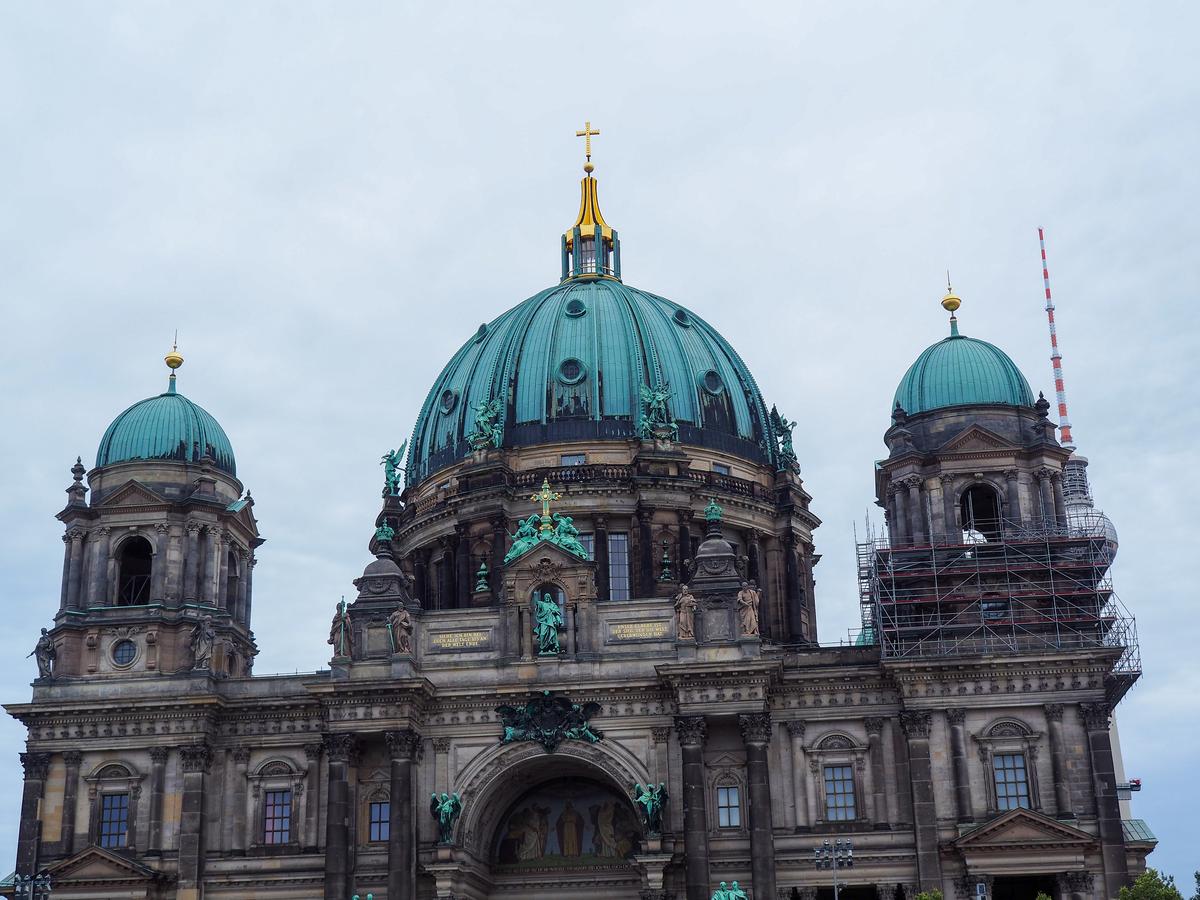
The cathedral is notable for its grand Neo‑Baroque and Renaissance Revival composition, with a monumental stone façade, large central dome, twin towers and richly decorated interior including mosaics, sculptures and an ornate altar and pulpit. Its stone and stucco workmanship and imposing dome contribute strongly to Berlin’s skyline.
Local significance
Berlin Cathedral (Berliner Dom) is a major religious and cultural landmark that functions as a gathering place for worship, concerts and civic events, and it anchors Museum Island’s ensemble in the city’s cultural identity. Locals recognize it for its distinctive dome on the skyline and as a venue for Protestant services, choral music and public ceremonies, while also acknowledging its heavy wartime damage and subsequent restoration as part of Berlin’s layered history. It remains a popular spot for both quiet reflection and social activity, linking religious life with tourism and the city’s cultural programming.
How we rate it
Universal appeal & authenticity10/10
Cultural richness & educational value10/10
Preservation & integrity10/10
Accessibility & visitor engagement10/10
Editorial scores on a 10-point scale, judged against places of the same kind.
Worth booking ahead in Germany
Hand-picked from the operators our guides already send readers to. Prices and availability are live on the partner site.
Day tripViator
Neuschwanstein and Linderhof royal castles day tour (opens Viator in a new tab)
Both royal castles and the coach in one long day; the practical way to see them from Munich without a car.
Where to stayBooking.com
Stays in Germany (opens Booking.com in a new tab)
Live rates and availability for Germany on Booking.com; filter by neighbourhood once you know where your days start.
We earn a commission if you book through these links, at no extra cost to you. It is how we keep the guides free and independent.



Where to find it
- Address
- Am Lustgarten, 10178 Berlin, Germany
- Map
- Open map ↗ Directions ↗ Verified location
- Coordinates
- 52.51906, 13.3985
- Phone
- +49 30 20269136
- Destination
- Germany