MenuClose

A place worth knowing

Diamond Head Crater

Natural attractions · State monument in HonoluluUpdated

  • Google rating4.7/5 (65,000 reviews)
  • Typical visit1.5-2.5 hours (1.8-mile round-trip hike, 175 stairs, 225-foot tunnel)
  • EntranceFree
Diamond Head Crater Overview
  • Today (Tuesday)Open 24 hours
  • Typical visit1.5-2.5 hours (1.8-mile round-trip hike, 175 stairs, 225-foot tunnel)
  • EntranceFree
  • Google rating4.7/5 65,000 reviews
  • WebsiteOfficial site ↗
Opening hours all week
Monday
Open 24 hours
Tuesday
Open 24 hours
Wednesday
Open 24 hours
Thursday
Open 24 hours
Friday
Open 24 hours
Saturday
Open 24 hours
Sunday
Open 24 hours
Quiet times
"{}"
Busy times
"{}"
Accessibility
"{"difficulty": "Strenuous hike not suitable for mobility limitations", "facilities": "Accessible restrooms at trailhead parking area", "trailAccess": "NOT wheelchair accessible – steep, uneven terrain", "alternatives": "Lookout points from parking area for limited views", "serviceAnimals": "Service animals allowed, no pets"}"
The short answer

Why it matters

A 300,000-year-old volcanic tuff cone whose 0.8-mile summit trail rewards hikers with 360-degree panoramas of Waikīkī, the Ko'olau Range, and the Pacific — Honolulu's most iconic hike.

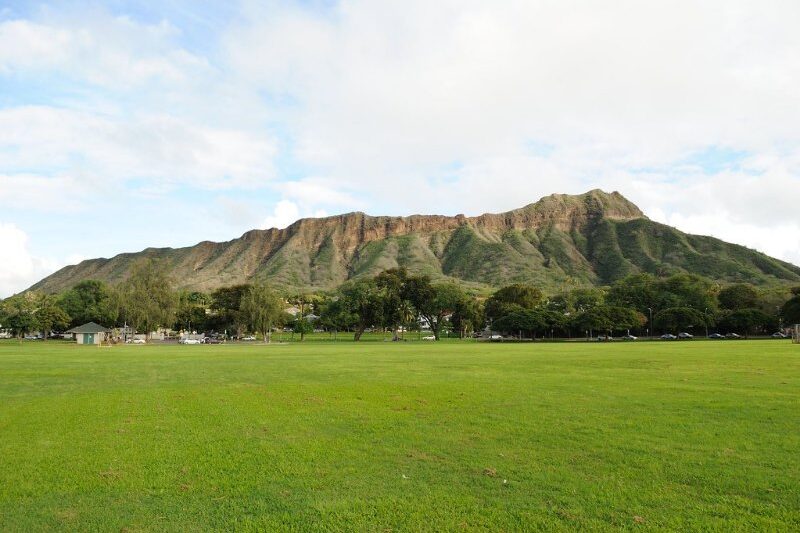
Diamond Head Crater rises dramatically from Oahu’s southeastern coastline as Hawaii’s most recognizable natural landmark and a powerful testament to the islands’ volcanic origins. Known to Hawaiians as Leʻahi (“brow of the tuna”), this 300,000-year-old tuff cone crater stretches 3,520 feet in diameter with a summit reaching 762 feet above sea level. The crater’s distinctive silhouette—resembling the dorsal fin of a tuna fish in Hawaiian cultural perspective—creates the iconic backdrop visible from Waikiki Beach that has symbolized Hawaii in countless photographs and films. Beyond its geological significance, Diamond Head holds important historical value as a strategic military lookout. In 1908, the U.S. Army built Fort Ruger within the crater, constructing a comprehensive coastal defense system including bunkers, observation decks, and artillery emplacements connected by a network of tunnels still visible today. The summit trail, originally built in 1908 as part of the defense system, now serves as a popular hiking route leading visitors through native Hawaiian ecosystems, military installations, and ultimately to panoramic views spanning Waikiki, Honolulu, and the sapphire Pacific. The 1.8-mile round-trip hike includes 175 stairs and navigation through a 225-foot tunnel, offering both physical challenge and educational value. For visitors seeking authentic Hawaiian experiences beyond resort areas, Diamond Head provides geological, historical, and cultural context for understanding Oahu’s complex identity while delivering some of the island’s most spectacular sunrise views and photographic opportunities.

Cultural Context

Known as Leahi in Hawaiian meaning brow or dorsal fin of tuna fish for its distinctive shape, Hawaiis most recognized landmark defining Waikiki skyline, British sailors named it Diamond Head mistaking calcite crystals for diamonds, National Natural Monument 1968 exemplifying volcanic tuff cone formation

Historical Context

Formed 300000 years ago during single explosive steam eruption when magma met groundwater creating 350-acre crater 3500 feet diameter, purchased 1904 by Federal government for coastal defense Fort Ruger built 1908-1943 with 5 batteries tunnels bunkers and observation posts though guns never fired in combat

Context

Story and significance

About

The 0.8-mile trail up Lēʻahi (Diamond Head) climbs 560 feet from the floor of a 300,000-year-old volcanic tuff cone to a summit observation point 760 feet above sea level, rewarding hikers with 360-degree views of Waikiki, downtown Honolulu, Koko Head, and the Pacific. The moderately challenging path follows switchbacks, staircases, and a 225-foot lighted tunnel through the crater wall before emerging at a historic 1908 military fire-control station. Non-residents must book timed reservations in advance ($5 per person, $10 parking). The roundtrip takes 1.5–2 hours; early morning starts beat both heat and crowds.

Historical significance

Diamond Head Crater holds profound historical significance, deeply intertwined with the cultural and military history of Hawaii. Known as Lēʻahi to Native Hawaiians, the name reflects the shape of the ridge resembling the forehead of a tuna fish, a form of traditional place-naming that connects the land to ocean life and Hawaiian heritage. In the early 20th century, the crater was strategically important to the United States military. Between 1908 and World War II, the U.S. Army constructed a series of bunkers, observation posts, and artillery batteries within the crater to defend Honolulu Harbor against potential naval attacks. These fortifications included the installation of coastal guns and a fire control station, which played a role in the broader defense network of the Pacific during a period of heightened military tension. After the war, the military presence diminished, and the crater was eventually designated as a state monument in 1968, reflecting a shift from militarization to conservation and public recreation. The site also holds cultural resonance for Native Hawaiians, serving as a reminder of the island’s volcanic formation and its place in traditional stories and navigation. Diamond Head’s layered history—from its geological birth to its military use and current status as a cherished natural landmark—illustrates the complex interactions between nature, culture, and history in Hawaii. Today, it stands not only as a testament to natural forces but also as a symbol of resilience and transformation in Hawaiian history.

Historical context

Formed 300000 years ago during single explosive steam eruption when magma met groundwater creating 350-acre crater 3500 feet diameter, purchased 1904 by Federal government for coastal defense Fort Ruger built 1908-1943 with 5 batteries tunnels bunkers and observation posts though guns never fired in combat

Cultural context

Known as Leahi in Hawaiian meaning brow or dorsal fin of tuna fish for its distinctive shape, Hawaiis most recognized landmark defining Waikiki skyline, British sailors named it Diamond Head mistaking calcite crystals for diamonds, National Natural Monument 1968 exemplifying volcanic tuff cone formation

Architecture

Military engineering marvel featuring Kapahulu Tunnel entrance through crater wall 1908, network of underground tunnels carved into mountain, historic concrete trail built 1908 as part of Oahu coastal defense system ascending 560 feet with switchbacks, World War II reinforcements including Battery Granger Adams 1935-1946

Local significance

Oahu premier hiking destination with 0.8 mile trail attracting thousands daily for panoramic views from 760-foot summit overlooking Waikiki to Koko Head, geological education site showing tuff layers ash cinders, State Monument encompassing 475 acres preserving natural landmark and military heritage for residents and tourists

Experience

Make the most of it

Local tips
  • Respect local conservation efforts
  • Local guides know hidden viewpoints
  • Wildlife most active early morning
  • Sunrise and sunset offer best light
  • Weekdays much less crowded
  • Seasonal changes create different experiences
  • Weather can change quickly
Hidden gems nearby
  • Historical markers easily missed
  • Hidden caves and grottos
  • Natural formations off main path
  • Perfect picnic spots away from crowds
  • Secret swimming holes known to locals
  • Wildlife observation spots
  • Unmarked trails to pristine areas
Special features
  • Diamond Head Crater, known locally as Lēʻahi, is a striking volcanic tuff cone that stands approximately 761 feet above sea level on the southeastern coast of Oahu. Its name derives from 19th-century British sailors who mistook the calcite crystals embedded in the rock for diamonds. The crater spans nearly 3,500 feet in diameter and was formed about 300,000 years ago during a single, brief eruption. Its distinctive profile is characterized by steep, rugged slopes and a wide, bowl-shaped interior, which contains a network of hiking trails and historic military bunkers. The summit offers panoramic views of Honolulu, Waikiki Beach, and the vast Pacific Ocean, making it a favored vantage point for photographers and nature enthusiasts. The crater is part of Diamond Head State Monument, which preserves its natural environment and provides access to visitors via a moderately challenging trail that includes stairways and tunnels. The flora within the crater is typical of dry coastal ecosystems, featuring native and introduced species adapted to the volcanic soil and arid conditions. The area is also a significant habitat for endemic birds and insects, contributing to its ecological importance. The juxtaposition of geological grandeur, ecological diversity, and accessibility makes Diamond Head a unique natural feature on Oahu, drawing both casual visitors and serious hikers alike. Its distinctive silhouette is an enduring symbol of Hawaii’s volcanic origins and natural beauty, embodying the island’s dynamic geological history and vibrant ecosystem.
Editorial scores

How we rate it

Authenticity9/10
Accessibility score9/10
Family-friendly score7/10
Off-the-beaten-path5/10

Editorial scores on a 10-point scale, judged against places of the same kind.

Updated Data: Editorial research · Google Places ratings · Verified coordinates