
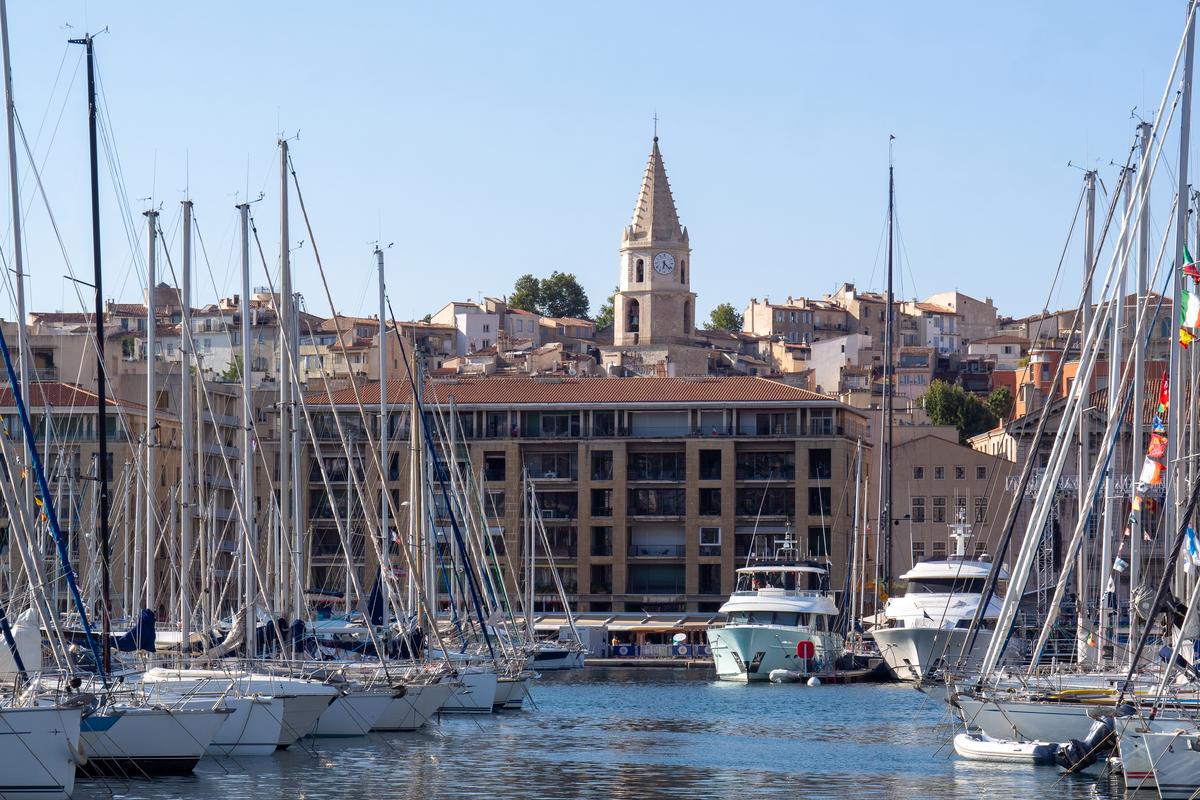
Vieux-Port de Marseille

Attraction · Harbor in MarseilleUpdated

  • Google rating4.5/5
  • Typical visit2-4 hours (longer if including a boat trip, meal, or extensive market browsing)
  • EntranceCheck https://www.marseille-tourisme.com/ for current pricing
Vieux-Port de Marseille, France: Historic port with yachts and scenic architecture
  • Today (Thursday)Open 24 hours
  • Typical visit2-4 hours (longer if including a boat trip, meal, or extensive market browsing)
  • EntranceCheck https://www.marseille-tourisme.com/ for current pricing
  • Google rating4.5/5
  • WebsiteOfficial site ↗
Opening hours all week
Monday
Open 24 hours
Tuesday
Open 24 hours
Wednesday
Open 24 hours
Thursday
Open 24 hours
Friday
Open 24 hours
Saturday
Open 24 hours
Sunday
Open 24 hours
The short answer

Why it matters

Marseille's 2,600-year-old harbor lined with cafés, fishing boats, and a daily fish market at its eastern quay

The heart of Marseille’s maritime heritage, this ancient harbor has been the city’s lifeline since Greek sailors founded Massalia in 600 BCE. Today, the Vieux-Port blends centuries of Mediterranean trading history with a vibrant modern atmosphere. Local fishermen still auction their daily catch at the morning fish market (Quai des Belges), while restaurants serving authentic bouillabaisse line the quayside. The port is framed by historic forts—Fort Saint-Nicolas and Fort Saint-Jean—and offers spectacular views, especially at sunset when the masts of moored sailboats create a forest of silhouettes against the golden light. As Marseille’s cultural crossroads, the port embodies the city’s multicultural spirit and serves as both a working harbor and a gathering place where locals and visitors alike come to experience the authentic Mediterranean way of life.

Cultural Context

The Vieux-Port de Marseille stands as one of Europe’s most historically significant harbors, representing the legendary birthplace of Marseille and 2,600 years of continuous Mediterranean civilization. This ancient natural harbor, originally called “Lacydon” by the Greeks, became the foundation of Massalia around 600 BC when Phocaean Greeks established France’s oldest city. According to legend immortalized by Aristotle, the city was born from the love story between Greek sailor Protis and Gyptis, daughter of the local Celtic-Ligurian chieftain Nannos, who offered her hand in marriage at a wedding feast—making this the romantic birthplace of one of Europe’s greatest ports. Throughout antiquity and the Middle Ages, this harbor served as the beating heart of a powerful maritime city-state that controlled Mediterranean trade routes and introduced Greek civilization to Gaul. The port’s strategic importance continued through the Roman Empire, medieval trading republics, and France’s colonial expansion to North Africa and the Far East. Today, while the massive commercial operations have moved to modern facilities, the Vieux-Port remains the cultural and social heart of Marseille, where traditional fish markets, the famous ferry-boat service (operating since 1880), and waterfront restaurants serving authentic bouillabaisse preserve centuries of Mediterranean maritime culture.

Historical Context

The Vieux-Port de Marseille, or Old Port of Marseille, serves as the historic heart of the city and is one of the oldest ports in Europe, with origins tracing back to 600 BCE when Greek settlers from Phocaea established the colony of Massalia. This harbor was pivotal for trade and cultural exchange throughout antiquity, serving as a gateway between the Mediterranean and inland Gaul. Over centuries, the port evolved through Roman, medieval, and modern periods, adapting to shifting political and economic landscapes. In the Middle Ages, it became a bustling center for commerce and naval activity, while in the 17th century, Louis XIV ordered extensive fortifications around the port to protect the city from maritime threats. The port experienced significant transformations during the 19th and 20th centuries with the advent of industrialization and modernization of maritime infrastructure. Despite these changes, the Vieux-Port has retained its central role in Marseille’s identity, witnessing historical events such as the French Revolution and World War II, during which the port was a strategic military site. Today, it stands as a living monument to Marseille’s enduring connection to the sea and its layered history spanning over 2,600 years.
Context

Story and significance

About

The Vieux-Port de Marseille is the historic heart of France’s oldest city, a natural harbor where Greek settlers from Phocaea established the trading post of Massalia around 600 BC. Guarded by Fort Saint-Nicolas and Fort Saint-Jean at its entrance, the port transitioned from a commercial hub to a modern marina renovated in 2013 with a canopy designed by Norman Foster. A morning fish market on the Quai des Belges sells fresh catch daily, and boats depart regularly for the Calanques National Park, the Frioul archipelago, and the Château d’If.

Historical significance

Vieux-Port is historically significant as the focal point of Marseille’s long role as a Mediterranean gateway, bearing witness to centuries of trade, migration, and cultural exchange. Its continuity as a port and its prominent place in the cityscape make it central to Marseille’s economic history and collective urban identity.

Historical context

The Vieux-Port de Marseille, or Old Port of Marseille, serves as the historic heart of the city and is one of the oldest ports in Europe, with origins tracing back to 600 BCE when Greek settlers from Phocaea established the colony of Massalia. This harbor was pivotal for trade and cultural exchange throughout antiquity, serving as a gateway between the Mediterranean and inland Gaul. Over centuries, the port evolved through Roman, medieval, and modern periods, adapting to shifting political and economic landscapes. In the Middle Ages, it became a bustling center for commerce and naval activity, while in the 17th century, Louis XIV ordered extensive fortifications around the port to protect the city from maritime threats. The port experienced significant transformations during the 19th and 20th centuries with the advent of industrialization and modernization of maritime infrastructure. Despite these changes, the Vieux-Port has retained its central role in Marseille’s identity, witnessing historical events such as the French Revolution and World War II, during which the port was a strategic military site. Today, it stands as a living monument to Marseille’s enduring connection to the sea and its layered history spanning over 2,600 years.

Cultural context

The Vieux-Port de Marseille stands as one of Europe’s most historically significant harbors, representing the legendary birthplace of Marseille and 2,600 years of continuous Mediterranean civilization. This ancient natural harbor, originally called “Lacydon” by the Greeks, became the foundation of Massalia around 600 BC when Phocaean Greeks established France’s oldest city. According to legend immortalized by Aristotle, the city was born from the love story between Greek sailor Protis and Gyptis, daughter of the local Celtic-Ligurian chieftain Nannos, who offered her hand in marriage at a wedding feast—making this the romantic birthplace of one of Europe’s greatest ports. Throughout antiquity and the Middle Ages, this harbor served as the beating heart of a powerful maritime city-state that controlled Mediterranean trade routes and introduced Greek civilization to Gaul. The port’s strategic importance continued through the Roman Empire, medieval trading republics, and France’s colonial expansion to North Africa and the Far East. Today, while the massive commercial operations have moved to modern facilities, the Vieux-Port remains the cultural and social heart of Marseille, where traditional fish markets, the famous ferry-boat service (operating since 1880), and waterfront restaurants serving authentic bouillabaisse preserve centuries of Mediterranean maritime culture.

Architecture

The architectural landscape of the Vieux-Port de Marseille reflects a rich tapestry of styles and periods, blending functional maritime structures with urban development. The port itself is characterized by its basin shape, protected by quays and fortified walls, with early fortifications dating back to the 17th century, including Fort Saint-Jean and Fort Saint-Nicolas, which showcase classic military architecture of the era with thick stone walls and bastions designed for defense. Surrounding the harbor, the quays and waterfront buildings exhibit a mix of 18th and 19th-century neoclassical and Belle Époque styles, featuring elegant stone facades, wrought iron balconies, and traditional Marseille tile roofs. The design of the port basin emphasizes accessibility and utility, with docks and piers constructed from durable limestone and reinforced concrete to withstand the Mediterranean climate. Modern interventions have been sensitively integrated, such as the pedestrian-friendly promenades and the recently renovated fish market building, which retains its original iron framework and open-air design. This architectural layering not only preserves the historical integrity of the port but also enhances its role as a vibrant public space. The Vieux-Port’s design is a testament to Marseille’s maritime heritage and urban evolution, balancing preservation with contemporary use.

Local significance

The Vieux-Port de Marseille is a central element of Marseille identity, historically the city’s maritime heart and today a daily hub where fishermen, residents and visitors converge. Locals use the quayside for commerce, nightlife and socializing; the port’s markets, cafes and ferry links sustain neighborhood routines and symbolize Marseille’s ongoing relationship to the sea and its multicultural, working-port heritage.

Last reviewed Data: Editorial research · Google Places ratings · Verified coordinates

